
08 Jan What’s a Grant Readiness Checklist for Inland Empire Nonprofits?
Short Answer
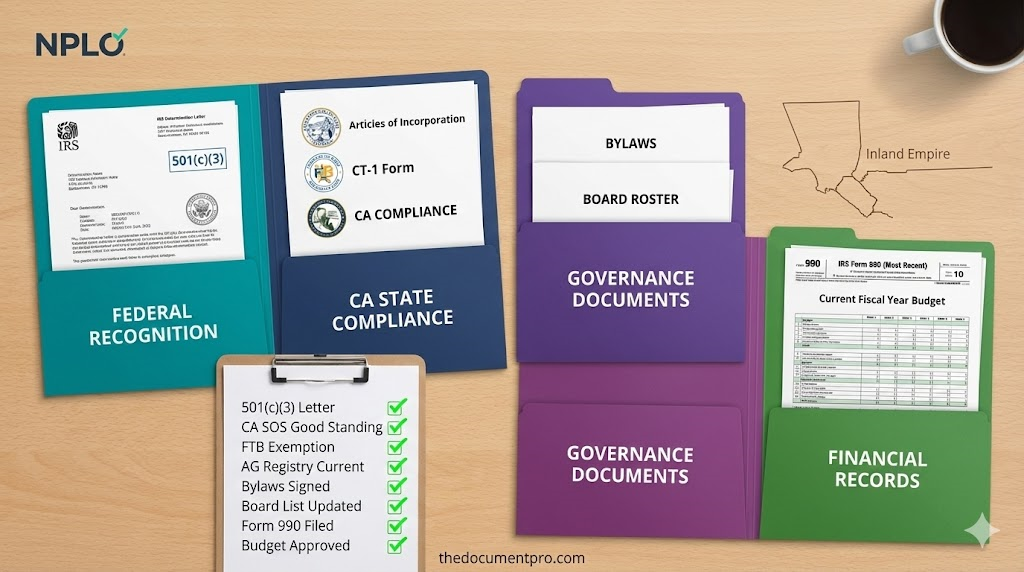
A grant readiness checklist for Inland Empire nonprofits typically includes federal IRS 501(c)(3) recognition verification, current standing with California’s three-agency compliance system (Secretary of State, Franchise Tax Board, and Attorney General Registry of Charities), organized governance documents (bylaws, board roster, conflict of interest policy), financial records (recent Form 990, operating budget, bank statements), and program documentation showing measurable community impact. Eligibility varies by grant, but most institutional funders require proof of multi-agency compliance plus operational capacity before considering program-specific requests.
What makes a checklist specifically useful for Inland Empire nonprofits?
Grant readiness checklists serve as diagnostic tools that reveal whether your nonprofit can meet the baseline requirements most funders verify before considering the programmatic merits of your application. For Riverside and Inland Empire organizations, regional funding sources like the Inland Empire Community Foundation, San Bernardino County grant programs, and Riverside County funding opportunities often share common verification requirements that reflect California’s unique regulatory structure.
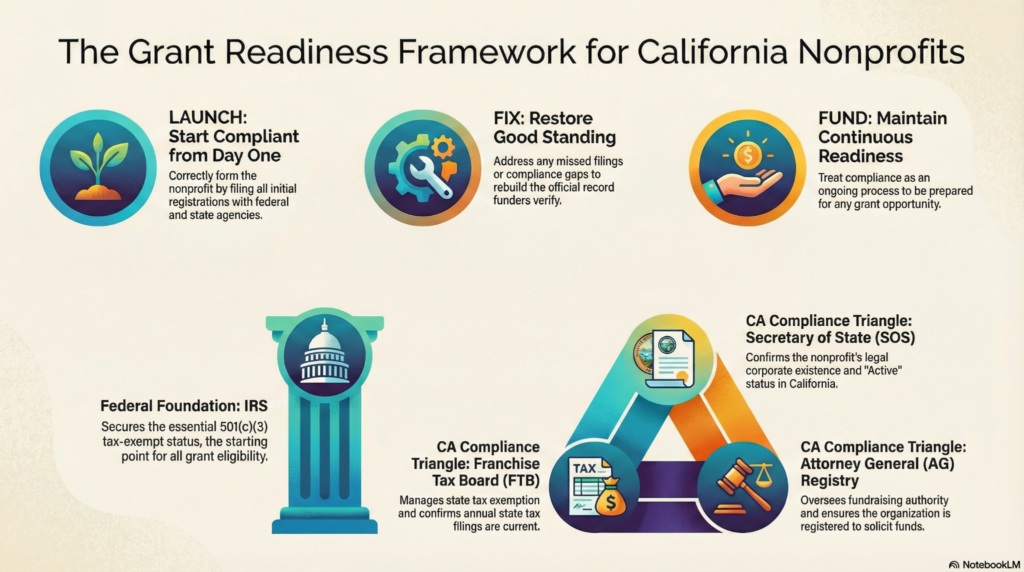
A useful checklist goes beyond generic national advice and addresses the specific multi-agency compliance reality California nonprofits face. While a nonprofit in Texas might only need to verify standing with the IRS and their Secretary of State, Inland Empire organizations must simultaneously maintain current status with four separate government entities—each with distinct filing schedules, documentation requirements, and enforcement mechanisms.
The practical value of a checklist emerges when you’re evaluating multiple funding opportunities simultaneously. Rather than assembling documentation from scratch for each application, you maintain a compliance folder containing the core items nearly all funders request. This approach transforms grant applications from crisis-driven document hunts into systematic processes where you focus on program narrative rather than scrambling for basic proof of legitimacy.
Riverside-based nonprofits pursuing diverse funding sources—corporate giving programs, community foundation grants, government contracts, and individual donor campaigns—benefit from checklists that organize requirements by category rather than by specific funder. Governance documents, financial records, compliance proofs, and program descriptions form the core categories that cut across nearly all application types.
How does a checklist connect to actual funder requirements?
Most institutional funders publish formal application guidelines that specify required attachments and eligibility criteria. A grant readiness checklist essentially reverse-engineers these common requirements into a preparation framework you can use before specific opportunities emerge. Rather than discovering you’re missing critical documentation two days before a deadline, you identify gaps during planning phases when you have time to address them.
California funders tend to request similar baseline documentation because they’re all verifying the same fundamental questions: Does this nonprofit legally exist? Can it receive tax-deductible contributions? Is it authorized to solicit funds in California? Does it have functional governance and financial oversight? Can it manage grant funds responsibly? The documents they request—determination letters, certificates, Form 990s, bylaws, budgets—serve as standardized proofs addressing these questions.
Application reviewers typically scan for compliance documentation first, setting aside incomplete applications before evaluating program quality. A strong program narrative paired with missing compliance documentation often results in immediate rejection, while adequate program descriptions paired with complete compliance packages advance to full review. Checklists help ensure you clear the compliance threshold so your program work actually gets considered.
For Inland Empire nonprofits, regional funders often add specific requirements reflecting local priorities—language access plans for multilingual communities, transportation strategies for geographically dispersed service areas, or partnership documentation showing collaboration across San Bernardino and Riverside counties. A localized checklist incorporates these regional patterns alongside universal compliance requirements.
Step-by-step: How NPLO helps build and maintain grant readiness
Step 1: Baseline Compliance Assessment We evaluate your nonprofit’s current status against the grant readiness checklist, identifying which items you already have organized and which require attention. This assessment covers federal recognition verification through IRS TEOS, California three-agency status checks, governance document completeness, and financial record organization.
Step 2: Document Gap Analysis We identify specific missing or outdated documents that appear on most funder checklists—expired determination letters, outdated board rosters, missing conflict of interest policies, incomplete Form 990 filings, or delinquent California renewals. This analysis prioritizes which gaps to address first based on funder frequency and urgency.
Step 3: Compliance Folder Creation We organize your grant readiness documents into a systematic folder structure—federal recognition proofs, California compliance certificates, governance documents, financial records, and program descriptions. This folder becomes your master source for application attachments, reducing preparation time for each new opportunity.
Step 4: Verification Systems Setup We establish quarterly verification routines where you check status with all four agencies (IRS, SOS, FTB, AG Registry) to catch problems before they block applications. This includes bookmark organization for relevant databases, calendar reminders for filing deadlines, and documentation protocols for new certifications as they’re issued.
Step 5: Board Governance Documentation We help prepare the governance documents funders commonly request—adopted bylaws with amendment dates, current board roster with contact information, conflict of interest policy with annual disclosure forms, and meeting minutes demonstrating active oversight. These documents prove functional governance to skeptical reviewers.
Step 6: Financial Records Organization We organize financial documentation into grant-ready formats—operating budgets showing income sources and expense categories, recent bank statements demonstrating fiscal capacity, Form 990 copies highlighting program expenses and fundraising efficiency, and financial policies addressing fund management and internal controls.
Step 7: Program Documentation Development We help articulate program descriptions, measurable outcomes, service statistics, and community impact narratives that translate operational work into funder-friendly language. This includes developing reusable program summaries adaptable to different word count requirements and focus areas.
Step 8: Checklist Maintenance Protocol We create systems for keeping your grant readiness checklist current as documents expire, boards change, financials update, and compliance renewals occur. This includes annual review cycles, document version control, and proactive replacement of expiring certifications before funders request them.
Checklist: What you should have ready before you apply
This checklist represents the core documentation Inland Empire funders may verify across most institutional grant applications. Having these items organized and current significantly accelerates application completion:
- IRS determination letter showing 501(c)(3) recognition with your organization’s current legal name and EIN clearly displayed
- IRS TEOS verification printout from apps.irs.gov/app/eos showing your nonprofit appears as currently recognized in the Tax Exempt Organization Search database
- California Secretary of State certificate or business entity search printout showing “Active” status with current registered agent and filing history
- Franchise Tax Board exemption confirmation (FTB 3500 form or equivalent) showing your nonprofit’s state tax-exempt status
- Attorney General Registry of Charities registration number (CT number) from your initial registration or most recent RRF-1 renewal confirmation
- Most recent IRS Form 990, 990-EZ, or 990-N filed with the IRS, showing complete financial activity and program descriptions
- Most recent California Form 199 or 199N filed with the Franchise Tax Board, demonstrating current state filing compliance
- Most recent RRF-1 (Registry Renewal Fee Report) filed with the Attorney General, showing current charitable fundraising registration
- Current Statement of Information filing confirmation from the Secretary of State showing biennial compliance within the past two years
- Adopted bylaws with board approval date and any amendment history, demonstrating your nonprofit’s governance structure
- Board roster listing current directors with names, titles, contact information, term dates, and any committee assignments
- Conflict of interest policy with signed annual disclosure statements from board members and key staff
- Operating budget for current fiscal year showing anticipated revenue sources and planned expense categories by program and administration
- Financial statements (at minimum, recent bank statements; for larger organizations, audited or reviewed financials may be expected)
- Program descriptions summarizing each major activity area with target populations, service geography, measurable outcomes, and community impact
- Insurance certificates showing general liability coverage and, if applicable, directors and officers liability protection
Quick Answers (PPA)
Do all grants require every item on the checklist? No, requirements vary significantly by funder type, grant size, and application complexity. A $2,000 grassroots community grant might only require IRS determination letter and basic program description. A $100,000 multi-year government contract typically requires complete documentation across all categories. However, having the full checklist prepared means you can respond to any opportunity without scrambling, and you won’t discover missing items during time-sensitive application windows.
How often should I update my grant readiness checklist documents? Federal and state compliance documents update on fixed schedules—Form 990 annually, Statement of Information biennially, RRF-1 annually. Governance documents should be reviewed annually even if content doesn’t change, with review dates documented. Financial records need monthly updates as bank statements and budget tracking occur. Program descriptions benefit from quarterly updates as service statistics and outcomes data accumulate. Many Riverside nonprofits establish quarterly “grant readiness reviews” where they systematically update all checklist categories.
Can I use a generic national checklist or do I need a California-specific version? California’s three-agency compliance structure makes generic checklists incomplete for Inland Empire nonprofits. National checklists typically address IRS recognition and basic governance but miss the Franchise Tax Board exemption documentation, Attorney General Registry requirements, and Secretary of State status verification that California funders routinely request. A California-specific checklist ensures you’re prepared for the multi-agency verification reality regional funders impose.
What if my nonprofit is very new and doesn’t have several years of Form 990 filings yet? Most funders understand that new nonprofits have limited filing history. Focus on having whatever filings you’re required to submit completed and available—even if that’s just a Form 990-N for organizations with gross receipts under $50,000. Some funders specifically target emerging organizations and may only require one year of financial data or accept detailed budgets in place of historical 990s. The key is having whatever documentation your nonprofit’s current status allows, organized and ready to share.
Should I create a physical binder or maintain everything digitally? Most grant applications now accept digital attachments exclusively, making digital organization essential. However, many nonprofits maintain both—a digital folder structure for application uploads and a physical binder for board review and internal reference. Digital files should use clear naming conventions (e.g., “IRS_Determination_Letter_2023.pdf” or “Board_Roster_2025_Q1.pdf”) and be stored in backed-up locations. Cloud storage with appropriate access controls allows multiple staff to prepare applications simultaneously without version confusion.
What to do next (DIY vs Done-With-You)
DIY approach: Download the checklist sections outlined above into a spreadsheet format. Create columns for “Document Name,” “Current Status,” “Last Updated,” “Next Update Due,” and “Location.” Work through each category systematically, checking off items you already have and flagging gaps. Start with compliance verification—check your status with IRS TEOS, Secretary of State business search, FTB exempt organization search, and AG Registry of Charities. Gather whatever documents you currently possess and organize them into clearly labeled digital folders. Create calendar reminders for recurring filing deadlines.
Done-With-You approach: The Nonprofit Launch Office provides comprehensive grant readiness assessments using a detailed checklist customized for Inland Empire funding patterns. We verify your current compliance status with all relevant agencies, identify specific documentation gaps, and prioritize which items to address first based on your funding timeline. We help organize existing documents into funder-friendly formats, prepare missing governance documents, coordinate multi-agency filings, and establish maintenance systems that keep your checklist current throughout the year. This approach is particularly valuable for Riverside nonprofits pursuing multiple funding sources simultaneously, where the time saved on application preparation and the reduced risk of compliance-based rejections justify the investment in professional support.
Contact
Book: https://thedocumentpro.com/
Call: 1(800) 285-0078
Email: mydocumentpro@gmail.com
The Nonprofit Launch Office™ — a discipline of The Document Pro, operated by Gitta Williams.
Operated by The Document Pro (Gitta Williams)
Sources
- https://www.irs.gov/charities-non-profits/charitable-organizations
- https://www.irs.gov/charities-non-profits/annual-exempt-organization-return-who-must-file
- https://apps.irs.gov/app/eos/
- https://www.sos.ca.gov/business-programs/business-entities
- https://www.ftb.ca.gov/file/business/types/nonprofits/index.html
- https://oag.ca.gov/charities
- https://calnonprofits.org/
Disclaimer
Document preparation and nonprofit readiness support — not legal or tax advice.