
08 Jan What is IRS Tax Exempt Organization Search (TEOS) and Why Does It Matter?
Short Answer
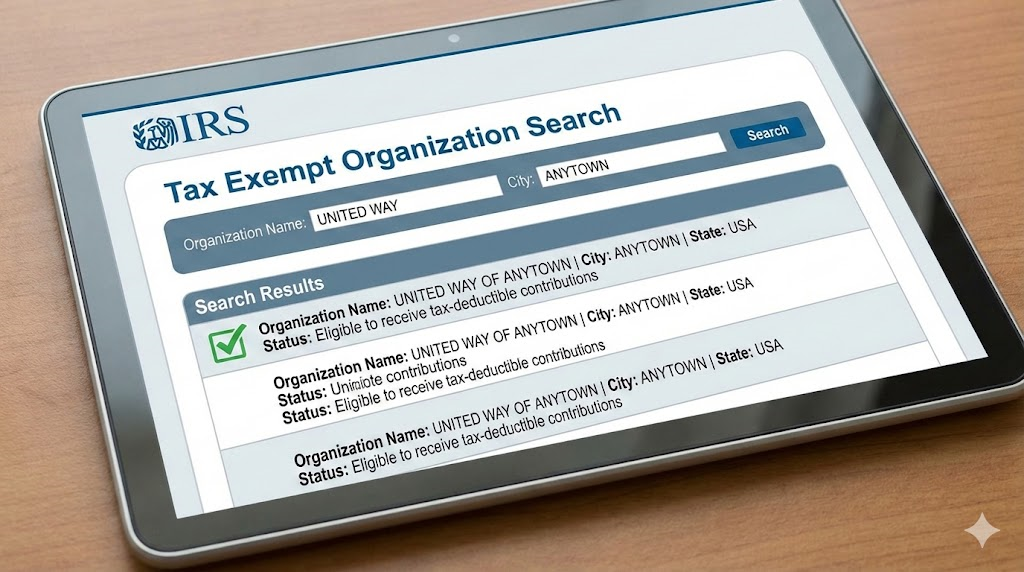
IRS Tax Exempt Organization Search (TEOS) is a free online database at apps.irs.gov/app/eos where anyone can verify a nonprofit’s current federal tax-exempt status, determination date, and eligibility to receive tax-deductible contributions. Grant makers, donors, and financial institutions regularly check TEOS to confirm that an organization holds legitimate 501(c)(3) recognition before releasing funds, making TEOS listing essential for credibility and access to most institutional funding. Eligibility varies by grant, but nearly all funders require verifiable federal recognition as a baseline qualification.
What exactly is TEOS and how does it work?
The IRS Tax Exempt Organization Search tool is a publicly accessible database maintained by the Internal Revenue Service that lists organizations currently recognized as tax-exempt under various sections of the Internal Revenue Code. For 501(c)(3) charitable organizations—the category most relevant for grant-seeking nonprofits in San Bernardino and the Inland Empire—TEOS provides instant verification that an organization holds current federal recognition and is authorized to receive tax-deductible contributions.
When you search TEOS using an organization’s legal name or Employer Identification Number, the database returns basic information including the organization’s official name, EIN, mailing address, determination date (when the IRS granted exemption), and subsection code (typically 501(c)(3) for charitable organizations). The database also indicates whether the organization is currently eligible to receive tax-deductible contributions, which is the critical verification point for most funders and donors.
TEOS updates regularly as the IRS processes new exemption applications and revokes recognition from organizations that fail to meet annual filing requirements. If a nonprofit appears in TEOS with “Eligible to receive tax-deductible contributions” status, it confirms current federal recognition. If an organization doesn’t appear in TEOS or shows revoked status, it signals serious compliance problems that will block most funding opportunities.
The tool replaced earlier publication-based systems where the IRS released annual lists of exempt organizations on CD-ROM or paper. TEOS provides real-time verification that’s accessible 24/7 from any internet connection, making it the go-to resource for due diligence checks. Most San Bernardino area funders now verify TEOS status as a standard first step in their application review process.
Why do grant makers rely on TEOS instead of just asking for determination letters?
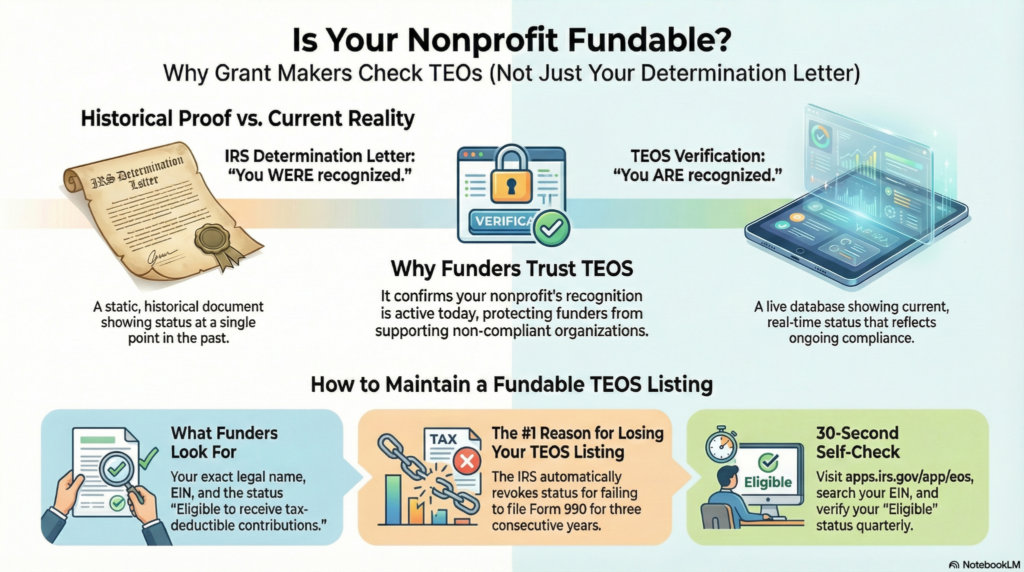
TEOS verification provides current status in a way that determination letters alone cannot. A nonprofit might possess a valid determination letter from years ago but have lost its tax-exempt status since then due to failing to file required annual returns (Form 990 series) for three consecutive years. The IRS automatically revokes recognition for nonprofits that miss this filing requirement, but the organization still has the original determination letter—it’s just no longer valid.
By checking TEOS, funders confirm that the organization’s federal recognition is active today, not just that it was granted at some point in the past. This protects funders from inadvertently supporting organizations that have lost their exempt status, which could create tax complications for the funder and legal liability for both parties. Grant contracts often specify that funding is contingent on maintaining tax-exempt status throughout the grant period, and TEOS provides the mechanism for verifying compliance.
TEOS also prevents fraud and misrepresentation. Determination letters can be forged or altered, and organizations can continue claiming tax-exempt status long after losing it. Because TEOS is controlled by the IRS and updated regularly, it serves as an authoritative third-party verification that funders trust more than self-reported documentation. Most institutional grant applications now specifically request that applicants provide their EIN so reviewers can independently verify TEOS status.
For Inland Empire nonprofits pursuing funding from sources like community foundations, corporate giving programs, or government contracts, understanding that TEOS verification happens behind the scenes helps explain why EIN accuracy is critical and why maintaining annual filing compliance directly affects funding access. A simple failure to file Form 990-N for small organizations can trigger revocation that immediately ends grant eligibility until resolved.
What does “active” actually mean when funders check your nonprofit?
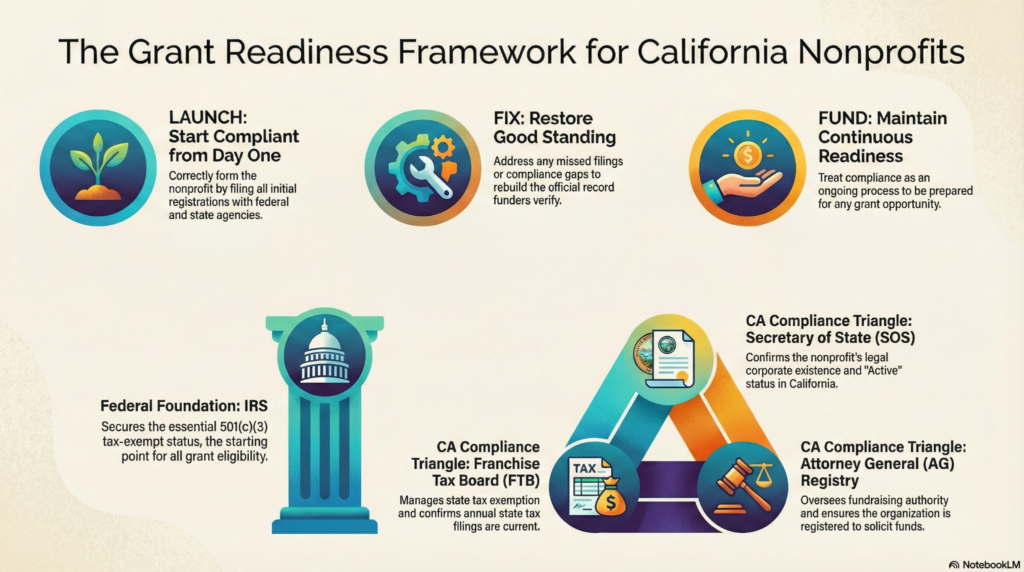
When a grant maker says they’re verifying your nonprofit is “active,” they’re generally looking at more than just whether your organization exists on paper. In California, active status is a three-part verification process that spans multiple government agencies. A nonprofit can be legally incorporated with the Secretary of State but still be considered inactive or ineligible by funders if it’s delinquent with the Franchise Tax Board or the Attorney General’s Registry of Charities.
This multi-agency reality often surprises first-time grant applicants in Temecula and throughout the Inland Empire. Many assume that having an IRS determination letter and being “Active” with the California Secretary of State is sufficient. However, institutional funders—foundations, county grant programs, and federal pass-through awards—typically require documentation proving current compliance across all relevant agencies before they’ll release funds.
The verification process exists to protect donors and grant makers from directing resources to organizations that cannot legally operate or solicit funds. When a nonprofit falls out of compliance with any one agency, it may lose its ability to enforce contracts, accept certain types of donations, or maintain its tax-exempt status, creating legal and financial risk for the funder.
Why do grant makers care about multiple agencies instead of just one?
California’s regulatory structure divides nonprofit oversight among three separate state agencies, each with distinct filing requirements and enforcement authority. This creates what’s often called the “California Compliance Triangle.” The Secretary of State tracks corporate existence and registered agent information. The Franchise Tax Board monitors tax exemption status and annual filing requirements. The Attorney General’s Registry of Charities oversees fundraising activity and asset protection.
Grant makers verify all three because each agency serves a different protective function. A nonprofit that’s current with the Secretary of State but delinquent with the Attorney General technically cannot solicit donations legally in California, which creates liability for any funder distributing money to that organization. Similarly, a nonprofit suspended by the Franchise Tax Board may lose its state tax exemption, affecting how donations are treated for state tax purposes.
Federal recognition through the IRS adds another verification layer. The IRS Tax Exempt Organization Search tool allows funders to confirm that a nonprofit holds current 501(c)(3) status and is eligible to receive tax-deductible contributions. Many grant programs require proof of federal recognition as a baseline eligibility criterion, then layer on state compliance requirements.
For Temecula-based nonprofits seeking funding from sources like the Inland Empire Community Foundation or county grant programs, understanding this verification structure is essential. Local funders often know the compliance landscape well and may reject applications immediately if they detect gaps in multi-agency standing.
Step-by-step: How NPLO helps maintain verifiable TEOS status
Step 1: TEOS Status Verification We check your nonprofit’s current TEOS listing using your EIN and legal name, confirming that you appear in the database with “Eligible to receive tax-deductible contributions” status. This verification identifies any discrepancies in how your organization is listed versus how you’re presenting your name on grant applications.
Step 2: EIN Accuracy Audit We verify that your EIN is being used consistently across all official documents—IRS filings, California registrations, grant applications, banking documents, and fundraising materials. EIN inconsistencies can prevent funders from verifying your TEOS status even when your recognition is valid.
Step 3: Annual Filing Compliance Assessment We review your Form 990 filing history to ensure you’re meeting the annual return requirement that maintains TEOS listing. This includes confirming you’re filing the appropriate form type (990, 990-EZ, or 990-N) based on your gross receipts and total assets, and that filings are submitted by required deadlines.
Step 4: Determination Letter Organization We help locate and organize your original IRS determination letter, which funders may request alongside TEOS verification. If your determination letter is lost or outdated, we assist with requesting replacement documentation from the IRS using Form 4506-A.
Step 5: TEOS Printout Preparation We generate current TEOS printouts showing your organization’s listing with eligible status, which many funders accept as supplementary proof of federal recognition. These printouts demonstrate to reviewers that your status is current as of the application date.
Step 6: Revocation Risk Prevention We establish filing calendar systems that prevent the three-year failure-to-file scenario that triggers automatic revocation. This includes advance reminders, deadline tracking, and Form 990 preparation planning well before submission deadlines.
Step 7: Application Language Preparation We help craft the federal recognition narrative that appears in grant applications, clearly stating your TEOS-verified status, determination date, and EIN. This language helps reviewers complete verification checks quickly and confidently.
Step 8: Ongoing TEOS Monitoring We provide quarterly TEOS status checks to catch any unexpected listing changes or data inaccuracies that could affect funder verification. Early detection allows correction before problems block active grant applications or pending awards.
Checklist: What you should have ready before you apply
Funders may verify TEOS status through different methods depending on their due diligence procedures. Having these items organized ensures smooth verification regardless of funder approach:
- Accurate EIN written consistently across all application materials, matching exactly how it appears in TEOS and on your IRS determination letter
- Exact legal name as registered with the IRS, which may differ slightly from your doing-business-as (DBA) name or common name
- Current TEOS printout downloaded from apps.irs.gov/app/eos showing your organization’s listing with eligible status and current date
- Original IRS determination letter showing 501(c)(3) recognition with your organization’s legal name, EIN, and determination date clearly visible
- Most recent Form 990, 990-EZ, or 990-N confirmation demonstrating current annual filing compliance that maintains your TEOS listing
- Verification instructions explaining to funders how to search TEOS using your EIN if they prefer independent verification over accepting your printout
- Mailing address matching what appears in TEOS, or explanation for any discrepancies if your organization has relocated since last IRS filing
- Subsection code confirmation (typically 501(c)(3) for charitable organizations) that matches funder eligibility requirements
- Determination date readily available for applications asking when your organization received federal recognition
- Foundation classification (usually “Public Charity” rather than “Private Foundation”) as this affects certain grant eligibility criteria
- Advance ruling expiration information if your organization received conditional recognition initially and needs to document transition to permanent status
Quick Answers (PPA)
What if my nonprofit doesn’t appear in TEOS at all? If your organization doesn’t appear in TEOS, it typically means one of several situations: you never applied for federal tax-exempt recognition, your application is still pending with the IRS, your recognition was revoked due to failure to file annual returns for three consecutive years, or you’re searching with incorrect information (wrong name or EIN). Check your determination letter for the exact legal name and EIN the IRS has on file. If you’ve lost recognition due to revocation, you’ll need to file delinquent returns and apply for retroactive reinstatement before you can pursue most grants.
Can a nonprofit operate without being listed in TEOS? Legally, a nonprofit can incorporate and operate programs without federal tax-exempt recognition or TEOS listing. However, contributions to such organizations are not tax-deductible for donors, and most institutional funders require TEOS-verifiable 501(c)(3) status as a baseline eligibility criterion. Some San Bernardino area nonprofits operate under fiscal sponsorship arrangements where the sponsor’s TEOS status covers activities until the new organization secures its own recognition. This provides temporary access to funding while completing the recognition process.
How quickly does TEOS update after filing annual returns? TEOS generally updates within a few weeks after the IRS processes your annual Form 990 filing. However, updates can be delayed during peak filing seasons or if your return encounters processing issues. If a funder checks TEOS immediately after your filing deadline but before IRS processing completes, your listing may still show the previous year’s information. Many funders understand this timing and will accept your filed return confirmation as interim proof of compliance until TEOS reflects the update.
Does TEOS show if a nonprofit is in good standing with California? No, TEOS only verifies federal IRS recognition and does not include information about California state compliance. San Bernardino nonprofits need separate verification of status with the California Secretary of State, Franchise Tax Board, and Attorney General Registry of Charities. Most regional funders check TEOS for federal status plus all three California agencies for state compliance, creating a four-point verification requirement that TEOS alone cannot satisfy.
What happens if funders find discrepancies between TEOS and my application? Discrepancies in legal name, EIN, or address between TEOS listing and grant application materials often trigger immediate verification problems that pause application review. Common issues include using a DBA name on applications when TEOS shows a different legal name, transposed EIN digits, or outdated addresses. Funders may request explanation and documentation to reconcile differences, or may reject applications if discrepancies suggest poor record-keeping or misrepresentation. Prevention through careful verification before applying avoids these delays.
What to do next (DIY vs Done-With-You)
DIY approach: Visit apps.irs.gov/app/eos and search for your organization using your exact legal name or EIN. Verify that your listing shows “Eligible to receive tax-deductible contributions” status. Download and save a current printout with today’s date for your grant readiness folder. Compare the information in TEOS (legal name, EIN, address) against your determination letter and other official documents to identify any discrepancies. If you find problems or can’t locate your organization, contact the IRS Exempt Organizations department at 877-829-5500 for assistance. Set a quarterly calendar reminder to re-verify your TEOS status.
Done-With-You approach: The Nonprofit Launch Office provides comprehensive TEOS verification and compliance monitoring as part of grant readiness assessments. We verify your current listing, identify any discrepancies between TEOS and your documentation, ensure EIN consistency across all materials, organize proof documents for funder verification, establish filing calendar systems that prevent revocation risk, and conduct quarterly monitoring to catch problems early. This approach is particularly valuable for San Bernardino and Inland Empire nonprofits pursuing multiple funding opportunities where TEOS verification happens repeatedly, and where the cost of a revocation or verification problem far exceeds the investment in proactive monitoring.
Contact
Book: https://thedocumentpro.com/
Call: 1(800) 285-0078
Email: mydocumentpro@gmail.com
The Nonprofit Launch Office™ — a discipline of The Document Pro, operated by Gitta Williams.
Operated by The Document Pro (Gitta Williams)
Sources
Disclaimer
Document preparation and nonprofit readiness support — not legal or tax advice.