
26 Jan What Documents Help Prove a Nonprofit’s Standing to Third Parties?
Short Answer
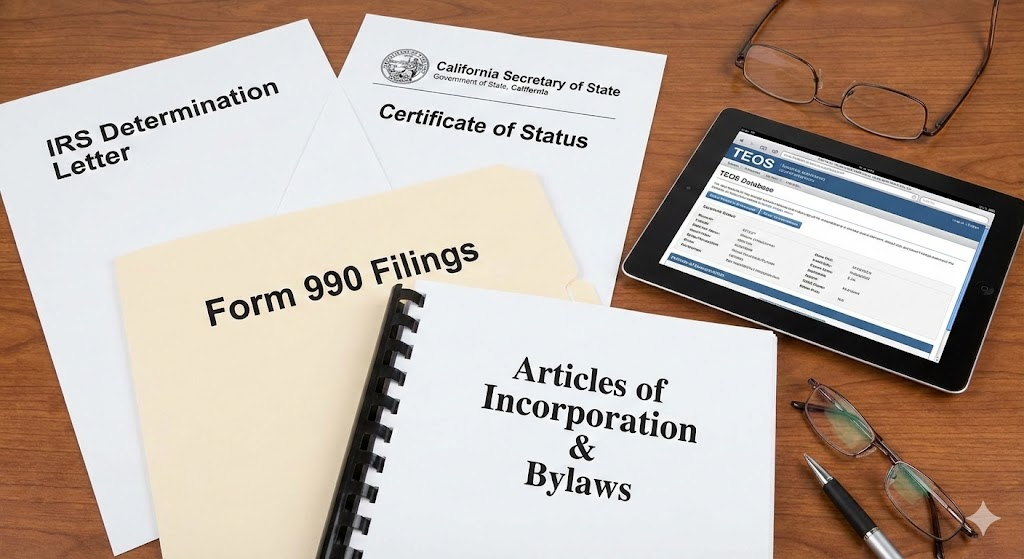
Key documents proving nonprofit standing include IRS determination letter confirming 501(c)(3) status, current TEOS database printout showing federal recognition, California Secretary of State Active status certificate, Franchise Tax Board exemption verification, Attorney General Registry current registration confirmation, recent Form 990 filings demonstrating financial transparency, Articles of Incorporation and bylaws showing governance structure, and board resolutions authorizing specific actions. These documents matter because funders verify claims during due diligence, banks require proof before opening accounts, and partners need documentation before signing agreements.
What federal documents demonstrate tax-exempt status and compliance?
IRS determination letter represents the official federal recognition document. This letter confirms 501(c)(3) approval and states your effective date of exemption. Funders request this letter to verify you’re actually tax-exempt, not just claiming to be. Keep the original determination letter in permanent organizational records and maintain digital copies for sharing.
TEOS database printout from apps.irs.gov/app/eos provides real-time verification. The IRS Tax Exempt Organization Search shows current status—”Eligible to receive tax-deductible contributions” confirms active recognition while “Revoked” or absence from database indicates problems. Many funders check TEOS directly, so you should verify your listing shows correctly before applications.
Form 990 annual returns demonstrate ongoing compliance and financial transparency. Recent 990s show funders your revenue sources, expense patterns, program spending percentages, and compensation practices. Organizations with clean 990 histories signal fiscal responsibility; those with missing years or concerning patterns raise red flags.
What California state documents prove compliance across three agencies?
Secretary of State status certificate shows “Active” corporate standing. The SOS business entity search at bizfileonline.sos.ca.gov generates printable status reports. Active status proves you can legally conduct business and enter contracts. Suspended or Forfeited status blocks grant agreements regardless of program quality.
Franchise Tax Board exemption verification confirms state tax-exempt status. The FTB exempt organization lookup generates printable confirmations. Current exemption without suspension flags proves state compliance. Suspended status indicates missed Form 199 filings and accrued tax liabilities.
Attorney General Registry current registration confirms fundraising authorization. The AG Registry search at oag.ca.gov/charities shows registration status—”Current” means you’re legally authorized to solicit donations in California. “Delinquent” means you’re operating without proper registration, violating charitable solicitation law.
Framework: Launch → Fix → Fund + Federal Recognition + CA Compliance Triangle
Launch includes obtaining and organizing foundational documents. New organizations should create a master documentation folder immediately after receiving IRS determination, collecting all formation and compliance documents in one accessible location.
Fix addresses situations where critical documents are missing or show problems. Organizations discovering suspended status or missing determination letters must obtain current verification documents before pursuing grants.
Fund depends on providing clean documentation quickly. Grant applications request documents with tight deadlines—having organized, current documents ready prevents scrambling or missing opportunities.
Federal Recognition documentation centers on the IRS determination letter and TEOS verification. Without these, you cannot demonstrate federal tax-exempt status to funders or partners.
CA Compliance Triangle requires simultaneous good standing across Secretary of State, Franchise Tax Board, and Attorney General Registry. You need current documentation from all three agencies—weakness in any area blocks funding access.
Step-by-step: How NPLO helps organizations organize standing documentation
Step 1: Document Inventory We identify which standing documents you currently have and which are missing.
Step 2: Current Status Verification We check real-time status across all four agencies, generating current printouts.
Step 3: Missing Document Acquisition We obtain replacement documents for anything missing—duplicate determination letters from IRS, status certificates from SOS.
Step 4: Organization System We create master documentation folders with clear labeling and version control.
Step 5: Digital and Physical Copies We establish both secure digital archives and physical backup files.
Step 6: Update Procedures We implement systems for obtaining fresh status verifications quarterly.
Step 7: Quick-Access Formatting We prepare documents in formats funders commonly request—PDFs, specific page selections.
Step 8: Board Access We ensure board members know where documentation is stored and how to access it.
Checklist: Essential standing documents to maintain
- IRS determination letter (original or certified copy)
- Current TEOS database printout (dated within 30 days)
- Most recent Form 990 (last 3 years preferred)
- California SOS Active status certificate (current)
- FTB exemption verification (current)
- AG Registry current registration confirmation
- Articles of Incorporation (filed version)
- Bylaws (current adopted version)
- Conflict of interest policy (board-approved)
- Board roster with current contact information
- Meeting minutes (recent year minimum)
- Financial statements (recent fiscal year)
- Audit report (if applicable)
- Board resolution authorizing grant applications
- Certificate of insurance (if applicable)
Quick Answers (PPA)
How current do status documents need to be—can we use printouts from six months ago? Most funders want verification dated within 30-90 days of application submission. Status can change between when old printouts were generated and when funders verify—organizations suspended in the interim face rejection even with old documentation showing previous good standing. Generate fresh status printouts quarterly and always obtain new verifications immediately before major grant applications.
What if our IRS determination letter was lost—how do we get a replacement? Request duplicate determination letters from IRS by calling the Tax Exempt and Government Entities division or writing to IRS Exempt Organizations Determinations office. Include your EIN, legal name, and incorporation date. IRS typically provides certified copies for a fee. While waiting, TEOS printouts provide interim verification of tax-exempt status for most purposes.
Do funders actually verify these documents independently, or do they just trust what we submit? Most sophisticated funders verify independently. They check TEOS directly, search California agency databases, and review public Form 990 filings. Submitting false documentation or claiming status you don’t have gets discovered during due diligence and results in immediate application rejection plus potential fraud investigations. Always provide accurate, current documentation matching what independent verification will show.
Can we black out sensitive information like board member addresses before sharing documents? Some information can be redacted while other information cannot. EIN and organizational identifying information must remain visible for verification purposes. Board member personal addresses can often be redacted if funders don’t specifically require them. However, blanket redaction of all board information raises transparency concerns. Review specific funder requirements and redact only what’s truly sensitive while maintaining verification capability.
What’s the difference between Articles of Incorporation we filed versus bylaws—which do funders want? Articles of Incorporation are the legal formation document filed with Secretary of State creating corporate existence. Bylaws are internal governance rules adopted by the board. Funders commonly request both—Articles prove legal existence and contain required charitable purpose language, while bylaws demonstrate governance structure and operational procedures. Some funders request only one; comprehensive applications typically request both.
What to do next (DIY vs Done-With-You)
DIY approach: Create master documentation folder organizing all standing documents. Verify current status across all four agencies—IRS TEOS, CA SOS, CA FTB, CA AG Registry. Generate and save dated printouts from each. Locate your IRS determination letter, Articles of Incorporation, and current bylaws. If determination letter is missing, request replacement from IRS. Download recent Form 990 filings from GuideStar or IRS. Compile recent board meeting minutes, financial statements, and board roster. Scan everything to PDF format for electronic sharing. Create both digital archive (secure cloud storage with backup) and physical binder with organized sections. Update quarterly—generate fresh status verifications, add recent 990s when filed, update board roster when directors change. Before each grant application, verify all documents are current and status printouts are dated within 30 days.
Done-With-You approach: The Nonprofit Launch Office provides comprehensive documentation organization for Moreno Valley and Inland Empire nonprofits. We inventory existing documents and identify gaps, verify current status across all agencies with dated printouts, obtain replacement documents for anything missing, create organized master documentation systems with clear labeling, establish digital archives and physical backup files, implement quarterly update procedures, prepare documents in formats funders commonly request, ensure board members can access documentation when needed, and provide quick-turnaround verification updates before urgent grant deadlines. This ensures you have complete, current, organized documentation ready when opportunities arise rather than scrambling under deadline pressure.
Contact
Book: https://thedocumentpro.com/
Call: 1(800) 285-0078
Email: mydocumentpro@gmail.com
The Nonprofit Launch Office™ — a discipline of The Document Pro, operated by Gitta Williams.
Operated by The Document Pro (Gitta Williams)
Sources
Disclaimer
Document preparation and nonprofit readiness support — not legal or tax advice.