
28 Jan What Are the Most Common Early Mistakes New Nonprofit Founders Make?
Short Answer
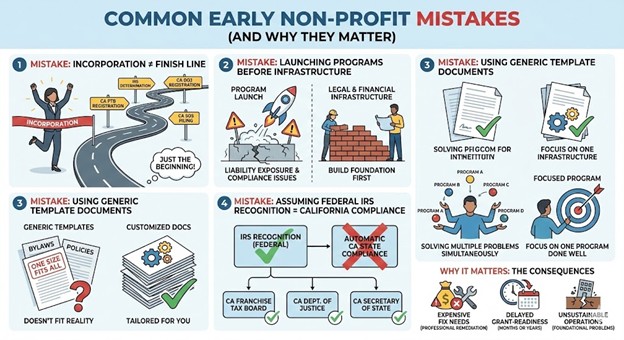
Common early mistakes include treating incorporation as the finish line when it’s just the beginning of a multi-step compliance process requiring IRS determination and California registrations, launching programs before establishing legal and financial infrastructure creating liability exposure and compliance problems, using generic template documents without customization leading to bylaws and policies that don’t fit organizational reality, assuming federal IRS recognition automatically provides California state compliance when three separate California agencies require independent filings, and starting with overly ambitious scopes trying to solve multiple problems simultaneously rather than focusing on one program done well. These mistakes matter because they create expensive Fix needs requiring professional remediation, delay grant-readiness by months or years while compliance is established, and sometimes result in organizations never achieving sustainable operations because foundational problems weren’t addressed during Launch.
What formation and compliance mistakes create the biggest problems?
Stopping after incorporation without completing IRS determination represents the most fundamental mistake. Many Temecula founders file California Articles of Incorporation, receive corporate status from Secretary of State, and believe they’re “done” forming their nonprofit. Incorporation creates a California corporation but provides zero tax benefits—you’re not tax-exempt until IRS grants 501(c)(3) determination. Organizations operating for years without IRS recognition cannot offer tax-deductible receipts to donors, don’t qualify for most grants requiring federal recognition, and face potential tax liabilities for income earned during the gap between incorporation and determination.
Mixing personal and organizational finances creates accounting nightmares and compliance risks. Founders using personal bank accounts for organizational transactions “until we open a nonprofit account,” paying organizational expenses from personal funds without proper documentation, or treating organizational accounts as personal resources blur the essential legal distinction between the individual and the organization. These practices create impossible-to-untangle financial records, raise IRS concerns about private inurement, and potentially expose founders to personal liability for organizational obligations.
Missing filing deadlines because no compliance calendar exists causes the majority of FTB suspensions and AG Registry delinquencies. New founders focused on program delivery often completely forget about recurring compliance obligations—annual Form 990 and Form 199 due 4.5 months after fiscal year end, biennial Statement of Information due during designated filing month, annual RRF-1 renewal due 4 months 15 days after fiscal year end. Missing one filing starts a cascade where organizations discover multiple concurrent compliance problems when funders verify status during grant applications.
Using the wrong fiscal year without understanding implications complicates financial management and reporting. Many founders choose calendar year (January-December) because it seems simple without realizing that calendar fiscal years create fourth-quarter year-end during holiday season when accounting attention is minimal. Organizations with significant December donations face rushed year-end bookkeeping. Choosing fiscal years strategically (like July-June for education organizations or October-September for health organizations) can align financial reporting with natural program cycles.
What governance and operational mistakes undermine credibility?
Rubber-stamp boards that meet once yearly and approve whatever founders propose fail the genuine governance test. IRS and funders look for evidence of active board oversight—meeting minutes showing discussion and deliberation, conflict of interest disclosures and recusals documented, independent review of compensation and major decisions, and attendance records proving directors actually participate. Boards dominated by founder’s family members who never question decisions or exercise independent judgment don’t demonstrate the governance oversight required for tax-exempt status.
Operating without adopted policies creates governance gaps that funders and IRS notice. Organizations that never formally adopted conflict of interest policies, whistleblower policies, or document retention policies appear poorly managed regardless of actual program quality. Even when founders informally follow good practices, lack of adopted written policies documented in board minutes suggests organizational immaturity. The fix is simple—adopt the policies—but having to explain to funders or IRS why you’ve operated for two years without basic governance policies weakens credibility.
Launching multiple programs simultaneously without proven capacity stretches limited resources impossibly thin. New founders excited about their mission often propose 5-8 different programs addressing various community needs without adequate funding, staffing, or infrastructure to execute any program well. Starting with one focused program delivered effectively, then expanding once that program proves sustainable, demonstrates better judgment than scattered unfocused efforts that deliver mediocre results across multiple areas.
Ignoring legal and liability considerations until problems emerge creates expensive crises. Operating without proper insurance, having volunteers work with vulnerable populations without background checks, entering contracts without legal review, or conducting activities that create liability exposure without understanding risks leads to preventable disasters. While risk can never be eliminated, proactive risk management during Launch prevents many crises that derail organizations during operations.
Framework: Launch → Fix → Fund + Federal Recognition + CA Compliance Triangle
Launch represents the critical window where doing things right from the beginning prevents expensive Fix needs later. Temecula nonprofits that complete full formation through IRS determination and California registrations, establish proper financial systems and governance from day one, adopt required policies at organizational meetings, and focus on achievable programs set themselves up for success.
Fix becomes necessary when Launch mistakes create compliance problems requiring remediation. Organizations discovering they’ve been suspended by FTB for three years, operating without IRS recognition for two years, or functioning with no adopted policies must invest significant time and money correcting foundational problems that proper Launch would have prevented.
Fund depends on complete Launch because grant applications require verification of IRS recognition, California good standing across all three agencies, adopted governance policies, and demonstrated operational capacity. Organizations stuck in Fix mode cannot pursue grants until compliance is restored—missing critical funding opportunities during restoration periods.
Federal Recognition represents a fundamental Launch milestone that cannot be skipped. Organizations assuming they can “get IRS recognition later” discover that later never comes because immediate operational demands always feel more urgent than applications requiring extensive documentation and planning.
CA Compliance Triangle illustrates why California Launch requires attention to three separate agencies. Founders assuming California compliance is automatic after IRS recognition discover that Secretary of State, Franchise Tax Board, and Attorney General Registry all require independent registrations and filings.
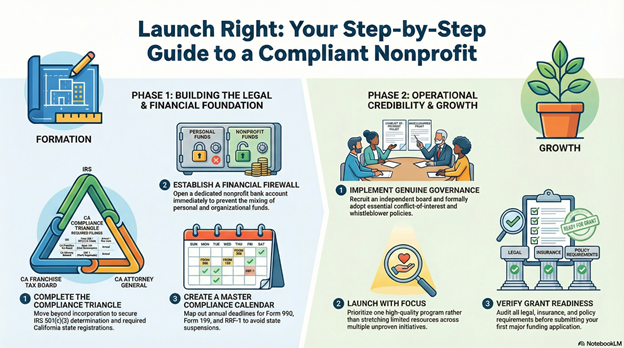
Step-by-step: How NPLO helps founders avoid common mistakes
Step 1: Complete Formation Roadmap We provide comprehensive timelines showing every step from incorporation through grant-readiness including IRS and all California requirements.
Step 2: Financial System Setup We guide proper bank account opening, accounting software selection, and financial management practices preventing personal/organizational confusion.
Step 3: Compliance Calendar Creation We establish comprehensive calendars showing all federal and California filing deadlines with advance reminders preventing missed filings.
Step 4: Governance Structure Implementation We help recruit genuinely independent boards, establish realistic meeting schedules, and implement active oversight practices.
Step 5: Policy Adoption Facilitation We ensure all required policies are adopted during organizational meetings documented in minutes.
Step 6: Focused Program Planning We help identify one primary program for initial implementation rather than scattered unfocused efforts.
Step 7: Risk Management Assessment We identify insurance needs, legal requirements, and liability exposure with mitigation strategies.
Step 8: Grant Readiness Verification We verify organizations have completed all formation and compliance requirements before pursuing grants.
Checklist: Common mistakes to avoid
Formation Mistakes:
- Stopping after incorporation without IRS determination
- Using generic templates without customization
- Choosing fiscal year without strategic consideration
- Assuming incorporation = tax-exempt status
- Filing California Articles without understanding federal requirements
Financial Mistakes:
- Mixing personal and organizational finances
- Operating without separate bank account
- No accounting system or financial tracking
- Accepting donations before IRS determination without disclosure
- No budget or financial planning
Governance Mistakes:
- Rubber-stamp board dominated by founders/family
- Meetings once yearly or less
- No adopted policies (conflict, whistleblower, retention)
- No meeting minutes or inadequate documentation
- Founder making all decisions without board oversight
Compliance Mistakes:
- No compliance calendar tracking deadlines
- Missing Form 990/199 filing deadlines
- Forgetting Statement of Information biennial filing
- Never registering with AG Registry of Charities
- Assuming IRS recognition = California compliance
Operational Mistakes:
- Launching multiple programs without proven capacity
- No insurance or risk management
- Volunteers working without background checks
- Contracts signed without legal review
- Starting programs before infrastructure ready
Quick Answers (PPA)
We’ve been operating for two years since incorporation but haven’t filed for IRS recognition yet—is this a major problem? Yes, this is a significant problem requiring immediate correction. You’ve been operating without federal tax-exempt status meaning donations aren’t tax-deductible, you don’t qualify for grants requiring IRS recognition, and you may have tax liabilities for income earned. File Form 1023/1023-EZ immediately. Organizations applying within 27 months of incorporation can receive retroactive recognition effective from incorporation date, but beyond that deadline you lose retroactive coverage. The longer you delay, the more complications you create. Stop accepting donations claiming tax-deductibility until you have IRS determination, and prioritize the application over everything except critical compliance filings.
Can we fix these mistakes, or do they permanently damage the organization? Most mistakes are fixable though correction requires time, money, and effort that proper Launch would have avoided. Missing compliance filings can be corrected by filing delinquent returns and paying penalties. Operating without policies can be remedied by adopting them retroactively. Poor governance can be restructured with independent board recruitment and better practices. However, some mistakes create permanent consequences—donations received claiming tax-deductibility before IRS recognition can’t be made retroactively deductible beyond 27 months, and years of poor financial records can’t be fully reconstructed. The key is stopping the mistake immediately, implementing corrections, and establishing proper practices going forward.
Should we hire professionals to help with formation, or can founders handle everything ourselves? This depends on founder skills, available time, and organizational complexity. Founders with nonprofit experience, legal/accounting knowledge, and significant available time may successfully handle formation DIY using quality resources. However, most new founders lack specialized knowledge and discover that self-guided formation takes far longer than expected with higher error rates. Professional assistance—whether attorneys, CPAs, or nonprofit consultants—costs money upfront but typically saves money long-term by preventing expensive mistakes, streamlining processes, and ensuring everything’s done correctly the first time. Many organizations use hybrid approaches—professional help for specialized tasks like IRS applications and legal formation, DIY for simpler tasks like policy adoption.
We made several of these mistakes—should we focus on fixing them before starting programs, or can we fix them while operating? Prioritize based on risk and urgency. Critical fixes that prevent immediate harm or legal jeopardy—filing IRS determination application, correcting FTB suspension, obtaining proper insurance—should be addressed immediately even if that delays program launch. Less urgent fixes—adopting better governance practices, implementing compliance calendars, restructuring board composition—can be phased in while continuing operations. The danger of “we’ll fix it later” is that later never comes because operational demands always feel urgent. Schedule dedicated Fix time, assign clear responsibility, and work systematically through corrections rather than ignoring problems hoping they’ll disappear.
How can we tell if our board is a “rubber stamp” versus providing genuine oversight? Genuine oversight boards meet regularly (at minimum quarterly, ideally monthly or bimonthly), review financial reports and ask questions about variances or concerns, discuss programmatic decisions and suggest alternatives or improvements, exercise independent judgment even when disagreeing with founder preferences, include members with no family or business relationships to founders, demonstrate preparation by having read materials before meetings, and document substantive discussions in minutes. Rubber-stamp boards meet annually, approve everything without questions, consist primarily of founder friends/family, conduct meetings in 15 minutes with no discussion, and create minutes that are identical year after year. If board meetings feel like formalities you endure rather than valuable governance, you likely have rubber-stamp problems requiring board development.
What to do next (DIY vs Done-With-You)
DIY approach: Audit your current organizational status against this mistake checklist identifying which errors you’ve made or are at risk of making. For formation gaps—incomplete IRS determination, missing California registrations—immediately develop timeline for completing requirements with deadlines. For financial mistakes—mixed personal/organizational funds, no accounting system—open proper bank account immediately, establish accounting software, and reconstruct financial records for the current fiscal year minimum. For governance mistakes—rubber-stamp board, no policies, inadequate minutes—schedule board meeting to adopt required policies, recruit additional independent directors, and establish regular meeting schedule with proper minute-taking. For compliance mistakes—no calendar, missed filings—create comprehensive filing calendar immediately, verify status with all agencies, and file any overdue returns. Prioritize fixes based on risk—critical issues creating legal exposure or preventing operations come first, governance improvements come second, and organizational development comes third. Document all corrections in board minutes. Commit to not repeating mistakes by implementing systems preventing recurrence.
Done-With-You approach: The Nonprofit Launch Office provides comprehensive formation and mistake remediation for Temecula and Inland Empire nonprofits. We audit organizational status identifying formation gaps, compliance problems, and governance weaknesses requiring attention, develop prioritized correction plans addressing critical issues first while scheduling longer-term improvements, complete missing formation steps including IRS determination applications and California registrations, establish proper financial systems separating personal and organizational finances with appropriate accounting, implement governance improvements including board development, policy adoption, and meeting practices, create comprehensive compliance calendars preventing future missed deadlines, develop focused program plans demonstrating realistic capacity, address risk management including insurance and legal requirements, and provide ongoing support ensuring corrections stick and organizations maintain proper practices. This ensures you correct existing mistakes efficiently while establishing systems preventing future problems that undermine organizational sustainability.
Contact
Book: https://thedocumentpro.com/
Call: 1(800) 285-0078
Email: mydocumentpro@gmail.com
The Nonprofit Launch Office™ — a discipline of The Document Pro, operated by Gitta Williams.
Operated by The Document Pro (Gitta Williams)
Find Us Locally
Service Area: Moreno Valley, CA and surrounding areas
Coordinates: 33.9535, -117.2081
Address: 23945 Sunnymead Blvd. #4, Moreno Valley, CA 92553
Sources
- https://www.irs.gov/charities-non-profits/charitable-organizations
- https://www.irs.gov/forms-pubs/about-form-1023
- https://calnonprofits.org/
Disclaimer
Document preparation and nonprofit readiness support — not legal or tax advice.