
26 Jan What Are Meeting Minutes and Why Do They Matter?
Short Answer
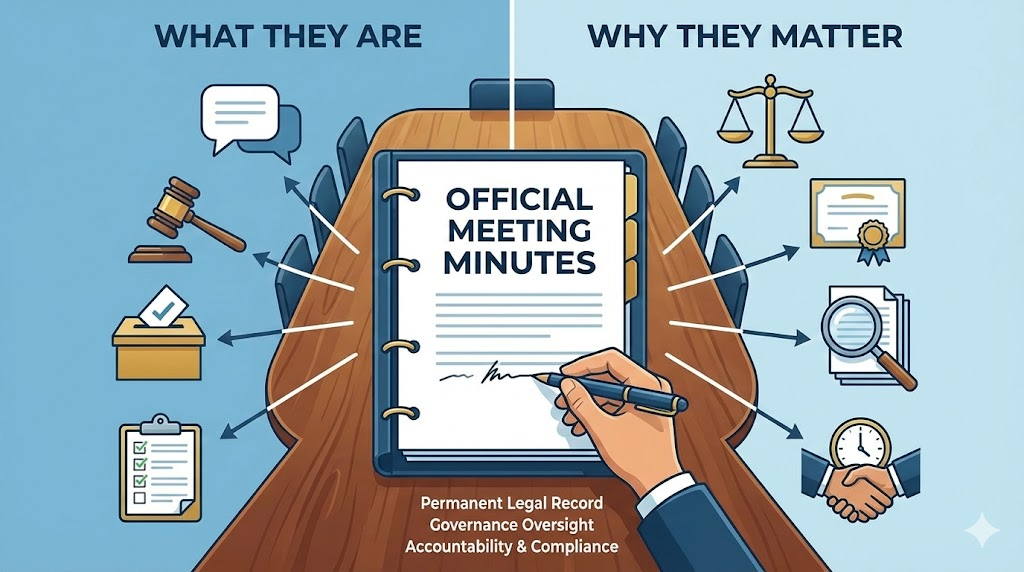
Meeting minutes are the official written record of board meetings documenting what was discussed, what decisions were made, who voted, and what actions were authorized. Minutes matter because they provide the permanent legal record proving the board exercises genuine governance oversight, they document compliance with bylaws and policies including conflict recusals and independent reviews, they serve as evidence for IRS and funders that governance is functional rather than theoretical, and they create accountability for board members by recording attendance, votes, and dissenting opinions.
What must meeting minutes document and what level of detail is required?
Basic meeting information establishes when governance occurred. Minutes must record the meeting date, start and end time, location (physical address or virtual platform), meeting type (regular, special, annual, organizational), and attendees present including board members, officers, staff, and guests. This basic documentation proves meetings actually happened and who participated in governance decisions.
Motions and votes form the core of meeting minutes. Every formal decision requires documentation—who made the motion, who seconded it, what the motion stated specifically, and the vote result (unanimous, majority approval with vote count, or individual director votes if roll call). For significant decisions like compensation approval or major contracts, individual votes by director name create accountability. Simply stating “the board approved” without recording votes provides insufficient documentation.
Recusals and conflicts must be documented when they occur. Minutes should record when board members disclosed conflicts, left the room during discussion, and abstained from voting. This documentation proves independent review occurred and that interested parties didn’t participate in conflicted decisions. Missing recusal documentation weakens conflict policy implementation even when recusals actually happened.
Discussion summary captures key points without verbatim transcripts. Minutes shouldn’t record every word spoken but should summarize major points raised, alternatives considered, and rationale for decisions. This context helps future boards understand why decisions were made and demonstrates thoughtful deliberation rather than rubber-stamping.
What common mistakes weaken or invalidate meeting minutes?
Retroactive minutes created weeks or months after meetings undermine their value as contemporaneous records. Minutes should be drafted during or immediately after meetings while discussions are fresh. Creating minutes months later from memory or reconstructed notes appears fabricated and won’t satisfy IRS or funder scrutiny. The secretary should take notes during meetings and draft minutes within days.
Missing vote documentation for major decisions creates problems proving board approval. Recording that “the board discussed compensation” without documenting that specific compensation amounts were approved through formal vote leaves uncertainty about what was actually authorized. Every significant decision needs motion, second, and vote recorded.
Excessive detail creates liability exposure and makes minutes unwieldy. Minutes shouldn’t record individual comments, disagreements, or sensitive discussions that could be used against the organization in litigation. Focus on what was decided, not blow-by-blow accounts of who said what. Balance between sufficient detail proving thoughtful governance and excessive detail creating legal risks.
Unsigned or unapproved minutes lack official status. Minutes should be reviewed and approved at subsequent meetings with the approval recorded in those next minutes. The secretary should sign approved minutes. Unsigned drafts in files don’t constitute official organizational records and won’t satisfy documentation requirements.
Framework: Launch → Fix → Fund + Federal Recognition + CA Compliance Triangle
Launch includes establishing minute-taking practices from the organizational meeting forward. New Riverside nonprofits should template minute formats, assign secretary responsibility clearly, and implement approval procedures from day one.
Fix addresses organizations with missing, incomplete, or problematic minutes requiring retroactive creation or correction. While contemporaneous minutes are ideal, documented efforts to reconstruct missing minutes from bank records, emails, or participant memories are better than nothing.
Fund depends on minutes because grant applications commonly request recent board meeting minutes proving active governance. Funders review minutes to verify meetings happen regularly, decisions follow proper procedures, and conflicts are managed appropriately.
Federal Recognition applications may request board meeting minutes showing organizational activity. IRS wants evidence boards actually meet and govern rather than existing only on paper. Recent minutes from the organizational meeting and subsequent meetings strengthen applications.
CA Compliance Triangle includes Attorney General authority to request meeting minutes during investigations. California law requires nonprofits to maintain minutes as part of corporate records. Missing minutes during AG review suggests poor governance or potential problems being hidden.
Step-by-step: How NPLO helps organizations establish good minute-taking practices
Step 1: Template Development We create minute templates matching organizational meeting types and complexity.
Step 2: Secretary Training We train secretaries on what to document and appropriate detail levels.
Step 3: Real-Time Assistance We can attend critical meetings helping capture proper documentation.
Step 4: Review Procedures We establish systems for minute review and approval at subsequent meetings.
Step 5: Signature Protocols We implement signing procedures after approval creating official status.
Step 6: Organized Storage We help establish minute books or digital archives maintaining chronological records.
Step 7: Retroactive Reconstruction We assist reconstructing missing minutes from available documentation when gaps exist.
Step 8: Grant Application Preparation We prepare minute excerpts funders request showing specific governance actions.
Checklist: What meeting minutes should contain
- Meeting date, time, location (or virtual platform)
- Meeting type (regular, special, annual, organizational)
- Attendees present (board members, officers, staff, guests)
- Quorum confirmation
- Approval of prior meeting minutes
- Reports presented (treasurer, committee, executive director)
- Each motion made with maker and seconder identified
- Discussion summary for major decisions
- Vote results (unanimous or vote counts)
- Individual votes for significant decisions
- Conflict disclosures and recusals documented
- Actions authorized and responsibilities assigned
- Next meeting date scheduled
- Adjournment time
- Secretary signature after approval
Quick Answers (PPA)
How detailed should meeting minutes be—do we need to record everything everyone says? No, minutes should be summary records, not verbatim transcripts. Record what was decided, not every comment made. Include enough context to show thoughtful deliberation—major points raised, alternatives considered, rationale for decisions—without creating excessive detail that could be used against the organization in disputes. Focus on motions, votes, and key information supporting decisions.
What should we do if we discover our organization has no minutes for the past several years? Retroactively reconstruct what you can from available documentation—bank records showing major transactions that would have required board approval, emails discussing decisions, grant applications referencing board actions, or participant memories. Document that minutes are being reconstructed, note the sources used, and acknowledge they’re not contemporaneous. Retroactive minutes are better than no documentation, though they lack the credibility of contemporaneous records. Most importantly, start taking proper minutes immediately going forward.
Can minutes be kept electronically, or must we maintain physical minute books? California law doesn’t require physical minute books—electronic records are acceptable if properly maintained with backups and security. Many organizations maintain both electronic working files and physical signed copies in organized binders. The key is ensuring minutes are preserved, organized chronologically, accessible when needed, and protected from loss or unauthorized alteration. Whatever system you use, maintain it consistently.
What if a board member disagrees with decisions—should their dissent be recorded in minutes? Board members can request their dissenting votes be recorded in minutes, which is appropriate for major decisions where members want documentation of their opposition. Recording dissent protects dissenting directors from liability for decisions they opposed. However, don’t record extensive arguments or personal criticisms—simply note “Director Smith voted no” or “Director Smith dissented.” The dissenting member can request more detail if desired for liability protection.
How long must we keep meeting minutes—can old ones be destroyed after several years? Meeting minutes are permanent organizational records that should never be destroyed. They document the organization’s governance history and may be needed decades later for legal matters, historical purposes, or demonstrating organizational continuity. While some operational records can be destroyed after retention periods expire, minutes should be maintained permanently. Digital storage makes this easy—scan and archive old physical minutes.
What to do next (DIY vs Done-With-You)
DIY approach: Create simple minute template including standard sections—meeting identification, attendees, quorum, prior minute approval, reports, business items with motions and votes, adjournment. The secretary should take notes during meetings capturing motions, seconds, discussion summaries, and vote results. Draft minutes within days while memory is fresh, not weeks later. Circulate draft minutes to attendees for factual corrections (not content debates about what should have been decided). Include minute approval as first agenda item at next meeting. Record that “Minutes of [date] meeting were approved as presented/amended.” Secretary signs approved minutes. Maintain chronological minute files (physical binder or electronic folder) where all board members can access. Before grant applications, review recent minutes ensuring they document the governance activity and decisions funders expect to see.
Done-With-You approach: The Nonprofit Launch Office provides comprehensive minute-taking support for Riverside and Inland Empire nonprofits. We create customized minute templates matching organizational needs, train secretaries on proper documentation standards and appropriate detail levels, attend critical meetings helping capture proper documentation of complex decisions, establish review and approval procedures, implement signature protocols creating official records, develop organized storage systems (physical and/or digital), assist reconstructing missing minutes from available documentation when gaps exist, and prepare minute excerpts for grant applications highlighting governance actions funders want to see. This ensures your organization maintains the contemporaneous governance documentation that satisfies IRS requirements, strengthens funder confidence, and protects board members from liability.
Contact
Book: https://thedocumentpro.com/
Call: 1(800) 285-0078
Email: mydocumentpro@gmail.com
The Nonprofit Launch Office™ — a discipline of The Document Pro, operated by Gitta Williams.
Operated by The Document Pro (Gitta Williams)
Sources
Disclaimer
Document preparation and nonprofit readiness support — not legal or tax advice.