
03 Mar How to Compare Non-Profit Filing Services in Perris, CA: What to Look For
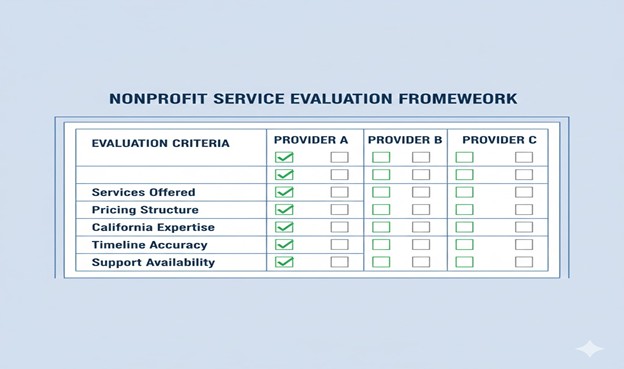
When comparing non-profit filing services in Perris, CA, focus on key evaluation criteria including document preparation scope, California specialization, pricing transparency, timeline honesty, and customer support availability. Understanding what to evaluate helps you select services that match your organization’s needs, budget, and formation goals while avoiding misleading claims or incomplete offerings.
This guide provides educational information and does not constitute legal or tax advice.
Answer-First Summary
- Service scope evaluation: Compare whether services prepare complete document packages (Articles, bylaws, IRS forms) or only partial filings
- California specialization matters: Providers with California-specific expertise understand Corporations Code requirements and common Secretary of State rejection triggers
- Pricing transparency: Quality providers disclose all costs upfront including state fees, professional service charges, and optional expedited processing
- Realistic timeline expectations: Be cautious of services promising faster timelines than government agencies can deliver; honest providers explain what they control versus agency processing
- Support accessibility: Consider business hours support versus after-hours availability, response time commitments, and ongoing guidance through formation process
- Local versus national services: Inland Empire providers may offer advantages for understanding Riverside County and Perris-specific requirements
Quick Actions Checklist
- Define your organization’s specific needs (simple structure versus complex governance)
- List must-have services (state filing only versus complete formation support including IRS application)
- Research multiple providers serving Perris and California statewide
- Request transparent pricing breakdowns from each provider
- Ask specific questions about California expertise and rejection rates
- Verify what’s included in quoted prices versus additional charges
- Check whether services include IRS tax-exempt application assistance or only state filing
- Assess communication style and support availability during initial consultations
- Compare realistic timeline expectations versus overpromising
- Evaluate whether provider identifies situations requiring legal consultation versus handling everything
Key Evaluation Criteria for Non-Profit Filing Services
1. Document Preparation Scope
The most critical factor is whether services prepare complete formation packages or only partial documents.
Complete service should include:
- California Articles of Incorporation (Form ARTS-PB-501)
- Organizational bylaws tailored to your structure
- Conflict of interest policy meeting IRS requirements
- Initial board meeting minutes and resolutions
- IRS Form 1023 or 1023-EZ preparation assistance
- Guidance on Statement of Information filing
- California Attorney General registration coordination
Incomplete services often provide:
- Only Articles of Incorporation filing
- Generic template bylaws without customization
- No IRS tax-exempt application support
- Limited post-filing guidance
Questions to ask:
- “What specific documents are included in your service?”
- “Do you assist with IRS Form 1023/1023-EZ or only state filing?”
- “Are bylaws customized to my organization or generic templates?”
- “What happens after California approves my incorporation?”
The Document Pro – Non-Profit Launch Office provides comprehensive document preparation including both California state filings and IRS tax-exempt application assistance. Services range from $400-$1,200 based on organizational complexity.
2. California-Specific Expertise
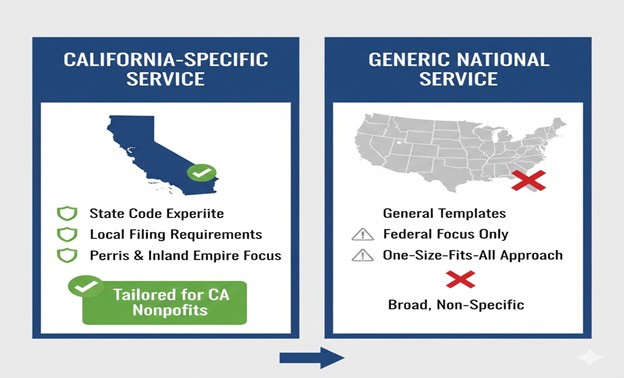
Generic national services often lack California Corporations Code knowledge leading to rejections and delays.
California expertise indicators:
- Familiarity with California Secretary of State formatting requirements
- Understanding of nonprofit public benefit corporation provisions
- Knowledge of dissolution language requirements
- Experience with California Attorney General registration
- Awareness of Statement of Information deadlines
Common California-specific issues:
- Proper corporate designator requirements (“corporation,” “incorporated,” etc.)
- Registered agent California address requirements
- Specific dissolution provisions language
- Nonprofit purpose statement formatting
- Initial address versus registered agent distinctions
Questions to ask:
- “How many California nonprofit formations have you completed?”
- “What are common California Secretary of State rejection reasons?”
- “Are you familiar with California Corporations Code sections 5120-5121?”
- “Do you handle California Attorney General registration?”
Providers specializing in California formations understand state-specific nuances that prevent costly rejections and resubmissions.
- Pricing Transparency and Structure
Pricing models vary significantly among providers, affecting total cost and predictability.
Transparent pricing includes:
- Clear base service fee disclosure
- Separate itemization of government filing fees ($30 California, $275-$600 IRS)
- Explanation of what’s included at each price level
- Upfront disclosure of expedited processing costs
- Clear policy on revision charges
Hidden fee warning signs:
- Advertised low prices without service scope details
- Separate charges for “document review,” “filing coordination,” or other standard services
- Unclear whether government fees are included or additional
- No written pricing before starting work
- Charges for minor revisions that should be included
Typical pricing structures:
Budget DIY Support ($200-400): Basic document templates with limited guidance, no customization, self-filing
Standard Professional Service ($400-800): Complete document preparation, California compliance review, filing coordination, basic IRS guidance
Comprehensive Formation ($800-1,200): Full document package, customized bylaws, complete IRS application assistance, ongoing compliance guidance
Questions to ask:
- “What is your total fee including all charges?”
- “Are California Secretary of State fees ($30) included or additional?”
- “Are IRS application fees ($275-$600) included or additional?”
- “What triggers additional charges beyond the quoted price?”
- “Is there a charge if documents need revisions?”
4. Timeline Honesty and Realism
Be extremely cautious of services promising timelines they cannot control.
Honest timeline communication:
- California standard filing: 5-7 business days
- California expedited: 24-hour or same-day (additional fees)
- IRS processing: 2-6+ months (cannot be expedited)
- Complete formation: 3-9 months typically
- Acknowledges variables outside provider control
Misleading timeline claims:
- “Complete nonprofit in 2 weeks” (impossible with IRS processing)
- “Guaranteed approval in 30 days” (no provider controls agency decisions)
- “Fastest service available” without explaining expedited fees
- Failure to distinguish state versus federal processing
- Overpromising delivery dates
Questions to ask:
- “How long does California Secretary of State take to process filings?”
- “Can you expedite IRS tax-exempt processing?” (correct answer: No)
- “What is your realistic estimate for complete formation to IRS approval?”
- “What parts of the timeline do you control versus government agencies?”
Realistic timeline expectations prevent disappointment and help you plan appropriately. The Document Pro provides honest timelines based on current agency processing, not marketing claims.
<iframe width=”560″ height=”315″ src=”https://www.youtube.com/embed/lXaP-H2HM8g?si=IwQUIlRQYv7uYIlR” title=”YouTube video player” frameborder=”0″ allow=”accelerometer; autoplay; clipboard-write; encrypted-media; gyroscope; picture-in-picture; web-share” referrerpolicy=”strict-origin-when-cross-origin” allowfullscreen></iframe>
5. Customer Support and Communication
Support quality significantly affects formation experience, especially for first-time nonprofit founders.
Support factors to evaluate:
- Business hours availability versus after-hours access
- Response time commitments (or lack thereof)
- Communication channels (phone, email, chat, in-person)
- Ongoing guidance through formation process
- Availability for questions after filing
Support models:
Self-Service Model: Submit documents, receive filing confirmation, limited interaction
Guided Service Model: Regular check-ins, proactive status updates, available for questions
Consultative Model: Comprehensive guidance, strategic advice, personalized attention throughout process
Questions to ask:
- “How quickly do you typically respond to client questions?”
- “What communication methods do you offer?”
- “Is support available outside business hours?”
- “Do you provide proactive status updates or only respond to inquiries?”
- “What happens if I have questions after filing?”
The Document Pro – Non-Profit Launch Office provides after-hours AI assistant support for intake, guidance, and document preparation questions outside regular business hours: 1(800) 285-0078 | mydocumentpro@gmail.com
6. Local versus National Service Providers
Consider advantages and limitations of local Inland Empire providers versus national services.
Local Perris/Riverside County advantages:
- Understanding of Riverside County permit requirements
- Familiarity with City of Perris business licensing
- Personal relationships with local regulatory offices
- Community knowledge and Inland Empire focus
- Potentially easier in-person meetings
National service advantages:
- Potentially broader experience volume
- Established processes and systems
- Online platforms and tools
- Often lower prices through scale
Questions to ask:
- “Do you serve organizations throughout California or focus on specific regions?”
- “Are you familiar with Riverside County and Perris requirements?”
- “Do you offer in-person consultations or only remote service?”
- “How many Inland Empire nonprofits have you assisted?”
Red Flags to Watch For
Warning Signs of Problematic Services
Unrealistic promises:
- “Guaranteed approval” (no provider controls government decisions)
- “Fastest formation available” without explaining process
- “Complete 501(c)(3) in 2 weeks” (impossible with IRS processing)
- “No rejections ever” (even perfect documents sometimes face clarification requests)
Pricing concerns:
- Unwillingness to provide written quotes
- Advertised prices significantly below market ($200-300 for full service unlikely sustainable)
- Vague descriptions of what’s included
- Nickel-and-diming for standard services
Expertise questions:
- Cannot explain California-specific requirements
- Unfamiliar with common Secretary of State rejection reasons
- Generic responses without California Corporations Code references
- No mention of California Attorney General registration
Communication issues:
- Slow response times to initial inquiries
- Unclear about support availability
- Pressure to commit immediately
- Inability to answer specific formation questions
Making Your Decision
Factors to Prioritize Based on Your Situation
If budget is primary concern:
- Compare total costs including all fees
- Understand what’s included at each price point
- Consider long-term value versus lowest upfront cost
- Factor in potential rejection and resubmission costs from cheap services
If speed is critical:
- Focus on services explaining expedited options clearly
- Verify understanding of what can/cannot be expedited
- Assess document preparation speed claims
- Confirm availability for quick consultations
If you want hands-on guidance:
- Prioritize services with strong support models
- Evaluate communication preferences (phone versus email)
- Check response time commitments
- Ask about ongoing guidance through process
If organizational complexity is high:
- Ensure service handles complex structures
- Verify IRS application experience
- Check whether provider identifies when legal counsel needed
- Assess customization capabilities versus template approach
If California compliance is paramount:
- Prioritize California-specialized providers
- Verify state-specific knowledge
- Check rejection and revision history
- Confirm Attorney General registration assistance
How The Document Pro – Non-Profit Launch Office Approaches Formation
While this guide focuses on general evaluation criteria, here’s how The Document Pro addresses these factors for transparency:
Service Scope: Comprehensive document preparation including California Articles of Incorporation, customized bylaws, conflict of interest policies, board resolutions, and IRS tax-exempt application assistance. Services range $400-$1,200 based on complexity.
California Specialization: Exclusive focus on California nonprofit formations with knowledge of Corporations Code requirements, Secretary of State formatting standards, and common rejection triggers.
Pricing Transparency: Clear disclosure of service fees and government filing costs, with written quotes before starting work. No hidden charges for standard revisions or consultations.
Timeline Honesty: Realistic expectations based on current agency processing (5-7 days California standard, 2-6+ months IRS, 3-9 months complete formation typically).
Customer Support: After-hours AI assistant support for intake and guidance outside regular business hours, serving Perris, Moreno Valley, Riverside County, and California statewide.
Local Focus: Inland Empire emphasis with understanding of Riverside County and Perris considerations while serving organizations throughout California.
Contact: 1(800) 285-0078 | mydocumentpro@gmail.com | https://thedocumentpro.com/
Can You Expedite the Process?
What CAN Be Expedited
California State Filing:
- 24-hour expedited service: Additional $350 fee
- Same-day expedited service: Additional $500 fee
- Applies only to Articles of Incorporation processing
- Does not guarantee approval if documents contain errors
What CANNOT Be Expedited
IRS Tax-Exempt Processing:
- No standard expedited processing available
- Special circumstances may warrant expedited review (rare)
- Typical processing time cannot be shortened through fees
- Timeline driven by IRS workload and application complexity
Best Approach: Focus on submitting complete, accurate applications rather than seeking expedited processing. Quality preparation prevents delays more effectively than expedited fees.
Why Choose The Document Pro – Non-Profit Launch Office
Timeline Expertise: We provide realistic timeline expectations based on current processing realities, not overpromised delivery dates we cannot control.
Error Prevention: Our document preparation focuses on accuracy and compliance to help avoid rejections and resubmission delays that extend timelines.
California Specialization: The Non-Profit Launch Office (NPLO), operated by The Document Pro and Gitta Williams, focuses exclusively on California formations with deep knowledge of state requirements.
Comprehensive Support: We assist with both California state filings and IRS tax-exempt applications, ensuring document coordination and consistency.
After-Hours Accessibility: Our AI assistant provides intake, guidance, and document preparation support outside regular business hours.
Transparent Pricing: Services range from $400-$1,200 based on organizational complexity with clear explanation of included services.
Contact Information:
- Phone: 1(800) 285-0078
- Email: mydocumentpro@gmail.com
- Website: https://thedocumentpro.com/
Frequently Asked Questions
How do I compare pricing between different non-profit filing services?
Request written quotes from multiple providers showing: (1) base service fee, (2) what’s included at that price, (3) which government fees are additional ($30 California, $275–$600 IRS), (4) costs for expedited processing if desired, and (5) any potential additional charges. Compare total estimated costs for equivalent service scope—not just advertised base prices. Be cautious of significantly low prices ($200–$300 for full formation services), which may indicate incomplete service scope or hidden fees.
What questions should I ask to verify California nonprofit expertise?
Ask about experience with California Corporations Code sections 5120–5121, common California Secretary of State rejection reasons for nonprofit filings, dissolution provision requirements, California Attorney General charitable registration procedures, and Statement of Information filing deadlines. Quality California-specialized providers will answer confidently with specific details. Generic or vague responses may indicate lack of state-specific expertise.
Should I choose local Perris services or statewide California providers?
Both can provide quality service. Local Perris or Riverside County providers may better understand city-specific licensing or county permit requirements. Statewide California providers with Inland Empire experience may offer equivalent expertise. Focus on California specialization rather than physical location—many reputable services operate virtually throughout California. The Document Pro serves Perris, Moreno Valley, Riverside County, and statewide with after-hours support.
How can I verify realistic timeline expectations from a provider?
Ask specific questions: “How long does California Secretary of State standard processing take?” (Answer: 5–7 business days.) “Can IRS tax-exempt processing be expedited?” (Answer: No, typically 2–6+ months.) “What is the typical complete formation timeline?” (Answer: 3–9 months.) Be skeptical of providers promising “complete 501(c)(3) in 2 weeks” or “guaranteed approval in 30 days,” as these claims are unrealistic given government processing timelines outside any provider’s control.
What’s included in complete non-profit formation services versus basic filing?
Complete services typically include: California Articles of Incorporation preparation, customized organizational bylaws, conflict of interest policy, initial board meeting minutes and resolutions, IRS Form 1023 or 1023-EZ preparation assistance, Statement of Information guidance, and California Attorney General registration coordination. Basic filing services may only prepare and submit Articles of Incorporation without IRS assistance or governance documents. Always clarify what is included before engaging services.
How important is after-hours support for nonprofit formation?
This depends on your schedule and preferences. Working professionals often appreciate after-hours accessibility for questions and document preparation. However, most formation activities occur during government business hours. Consider whether you need evening or weekend consultation availability. The Document Pro provides after-hours AI assistant support for intake and general guidance.
Should I avoid services that advertise themselves as “cheapest” or “fastest”?
Exercise caution with extreme claims. “Cheapest” may indicate incomplete services or hidden fees. “Fastest” may refer to expedited state filing (legitimate but costly) or unrealistic promises about full formation timelines. Quality providers emphasize accuracy, completeness, and realistic expectations rather than superlatives. Ask what makes the service cheaper or faster—transparent explanations are a good sign; vague answers may not be.
Additional Resources
- I'm ready to start my non-profit in California. What documents do you prepare and how long does the filing process take?
- Cost to Prepare Non-Profit Papers in Perris, CA
- Urgent 24/7 Non-Profit Filing Help in Perris, CA
- How Long Does Non-Profit Filing Take in Perris, CA?
External Authority Sources
- California Secretary of State - Articles of Incorporation Requirements
- Internal Revenue Service - Form 1023 and 1023-EZ Instructions
- California Corporations Code - Non-profit Formation Requirements
- California Attorney General's Registry of Charitable Trusts
- IRS Publication 557 - Tax-Exempt Status Guidelines
- National Council of Nonprofits - Governance Document Templates
Sources & References
California Secretary of State – Official forms, filing procedures, and non-profit corporation requirements under California Corporations Code.
Internal Revenue Service (IRS) – Form 1023, Form 1023-EZ, EIN applications, and tax-exempt status determination procedures.
California Corporations Code – Legal requirements for non-profit public benefit corporations, Articles of Incorporation provisions, and governance standards.
California Attorney General's Registry of Charitable Trusts – Charitable organization registration requirements and ongoing compliance obligations.
National Council of Nonprofits – Best practices for non-profit formation, governance documents, and organizational policies.
IRS Publication 557 – Comprehensive guidance on tax-exempt status applications and organizational requirements for 501(c)(3) organizations.
Disclaimer: This information is provided for educational purposes and does not constitute legal or tax advice. Non-profit formation requirements can vary based on organizational structure and specific circumstances. Consult with qualified legal and tax professionals for advice specific to your situation.
Contact
Book: https://thedocumentpro.com/
Call: 1(800) 285-0078
Email: mydocumentpro@gmail.com
The Nonprofit Launch Office™ — a discipline of The Document Pro, operated by Gitta Williams.
Operated by The Document Pro (Gitta Williams)
Find Us Locally
Service Area: Moreno Valley, CA and surrounding areas
Coordinates: 33.9535, -117.2081
Address: 23945 Sunnymead Blvd. #4, Moreno Valley, CA 92553
Sources
- https://www.irs.gov/charities-non-profits/charitable-organizations
- https://www.irs.gov/forms-pubs/about-form-1023
- https://calnonprofits.org/
Disclaimer
Document preparation and nonprofit readiness support — not legal or tax advice.