
09 Jan How Do I Check My Nonprofit’s Status with SOS, FTB, and AG (Conceptually)?
Short Answer
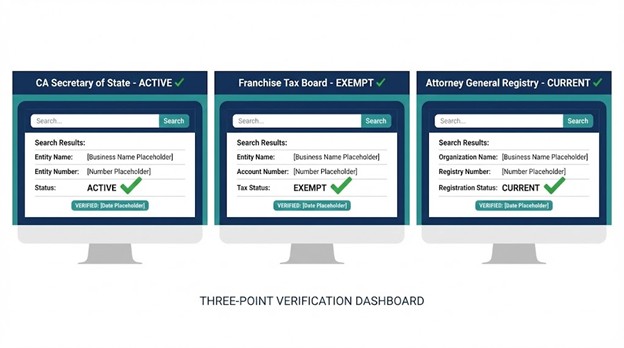
California nonprofits check their status conceptually by understanding three distinct verification points: the Secretary of State (SOS) confirms corporate entity status and registered agent compliance through the online business search tool, the Franchise Tax Board (FTB) verifies state tax exemption status through their exempt organization database, and the Attorney General Registry of Charities (AG) shows fundraising registration and annual renewal status through the Registry search portal. Each agency maintains separate online databases that nonprofits and funders can access independently, and eligibility for grants typically requires current “Active” or “good standing” status with all three agencies simultaneously, plus federal IRS recognition.
Why does California divide nonprofit oversight among three different agencies?
California’s regulatory structure distributes nonprofit oversight responsibilities across three separate state agencies because each serves a distinct protective function under state law. The Secretary of State manages corporate existence and public records through the Business Programs division, the Franchise Tax Board administers state taxation including exemptions for qualifying organizations, and the Attorney General’s Registry of Charities protects charitable assets and regulates fundraising to prevent fraud and misuse of donations.
This division reflects California’s specific statutory framework where corporate law, tax law, and charitable solicitation law operate under separate legal authorities. Unlike some states that consolidate nonprofit oversight in a single agency, California’s system requires organizations to maintain relationships with multiple government entities, each with its own filing schedules, documentation requirements, and compliance protocols.
For Temecula and Inland Empire nonprofits, this multi-agency structure means that checking your status isn’t a single lookup but rather a systematic verification process across three different databases. You might be perfectly current with the Secretary of State but suspended by the Franchise Tax Board, or Active with both while delinquent with the Attorney General’s Registry. Each agency tracks compliance independently and can take enforcement action without coordinating with the others.
Understanding this conceptual framework helps explain why grant makers in California typically verify multiple data points before approving funding. They’re not being unnecessarily bureaucratic—they’re confirming that your nonprofit maintains legal standing across all relevant regulatory authorities. A compliance gap with any single agency can block your ability to operate legally or receive funding, regardless of your status with the other two.
What does each agency actually track and why does it matter for funding?
The Secretary of State tracks your nonprofit’s corporate existence and structural compliance. When you check SOS status, you’re verifying that your nonprofit remains a legally recognized entity in California, has a current registered agent who can receive legal notices, and has filed required Statement of Information updates showing current directors and principal office address. SOS status of “Active” means your corporate entity exists and is compliant with these basic structural requirements.
The Franchise Tax Board tracks your state tax exemption status and annual filing compliance. Even though California exempts qualifying 501(c)(3) organizations from the standard $800 annual franchise tax, you must still file annual information returns (Form 199 or 199N) to maintain that exemption. FTB status verification shows whether you’re current with these filings or have been suspended for delinquency. Suspension triggers financial penalties and can affect your ability to conduct business in California.
The Attorney General’s Registry of Charities tracks your authorization to solicit charitable contributions in California. Most nonprofits must register with the Registry within 30 days of first receiving assets and file annual renewal reports (RRF-1) to maintain active registration. AG Registry status shows your CT number (Charity Trust registration number) and whether your annual reporting is current. Operating without current registration when required violates state charitable solicitation law and creates legal liability.
Funders verify all three because each addresses a different risk. SOS verification confirms you’re a legal entity that can enter contracts. FTB verification confirms you’re not operating under suspension that could affect financial transactions. AG Registry verification confirms you’re legally authorized to receive charitable funds. All three must show current standing for the funder to proceed with confidence that the grant relationship is legally sound.
Framework: Launch → Fix → Fund + Federal Recognition + CA Compliance Triangle
The Nonprofit Launch Office operates within a strategic framework designed to help California nonprofits move from formation to fundability:
Launch means forming your nonprofit correctly from day one with all three California agencies properly registered. This includes filing Articles of Incorporation with the Secretary of State to create corporate existence, obtaining initial exemption from the Franchise Tax Board to avoid unnecessary tax obligations, and registering with the Attorney General’s Registry of Charities before first receiving assets. Proper launch creates clean initial status across all three agencies.
Fix addresses situations where a nonprofit has fallen out of good standing with one or more agencies—suspended by FTB for missed annual filings, delinquent with AG Registry for failure to file RRF-1 renewals, or facing involuntary dissolution by SOS for failure to maintain a registered agent. Restoration requires understanding which agency has the problem, what filings are missing, and coordinating multi-agency submissions to regain full compliance.
Fund focuses on maintaining continuous current status across all three agencies so status checks never reveal problems. This means tracking three separate filing calendars—biennial Statement of Information with SOS, annual Form 199 with FTB, annual RRF-1 with AG Registry—and ensuring submissions happen on schedule. Fund-lane work treats multi-agency compliance as routine maintenance rather than crisis intervention.
Federal Recognition means securing and maintaining IRS determination of 501(c)(3) status through initial application and ongoing Form 990 filing compliance. Federal recognition serves as the prerequisite for state-level exemptions and provides the foundation that California’s three-agency structure builds upon. Most funders verify federal status through IRS TEOS before checking California agency status.
CA Compliance Triangle represents the three-agency verification system unique to California: the Secretary of State (corporate status), the Franchise Tax Board (tax exemption), and the Attorney General Registry of Charities (fundraising authority). Grant readiness for Temecula nonprofits requires understanding how to check status with each agency independently and maintaining current standing with all three simultaneously.
Step-by-step: How NPLO helps verify and maintain multi-agency status
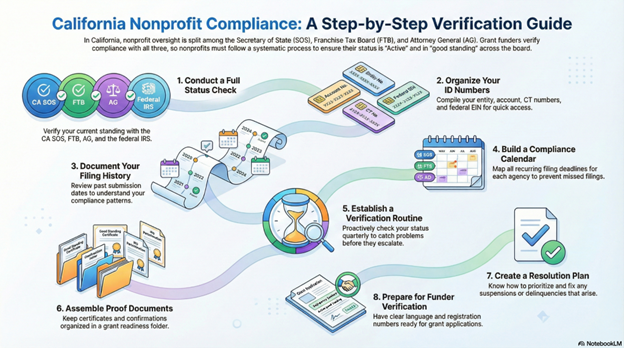
Step 1: Comprehensive Status Check Across All Agencies We conduct systematic verification of your nonprofit’s current standing with all three California agencies plus federal IRS status. This includes checking Secretary of State business entity search for Active status, Franchise Tax Board exempt organization lookup for exemption and filing compliance, Attorney General Registry search for current registration and RRF-1 status, and IRS TEOS for federal recognition. This baseline assessment reveals exactly where you stand.
Step 2: Entity Information Organization We compile the specific identifiers needed for status verification—your Secretary of State entity number, Franchise Tax Board exemption account number, Attorney General CT number, and federal EIN. Having these organized allows quick status checks and helps funders verify your standing independently when they conduct due diligence.
Step 3: Filing History Documentation We review your filing history with each agency to understand compliance patterns—when was your last Statement of Information filed with SOS, when was your most recent Form 199 submitted to FTB, when was your latest RRF-1 filed with AG Registry. This historical view identifies recurring problems or patterns that suggest systemic compliance issues.
Step 4: Compliance Calendar Creation We build a master calendar showing all recurring filing deadlines across the three agencies—Statement of Information due every two years in the month your Articles were filed, Form 199 due on the 15th day of the 5th month after your fiscal year ends, RRF-1 due based on your registration anniversary date. Color-coded deadlines help prevent the missed filings that trigger status problems.
Step 5: Verification Protocol Establishment We create a quarterly verification routine where you systematically check status with all three agencies using bookmarked database links and documented search procedures. This proactive monitoring catches problems early before they escalate into suspensions or delinquencies that funders discover during application review.
Step 6: Proof Document Assembly We organize the certificates and confirmation documents that prove current status to funders—Secretary of State certificate of good standing or business search printout showing Active status, Franchise Tax Board exemption letter or online verification, and Attorney General confirmation of current registration. These documents go in your grant readiness folder for quick access.
Step 7: Discrepancy Resolution Guidance When status checks reveal problems—suspended FTB status, delinquent AG Registry filing, or registered agent issues with SOS—we help prioritize which problems to address first, identify required filings or payments, and coordinate multi-agency submissions to restore full compliance efficiently.
Step 8: Funder Verification Support We prepare clear language explaining your compliance status for grant applications, including specific registration numbers funders need for independent verification. If status problems exist, we help craft appropriate disclosures and demonstrate remediation efforts that maintain funder confidence during restoration periods.
Checklist: What you should have ready before you apply
Having these items organized allows you to check your status quickly and provide verification information to funders when requested:
- Secretary of State entity number from your original Articles of Incorporation filing or Statement of Information confirmations
- Exact legal name as registered with the Secretary of State, which may differ from your DBA or common name
- Current registered agent information including agent name and street address as shown in SOS records
- Franchise Tax Board exemption account number from your FTB 3500 exemption approval or correspondence
- FTB filing history showing most recent Form 199 or 199N submission date and confirmation
- Attorney General CT number (Charity Trust registration number) from your initial CT-1 filing or RRF-1 renewals
- AG Registry filing history showing most recent RRF-1 submission date and acceptance
- Federal EIN used consistently across all agency filings and official documents
- IRS determination letter showing 501(c)(3) recognition with the legal name matching your California registrations
- Bookmarked database links for quick access to all three agency search portals
- Login credentials if any agency requires account access for detailed status information
- Filing calendar showing upcoming deadline dates for each agency’s recurring requirements
- Contact information for relevant agency departments in case status checks reveal questions or discrepancies
- Recent bank statements or cancelled checks showing payment of any fees required by agencies
- Board minutes documenting registered agent appointments or changes that affect SOS status
Quick Answers (PPA)
Can I check all three agencies in one place or do I need separate searches? California does not provide a unified database showing your status across all three agencies. You must check each agency independently using their separate online portals. Secretary of State has a business entity search tool, Franchise Tax Board has an exempt organization lookup, and Attorney General has a Registry of Charities search. Some third-party services aggregate this data, but official verification requires visiting each agency’s system directly. Temecula nonprofits pursuing grants benefit from bookmarking all three search portals and establishing quarterly verification routines.
How long does it take for status changes to appear in each database? Update timing varies by agency and filing type. Secretary of State typically updates entity status within a few business days of receiving and processing your Statement of Information. Franchise Tax Board can take several weeks to update exemption status after receiving and processing Form 199, particularly during peak filing seasons. Attorney General Registry updates generally within a few weeks of receiving RRF-1 renewals. If you file something and immediately check status, you may not see the update yet—agencies need processing time before database changes reflect.
What if one agency shows good standing but another shows problems? This scenario is common and reflects the independent nature of California’s multi-agency system. You might be Active with Secretary of State while suspended by Franchise Tax Board if you filed your Statement of Information but missed your Form 199. Or you might be current with both SOS and FTB but delinquent with Attorney General if you missed an RRF-1 filing. Grant makers typically require good standing with all relevant agencies, so even one problem can block funding until resolved. Priority should go to whichever agency has enforcement action pending.
Do all California nonprofits need to check all three agencies? Most California nonprofits need to verify status with all three agencies. All California nonprofits incorporated as corporations must maintain Secretary of State compliance. All nonprofits claiming tax exemption must maintain Franchise Tax Board compliance. Most nonprofits that solicit contributions must maintain Attorney General Registry compliance, though some small religious organizations and certain other entities have exemptions. When in doubt, verify status with all three—excess verification is safer than missing a requirement.
How often should I check status across all three agencies? Many grant-ready nonprofits establish quarterly verification checks as part of routine governance. At minimum, check all three agencies annually before major grant seasons, whenever you receive any compliance notice from any agency, before submitting significant grant applications, and after filing required documents to verify processing. More frequent checking helps catch problems early when they’re easier to fix. Some Inland Empire nonprofits assign status verification as a standing board committee task with quarterly reporting.
What to do next (DIY vs Done-With-You)
DIY approach: Create bookmarks for all three agency search portals—California Secretary of State business search at bizfileonline.sos.ca.gov, Franchise Tax Board exempt organization search through their website, and Attorney General Registry of Charities search at oag.ca.gov/charities. Gather your entity number, FTB account number, CT number, and EIN. Visit each portal and search for your organization using these identifiers. Document what you find—Active, suspended, current, delinquent—and save dated screenshots or printouts. Create a spreadsheet tracking verification dates and status results. Set quarterly calendar reminders to repeat the process. If you discover problems, research the specific filing or payment needed to resolve them.
Done-With-You approach: The Nonprofit Launch Office provides comprehensive multi-agency status verification and monitoring as part of grant readiness services. We check your current standing across all three California agencies plus federal IRS status, identify specific compliance gaps with detailed remediation guidance, organize all relevant identifiers and proof documents, establish custom filing calendars reflecting your nonprofit’s specific deadlines, create quarterly monitoring protocols with documented results, and provide ongoing support when status checks reveal problems or questions. This approach is particularly valuable for Temecula and Inland Empire nonprofits pursuing multiple funding opportunities where the time invested in learning three different agency systems plus the risk of missing compliance requirements typically exceeds the cost of professional monitoring support.
Contact
Book: https://thedocumentpro.com/
Call: 1(800) 285-0078
Email: mydocumentpro@gmail.com
The Nonprofit Launch Office™ — a discipline of The Document Pro, operated by Gitta Williams.
Operated by The Document Pro (Gitta Williams)
Sources
Disclaimer
Document preparation and nonprofit readiness support — not legal or tax advice.