Education

Short Answer

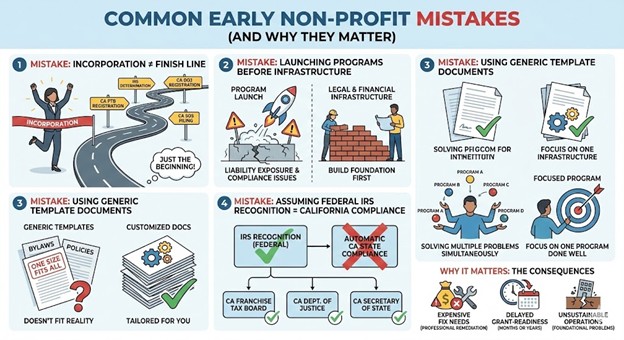
Common early mistakes include treating incorporation as the finish line when it’s just the beginning of a multi-step compliance process requiring IRS determination and California registrations, launching programs before establishing legal and financial infrastructure creating liability exposure and compliance problems, using generic template documents without customization leading to bylaws and policies that don’t fit organizational reality, assuming federal IRS recognition automatically provides California state compliance when three separate California agencies require independent filings, and starting with overly ambitious scopes trying to solve multiple problems simultaneously rather than focusing on one program done well. These mistakes matter because they create expensive Fix needs requiring professional remediation, delay grant-readiness by months or years while compliance is established, and sometimes result in organizations never achieving sustainable operations because foundational problems weren’t addressed during Launch.

What formation and compliance mistakes create the biggest problems?

Stopping after incorporation without completing IRS determination represents the most fundamental mistake. Many Temecula founders file California Articles of Incorporation, receive corporate status from Secretary of State, and believe they’re “done” forming their nonprofit. Incorporation creates a California corporation but provides zero tax benefits—you’re not tax-exempt until IRS grants 501(c)(3) determination. Organizations operating for years without IRS recognition cannot offer tax-deductible receipts to donors, don’t qualify for most grants requiring federal recognition, and face potential tax liabilities for income earned during the gap between incorporation and determination.

Mixing personal and organizational finances creates accounting nightmares and compliance risks. Founders using personal bank accounts for organizational transactions “until we open a nonprofit account,” paying organizational expenses from personal funds without proper documentation, or treating organizational accounts as personal resources blur the essential legal distinction between the individual and the organization. These practices create impossible-to-untangle financial records, raise IRS concerns about private inurement, and potentially expose founders to personal liability for organizational obligations.

Missing filing deadlines because no compliance calendar exists causes the majority of FTB suspensions and AG Registry delinquencies. New founders focused on program delivery often completely forget about recurring compliance obligations—annual Form 990 and Form 199 due 4.5 months after fiscal year end, biennial Statement of Information due during designated filing month, annual RRF-1 renewal due 4 months 15 days after fiscal year end. Missing one filing starts a cascade where organizations discover multiple concurrent compliance problems when funders verify status during grant applications.

Using the wrong fiscal year without understanding implications complicates financial management and reporting. Many founders choose calendar year (January-December) because it seems simple without realizing that calendar fiscal years create fourth-quarter year-end during holiday season when accounting attention is minimal. Organizations with significant December donations face rushed year-end bookkeeping. Choosing fiscal years strategically (like July-June for education organizations or October-September for health organizations) can align financial reporting with natural program cycles.

What governance and operational mistakes undermine credibility?

Rubber-stamp boards that meet once yearly and approve whatever founders propose fail the genuine governance test. IRS and funders look for evidence of active board oversight—meeting minutes showing discussion and deliberation, conflict of interest disclosures and recusals documented, independent review of compensation and major decisions, and attendance records proving directors actually participate. Boards dominated by founder’s family members who never question decisions or exercise independent judgment don’t demonstrate the governance oversight required for tax-exempt status.

Operating without adopted policies creates governance gaps that funders and IRS notice. Organizations that never formally adopted conflict of interest policies, whistleblower policies, or document retention policies appear poorly managed regardless of actual program quality. Even when founders informally follow good practices, lack of adopted written policies documented in board minutes suggests organizational immaturity. The fix is simple—adopt the policies—but having to explain to funders or IRS why you’ve operated for two years without basic governance policies weakens credibility.

Launching multiple programs simultaneously without proven capacity stretches limited resources impossibly thin. New founders excited about their mission often propose 5-8 different programs addressing various community needs without adequate funding, staffing, or infrastructure to execute any program well. Starting with one focused program delivered effectively, then expanding once that program proves sustainable, demonstrates better judgment than scattered unfocused efforts that deliver mediocre results across multiple areas.

Ignoring legal and liability considerations until problems emerge creates expensive crises. Operating without proper insurance, having volunteers work with vulnerable populations without background checks, entering contracts without legal review, or conducting activities that create liability exposure without understanding risks leads to preventable disasters. While risk can never be eliminated, proactive risk management during Launch prevents many crises that derail organizations during operations.

Framework: Launch → Fix → Fund + Federal Recognition + CA Compliance Triangle

Launch represents the critical window where doing things right from the beginning prevents expensive Fix needs later. Temecula nonprofits that complete full formation through IRS determination and California registrations, establish proper financial systems and governance from day one, adopt required policies at organizational meetings, and focus on achievable programs set themselves up for success.

Fix becomes necessary when Launch mistakes create compliance problems requiring remediation. Organizations discovering they’ve been suspended by FTB for three years, operating without IRS recognition for two years, or functioning with no adopted policies must invest significant time and money correcting foundational problems that proper Launch would have prevented.

Fund depends on complete Launch because grant applications require verification of IRS recognition, California good standing across all three agencies, adopted governance policies, and demonstrated operational capacity. Organizations stuck in Fix mode cannot pursue grants until compliance is restored—missing critical funding opportunities during restoration periods.

Federal Recognition represents a fundamental Launch milestone that cannot be skipped. Organizations assuming they can “get IRS recognition later” discover that later never comes because immediate operational demands always feel more urgent than applications requiring extensive documentation and planning.

CA Compliance Triangle illustrates why California Launch requires attention to three separate agencies. Founders assuming California compliance is automatic after IRS recognition discover that Secretary of State, Franchise Tax Board, and Attorney General Registry all require independent registrations and filings.
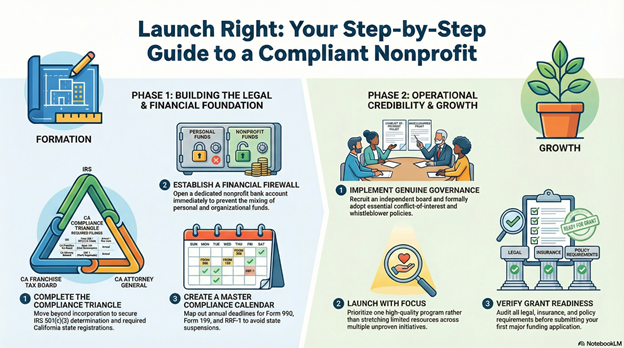
Step-by-step: How NPLO helps founders avoid common mistakes

Step 1: Complete Formation Roadmap We provide comprehensive timelines showing every step from incorporation through grant-readiness including IRS and all California requirements.

Step 2: Financial System Setup We guide proper bank account opening, accounting software selection, and financial management practices preventing personal/organizational confusion.

Step 3: Compliance Calendar Creation We establish comprehensive calendars showing all federal and California filing deadlines with advance reminders preventing missed filings.

Step 4: Governance Structure Implementation We help recruit genuinely independent boards, establish realistic meeting schedules, and implement active oversight practices.

Step 5: Policy Adoption Facilitation We ensure all required policies are adopted during organizational meetings documented in minutes.

Step 6: Focused Program Planning We help identify one primary program for initial implementation rather than scattered unfocused efforts.

Step 7: Risk Management Assessment We identify insurance needs, legal requirements, and liability exposure with mitigation strategies.

Step 8: Grant Readiness Verification We verify organizations have completed all formation and compliance requirements before pursuing grants.

Checklist: Common mistakes to avoid

Formation Mistakes:

  • Stopping after incorporation without IRS determination
  • Using generic templates without customization
  • Choosing fiscal year without strategic consideration
  • Assuming incorporation = tax-exempt status
  • Filing California Articles without understanding federal requirements

Financial Mistakes:

  • Mixing personal and organizational finances
  • Operating without separate bank account
  • No accounting system or financial tracking
  • Accepting donations before IRS determination without disclosure
  • No budget or financial planning

Governance Mistakes:

  • Rubber-stamp board dominated by founders/family
  • Meetings once yearly or less
  • No adopted policies (conflict, whistleblower, retention)
  • No meeting minutes or inadequate documentation
  • Founder making all decisions without board oversight

Compliance Mistakes:

  • No compliance calendar tracking deadlines
  • Missing Form 990/199 filing deadlines
  • Forgetting Statement of Information biennial filing
  • Never registering with AG Registry of Charities
  • Assuming IRS recognition = California compliance

Operational Mistakes:

  • Launching multiple programs without proven capacity
  • No insurance or risk management
  • Volunteers working without background checks
  • Contracts signed without legal review
  • Starting programs before infrastructure ready


Quick Answers (PPA)

We’ve been operating for two years since incorporation but haven’t filed for IRS recognition yet—is this a major problem? Yes, this is a significant problem requiring immediate correction. You’ve been operating without federal tax-exempt status meaning donations aren’t tax-deductible, you don’t qualify for grants requiring IRS recognition, and you may have tax liabilities for income earned. File Form 1023/1023-EZ immediately. Organizations applying within 27 months of incorporation can receive retroactive recognition effective from incorporation date, but beyond that deadline you lose retroactive coverage. The longer you delay, the more complications you create. Stop accepting donations claiming tax-deductibility until you have IRS determination, and prioritize the application over everything except critical compliance filings.

Can we fix these mistakes, or do they permanently damage the organization? Most mistakes are fixable though correction requires time, money, and effort that proper Launch would have avoided. Missing compliance filings can be corrected by filing delinquent returns and paying penalties. Operating without policies can be remedied by adopting them retroactively. Poor governance can be restructured with independent board recruitment and better practices. However, some mistakes create permanent consequences—donations received claiming tax-deductibility before IRS recognition can’t be made retroactively deductible beyond 27 months, and years of poor financial records can’t be fully reconstructed. The key is stopping the mistake immediately, implementing corrections, and establishing proper practices going forward.

Should we hire professionals to help with formation, or can founders handle everything ourselves? This depends on founder skills, available time, and organizational complexity. Founders with nonprofit experience, legal/accounting knowledge, and significant available time may successfully handle formation DIY using quality resources. However, most new founders lack specialized knowledge and discover that self-guided formation takes far longer than expected with higher error rates. Professional assistance—whether attorneys, CPAs, or nonprofit consultants—costs money upfront but typically saves money long-term by preventing expensive mistakes, streamlining processes, and ensuring everything’s done correctly the first time. Many organizations use hybrid approaches—professional help for specialized tasks like IRS applications and legal formation, DIY for simpler tasks like policy adoption.

We made several of these mistakes—should we focus on fixing them before starting programs, or can we fix them while operating? Prioritize based on risk and urgency. Critical fixes that prevent immediate harm or legal jeopardy—filing IRS determination application, correcting FTB suspension, obtaining proper insurance—should be addressed immediately even if that delays program launch. Less urgent fixes—adopting better governance practices, implementing compliance calendars, restructuring board composition—can be phased in while continuing operations. The danger of “we’ll fix it later” is that later never comes because operational demands always feel urgent. Schedule dedicated Fix time, assign clear responsibility, and work systematically through corrections rather than ignoring problems hoping they’ll disappear.

How can we tell if our board is a “rubber stamp” versus providing genuine oversight? Genuine oversight boards meet regularly (at minimum quarterly, ideally monthly or bimonthly), review financial reports and ask questions about variances or concerns, discuss programmatic decisions and suggest alternatives or improvements, exercise independent judgment even when disagreeing with founder preferences, include members with no family or business relationships to founders, demonstrate preparation by having read materials before meetings, and document substantive discussions in minutes. Rubber-stamp boards meet annually, approve everything without questions, consist primarily of founder friends/family, conduct meetings in 15 minutes with no discussion, and create minutes that are identical year after year. If board meetings feel like formalities you endure rather than valuable governance, you likely have rubber-stamp problems requiring board development.

What to do next (DIY vs Done-With-You)

DIY approach: Audit your current organizational status against this mistake checklist identifying which errors you’ve made or are at risk of making. For formation gaps—incomplete IRS determination, missing California registrations—immediately develop timeline for completing requirements with deadlines. For financial mistakes—mixed personal/organizational funds, no accounting system—open proper bank account immediately, establish accounting software, and reconstruct financial records for the current fiscal year minimum. For governance mistakes—rubber-stamp board, no policies, inadequate minutes—schedule board meeting to adopt required policies, recruit additional independent directors, and establish regular meeting schedule with proper minute-taking. For compliance mistakes—no calendar, missed filings—create comprehensive filing calendar immediately, verify status with all agencies, and file any overdue returns. Prioritize fixes based on risk—critical issues creating legal exposure or preventing operations come first, governance improvements come second, and organizational development comes third. Document all corrections in board minutes. Commit to not repeating mistakes by implementing systems preventing recurrence.

Done-With-You approach: The Nonprofit Launch Office provides comprehensive formation and mistake remediation for Temecula and Inland Empire nonprofits. We audit organizational status identifying formation gaps, compliance problems, and governance weaknesses requiring attention, develop prioritized correction plans addressing critical issues first while scheduling longer-term improvements, complete missing formation steps including IRS determination applications and California registrations, establish proper financial systems separating personal and organizational finances with appropriate accounting, implement governance improvements including board development, policy adoption, and meeting practices, create comprehensive compliance calendars preventing future missed deadlines, develop focused program plans demonstrating realistic capacity, address risk management including insurance and legal requirements, and provide ongoing support ensuring corrections stick and organizations maintain proper practices. This ensures you correct existing mistakes efficiently while establishing systems preventing future problems that undermine organizational sustainability.

Contact


Book: https://thedocumentpro.com/
 Call: 1(800) 285-0078
 Email: mydocumentpro@gmail.com
 The Nonprofit Launch Office™ — a discipline of The Document Pro, operated by Gitta Williams.
 Operated by The Document Pro (Gitta Williams)

Find Us Locally

Service Area: Moreno Valley, CA and surrounding areas

Coordinates: 33.9535, -117.2081

Address: 23945 Sunnymead Blvd. #4, Moreno Valley, CA 92553

Sources

  • https://www.irs.gov/charities-non-profits/charitable-organizations
  • https://www.irs.gov/forms-pubs/about-form-1023
  • https://calnonprofits.org/
Disclaimer

Document preparation and nonprofit readiness support — not legal or tax advice.

Short Answer

A basic year-one nonprofit budget should include realistic revenue projections from identified sources (individual donations, grants, fundraising events, earned income), essential operating expenses (rent, utilities, insurance, technology, supplies), program delivery costs (materials, staff time, participant support), administrative overhead (accounting, legal, compliance fees, bank charges), and personnel costs if hiring staff (salaries, payroll taxes, benefits). The budget matters because it demonstrates financial planning to IRS during 501(c)(3) applications, proves fiscal responsibility to funders evaluating grant eligibility, guides board decisions about affordable activities versus unsustainable commitments, and establishes baseline for tracking actual versus projected financial performance throughout the year.

What revenue sources should year-one budgets realistically project?

Individual donations from board members, founders, family, and friends represent the most reliable startup revenue. New Moreno Valley nonprofits should budget conservatively based on specific commitments or reasonable expectations from known supporters. If five board members commit $1,000 each and you expect $5,000 from family and friends, budget $10,000 in individual donations rather than hoping for $50,000 from unknown donors who haven’t been identified.

Small grants from local foundations or corporate giving programs provide realistic year-one targets. Community foundations often offer emerging organization grants in the $2,500-$10,000 range specifically for new nonprofits. Research specific opportunities, note application deadlines, and budget only grants you’ll actually apply for with reasonable chance of success. Don’t budget $100,000 in grants without identifying which specific funders you’ll approach.

Fundraising events can generate revenue but also incur significant expenses. Budget both gross revenue expected and event costs to show net revenue. A small fundraising dinner might generate $5,000 in ticket sales but cost $2,000 in venue, food, and materials, yielding $3,000 net. First-year events should be modest and manageable rather than ambitious galas requiring extensive upfront investment.

Earned income from fee-for-service programs, product sales, or contracts should only be budgeted if you have concrete plans and identified customers. Don’t budget $20,000 in program fees without knowing who will pay those fees and why. If offering services, research what similar organizations charge and estimate realistic participation numbers.

What expenses must year-one budgets include?

Essential operating expenses keep the organization functioning. Budget for registered agent service ($100-300 annually), business liability insurance ($500-1,500 depending on activities), technology costs (website hosting, email, productivity software, potentially $500-1,500), office supplies and postage ($300-500), and bank fees ($100-300 if the bank charges monthly fees). These costs exist regardless of program scale.

Program delivery expenses vary by organizational mission and activities. If providing food assistance, budget food costs or grocery cards. If offering tutoring, budget educational materials. If conducting workshops, budget space rental and supplies. Connect every budgeted program expense to specific planned activities with realistic participant numbers and unit costs.

Professional services prevent costly mistakes. Budget for accounting or bookkeeping ($500-2,000 depending on transaction volume and complexity), annual tax return preparation ($500-1,500 for Form 990), potential legal consultation ($500-1,000 for contract review or guidance), and nonprofit formation assistance if not already completed. These investments in professional support pay dividends through prevented compliance problems.

Personnel costs represent the largest budget category if hiring staff. Budget for gross salaries or hourly wages at market rates for roles and experience levels, employer payroll taxes (approximately 7.65% of wages), workers’ compensation insurance (varies by state and job classification), and benefits if offering health insurance, retirement contributions, or paid time off. Be realistic about whether year-one revenue supports staff or if volunteer leadership suffices initially.

Framework: Launch → Fix → Fund + Federal Recognition + CA Compliance Triangle

Launch includes developing realistic year-one budgets before IRS applications and fundraising begins. New Moreno Valley nonprofits should create conservative budgets demonstrating financial planning rather than wishful thinking about unrealistic revenue.

Fix addresses organizations that launched without budgets or with completely unrealistic projections requiring revision based on actual financial capacity and performance. Correcting budgets mid-year allows more realistic planning going forward.

Fund depends on credible budgets because grant applications require submitting organizational budgets showing how you’ll use grant funds within broader financial context. Funders evaluate whether budgets are realistic and sustainable or indicate poor financial planning.

Federal Recognition applications request projected budgets for Form 1023 demonstrating how the organization will support its charitable activities. Budgets showing careful planning strengthen applications; budgets with obvious flaws raise questions about organizational capacity.

CA Compliance Triangle doesn’t directly review budgets but board financial oversight responsibilities under California law require adopting and monitoring budgets. Boards that never adopt budgets or never compare actual versus budget results fail basic fiduciary duties.

Step-by-step: How NPLO helps organizations develop year-one budgets

Step 1: Activity Planning We help identify specific programs and activities planned for year one with realistic scope.

Step 2: Revenue Source Identification We research realistic funding opportunities and estimate conservative revenue projections.

Step 3: Expense Categorization We organize expenses into program, administrative, and fundraising categories for Form 990 alignment.

Step 4: Cost Research We help determine market rates for services, typical costs for supplies, and reasonable estimates for planned activities.

Step 5: Personnel Planning We evaluate whether revenue supports staff hiring or if volunteer operations are more sustainable initially.

Step 6: Budget Format Development We create simple budget spreadsheets showing revenue, expenses, and net surplus or deficit.

Step 7: Board Review Preparation We prepare budget narratives explaining assumptions and helping boards understand financial projections.

Step 8: Quarterly Monitoring Setup We establish systems for comparing actual versus budget results quarterly and adjusting as needed.

Checklist: Essential year-one budget components

Revenue Section:

  • Individual donations (specific commitments)
  • Board member contributions
  • Foundation grants (identified opportunities)
  • Corporate donations (researched prospects)
  • Fundraising events (net after expenses)
  • Earned income (realistic projections)
  • In-kind donations (valued appropriately)

Program Expenses:

  • Direct service delivery costs
  • Program materials and supplies
  • Participant support costs
  • Program-specific technology or equipment

Administrative Expenses:

  • Registered agent fee
  • Liability insurance
  • Technology (website, email, software)
  • Office supplies and postage
  • Bank fees
  • Accounting/bookkeeping
  • Tax return preparation
  • Legal consultation

Personnel Costs (if applicable):

  • Gross salaries or wages
  • Employer payroll taxes
  • Workers’ compensation insurance
  • Benefits (if offered)

Fundraising Expenses:

  • Event costs (venue, food, materials)
  • Marketing and communications
  • Donor database or fundraising software

Quick Answers (PPA)

Should our first-year budget show surplus, break-even, or deficit? Conservative year-one budgets often project small deficits or break-even because startup costs exist before revenue streams are fully established. Modest deficits covered by founder contributions or board commitments demonstrate realistic planning. However, budgets shouldn’t project large unsustainable deficits without clear plans for covering shortfalls. Funders want to see that you understand financial realities—small planned deficits are acceptable; massive unrealistic gaps raise concerns about fiscal management.

How detailed should the budget be—do we need line items for every small expense? Year-one budgets should be detailed enough to guide decisions but not so granular that maintaining them becomes burdensome. Group similar small expenses into reasonable categories—”office supplies” rather than separate lines for pens, paper, staplers. Separate significant expense categories to track major cost drivers. The right level of detail allows meaningful monitoring of actual versus budget performance without creating administrative burden exceeding organizational capacity.

What if actual revenue comes in much lower than budgeted—do we need to formally revise the budget? Yes, budgets should be living documents revised when circumstances change significantly. If projected grant doesn’t materialize or fundraising event underperforms, revise the budget to reflect new revenue reality and reduce planned expenses accordingly. Board should review and approve budget revisions documenting what changed and why. Regular quarterly review comparing actual versus budget triggers revision discussions when significant variances appear.

Can we budget for founder or executive director salary in year one if we’re just starting? Yes, if revenue realistically supports it and proper conflict of interest procedures are followed. Many new organizations operate with volunteer leadership initially and add paid positions as revenue grows. Others budget for part-time founder compensation from inception if funding is adequate. The key is ensuring independent board approval of any founder compensation, demonstrating it’s reasonable for services rendered, and not over-committing revenue to salaries at the expense of program delivery.

What percentage of budget should go to programs versus administrative costs? Funders generally expect at least 60-75% of expenses support program activities with remainder covering administration and fundraising. However, year-one budgets naturally show higher administrative percentages because startup costs (formation, insurance, initial infrastructure) don’t scale with programs yet. As organizations mature and grow, program percentages should increase. What matters most is that budgets demonstrate thoughtful allocation and that administrative spending supports program delivery rather than excessive overhead.

What to do next (DIY vs Done-With-You)

DIY approach: Start by listing all planned activities for year one with realistic descriptions—how many people served, how often, with what materials or support. Research costs for each activity component using vendor quotes, similar organization examples, or reasonable estimates. List all identified revenue sources with conservative amounts based on specific commitments or researched opportunities—don’t budget grants you haven’t identified or donations from unknown sources. Create simple spreadsheet with revenue section, expense section broken into program/administrative/fundraising categories, and bottom line showing surplus or deficit. Include brief narrative explaining major assumptions—where grant amounts come from, how you estimated participation numbers, why you chose certain expense levels. Present budget to board for discussion, revision, and formal adoption. Record adoption in board meeting minutes. Compare actual financial results to budget quarterly, discussing significant variances and revising budget if circumstances change materially.

Done-With-You approach: The Nonprofit Launch Office provides comprehensive year-one budget development for Moreno Valley and Inland Empire nonprofits. We help identify realistic first-year activities and programs within organizational capacity, research achievable funding opportunities specific to your region and mission, develop conservative revenue projections based on identified sources rather than wishful thinking, organize expenses into appropriate categories aligning with Form 990 functional expense reporting, research market-rate costs for planned services and activities, evaluate whether revenue supports staff hiring or volunteer operations are more sustainable, create clear budget formats showing revenue, expenses, and net results, prepare narrative explanations helping boards understand assumptions and planning, guide board budget review, discussion, and adoption, and establish quarterly monitoring systems comparing actual versus budget with revision processes. This ensures your budget demonstrates realistic financial planning that strengthens IRS applications, supports successful grant pursuits, and guides sustainable organizational operations.

Contact

Book: https://thedocumentpro.com/
 Call: 1(800) 285-0078
 Email: mydocumentpro@gmail.com
 The Nonprofit Launch Office™ — a discipline of The Document Pro, operated by Gitta Williams.
 Operated by The Document Pro (Gitta Williams)

Sources


Disclaimer

Document preparation and nonprofit readiness support — not legal or tax advice.
Short Answer

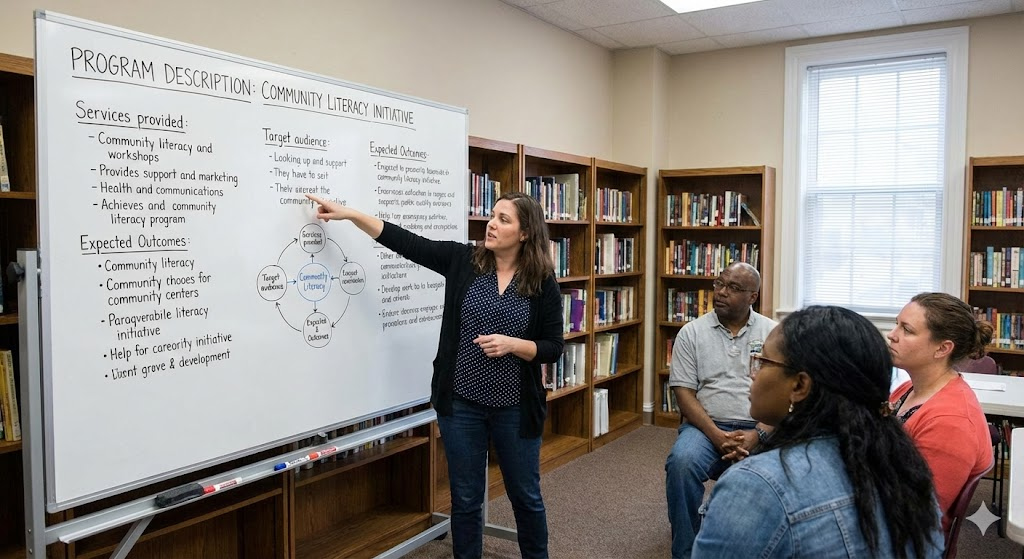
A nonprofit program description is a clear narrative explaining what specific services or activities the organization provides, who benefits from those services, how the services are delivered, and what outcomes or community impact result from the work. Program descriptions matter because IRS Form 1023 applications require detailed explanations of planned activities to evaluate whether they qualify as charitable, grant applications universally request program descriptions to assess mission alignment and impact potential, and well-articulated program descriptions help boards focus organizational efforts rather than pursuing unfocused activities that dilute effectiveness.

What essential elements must program descriptions include?

Target population identification specifies who the program serves. Effective descriptions define beneficiaries with enough specificity to demonstrate focus—”low-income youth ages 14-18 in Temecula,” “homeless veterans in Riverside County,” “seniors experiencing food insecurity.” Vague descriptions like “people in need” or “the community” don’t communicate meaningful program focus. IRS wants to know that charitable activities serve identified populations with genuine needs rather than providing general benefits available to anyone.

Specific activities and services describe what the organization actually does. Rather than stating “we help youth succeed,” effective descriptions specify “we provide one-on-one academic tutoring twice weekly, college application workshops quarterly, and mentoring relationships pairing participants with community professionals.” Activity descriptions should be concrete enough that IRS reviewers, funders, and stakeholders understand operational reality rather than abstract aspirations.

Delivery methods explain how services reach target populations. Descriptions should address where services are provided (dedicated facility, partner locations, participants’ homes, virtual platforms), how frequently services occur (weekly classes, monthly workshops, ongoing case management, annual events), and who delivers services (staff, trained volunteers, professional contractors, partner organizations). Clear delivery methods demonstrate operational feasibility.

Intended outcomes or impact articulate what positive change the program pursues. While avoiding unrealistic guarantees, descriptions should explain expected results—”participants will improve academic performance and high school graduation rates,” “participants will achieve stable housing and employment,” “participants will access nutritious food and demonstrate improved health outcomes.” Outcome statements demonstrate that programs pursue meaningful community impact rather than conducting activities for activities’ sake.

How should program descriptions differ for IRS applications versus grant proposals?

IRS Form 1023 program descriptions emphasize charitable purpose qualification. The IRS wants to know that planned activities clearly advance recognized 501(c)(3) purposes—education, poverty relief, health promotion, community development. Descriptions should use terminology that connects activities to charitable categories and demonstrate that programs serve public benefit rather than private interests. IRS descriptions can be relatively broad since you’re establishing overall organizational mission rather than seeking funding for specific projects.

Grant application program descriptions emphasize alignment with funder priorities and demonstrate impact potential. Funders want to know that your specific program matches their funding focus, that you understand the problem you’re addressing with supporting data, that your approach is evidence-based or innovative, and that you can measure results demonstrating effective use of grant funds. Grant descriptions should be detailed about specific implementation plans and evaluation methods.

Length and format requirements differ significantly. IRS Form 1023 provides limited space for program descriptions requiring concise summaries. Grant applications often request extensive narratives with multiple pages explaining needs assessment, program design, implementation timeline, evaluation plan, and sustainability strategy. Temecula nonprofits need both concise versions for IRS and detailed versions for grants.

Adaptation to audience matters for both. IRS reviewers evaluate tax-exempt qualification and compliance with charitable purpose definitions. Grant reviewers evaluate program quality, organizational capacity, and likelihood of achieving outcomes matching funder goals. The same core program can be described differently emphasizing elements most relevant to each audience while maintaining consistency about what the organization actually does.

Framework: Launch → Fix → Fund + Federal Recognition + CA Compliance Triangle

Launch includes developing clear program descriptions during formation before IRS applications. New Temecula nonprofits should articulate programs precisely rather than vaguely, ensuring descriptions align with charitable purposes and demonstrate focused mission.

Fix addresses organizations with vague, outdated, or inconsistent program descriptions across different documents. Clarifying program descriptions and ensuring consistency between IRS applications, grant proposals, websites, and Form 990 reporting strengthens organizational coherence.

Fund depends critically on compelling program descriptions because grant applications are primarily evaluated based on program quality, need, and potential impact. Weak descriptions that don’t clearly communicate what you do or why it matters result in application rejection regardless of actual program effectiveness.

Federal Recognition applications require program descriptions detailed enough for IRS to determine whether activities qualify as charitable. Vague descriptions trigger IRS questions requesting clarification. Clear descriptions demonstrating obvious charitable purpose streamline approval.

CA Compliance Triangle includes Form 990 program service accomplishment reporting describing major programs annually. Descriptions should be consistent with what was stated in IRS determination applications, what appears on websites, and what funders support through grants.

Step-by-step: How NPLO helps organizations develop program descriptions

Step 1: Program Clarification We help identify exactly what activities you’ll conduct, moving from vague intentions to concrete plans.

Step 2: Target Population Definition We develop specific population descriptions balancing focus with appropriate flexibility.

Step 3: Activity Documentation We document specific services, frequency, delivery methods, and staffing in operational detail.

Step 4: Outcomes Articulation We help describe intended impact in measurable terms without unrealistic guarantees.

Step 5: IRS Version Development We create concise program descriptions emphasizing charitable purpose for Form 1023 applications.

Step 6: Grant Version Development We develop detailed program narratives appropriate for grant applications including needs assessment and evaluation.

Step 7: Consistency Verification We ensure program descriptions align across IRS applications, grant proposals, websites, and annual reporting.

Step 8: Board Communication We prepare program descriptions for board review ensuring directors understand organizational focus.

Checklist: Essential program description components

  • Program name and brief overview
  • Target population (demographics, geography, needs)
  • Specific problem or need being addressed
  • Program activities (what you actually do)
  • Service frequency (how often activities occur)
  • Delivery location and methods
  • Staffing (who provides services)
  • Participant numbers (how many served)
  • Intended outcomes (what change you pursue)
  • Measurement methods (how you’ll track results)
  • Connection to charitable purpose (education, poverty relief, etc.)
  • Evidence or rationale for approach
  • Collaboration with partners (if applicable)
  • Sustainability plan (how program continues)

Quick Answers (PPA)

Should program descriptions be very specific about exact activities, or more general to allow flexibility? Balance specificity demonstrating clear focus with flexibility allowing reasonable program evolution. Describe program categories and approaches specifically enough that IRS and funders understand what you do, but avoid such narrow specificity that minor changes require amending Articles of Incorporation or re-explaining to IRS. For example: “We provide academic tutoring, mentoring, and college preparation services for at-risk youth” allows flexibility in specific tutoring subjects or mentoring models while clearly communicating program focus. Avoid either extreme—”we help people” (too vague) or “we provide geometry tutoring using Saxon textbooks exclusively for 10th graders at Temecula High School” (too narrow).

What if our programs evolve over time—do we need to notify IRS of program changes? Minor program modifications and reasonable evolution within stated charitable purposes don’t require IRS notification. If your stated purpose is advancing education through youth programs, changing from after-school tutoring to summer enrichment camps is reasonable evolution. However, significant mission shifts adding new charitable purpose categories or fundamentally changing who you serve may require IRS notification through supplemental filings. The key is whether changes remain consistent with the charitable purposes approved in your determination. When uncertain, consult tax professionals about notification requirements.

How many different programs should new nonprofits describe, or should we focus on one main program initially? Starting focused with one or two well-designed programs is generally stronger than attempting multiple unfocused activities. New organizations often lack capacity to execute many programs simultaneously, and funders prefer seeing mastery of core programs over scattered efforts. However, some missions naturally involve multiple related services—an organization addressing homelessness might describe emergency shelter, case management, and employment services as complementary components of comprehensive assistance. The key is ensuring each described program has clear implementation plans, adequate resources, and genuine organizational capacity rather than listing ambitious programs you can’t actually deliver.

Should program descriptions emphasize the innovative or unique aspects of our approach, or is it better to describe proven methods? Both innovation and proven effectiveness have value depending on context and audience. IRS cares primarily that programs advance charitable purposes regardless of whether approaches are innovative or traditional. Some funders specifically seek innovative approaches while others prefer evidence-based proven methods. The strongest descriptions explain your approach clearly, provide rationale for why that approach addresses identified needs effectively, and acknowledge relevant research or best practices whether your methods align with or intentionally differ from standard approaches. Claiming innovation without substance raises concerns; describing proven methods without explanation seems unthoughtful.

Can program descriptions mention specific partner organizations by name, or should they stay generic? Mentioning specific current partners by name strengthens descriptions by demonstrating concrete relationships and community integration. However, avoid describing programs as entirely dependent on specific partners who could withdraw—if your entire program description is “we work with XYZ School District providing services on their campuses,” what happens if that partnership ends? Better to describe “we partner with local school districts, currently including XYZ, providing services on campus” showing the partnership model allows flexibility. Naming partners demonstrates legitimacy; making programs entirely dependent on named partners creates vulnerability.

What to do next (DIY vs Done-With-You)

DIY approach: Begin by listing every activity your organization plans to conduct in year one with concrete details—tutoring sessions twice weekly, monthly food distribution, quarterly workshops. For each activity, specify who participates (target population with demographic details), where it occurs (specific locations or virtual platforms), who provides services (staff, volunteers, professionals), and how many people you expect to serve. Then explain why these activities matter—what problem or need they address, what outcomes you expect, how you’ll know if programs succeed. Draft concise versions (2-3 paragraphs) emphasizing charitable purpose for IRS applications. Draft detailed versions (multiple pages) including needs assessment, evidence-based rationale, implementation timeline, and evaluation plan for grant applications. Review all organizational documents—Articles of Incorporation, IRS Form 1023, grant proposals, website, Form 990—ensuring program descriptions are consistent while appropriately adapted to each audience. Have board members review descriptions confirming they accurately reflect planned activities and that organization has capacity to deliver described programs.

Done-With-You approach: The Nonprofit Launch Office provides comprehensive program description development for Temecula and Inland Empire nonprofits. We clarify exactly what activities you’ll conduct moving from vague intentions to concrete operational plans, define target populations with specificity demonstrating focus while preserving appropriate flexibility, document services including frequency, delivery methods, staffing, and participant numbers, articulate intended outcomes and community impact in measurable terms, develop concise IRS-focused descriptions emphasizing charitable purpose qualification, create detailed grant-focused narratives including needs assessment and evaluation frameworks, verify consistency across IRS applications, grant proposals, websites, and Form 990 reporting, and prepare program descriptions for board review ensuring directors understand organizational focus. This ensures your program descriptions strengthen IRS applications, improve grant competitiveness, and guide focused effective organizational operations.

Contact

Book: https://thedocumentpro.com/
 Call: 1(800) 285-0078
 Email: mydocumentpro@gmail.com
 The Nonprofit Launch Office™ — a discipline of The Document Pro, operated by Gitta Williams.
 Operated by The Document Pro (Gitta Williams)

Sources


Disclaimer

Document preparation and nonprofit readiness support — not legal or tax advice.
Short Answer

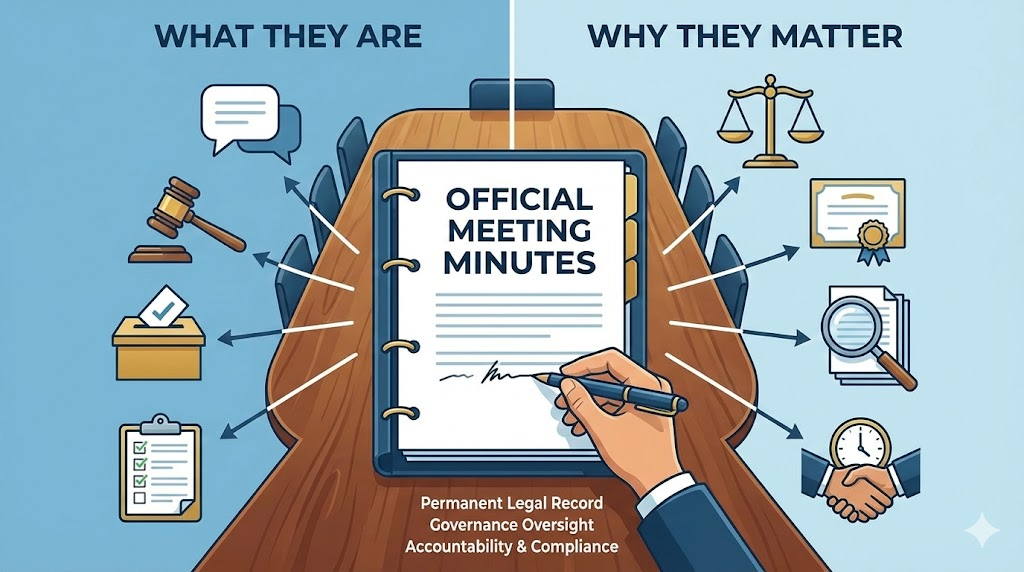
Meeting minutes are the official written record of board meetings documenting what was discussed, what decisions were made, who voted, and what actions were authorized. Minutes matter because they provide the permanent legal record proving the board exercises genuine governance oversight, they document compliance with bylaws and policies including conflict recusals and independent reviews, they serve as evidence for IRS and funders that governance is functional rather than theoretical, and they create accountability for board members by recording attendance, votes, and dissenting opinions.

What must meeting minutes document and what level of detail is required?

Basic meeting information establishes when governance occurred. Minutes must record the meeting date, start and end time, location (physical address or virtual platform), meeting type (regular, special, annual, organizational), and attendees present including board members, officers, staff, and guests. This basic documentation proves meetings actually happened and who participated in governance decisions.

Motions and votes form the core of meeting minutes. Every formal decision requires documentation—who made the motion, who seconded it, what the motion stated specifically, and the vote result (unanimous, majority approval with vote count, or individual director votes if roll call). For significant decisions like compensation approval or major contracts, individual votes by director name create accountability. Simply stating “the board approved” without recording votes provides insufficient documentation.

Recusals and conflicts must be documented when they occur. Minutes should record when board members disclosed conflicts, left the room during discussion, and abstained from voting. This documentation proves independent review occurred and that interested parties didn’t participate in conflicted decisions. Missing recusal documentation weakens conflict policy implementation even when recusals actually happened.

Discussion summary captures key points without verbatim transcripts. Minutes shouldn’t record every word spoken but should summarize major points raised, alternatives considered, and rationale for decisions. This context helps future boards understand why decisions were made and demonstrates thoughtful deliberation rather than rubber-stamping.

What common mistakes weaken or invalidate meeting minutes?

Retroactive minutes created weeks or months after meetings undermine their value as contemporaneous records. Minutes should be drafted during or immediately after meetings while discussions are fresh. Creating minutes months later from memory or reconstructed notes appears fabricated and won’t satisfy IRS or funder scrutiny. The secretary should take notes during meetings and draft minutes within days.

Missing vote documentation for major decisions creates problems proving board approval. Recording that “the board discussed compensation” without documenting that specific compensation amounts were approved through formal vote leaves uncertainty about what was actually authorized. Every significant decision needs motion, second, and vote recorded.

Excessive detail creates liability exposure and makes minutes unwieldy. Minutes shouldn’t record individual comments, disagreements, or sensitive discussions that could be used against the organization in litigation. Focus on what was decided, not blow-by-blow accounts of who said what. Balance between sufficient detail proving thoughtful governance and excessive detail creating legal risks.

Unsigned or unapproved minutes lack official status. Minutes should be reviewed and approved at subsequent meetings with the approval recorded in those next minutes. The secretary should sign approved minutes. Unsigned drafts in files don’t constitute official organizational records and won’t satisfy documentation requirements.

Framework: Launch → Fix → Fund + Federal Recognition + CA Compliance Triangle

Launch includes establishing minute-taking practices from the organizational meeting forward. New Riverside nonprofits should template minute formats, assign secretary responsibility clearly, and implement approval procedures from day one.

Fix addresses organizations with missing, incomplete, or problematic minutes requiring retroactive creation or correction. While contemporaneous minutes are ideal, documented efforts to reconstruct missing minutes from bank records, emails, or participant memories are better than nothing.

Fund depends on minutes because grant applications commonly request recent board meeting minutes proving active governance. Funders review minutes to verify meetings happen regularly, decisions follow proper procedures, and conflicts are managed appropriately.

Federal Recognition applications may request board meeting minutes showing organizational activity. IRS wants evidence boards actually meet and govern rather than existing only on paper. Recent minutes from the organizational meeting and subsequent meetings strengthen applications.

CA Compliance Triangle includes Attorney General authority to request meeting minutes during investigations. California law requires nonprofits to maintain minutes as part of corporate records. Missing minutes during AG review suggests poor governance or potential problems being hidden.

Step-by-step: How NPLO helps organizations establish good minute-taking practices

Step 1: Template Development We create minute templates matching organizational meeting types and complexity.

Step 2: Secretary Training We train secretaries on what to document and appropriate detail levels.

Step 3: Real-Time Assistance We can attend critical meetings helping capture proper documentation.

Step 4: Review Procedures We establish systems for minute review and approval at subsequent meetings.

Step 5: Signature Protocols We implement signing procedures after approval creating official status.

Step 6: Organized Storage We help establish minute books or digital archives maintaining chronological records.

Step 7: Retroactive Reconstruction We assist reconstructing missing minutes from available documentation when gaps exist.

Step 8: Grant Application Preparation We prepare minute excerpts funders request showing specific governance actions.

Checklist: What meeting minutes should contain

  • Meeting date, time, location (or virtual platform)
  • Meeting type (regular, special, annual, organizational)
  • Attendees present (board members, officers, staff, guests)
  • Quorum confirmation
  • Approval of prior meeting minutes
  • Reports presented (treasurer, committee, executive director)
  • Each motion made with maker and seconder identified
  • Discussion summary for major decisions
  • Vote results (unanimous or vote counts)
  • Individual votes for significant decisions
  • Conflict disclosures and recusals documented
  • Actions authorized and responsibilities assigned
  • Next meeting date scheduled
  • Adjournment time
  • Secretary signature after approval

Quick Answers (PPA)

How detailed should meeting minutes be—do we need to record everything everyone says? No, minutes should be summary records, not verbatim transcripts. Record what was decided, not every comment made. Include enough context to show thoughtful deliberation—major points raised, alternatives considered, rationale for decisions—without creating excessive detail that could be used against the organization in disputes. Focus on motions, votes, and key information supporting decisions.

What should we do if we discover our organization has no minutes for the past several years? Retroactively reconstruct what you can from available documentation—bank records showing major transactions that would have required board approval, emails discussing decisions, grant applications referencing board actions, or participant memories. Document that minutes are being reconstructed, note the sources used, and acknowledge they’re not contemporaneous. Retroactive minutes are better than no documentation, though they lack the credibility of contemporaneous records. Most importantly, start taking proper minutes immediately going forward.

Can minutes be kept electronically, or must we maintain physical minute books? California law doesn’t require physical minute books—electronic records are acceptable if properly maintained with backups and security. Many organizations maintain both electronic working files and physical signed copies in organized binders. The key is ensuring minutes are preserved, organized chronologically, accessible when needed, and protected from loss or unauthorized alteration. Whatever system you use, maintain it consistently.

What if a board member disagrees with decisions—should their dissent be recorded in minutes? Board members can request their dissenting votes be recorded in minutes, which is appropriate for major decisions where members want documentation of their opposition. Recording dissent protects dissenting directors from liability for decisions they opposed. However, don’t record extensive arguments or personal criticisms—simply note “Director Smith voted no” or “Director Smith dissented.” The dissenting member can request more detail if desired for liability protection.

How long must we keep meeting minutes—can old ones be destroyed after several years? Meeting minutes are permanent organizational records that should never be destroyed. They document the organization’s governance history and may be needed decades later for legal matters, historical purposes, or demonstrating organizational continuity. While some operational records can be destroyed after retention periods expire, minutes should be maintained permanently. Digital storage makes this easy—scan and archive old physical minutes.

What to do next (DIY vs Done-With-You)

DIY approach: Create simple minute template including standard sections—meeting identification, attendees, quorum, prior minute approval, reports, business items with motions and votes, adjournment. The secretary should take notes during meetings capturing motions, seconds, discussion summaries, and vote results. Draft minutes within days while memory is fresh, not weeks later. Circulate draft minutes to attendees for factual corrections (not content debates about what should have been decided). Include minute approval as first agenda item at next meeting. Record that “Minutes of [date] meeting were approved as presented/amended.” Secretary signs approved minutes. Maintain chronological minute files (physical binder or electronic folder) where all board members can access. Before grant applications, review recent minutes ensuring they document the governance activity and decisions funders expect to see.

Done-With-You approach: The Nonprofit Launch Office provides comprehensive minute-taking support for Riverside and Inland Empire nonprofits. We create customized minute templates matching organizational needs, train secretaries on proper documentation standards and appropriate detail levels, attend critical meetings helping capture proper documentation of complex decisions, establish review and approval procedures, implement signature protocols creating official records, develop organized storage systems (physical and/or digital), assist reconstructing missing minutes from available documentation when gaps exist, and prepare minute excerpts for grant applications highlighting governance actions funders want to see. This ensures your organization maintains the contemporaneous governance documentation that satisfies IRS requirements, strengthens funder confidence, and protects board members from liability.

Contact

Book: https://thedocumentpro.com/
 Call: 1(800) 285-0078
 Email: mydocumentpro@gmail.com
 The Nonprofit Launch Office™ — a discipline of The Document Pro, operated by Gitta Williams.
 Operated by The Document Pro (Gitta Williams)

Sources


Disclaimer

Document preparation and nonprofit readiness support — not legal or tax advice.