Education

Short Answer

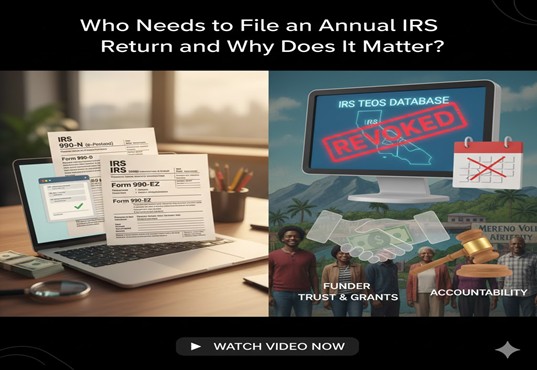
All 501(c)(3) organizations with IRS recognition must file annual information returns unless specifically exempted—organizations with gross receipts normally $50,000 or less file Form 990-N (e-Postcard), organizations with receipts under $200,000 and assets under $500,000 file Form 990-EZ, and organizations exceeding those thresholds file full Form 990. Annual filing matters because missing returns for three consecutive years triggers automatic revocation of tax-exempt status without further IRS notice, Form 990 is a public document that funders review when evaluating grant applications and organizational credibility, the return provides IRS oversight ensuring organizations operate for approved charitable purposes, and filing demonstrates organizational transparency and accountability to donors, regulators, and the communities served.

What determines which Form 990 version organizations must file?

Gross receipts and total assets determine form requirements. Organizations with gross receipts normally $50,000 or less file Form 990-N (e-Postcard), a simple online submission requiring basic information like organization name, EIN, principal officer, and confirmation that gross receipts remain under the threshold. Organizations with gross receipts under $200,000 AND total assets under $500,000 file Form 990-EZ, a simplified 4-page return with fewer schedules. Organizations exceeding either the $200,000 receipts or $500,000 assets threshold file full Form 990, a comprehensive return potentially spanning 20+ pages with multiple schedules.

Threshold calculations require understanding “gross receipts normally.” IRS uses a three-year average to determine normal gross receipts. A new organization’s first year uses actual receipts from that year. The second year averages years one and two. The third year and beyond average the current year plus prior two years. This smoothing prevents organizations from bouncing between forms yearly due to one-time large gifts or revenue fluctuations.

Total assets include all organizational property, investments, and resources at fair market value. Organizations must consider cash, accounts receivable, investments, equipment, buildings, land, and other assets when determining whether the $500,000 threshold is exceeded. Organizations with modest revenue but significant endowments or real estate holdings may need to file Form 990 rather than 990-EZ due to asset thresholds.

Certain organizations cannot use simplified forms regardless of size. Churches and church-affiliated organizations filing Form 990 cannot use Form 990-EZ. Organizations filing as supporting organizations or private foundations have specific form requirements. When uncertain which form to file, consult IRS instructions or tax professionals—filing wrong forms creates complications.

Why do funders review Form 990 returns during grant evaluation?

Financial health assessment occurs through Form 990 review. Funders examine revenue sources, expense categories, changes in net assets, and ending fund balances evaluating whether organizations are financially stable or struggling. Large deficits, declining revenue, minimal reserves, or concerning expense patterns raise questions about sustainability and capacity to manage grant funds effectively.

Governance quality indicators appear throughout Form 990. Organizations answer questions about conflict of interest policies, document retention policies, whistleblower policies, board meeting frequency, board independence, and compensation review processes. Funders interpret answers as signals about organizational maturity and management quality. Organizations answering “no” to governance questions look poorly managed regardless of program effectiveness.

Program spending ratios influence funder perceptions. Funders calculate what percentage of expenses support program activities versus administrative overhead and fundraising costs. While ratios vary by organization type and maturity stage, funders generally expect at least 60-75% of expenses supporting programs. Organizations showing high administrative percentages or excessive fundraising costs face scrutiny about efficiency and mission focus.

Compensation information reveals leadership structure and potential concerns. Form 990 requires disclosing compensation for officers, directors, key employees, and highest-compensated employees. Funders review this information evaluating whether compensation is reasonable for organizational size and region, whether multiple family members receive compensation suggesting nepotism, and whether compensation increases appear appropriate given organizational performance.

Framework: Launch → Fix → Fund + Federal Recognition + CA Compliance Triangle

Launch includes understanding filing obligations from inception. Moreno Valley nonprofits should establish Form 990 preparation systems, filing calendars, and recordkeeping practices supporting accurate annual returns before first deadline arrives—not scrambling at the last minute.

Fix becomes necessary when organizations missed Form 990 filings triggering automatic revocation, filed incorrect forms requiring amendment, or submitted returns with errors or omissions causing IRS questions. Correcting filing failures requires filing delinquent returns potentially with penalties and applying for reinstatement if revocation occurred.

Fund depends significantly on Form 990 quality because funders request recent returns as standard due diligence documents. Well-prepared returns demonstrating financial health, strong governance, and appropriate program spending strengthen applications. Problematic returns raising red flags weaken applications regardless of program proposals’ quality.

Federal Recognition requires maintaining filing compliance. IRS grants 501(c)(3) status expecting organizations will meet annual filing obligations demonstrating ongoing charitable operations. Recognition continues only while organizations maintain filing compliance and operational standards.

CA Compliance Triangle includes separate California filing requirements beyond Form 990. Organizations must file both IRS Form 990 AND California Form 199 with Franchise Tax Board, plus annual RRF-1 with Attorney General Registry. Filing federal Form 990 doesn’t satisfy California obligations.

Step-by-step: How NPLO helps organizations with Form 990 compliance

Step 1: Form Determination We evaluate which Form 990 version organizations must file based on receipts and assets thresholds.

Step 2: Information Gathering We collect financial records, program descriptions, governance documentation, and other information required for returns.

Step 3: Return Preparation We prepare complete accurate returns answering all questions and completing all required schedules.

Step 4: Governance Review We ensure governance question responses reflect actual practices and that supporting documentation exists.

Step 5: Board Review We prepare returns for board examination before filing ensuring accuracy and board awareness of reported information.

Step 6: Filing Management We file returns electronically through IRS-authorized providers ensuring timely submission.

Step 7: Record Retention We help establish systems preserving filed returns and supporting documentation for required periods.

Step 8: Funder Preparation We prepare Form 990 copies in formats funders commonly request for grant applications.

Checklist: Form 990 filing essentials

Determine Correct Form:

  • Calculate 3-year average gross receipts
  • Assess total assets at fair market value
  • Identify: 990-N (<$50K), 990-EZ (<$200K receipts AND <$500K assets), or Form 990 (above thresholds)

Filing Deadline:

  • 15th day of 5th month after fiscal year end
  • May 15 for calendar-year organizations
  • File Form 8868 for automatic 6-month extension if needed

Required Information:

  • Complete financial statements
  • Program service accomplishments
  • Governance policies and practices
  • Compensation information
  • Related party transactions
  • Required schedules based on activities

Governance Questions:

  • Conflict of interest policy adopted
  • Whistleblower policy adopted
  • Document retention policy adopted
  • Board meeting frequency
  • Board independence (uncompensated/unrelated)
  • Compensation review procedures

Public Disclosure:

  • Make Form 990 available on request
  • Post on organizational website (recommended)
  • Understand information is public record

Quick Answers (PPA)

What if our revenue fluctuates significantly year to year—how do we know which form to file? Use the three-year rolling average for “normally” calculations smoothing fluctuations. If you had receipts of $30K, $75K, and $45K in the past three years, your average is $50K—right at the threshold where you could file 990-N or might need 990-EZ depending on how IRS interprets “normally.” When close to thresholds with fluctuating revenue, consider filing the more comprehensive form voluntarily to avoid risk of filing the wrong form. Organizations can always file Form 990 even if they qualify for simplified versions, though not vice versa.

Can we file Form 990-N (e-Postcard) if we’re well under $50K to save time, or should we file fuller returns? If you qualify for 990-N based on gross receipts normally under $50K, you can file it satisfying legal requirements. However, sophisticated funders prefer seeing fuller Form 990-EZ or 990 returns providing financial and program information that e-Postcard doesn’t contain. Organizations serious about pursuing grants often voluntarily file Form 990-EZ even when 990-N would suffice, providing transparency and information funders want. The additional preparation time investment often pays off through stronger grant applications.

What happens if we file the wrong Form 990 version—do we need to amend? Filing a more comprehensive form than required (Form 990 when you could have filed 990-EZ) isn’t a problem—you satisfied requirements. Filing a simpler form when you should have filed a more comprehensive version (990-EZ when you exceeded thresholds requiring full Form 990) may require amendment. IRS might accept the simpler filing if information is substantially complete, or might request that you file the correct form. When you discover you filed the wrong version, consult tax professionals about whether amendment is necessary or whether the filing adequately satisfied requirements given the circumstances.

Do we need to file Form 990 for the year we incorporated even if we had minimal activity? Yes, filing requirements begin the fiscal year you receive IRS determination or, for organizations operating before determination, the year activities commenced. Even with minimal activity, file the appropriate form showing limited revenue and expenses. Don’t assume you don’t need to file—starting the three-year countdown toward automatic revocation by not filing your first year is poor beginning. Filing shows IRS and future funders that you understand compliance obligations from inception.

What if we disagree with something in our filed Form 990—can we correct it after submission? Yes, file Form 990-X (Amended Return) correcting errors or omissions. However, consider whether corrections are necessary versus preferable. Material errors affecting financial information, program descriptions, or governance responses should be corrected. Minor typos or immaterial errors might not warrant amendment. Don’t file amended returns simply because you wish you had phrased something differently—amendments should correct actual errors or add required information that was omitted. Frequent amendments raise questions about recordkeeping quality.

What to do next (DIY vs Done-With-You)

DIY approach: Determine which Form 990 version you must file by calculating your three-year average gross receipts and assessing total assets. Mark your filing deadline (15th day of 5th month after fiscal year end) on calendar with 90-day, 60-day, and 30-day advance reminders. Gather complete financial records including revenue sources, expense categories, and year-end financial statements. Document all program activities with participant numbers, services provided, and outcomes achieved. Compile governance documentation showing board meetings, policy adoptions, and decision-making processes. Download appropriate Form 990 version and instructions from IRS website. Review instructions carefully—don’t guess at questions. Complete return accurately answering all questions and completing all required schedules. Have board treasurer or finance committee review draft return before filing. Consider having board vote approving final return creating documentation that board reviewed financial reporting. File electronically through IRS-authorized e-file provider. Save filed return and all supporting documentation for minimum seven years. Provide copy to accountant or tax preparer preparing next year’s return. Post Form 990 on organizational website or maintain system for providing copies when requested.

Done-With-You approach: The Nonprofit Launch Office provides comprehensive Form 990 preparation and filing support for Moreno Valley and Inland Empire nonprofits. We determine which form version organizations must file based on accurate threshold calculations, gather all required financial and programmatic information through systematic collection processes, prepare complete accurate returns reflecting organizational activities and governance, ensure governance question responses match actual practices with supporting documentation, prepare returns for board review with explanations of reported information, file returns electronically through IRS-authorized providers ensuring timely submission, establish record retention systems preserving returns and documentation, prepare funder-ready copies for grant applications, and guide amendment processes when corrections are needed. This ensures your Form 990 satisfies IRS requirements while presenting your organization favorably to funders evaluating financial health, governance quality, and program effectiveness.

What happens immediately after missing a filing deadline?

Late filing penalties begin accruing based on organization size. Organizations with gross receipts over $1 million face penalties of $105 per day up to maximum $52,500. Smaller organizations face penalties of $20 per day up to lesser of $10,500 or 5% of gross receipts. Penalties accrue from the filing deadline until the return is filed, making prompt filing of delinquent returns financially important beyond just compliance concerns.

The three-year countdown toward automatic revocation starts. IRS tracks consecutive years without required filings. Missing one year doesn’t immediately revoke status but begins the countdown. If the organization files the second year’s return (even if late), the countdown resets. However, missing year two after missing year one creates serious urgency—you’re now one year away from automatic revocation requiring immediate corrective action.

TEOS database status remains active initially. After missing one filing deadline, the organization still appears in TEOS showing active status eligible to receive deductible contributions. Funders checking TEOS won’t immediately detect the filing failure. However, sophisticated funders requesting copies of recent Form 990 returns will discover the missing filing when organizations cannot provide the most recent year’s return.

IRS notices may or may not arrive. While IRS sometimes sends reminder notices about unfiled returns, don’t rely on receiving warnings. The IRS is not required to notify organizations before automatic revocation occurs. Many organizations only discover they’ve been revoked when checking TEOS database for other reasons or when funders inform them of revoked status during grant application due diligence.

What are the consequences of automatic revocation after three years?

Tax-exempt status terminates completely. After three consecutive years without required filings, IRS automatically revokes 501(c)(3) recognition effective the filing due date of the third missed year. The organization is no longer tax-exempt—any income generated after the effective date of revocation is potentially taxable as if the organization were a for-profit corporation. The determination letter becomes invalid and TEOS listing changes to “revoked” status.

Donor tax deductions become unavailable. Contributions made after the effective revocation date are not tax-deductible regardless of what the organization tells donors. Organizations continuing to solicit donations while claiming tax-deductibility after revocation commit fraud. Donors discovering their contributions weren’t actually deductible may demand refunds and can report organizations to IRS and state regulators for fraudulent solicitation.

Grant eligibility disappears immediately. Foundation and corporate grant programs verify tax-exempt status through TEOS searches before processing awards. Organizations showing “revoked” status fail basic eligibility requirements triggering automatic application rejection. Existing multi-year grants may be terminated when funders discover grantees lost tax-exempt status, potentially requiring return of already-disbursed funds depending on grant agreements.

Banking and vendor relationships face complications. Many banks, payment processors, donors management platforms, and vendors offer nonprofit pricing or services contingent on verified tax-exempt status. Loss of exemption may trigger account holds, service terminations, or repricing to for-profit rates. Organizations may be unable to process online donations through platforms like PayPal Giving Fund that verify tax-exempt status.

Framework: Launch → Fix → Fund + Federal Recognition + CA Compliance Triangle

Launch includes establishing filing systems preventing missed deadlines. Temecula nonprofits should create filing calendars with multiple advance reminders, assign clear responsibility for Form 990 preparation, and implement backup systems ensuring filings occur even when personnel changes happen.

Fix is precisely where organizations land after missing IRS filings. The Fix work involves filing all delinquent returns immediately, paying applicable penalties, applying for reinstatement if automatic revocation occurred, and establishing systems preventing future filing failures. Fix work is expensive and time-consuming—far better to prevent than remediate.

Fund access completely stops during revocation. Organizations cannot pursue grants while showing revoked TEOS status. Even after filing reinstatement applications, the processing period (often 3-6 months) prevents grant pursuit until TEOS updates showing restored active status. Every month in Fix mode is a month losing potential funding opportunities.

Federal Recognition was granted contingent on meeting ongoing filing requirements. Determination letters aren’t permanent guarantees—they represent recognition valid only while organizations maintain compliance including annual filing obligations. Missing filings voids the recognition determination originally granted.

CA Compliance Triangle operates independently of federal filing compliance. Organizations can miss IRS Form 990 filings while remaining current with California Secretary of State, Franchise Tax Board, and Attorney General—or vice versa. However, most Temecula nonprofits missing federal filings also miss California filings creating multiple concurrent compliance failures requiring simultaneous remediation.

Step-by-step: How NPLO helps organizations correct missed IRS filings

Step 1: Status Assessment We determine exactly which years have unfiled returns and whether revocation has occurred.

Step 2: TEOS Verification We check current TEOS listing confirming whether status shows active or revoked.

Step 3: Delinquent Return Preparation We prepare all missing Form 990/990-EZ/990-N returns for unfiled years.

Step 4: Penalty Calculation We calculate applicable late filing penalties and advise on reasonable cause abatement requests if circumstances warrant.

Step 5: Simultaneous Filing We file all delinquent returns together demonstrating commitment to compliance restoration.

Step 6: Reinstatement Application If revocation occurred, we prepare Form 1023 or 1024 applications requesting retroactive reinstatement.

Step 7: Status Monitoring We track reinstatement processing and TEOS updates confirming restored active status.

Step 8: Prevention Systems We establish filing calendars, responsibility assignments, and backup procedures preventing future missed filings.

Checklist: Correcting missed IRS filings

Immediate Actions:

  • Check TEOS database determining current status
  • Count consecutive years without filings
  • Gather financial records for all unfiled years
  • Determine which Form 990 version was required each year
  • Calculate late filing penalties

Filing Delinquent Returns:

  • Prepare accurate returns for each missed year
  • Complete all required schedules
  • Answer governance questions honestly
  • Include explanatory statements about late filing
  • File all delinquent returns promptly

If Revoked (3+ consecutive years):

  • File all delinquent Form 990 returns
  • Prepare Form 1023 or 1024 reinstatement application
  • Request retroactive reinstatement to effective revocation date
  • Pay user fees ($275 or $600)
  • Include explanations of filing failure causes
  • Demonstrate corrective measures preventing recurrence

After Reinstatement:

  • Verify TEOS shows active status restored
  • Update donor communications confirming deductibility restored
  • Notify funders of restored status
  • Resume grant applications
  • Establish prevention systems

Prevention Going Forward:

  • Create filing calendar with 90/60/30-day reminders
  • Assign clear responsibility for preparation
  • Establish backup person awareness
  • Consider professional preparation assistance
  • Review compliance quarterly

Quick Answers (PPA)

We just discovered we missed last year’s Form 990—should we file it immediately or wait until this year’s is due to file both together? File the missed return immediately—don’t wait. Filing late is far better than missing a second consecutive year which accelerates toward automatic revocation. You started the three-year countdown by missing one year; filing the delinquent return promptly stops that countdown and demonstrates good faith compliance effort potentially supporting penalty abatement. After filing the late return, ensure you file the current year’s return on time preventing any future gaps.

Can we request penalty abatement for late filing, or do we automatically have to pay? You can request reasonable cause abatement by submitting written explanation of circumstances preventing timely filing with your delinquent return. IRS may waive penalties if you demonstrate reasonable cause (serious illness, natural disaster, death of key personnel, unavoidable circumstance beyond organizational control) and that you acted responsibly by filing as soon as circumstances permitted. However, simply being disorganized, forgetting the deadline, or lacking funds to hire preparers typically don’t qualify as reasonable cause. Don’t assume automatic abatement—include detailed reasonable cause statement if requesting penalty waiver.

If we’re automatically revoked, can we just start a new nonprofit instead of going through reinstatement? Starting new organizations to avoid reinstatement creates significant problems. The new organization wouldn’t have your operating history, established reputation, existing contracts, donor relationships, or community recognition. Assets and liabilities from the old organization don’t automatically transfer to new entities—complex transactions would be required. Some funders track organizations that dissolved and reformed viewing it as attempt to escape accountability. Furthermore, the underlying causes of filing failure likely exist in the new organization too without corrective measures. Reinstatement is usually faster, simpler, and more appropriate than starting over.

How long does reinstatement take after filing the application? Reinstatement applications typically process in 3-6 months similar to original determination applications, though complex cases can take longer. Organizations cannot legitimately operate as tax-exempt or tell donors contributions are deductible during the processing period—you must wait for IRS approval and TEOS database update showing restored status. This processing delay is why prevention is so critical—every month without valid exemption is a month you can’t fundraise or pursue grants effectively.

Will funders hold the missed filings against us even after we’re reinstated? Many funders will ask about the circumstances of revocation and what measures you’ve implemented preventing recurrence. Honest acknowledgment of the failure, clear explanation of corrective actions, and demonstration of improved systems can rebuild funder confidence. However, some funders may view revocation as indicator of poor management regardless of subsequent correction. The best approach is transparency about what happened, accountability for the failure, and concrete evidence of improved compliance systems—don’t hide or minimize the revocation, but do demonstrate you’ve learned and improved.

What to do next (DIY vs Done-With-You)

DIY approach: Immediately check IRS TEOS database at apps.irs.gov/app/eos searching for your organization by name and EIN. Note whether status shows “Active” or “Revoked.” Count how many consecutive years you’ve missed filings—one year means urgency but not yet revoked, two consecutive years means extreme urgency and immediate action required, three or more means automatic revocation requiring reinstatement application. Gather financial records, bank statements, receipts, and program documentation for all unfiled years. Determine which Form 990 version was required each year based on revenue and asset thresholds at that time. Download appropriate forms and instructions from IRS website. Complete accurate returns for each missed year answering all questions honestly including governance questions. Consider including brief explanatory statement about why filing was late and what measures you’ve implemented preventing future failures. File all delinquent returns electronically through IRS-authorized e-file provider. If you’ve been revoked (three consecutive years missed), file all delinquent Form 990s first, then prepare Form 1023 or 1024 requesting retroactive reinstatement including detailed explanation of filing failure causes and corrective measures. After filing, monitor TEOS database weekly checking for status updates. Establish comprehensive filing calendar with multiple advance reminders preventing future missed filings. Assign clear responsibility for Form 990 preparation and establish backup procedures.

Done-With-You approach: The Nonprofit Launch Office provides comprehensive missed filing correction for Temecula and Inland Empire nonprofits. We determine exactly which years have unfiled returns and current TEOS status, prepare all delinquent Form 990/990-EZ/990-N returns with accurate financial information and governance responses, calculate late filing penalties and advise on reasonable cause abatement requests if circumstances warrant, file all delinquent returns promptly demonstrating compliance restoration commitment, prepare reinstatement applications (Form 1023/1024) if automatic revocation occurred including persuasive explanations and corrective measures, track reinstatement processing and TEOS updates confirming restored active status, communicate with funders about restored status when appropriate, and establish prevention systems including filing calendars, responsibility assignments, and backup procedures preventing future filing failures. This ensures you correct filing failures as efficiently as possible, minimize penalties where reasonable cause exists, restore tax-exempt status through successful reinstatement, and prevent future compliance failures through improved systems.

Contact


Book: https://thedocumentpro.com/
 Call: 1(800) 285-0078
 Email: mydocumentpro@gmail.com
 The Nonprofit Launch Office™ — a discipline of The Document Pro, operated by Gitta Williams.
 Operated by The Document Pro (Gitta Williams)

Find Us Locally

Service Area: Moreno Valley, CA and surrounding areas

Coordinates: 33.9535, -117.2081

Address: 23945 Sunnymead Blvd. #4, Moreno Valley, CA 92553

Sources

  • https://www.irs.gov/charities-non-profits/charitable-organizations
  • https://www.irs.gov/forms-pubs/about-form-1023
  • https://calnonprofits.org/
Disclaimer

Document preparation and nonprofit readiness support — not legal or tax advice.
Short Answer

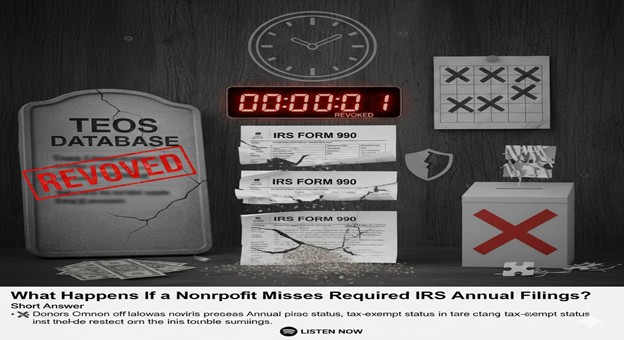
Missing required IRS Form 990 annual filings triggers progressively serious consequences—one missed year starts a three-year countdown toward automatic revocation but can be corrected by filing the delinquent return, two consecutive missed years intensifies urgency requiring immediate filing of both delinquent returns to prevent reaching the third-year threshold, and three consecutive missed years results in automatic revocation of tax-exempt status without further IRS notice causing the organization to disappear from TEOS database showing “revoked” status, preventing donors from claiming tax deductions, and disqualifying the organization from grants until reinstatement is completed. Late filing penalties may apply even when filing delinquent returns, but penalties are far preferable to revocation consequences including inability to operate as tax-exempt, months-long reinstatement processes requiring filing all delinquent returns plus new determination applications, and permanent loss of retroactive tax-exempt coverage for periods during revocation.

What annual filing requirements must organizations meet?

Form 990 series annual information returns report organizational finances and activities to IRS. Organizations with gross receipts over $200,000 or assets over $500,000 file full Form 990. Organizations with gross receipts under $200,000 and assets under $500,000 file Form 990-EZ. Organizations with gross receipts normally $50,000 or less file Form 990-N (e-Postcard). These returns are due by the 15th day of the 5th month after fiscal year end (May 15 for calendar-year organizations).

Filing deadline compliance prevents automatic revocation. Organizations missing Form 990 filings for three consecutive years automatically lose tax-exempt status without further IRS notice. The organization disappears from TEOS database showing revoked status, donors can no longer deduct contributions, and the organization must apply for reinstatement to restore recognition. Missing one year doesn’t trigger revocation, but starting the three-year countdown toward automatic loss of exemption.

Extensions provide additional filing time when needed. Organizations unable to complete Form 990 by the regular deadline can file Form 8868 requesting automatic six-month extension (extending deadline to November 15 for calendar-year organizations). Extensions prevent late filing penalties but don’t extend payment deadlines for any taxes owed. Filing extension requests demonstrates good faith compliance even when circumstances prevent timely completion.

Accuracy and completeness matter beyond just meeting deadlines. Form 990 is a public document that funders, media, watchdog organizations, and community members review. Incomplete forms with missing schedules, inconsistent data, or obvious errors create credibility problems. Answers to governance questions about conflict policies, board meeting frequency, and document availability signal organizational quality to sophisticated reviewers.

What operational compliance requirements continue after approval?

Exclusive charitable purpose operation must continue. The IRS granted exemption based on organizational purposes and planned activities described in Form 1023/1023-EZ applications. Substantial changes to purposes or activities—adding major new program areas not described in applications, fundamentally shifting who you serve, or conducting activities outside approved charitable categories—should be disclosed to IRS through amended applications or supplemental correspondence. Organizations operating significantly differently from what IRS approved risk determination that exemption was granted based on incorrect information.

Political campaign intervention remains absolutely prohibited. Tax-exempt 501(c)(3) organizations cannot participate in or intervene in political campaigns supporting or opposing candidates for public office. This includes making contributions to campaigns, endorsing candidates in organizational capacity, distributing campaign materials, or allowing organizational resources to be used for campaign purposes. Any amount of campaign intervention jeopardizes exemption—there’s no de minimis exception. Issue advocacy and nonpartisan voter education are permitted with careful structuring.

Lobbying limitations require monitoring. While campaign intervention is completely prohibited, lobbying (attempting to influence legislation) is permitted as long as it doesn’t constitute a substantial part of activities. Most organizations interpret “substantial” as less than 5-10% of time and resources. Organizations can elect to measure lobbying under Section 501(h) expenditure test providing more precise limits. Exceeding substantial lobbying limits can result in excise taxes or exemption loss.

Private inurement and excess benefit prevention continues. No part of net earnings can benefit private individuals including founders, board members, substantial contributors, or their families beyond reasonable compensation for actual services rendered. Organizations must maintain conflict of interest procedures, ensure compensation decisions receive independent review based on comparability data, and avoid self-dealing transactions benefiting insiders. Excess benefit transactions trigger excise taxes on recipients and approving managers even without exemption revocation.

Framework: Launch → Fix → Fund + Federal Recognition + CA Compliance Triangle

Launch includes establishing systems ensuring ongoing compliance from inception. Riverside nonprofits should create Form 990 filing calendars, implement governance practices supporting compliance, and establish recordkeeping systems preserving required documentation before compliance failures occur.

Fix becomes necessary when organizations missed Form 990 filings triggering automatic revocation, conducted prohibited activities requiring correction and potential penalty payment, or discovered operations drifted substantially from IRS-approved purposes requiring amended applications or operational corrections.

Fund depends on maintaining compliance because funders verify current tax-exempt status through TEOS database before awarding grants. Organizations showing revoked status due to missed filings cannot receive grants until status is restored. Organizations with compliance problems face funder skepticism even after correction.

Federal Recognition isn’t a one-time achievement but ongoing status maintained through continuous compliance. The determination letter proves recognition was granted, but maintaining recognition requires meeting annual filing requirements and operational standards indefinitely.

CA Compliance Triangle operates parallel to federal compliance. Organizations must maintain both IRS federal compliance AND California Secretary of State, Franchise Tax Board, and Attorney General compliance simultaneously—success in one doesn’t compensate for failure in others.

What happens immediately after missing a filing deadline?

Late filing penalties begin accruing based on organization size. Organizations with gross receipts over $1 million face penalties of $105 per day up to maximum $52,500. Smaller organizations face penalties of $20 per day up to lesser of $10,500 or 5% of gross receipts. Penalties accrue from the filing deadline until the return is filed, making prompt filing of delinquent returns financially important beyond just compliance concerns.

The three-year countdown toward automatic revocation starts. IRS tracks consecutive years without required filings. Missing one year doesn’t immediately revoke status but begins the countdown. If the organization files the second year’s return (even if late), the countdown resets. However, missing year two after missing year one creates serious urgency—you’re now one year away from automatic revocation requiring immediate corrective action.

TEOS database status remains active initially. After missing one filing deadline, the organization still appears in TEOS showing active status eligible to receive deductible contributions. Funders checking TEOS won’t immediately detect the filing failure. However, sophisticated funders requesting copies of recent Form 990 returns will discover the missing filing when organizations cannot provide the most recent year’s return.

IRS notices may or may not arrive. While IRS sometimes sends reminder notices about unfiled returns, don’t rely on receiving warnings. The IRS is not required to notify organizations before automatic revocation occurs. Many organizations only discover they’ve been revoked when checking TEOS database for other reasons or when funders inform them of revoked status during grant application due diligence.

What are the consequences of automatic revocation after three years?

Tax-exempt status terminates completely. After three consecutive years without required filings, IRS automatically revokes 501(c)(3) recognition effective the filing due date of the third missed year. The organization is no longer tax-exempt—any income generated after the effective date of revocation is potentially taxable as if the organization were a for-profit corporation. The determination letter becomes invalid and TEOS listing changes to “revoked” status.

Donor tax deductions become unavailable. Contributions made after the effective revocation date are not tax-deductible regardless of what the organization tells donors. Organizations continuing to solicit donations while claiming tax-deductibility after revocation commit fraud. Donors discovering their contributions weren’t actually deductible may demand refunds and can report organizations to IRS and state regulators for fraudulent solicitation.

Grant eligibility disappears immediately. Foundation and corporate grant programs verify tax-exempt status through TEOS searches before processing awards. Organizations showing “revoked” status fail basic eligibility requirements triggering automatic application rejection. Existing multi-year grants may be terminated when funders discover grantees lost tax-exempt status, potentially requiring return of already-disbursed funds depending on grant agreements.

Banking and vendor relationships face complications. Many banks, payment processors, donors management platforms, and vendors offer nonprofit pricing or services contingent on verified tax-exempt status. Loss of exemption may trigger account holds, service terminations, or repricing to for-profit rates. Organizations may be unable to process online donations through platforms like PayPal Giving Fund that verify tax-exempt status.

Framework: Launch → Fix → Fund + Federal Recognition + CA Compliance Triangle

Launch includes establishing filing systems preventing missed deadlines. Temecula nonprofits should create filing calendars with multiple advance reminders, assign clear responsibility for Form 990 preparation, and implement backup systems ensuring filings occur even when personnel changes happen.

Fix is precisely where organizations land after missing IRS filings. The Fix work involves filing all delinquent returns immediately, paying applicable penalties, applying for reinstatement if automatic revocation occurred, and establishing systems preventing future filing failures. Fix work is expensive and time-consuming—far better to prevent than remediate.

Fund access completely stops during revocation. Organizations cannot pursue grants while showing revoked TEOS status. Even after filing reinstatement applications, the processing period (often 3-6 months) prevents grant pursuit until TEOS updates showing restored active status. Every month in Fix mode is a month losing potential funding opportunities.

Federal Recognition was granted contingent on meeting ongoing filing requirements. Determination letters aren’t permanent guarantees—they represent recognition valid only while organizations maintain compliance including annual filing obligations. Missing filings voids the recognition determination originally granted.

CA Compliance Triangle operates independently of federal filing compliance. Organizations can miss IRS Form 990 filings while remaining current with California Secretary of State, Franchise Tax Board, and Attorney General—or vice versa. However, most Temecula nonprofits missing federal filings also miss California filings creating multiple concurrent compliance failures requiring simultaneous remediation.

Step-by-step: How NPLO helps organizations correct missed IRS filings

Step 1: Status Assessment We determine exactly which years have unfiled returns and whether revocation has occurred.

Step 2: TEOS Verification We check current TEOS listing confirming whether status shows active or revoked.

Step 3: Delinquent Return Preparation We prepare all missing Form 990/990-EZ/990-N returns for unfiled years.

Step 4: Penalty Calculation We calculate applicable late filing penalties and advise on reasonable cause abatement requests if circumstances warrant.

Step 5: Simultaneous Filing We file all delinquent returns together demonstrating commitment to compliance restoration.

Step 6: Reinstatement Application If revocation occurred, we prepare Form 1023 or 1024 applications requesting retroactive reinstatement.

Step 7: Status Monitoring We track reinstatement processing and TEOS updates confirming restored active status.

Step 8: Prevention Systems We establish filing calendars, responsibility assignments, and backup procedures preventing future missed filings.

Checklist: Correcting missed IRS filings

Immediate Actions:

  • Check TEOS database determining current status
  • Count consecutive years without filings
  • Gather financial records for all unfiled years
  • Determine which Form 990 version was required each year
  • Calculate late filing penalties

Filing Delinquent Returns:

  • Prepare accurate returns for each missed year
  • Complete all required schedules
  • Answer governance questions honestly
  • Include explanatory statements about late filing
  • File all delinquent returns promptly

If Revoked (3+ consecutive years):

  • File all delinquent Form 990 returns
  • Prepare Form 1023 or 1024 reinstatement application
  • Request retroactive reinstatement to effective revocation date
  • Pay user fees ($275 or $600)
  • Include explanations of filing failure causes
  • Demonstrate corrective measures preventing recurrence

After Reinstatement:

  • Verify TEOS shows active status restored
  • Update donor communications confirming deductibility restored
  • Notify funders of restored status
  • Resume grant applications
  • Establish prevention systems

Prevention Going Forward:

  • Create filing calendar with 90/60/30-day reminders
  • Assign clear responsibility for preparation
  • Establish backup person awareness
  • Consider professional preparation assistance
  • Review compliance quarterly

Quick Answers (PPA)

We just discovered we missed last year’s Form 990—should we file it immediately or wait until this year’s is due to file both together? File the missed return immediately—don’t wait. Filing late is far better than missing a second consecutive year which accelerates toward automatic revocation. You started the three-year countdown by missing one year; filing the delinquent return promptly stops that countdown and demonstrates good faith compliance effort potentially supporting penalty abatement. After filing the late return, ensure you file the current year’s return on time preventing any future gaps.

Can we request penalty abatement for late filing, or do we automatically have to pay? You can request reasonable cause abatement by submitting written explanation of circumstances preventing timely filing with your delinquent return. IRS may waive penalties if you demonstrate reasonable cause (serious illness, natural disaster, death of key personnel, unavoidable circumstance beyond organizational control) and that you acted responsibly by filing as soon as circumstances permitted. However, simply being disorganized, forgetting the deadline, or lacking funds to hire preparers typically don’t qualify as reasonable cause. Don’t assume automatic abatement—include detailed reasonable cause statement if requesting penalty waiver.

If we’re automatically revoked, can we just start a new nonprofit instead of going through reinstatement? Starting new organizations to avoid reinstatement creates significant problems. The new organization wouldn’t have your operating history, established reputation, existing contracts, donor relationships, or community recognition. Assets and liabilities from the old organization don’t automatically transfer to new entities—complex transactions would be required. Some funders track organizations that dissolved and reformed viewing it as attempt to escape accountability. Furthermore, the underlying causes of filing failure likely exist in the new organization too without corrective measures. Reinstatement is usually faster, simpler, and more appropriate than starting over.

How long does reinstatement take after filing the application? Reinstatement applications typically process in 3-6 months similar to original determination applications, though complex cases can take longer. Organizations cannot legitimately operate as tax-exempt or tell donors contributions are deductible during the processing period—you must wait for IRS approval and TEOS database update showing restored status. This processing delay is why prevention is so critical—every month without valid exemption is a month you can’t fundraise or pursue grants effectively.

Will funders hold the missed filings against us even after we’re reinstated? Many funders will ask about the circumstances of revocation and what measures you’ve implemented preventing recurrence. Honest acknowledgment of the failure, clear explanation of corrective actions, and demonstration of improved systems can rebuild funder confidence. However, some funders may view revocation as indicator of poor management regardless of subsequent correction. The best approach is transparency about what happened, accountability for the failure, and concrete evidence of improved compliance systems—don’t hide or minimize the revocation, but do demonstrate you’ve learned and improved.

What to do next (DIY vs Done-With-You)

DIY approach: Immediately check IRS TEOS database at apps.irs.gov/app/eos searching for your organization by name and EIN. Note whether status shows “Active” or “Revoked.” Count how many consecutive years you’ve missed filings—one year means urgency but not yet revoked, two consecutive years means extreme urgency and immediate action required, three or more means automatic revocation requiring reinstatement application. Gather financial records, bank statements, receipts, and program documentation for all unfiled years. Determine which Form 990 version was required each year based on revenue and asset thresholds at that time. Download appropriate forms and instructions from IRS website. Complete accurate returns for each missed year answering all questions honestly including governance questions. Consider including brief explanatory statement about why filing was late and what measures you’ve implemented preventing future failures. File all delinquent returns electronically through IRS-authorized e-file provider. If you’ve been revoked (three consecutive years missed), file all delinquent Form 990s first, then prepare Form 1023 or 1024 requesting retroactive reinstatement including detailed explanation of filing failure causes and corrective measures. After filing, monitor TEOS database weekly checking for status updates. Establish comprehensive filing calendar with multiple advance reminders preventing future missed filings. Assign clear responsibility for Form 990 preparation and establish backup procedures.

Done-With-You approach: The Nonprofit Launch Office provides comprehensive missed filing correction for Temecula and Inland Empire nonprofits. We determine exactly which years have unfiled returns and current TEOS status, prepare all delinquent Form 990/990-EZ/990-N returns with accurate financial information and governance responses, calculate late filing penalties and advise on reasonable cause abatement requests if circumstances warrant, file all delinquent returns promptly demonstrating compliance restoration commitment, prepare reinstatement applications (Form 1023/1024) if automatic revocation occurred including persuasive explanations and corrective measures, track reinstatement processing and TEOS updates confirming restored active status, communicate with funders about restored status when appropriate, and establish prevention systems including filing calendars, responsibility assignments, and backup procedures preventing future filing failures. This ensures you correct filing failures as efficiently as possible, minimize penalties where reasonable cause exists, restore tax-exempt status through successful reinstatement, and prevent future compliance failures through improved systems.

Contact


Book: https://thedocumentpro.com/
 Call: 1(800) 285-0078
 Email: mydocumentpro@gmail.com
 The Nonprofit Launch Office™ — a discipline of The Document Pro, operated by Gitta Williams.
 Operated by The Document Pro (Gitta Williams)

Find Us Locally

Service Area: Moreno Valley, CA and surrounding areas

Coordinates: 33.9535, -117.2081

Address: 23945 Sunnymead Blvd. #4, Moreno Valley, CA 92553

Sources

  • https://www.irs.gov/charities-non-profits/charitable-organizations
  • https://www.irs.gov/forms-pubs/about-form-1023
  • https://calnonprofits.org/
Disclaimer

Document preparation and nonprofit readiness support — not legal or tax advice.
Short Answer

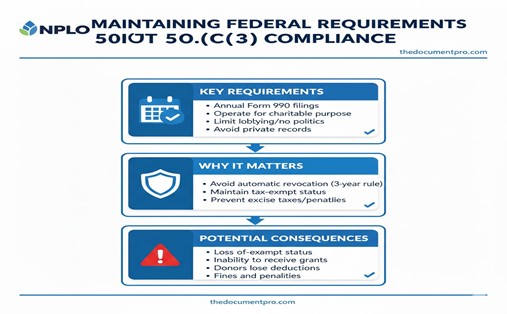
Maintaining federal compliance after IRS 501(c)(3) approval means filing required annual information returns (Form 990, 990-EZ, or 990-N) by deadlines, continuing to operate exclusively for approved charitable purposes without substantial changes to mission or activities, avoiding prohibited political campaign intervention and limiting lobbying to insubstantial amounts, preventing private inurement where net earnings benefit insiders beyond reasonable compensation, and preserving organizational documents including meeting minutes, financial records, and governance policies. Ongoing compliance matters because failure to file Form 990 for three consecutive years triggers automatic revocation of tax-exempt status, substantial deviation from approved charitable purposes can result in IRS determination that the organization no longer qualifies for exemption, and violations of prohibited activity rules (political campaigns, excess private benefit, unrelated business income) can lead to excise taxes or complete loss of recognition.

What annual filing requirements must organizations meet?

Form 990 series annual information returns report organizational finances and activities to IRS. Organizations with gross receipts over $200,000 or assets over $500,000 file full Form 990. Organizations with gross receipts under $200,000 and assets under $500,000 file Form 990-EZ. Organizations with gross receipts normally $50,000 or less file Form 990-N (e-Postcard). These returns are due by the 15th day of the 5th month after fiscal year end (May 15 for calendar-year organizations).

Filing deadline compliance prevents automatic revocation. Organizations missing Form 990 filings for three consecutive years automatically lose tax-exempt status without further IRS notice. The organization disappears from TEOS database showing revoked status, donors can no longer deduct contributions, and the organization must apply for reinstatement to restore recognition. Missing one year doesn’t trigger revocation, but starting the three-year countdown toward automatic loss of exemption.

Extensions provide additional filing time when needed. Organizations unable to complete Form 990 by the regular deadline can file Form 8868 requesting automatic six-month extension (extending deadline to November 15 for calendar-year organizations). Extensions prevent late filing penalties but don’t extend payment deadlines for any taxes owed. Filing extension requests demonstrates good faith compliance even when circumstances prevent timely completion.

Accuracy and completeness matter beyond just meeting deadlines. Form 990 is a public document that funders, media, watchdog organizations, and community members review. Incomplete forms with missing schedules, inconsistent data, or obvious errors create credibility problems. Answers to governance questions about conflict policies, board meeting frequency, and document availability signal organizational quality to sophisticated reviewers.

What operational compliance requirements continue after approval?

Exclusive charitable purpose operation must continue. The IRS granted exemption based on organizational purposes and planned activities described in Form 1023/1023-EZ applications. Substantial changes to purposes or activities—adding major new program areas not described in applications, fundamentally shifting who you serve, or conducting activities outside approved charitable categories—should be disclosed to IRS through amended applications or supplemental correspondence. Organizations operating significantly differently from what IRS approved risk determination that exemption was granted based on incorrect information.

Political campaign intervention remains absolutely prohibited. Tax-exempt 501(c)(3) organizations cannot participate in or intervene in political campaigns supporting or opposing candidates for public office. This includes making contributions to campaigns, endorsing candidates in organizational capacity, distributing campaign materials, or allowing organizational resources to be used for campaign purposes. Any amount of campaign intervention jeopardizes exemption—there’s no de minimis exception. Issue advocacy and nonpartisan voter education are permitted with careful structuring.

Lobbying limitations require monitoring. While campaign intervention is completely prohibited, lobbying (attempting to influence legislation) is permitted as long as it doesn’t constitute a substantial part of activities. Most organizations interpret “substantial” as less than 5-10% of time and resources. Organizations can elect to measure lobbying under Section 501(h) expenditure test providing more precise limits. Exceeding substantial lobbying limits can result in excise taxes or exemption loss.

Private inurement and excess benefit prevention continues. No part of net earnings can benefit private individuals including founders, board members, substantial contributors, or their families beyond reasonable compensation for actual services rendered. Organizations must maintain conflict of interest procedures, ensure compensation decisions receive independent review based on comparability data, and avoid self-dealing transactions benefiting insiders. Excess benefit transactions trigger excise taxes on recipients and approving managers even without exemption revocation.

Framework: Launch → Fix → Fund + Federal Recognition + CA Compliance Triangle

Launch includes establishing systems ensuring ongoing compliance from inception. Riverside nonprofits should create Form 990 filing calendars, implement governance practices supporting compliance, and establish recordkeeping systems preserving required documentation before compliance failures occur.

Fix becomes necessary when organizations missed Form 990 filings triggering automatic revocation, conducted prohibited activities requiring correction and potential penalty payment, or discovered operations drifted substantially from IRS-approved purposes requiring amended applications or operational corrections.

Fund depends on maintaining compliance because funders verify current tax-exempt status through TEOS database before awarding grants. Organizations showing revoked status due to missed filings cannot receive grants until status is restored. Organizations with compliance problems face funder skepticism even after correction.

Federal Recognition isn’t a one-time achievement but ongoing status maintained through continuous compliance. The determination letter proves recognition was granted, but maintaining recognition requires meeting annual filing requirements and operational standards indefinitely.

CA Compliance Triangle operates parallel to federal compliance. Organizations must maintain both IRS federal compliance AND California Secretary of State, Franchise Tax Board, and Attorney General compliance simultaneously—success in one doesn’t compensate for failure in others.

Step-by-step: How NPLO helps organizations maintain federal compliance

Step 1: Filing Calendar Creation We establish comprehensive calendars showing Form 990 deadlines with advance reminders preventing missed filings.

Step 2: Annual Filing Preparation We prepare accurate complete Form 990/990-EZ/990-N returns reflecting organizational activities and finances.

Step 3: Governance Documentation We ensure boards maintain meeting minutes, policies, and records supporting Form 990 governance responses.

Step 4: Activity Monitoring We help organizations evaluate whether programs remain consistent with IRS-approved purposes or require notification.

Step 5: Political Activity Guidance We provide clear guidance preventing prohibited campaign intervention while allowing permitted issue advocacy.

Step 6: Compensation Review We establish procedures ensuring insider compensation receives independent review with comparability documentation.

Step 7: TEOS Verification We monitor TEOS database quarterly ensuring organizations show current active status without revocation flags.

Step 8: Corrective Action When compliance problems emerge, we guide remediation including delinquent filing, penalty abatement, or reinstatement applications.

Checklist: Federal compliance requirements

Annual Filing Requirements:

  • File Form 990/990-EZ/990-N by deadline
  • Choose correct form based on revenue thresholds
  • Complete all required schedules
  • Provide accurate financial information
  • Answer governance questions honestly
  • File extension (Form 8868) if needed
  • Maintain copies of filed returns

Operational Requirements:

  • Continue operating for approved charitable purposes
  • Avoid substantial mission or activity changes without IRS notification
  • Maintain charitable purpose exclusivity
  • Document all programs and activities
  • Ensure activities advance exempt purposes

Prohibited Activity Avoidance:

  • No political campaign intervention (zero tolerance)
  • Limit lobbying to insubstantial amounts
  • No private inurement to insiders
  • Prevent excess benefit transactions
  • Avoid unrelated business income or pay UBIT on it

Governance and Documentation:

  • Hold regular board meetings
  • Maintain meeting minutes
  • Preserve financial records (7 years minimum)
  • Keep organizational documents accessible
  • Update policies as needed
  • Ensure conflict procedures are followed

Public Disclosure:

  • Make Form 990 available on request
  • Provide determination letter when requested
  • Maintain TEOS database listing accuracy

Quick Answers (PPA)

What happens if we miss our Form 990 deadline—is there a grace period or penalty? Organizations missing deadlines can file late returns preventing the three-year countdown toward automatic revocation, though late filing penalties may apply ($20 per day up to $10,000 for small organizations, higher for large organizations). File immediately upon discovering missed deadline—late filing is far better than not filing. If you missed one year, file that delinquent return now before missing a second year. If you missed two consecutive years, file both immediately before the third-year deadline preventing automatic revocation. While penalties exist, reinstatement after revocation is far more expensive and time-consuming than paying late filing penalties.

Can we change our programs and activities after IRS approval, or are we locked into what we initially described? Organizations can and should evolve programs as community needs change, as long as modifications remain within approved charitable purposes and don’t constitute substantial organizational changes. Adding a new tutoring program when approved purposes include education doesn’t require IRS notification. Completely shifting from education mission to healthcare mission requires substantial explanation to IRS. The test is whether changes are reasonable program evolution within existing exempt purposes versus fundamental mission shifts requiring amended applications. When uncertain, consult tax professionals about whether contemplated changes require IRS notification.

What’s the difference between lobbying (which is allowed with limits) and political activity (which is prohibited)? Lobbying is attempting to influence legislation—contacting legislators about pending bills, encouraging public to contact legislators, or taking positions on specific legislation. This is permitted as long as not substantial (typically interpreted as under 5-10% of activities). Political campaign intervention is participating in campaigns for or against candidates for public office—endorsing candidates, contributing to campaigns, distributing campaign literature, allowing candidates to use organizational resources. This is absolutely prohibited with zero tolerance—any amount jeopardizes exemption. Organizations can engage in issue advocacy and nonpartisan activities without violating either restriction with careful structuring.

If we have conflicts of interest, does that automatically violate compliance, or is it okay as long as we follow our conflict policy? Having conflicts doesn’t violate compliance—conflicts are unavoidable when board members have business relationships, family connections, or financial interests that intersect with organizational activities. What matters is how conflicts are managed. Organizations must have conflict of interest policies requiring disclosure, recusal from conflicted decisions, and independent review of conflicted transactions. Following proper conflict procedures allows legitimate transactions with appropriate oversight. Failing to disclose conflicts, allowing interested parties to vote on their own compensation, or conducting self-dealing without independent review violates compliance regardless of whether written policies exist.

How do we know if we’re still in compliance, or do we just hope we don’t hear from IRS? Proactive compliance verification is far better than hoping. Check TEOS database quarterly confirming your organization shows active status eligible to receive deductible contributions without revocation warnings. Review Form 990 filing history ensuring you haven’t missed any years. Conduct annual board review of activities confirming operations remain consistent with exempt purposes. Review compensation arrangements periodically ensuring independent approval and reasonableness. If you discover compliance problems, address them immediately rather than hoping IRS won’t notice—voluntary correction with cooperation is far better than IRS discovering violations during audits.

What to do next (DIY vs Done-With-You)

DIY approach: Create comprehensive filing calendar showing your Form 990 deadline (15th day of 5th month after fiscal year end) with 90-day, 60-day, and 30-day advance reminders. Determine which Form 990 version you must file based on revenue and asset thresholds, updating annually as organization grows. Gather financial records, program information, and governance documentation throughout the year rather than scrambling at deadline. Review Form 990 instructions thoroughly before completing return—don’t guess at answers to governance or activity questions. Complete all required schedules based on organizational activities. Have board review draft Form 990 before filing ensuring accuracy. File electronically through IRS-authorized e-file providers. Save filed returns and all supporting documentation for seven years minimum. Verify after filing that TEOS database still shows active status. Review organizational activities annually comparing to purposes approved in IRS determination ensuring substantial consistency. Avoid political campaign intervention completely and monitor lobbying to ensure insubstantial. Maintain conflict of interest procedures with annual disclosures and proper recusal documentation. If you miss a filing deadline or discover compliance problems, address immediately rather than hoping they’ll go unnoticed.

Done-With-You approach: The Nonprofit Launch Office provides comprehensive ongoing federal compliance support for Riverside and Inland Empire nonprofits. We establish filing calendars with automated deadline reminders preventing missed Form 990 returns, prepare accurate complete annual returns reflecting organizational activities and governance, ensure board meeting minutes and policies support Form 990 governance responses, help organizations evaluate whether program evolution requires IRS notification of changes, provide clear guidance preventing prohibited political activity while allowing permitted advocacy, establish compensation review procedures ensuring independent approval with comparability documentation, monitor TEOS database quarterly verifying current active status, guide corrective action when compliance problems emerge including delinquent filing or reinstatement applications, and provide ongoing consultation as questions arise about activities, transactions, or situations with compliance implications. This ensures you maintain the tax-exempt status that funders verify and that your organization depends on for operations and fundraising.

Contact


Book: https://thedocumentpro.com/
 Call: 1(800) 285-0078
 Email: mydocumentpro@gmail.com
 The Nonprofit Launch Office™ — a discipline of The Document Pro, operated by Gitta Williams.
 Operated by The Document Pro (Gitta Williams)

Find Us Locally

Service Area: Moreno Valley, CA and surrounding areas

Coordinates: 33.9535, -117.2081

Address: 23945 Sunnymead Blvd. #4, Moreno Valley, CA 92553

Sources

  • https://www.irs.gov/charities-non-profits/charitable-organizations
  • https://www.irs.gov/forms-pubs/about-form-1023
  • https://calnonprofits.org/
Disclaimer

Document preparation and nonprofit readiness support — not legal or tax advice.
Short Answer

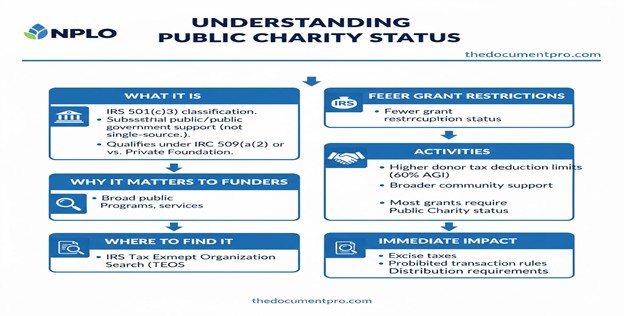
Public charity status is an IRS classification within 501(c)(3) designating organizations that receive substantial support from the general public or government rather than from a single source, qualifying under Section 509(a)(1), 509(a)(2), or 509(a)(3) rather than being classified as private foundations. Funders care because public charities face fewer restrictions on activities and grant-making, donors receive higher tax deduction limits for contributions to public charities versus private foundations, public charities demonstrate broader community support and engagement rather than single-source control, and most foundation and corporate grant programs explicitly restrict funding to public charities excluding private foundations from eligibility. The classification appears in IRS determination letters and matters immediately—organizations classified as private foundations face additional excise taxes, prohibited transaction rules, and mandatory distribution requirements that public charities avoid.

What distinguishes public charities from private foundations?

Public support requirements define the primary distinction. Public charities receive substantial portions of their funding from diverse sources—individual donations from many people, government grants, fees for charitable services, or support from other public charities. Private foundations typically receive funding from single sources—one wealthy individual, family, or corporation—and primarily make grants to other organizations rather than conducting direct programs. The public support test demonstrates that the organization serves broad public interests rather than private donor preferences.

Section 509(a) classifications specify different public charity types. Most operating nonprofits qualify as 509(a)(1) public charities receiving broad public support or 509(a)(2) public charities receiving substantial revenue from program service fees. Supporting organizations classified as 509(a)(3) support other public charities. Organizations not meeting any 509(a) public charity test automatically classify as private foundations under Section 509(a)—it’s the default classification when public charity status can’t be proven.

Operating versus grant-making focuses distinguish most public charities from most private foundations. Public charities typically conduct direct charitable programs—running schools, operating clinics, providing social services, conducting research. Private foundations primarily make grants to other organizations that conduct direct programs. While public charities can make grants and private foundations can operate programs, the predominant activity pattern differs between classifications.

Tax treatment differences create significant operational impacts. Private foundations pay 1-2% excise tax on net investment income. Private foundations face strict rules prohibiting self-dealing, excess business holdings, jeopardy investments, and taxable expenditures. Private foundations must distribute approximately 5% of assets annually. Public charities avoid these additional taxes and restrictions, operating under the same basic 501(c)(3) rules without foundation-specific complications.

Why do funders restrict grants to public charities?

Donor deduction limits favor public charity recipients. Individual donors can deduct contributions up to 60% of adjusted gross income for cash donations to public charities, but only 30% for contributions to private foundations. For appreciated property, limits are 30% for public charities versus 20% for private foundations. These higher deduction limits make public charities more attractive to major donors seeking maximum tax benefits, creating fundraising advantages.

Foundation grant-making rules complicate giving to private foundations. Private foundations making grants to other private foundations face “expenditure responsibility” requirements involving extensive documentation, monitoring, and reporting that don’t apply to grants to public charities. Many foundations avoid this administrative burden by restricting grants to public charities. Additionally, some foundation charters or policies explicitly limit giving to public charities as matter of preference or mission focus.

Public accountability expectations drive funder preferences. Public charities’ broader support base suggests community validation and engagement that private foundations’ single-source funding doesn’t demonstrate. Funders assume public charities responsive to diverse stakeholders operate more transparently and accountably than private foundations potentially dominated by single donor interests. Whether fair or not, this perception influences funding decisions.

Regulatory complexity avoidance motivates restrictions. Funders familiar with private foundation rules’ complexity may simply prefer supporting public charities to avoid dealing with foundation-specific regulations, even for legitimate foundation grantees. Grant administrators find public charity grants simpler to process and monitor than foundation grants requiring special considerations.

Framework: Launch → Fix → Fund + Federal Recognition + CA Compliance Triangle

Launch includes understanding public charity classification and structuring organizations to qualify. Most Temecula nonprofits conducting direct programs and seeking diverse funding sources will qualify as public charities automatically. Organizations considering private foundation structure should understand the implications.

Fix addresses rare situations where organizations expected public charity classification but received private foundation determination, requiring supplemental information demonstrating public support or appealing IRS classification. Most organizations receive expected classifications without problems.

Fund access depends heavily on public charity status because most institutional funders restrict grants to public charities. Organizations classified as private foundations face severely limited foundation and corporate grant opportunities, though they can still receive individual donations and pursue the smaller pool of funders willing to support foundations.

Federal Recognition determination letters specify classification. The IRS determination states whether the organization qualifies as a public charity under Section 509(a)(1), 509(a)(2), or 509(a)(3), or whether it’s classified as a private foundation. This classification profoundly affects operational requirements and funding access.

CA Compliance Triangle operates identically for public charities and private foundations—both need California Secretary of State, Franchise Tax Board, and Attorney General compliance. Classification difference is federal, not California-specific.

Step-by-step: How NPLO helps organizations achieve public charity classification

Step 1: Classification Assessment We evaluate whether planned funding models and activities will qualify for public charity status.

Step 2: Structure Optimization We help design funding strategies demonstrating broad public support for public charity qualification.

Step 3: Application Preparation We prepare IRS applications presenting organizational models clearly qualifying as public charities.

Step 4: Public Support Documentation We document diverse funding sources and public engagement demonstrating public charity qualification.

Step 5: Determination Verification We verify determination letters specify public charity classification under appropriate Section 509(a) subsection.

Step 6: Annual Maintenance We help organizations maintain public support percentages satisfying public charity tests ongoing.

Step 7: Reclassification Prevention We establish monitoring ensuring organizations don’t inadvertently lose public charity status.

Step 8: Funder Communication We help organizations communicate public charity status to funders when requested.

Checklist: Public charity vs private foundation comparison

Public Charities:

  • Receive broad public support or program revenue
  • Classified under Section 509(a)(1), (2), or (3)
  • No excise tax on investment income
  • No mandatory 5% distribution
  • Fewer prohibited transaction restrictions
  • Higher donor deduction limits (60% vs 30%)
  • Qualify for most foundation grants
  • Less complex regulatory requirements

Private Foundations:

  • Funded primarily by single source
  • Default classification if public charity tests not met
  • 1-2% excise tax on investment income
  • Must distribute ~5% of assets annually
  • Strict self-dealing prohibitions
  • Excess business holdings limits
  • Lower donor deduction limits
  • Limited foundation grant eligibility
  • Complex expenditure responsibility rules

Why Most New Nonprofits Are Public Charities:

  • Conducting direct programs (not just grant-making)
  • Seeking diverse funding (not single-source)
  • Want foundation grant eligibility
  • Prefer simpler regulatory environment

Quick Answers (PPA)

How do we know if we’re classified as a public charity or private foundation? Your IRS determination letter explicitly states the classification. The letter will say you’re recognized as a 501(c)(3) organization and specify that you’re a “public charity” qualifying under Section 509(a)(1), 509(a)(2), or 509(a)(3). If the letter doesn’t specify public charity status or explicitly states private foundation classification, you’re a private foundation. The IRS TEOS database also shows classification. Most organizations conducting direct charitable programs with diverse funding are classified as public charities automatically unless something unusual about their funding model triggers foundation classification.

Can we change from private foundation to public charity classification, or vice versa? Yes, organizations can change classification in either direction though the process varies. Private foundations seeking public charity reclassification must demonstrate meeting public support tests for a statutory period (typically four years) then file Form 8734 requesting reclassification. Public charities that lose public support over time may automatically reclassify as private foundations unless they take corrective action. Most organizations don’t need to change—they receive appropriate classification initially and maintain it through consistent operations. Changes usually result from significant funding model shifts like receiving single large gift that overwhelms other support.

What happens if we’re classified as private foundation but wanted public charity status? If you believe the classification is incorrect, you can appeal through IRS administrative processes providing additional information demonstrating you meet public charity tests. However, if you’re genuinely funded primarily by a single source and don’t conduct substantial direct programs, private foundation may be the correct classification regardless of preference. Some organizations initially classified as private foundations due to startup funding from one source transition to public charity status as they develop broader support. If you’re operating as a true private foundation (single-source funded grant-maker), accept that classification and operate within foundation rules rather than fighting appropriate classification.

Do donors know or care whether we’re public charity or private foundation when making gifts? Sophisticated major donors absolutely care because of deduction limit differences. A donor in high tax bracket making $100,000 gift wants to know whether they can deduct 60% (public charity) or only 30% (private foundation) of their adjusted gross income. Smaller donors making contributions under deduction limits may not notice differences. When soliciting major gifts, be prepared to confirm your public charity status if asked—uncertainty about classification creates hesitation from donors whose advisors tell them to verify before making large gifts.

Can public charities make grants to other organizations like foundations do? Yes, public charities can make grants to other charities though most focus on direct programs. Unlike private foundations making grants to other organizations, public charities making grants don’t face expenditure responsibility requirements for grants to other public charities and don’t have mandatory 5% distribution requirements. Many community foundations, federated campaigns, and other public charities make grants as primary activity while maintaining public charity classification through their own diverse support. The operating-versus-grant-making distinction is typical but not absolute—classification depends on public support sources, not whether grants are made.

What to do next (DIY vs Done-With-You)

DIY approach: Locate your IRS determination letter and read the classification section. It will explicitly state whether you’re a public charity under Section 509(a)(1), 509(a)(2), or 509(a)(3), or whether you’re classified as a private foundation. If you’re a public charity (the most common classification), note which subsection you qualified under. Verify your TEOS listing also shows public charity classification. If you’re a private foundation but didn’t intend to be, evaluate whether the classification is actually correct based on your funding model—if you’re funded primarily by one source and make grants rather than operating direct programs, foundation classification may be appropriate. If you’re a public charity conducting direct programs with diverse funding but somehow received foundation classification, gather documentation of your actual operations and public support sources and consider requesting IRS reconsideration. For ongoing operations, monitor your funding sources ensuring you maintain public support percentages satisfying public charity tests—Form 990 Schedule A provides public support calculations you should review annually. When applying for grants, be prepared to confirm your public charity status if funders ask.

Done-With-You approach: The Nonprofit Launch Office provides comprehensive public charity classification support for Temecula and Inland Empire nonprofits. We evaluate whether planned funding models and activities will qualify for public charity status, help design organizational structures and funding strategies demonstrating broad public support, prepare IRS applications presenting clear public charity qualification, document diverse funding and public engagement supporting classification, verify determination letters specify appropriate public charity classification, establish annual monitoring maintaining public support percentages, prevent inadvertent loss of public charity status through funding shifts, and help communicate classification to funders when requested. This ensures you achieve and maintain the public charity classification that opens funding doors and avoids private foundation regulatory complexity.

Contact


Book: https://thedocumentpro.com/
 Call: 1(800) 285-0078
 Email: mydocumentpro@gmail.com
 The Nonprofit Launch Office™ — a discipline of The Document Pro, operated by Gitta Williams.
 Operated by The Document Pro (Gitta Williams)

Find Us Locally

Service Area: Moreno Valley, CA and surrounding areas

Coordinates: 33.9535, -117.2081

Address: 23945 Sunnymead Blvd. #4, Moreno Valley, CA 92553

Sources

  • https://www.irs.gov/charities-non-profits/charitable-organizations
  • https://www.irs.gov/forms-pubs/about-form-1023
  • https://calnonprofits.org/
Disclaimer

Document preparation and nonprofit readiness support — not legal or tax advice.