Education

Short Answer

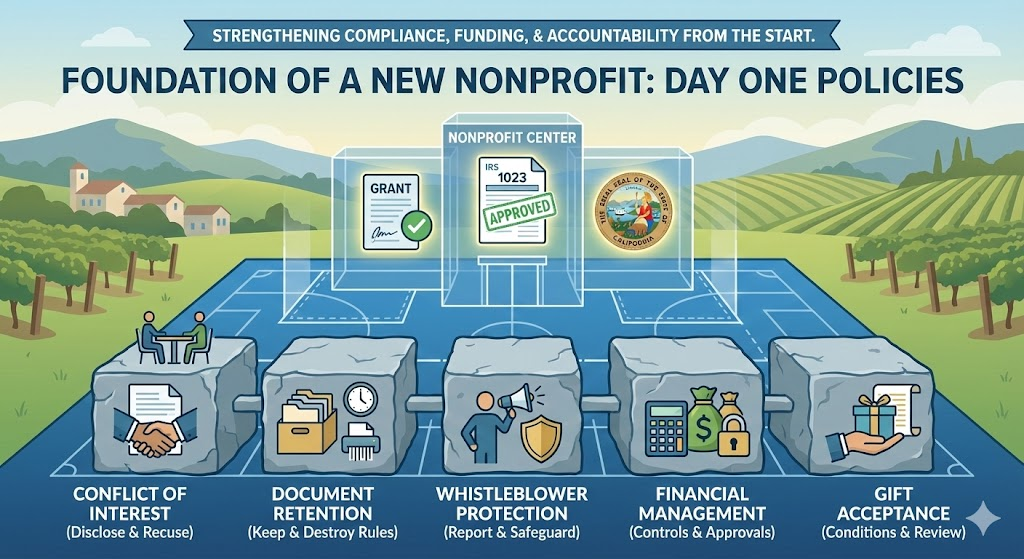
New nonprofits should establish from day one a conflict of interest policy requiring annual disclosure and recusal procedures, a document retention and destruction policy specifying what records to keep and for how long, a whistleblower policy protecting individuals who report suspected violations or misconduct, financial management policies addressing approval authorities and internal controls, and a gift acceptance policy clarifying what donations the organization will accept and under what conditions. Eligibility varies by organization, but these core policies matter because the IRS Form 1023 application specifically asks about conflict of interest and whistleblower policies, funders commonly request governance policies when evaluating grant applications, proper policies prevent compliance problems and operational confusion, and California Attorney General monitors nonprofit governance practices including policy adoption. Temecula and Inland Empire nonprofits that establish these foundational policies during formation demonstrate organizational maturity and governance quality that strengthen IRS determination applications, improve grant competitiveness, and create accountability frameworks preventing the governance problems that plague nonprofits lacking clear operational guidelines.

What are the essential policies IRS and funders expect to see?

Conflict of interest policy represents the single most critical governance policy for new nonprofits because IRS Form 1023 applications specifically ask whether the organization has adopted a conflict of interest policy, and because conflict management demonstrates the board exercises genuine oversight rather than rubber-stamping founder decisions. Effective conflict policies require annual written disclosure statements from all board members, officers, and key employees identifying potential conflicts (business relationships, family connections, financial interests in vendors or partners), establish procedures for board members to identify conflicts as they arise in specific decisions, prohibit interested parties from voting on matters where they have conflicts, and require that a majority of board members and all committee members reviewing conflicted transactions be free from conflicts themselves. The policy should define what constitutes a conflict broadly—not just direct financial benefit but also indirect benefits through family members or business associates.

Whistleblower policy (sometimes called whistleblower protection policy) provides procedures for employees, volunteers, and board members to report suspected legal violations, financial improprieties, or policy breaches without fear of retaliation. The IRS Form 1023 asks about whistleblower policies, and the Sarbanes-Oxley Act requires certain protections even for nonprofits. Effective whistleblower policies establish multiple reporting channels (supervisor, board chair, legal counsel, outside hotline), prohibit retaliation against individuals who report concerns in good faith, outline investigation procedures when reports are received, and maintain confidentiality to the extent possible. Whistleblower policies matter because they create accountability mechanisms encouraging early problem identification and demonstrate commitment to ethical operations.

Document retention and destruction policy specifies what organizational records must be maintained, for how long, under what conditions, and when/how they can be destroyed. The Sarbanes-Oxley Act requires nonprofits to retain certain financial and governance documents, and various state and federal laws impose retention requirements. Effective policies identify document categories (incorporation documents, IRS determination letters, tax returns, financial records, board minutes, employee files, donor records, grant agreements, contracts) with specific retention periods for each category, establish secure storage procedures, and create destruction protocols ensuring documents are destroyed systematically when retention periods expire rather than selectively destroyed when convenient. Document retention policies prevent both accidental loss of critical records and intentional destruction of documents relevant to investigations.

Financial management policies establish internal controls preventing fraud, misappropriation, or financial mismanagement. While comprehensive financial policies evolve as organizations mature, day-one policies should address: who has authority to approve expenses and at what dollar thresholds, how many signatures are required on checks or electronic fund transfers, how cash receipts are handled and deposited, what documentation is required for expense reimbursement, how credit cards or debit cards are controlled, and how financial reports are reviewed by board or finance committee. Financial policies demonstrate fiscal responsibility to funders and provide accountability frameworks preventing the common nonprofit problem where founders have unchecked access to organizational funds.

What additional policies strengthen governance and operations?

Gift acceptance policy clarifies what types of donations the organization will accept, under what conditions, and what donations will be declined or require special board approval. Basic gift acceptance policies address: cash and check donations (almost always accepted), stock or securities (accepted if readily marketable), real estate (requires appraisal and board approval due to liability and maintenance concerns), vehicles or equipment (evaluated for usefulness versus disposal costs), in-kind goods or services (accepted if needed for programs, declined if storage/disposal is burdensome), and restricted gifts (accepted only if restrictions align with organizational mission and capacity). Gift acceptance policies prevent problems where well-meaning donors offer gifts that create financial burden, liability exposure, or mission drift through restrictive conditions the organization cannot reasonably satisfy.

Records access policy (sometimes called transparency policy) establishes what organizational documents are available to the public, board members, donors, or regulatory agencies, and through what procedures access is provided. California law and IRS regulations require certain documents be made available—Form 990 returns, IRS determination letter, and (for California nonprofits) Articles of Incorporation and bylaws to Attorney General upon request. Policies should specify: what documents are public versus confidential, how requests for documents are handled and by whom, whether fees are charged for copying, and what timeframes apply for providing requested documents. Clear access policies prevent confusion when stakeholders or journalists request organizational information.

Expense reimbursement and travel policy establishes what organizational expenses will be reimbursed to board members, employees, or volunteers, what documentation is required, and what approval is necessary. Policies typically address: mileage reimbursement rates (often tied to IRS standard rates), meal and lodging expense limits, what receipts are required for reimbursement, how quickly reimbursement requests must be submitted, and who approves reimbursements. Clear expense policies prevent disputes about what’s reimbursable and ensure consistent treatment of similar expenses rather than ad hoc decisions that may appear to favor certain individuals.

Volunteer management policy (particularly important for volunteer-dependent organizations) addresses volunteer recruitment, screening, training, supervision, and recognition procedures. Policies might cover: background check requirements for volunteers working with vulnerable populations, confidentiality obligations for volunteers accessing sensitive information, volunteer rights and responsibilities, grievance procedures if problems arise, and risk management procedures ensuring adequate insurance coverage for volunteer activities. Volunteer policies demonstrate professionalism in volunteer engagement and reduce liability exposure from inadequately supervised volunteers.

Framework: Launch → Fix → Fund + Federal Recognition + CA Compliance Triangle

The Nonprofit Launch Office operates within a strategic framework designed to help California nonprofits move from formation to fundability:

Launch includes adopting core governance policies during the organizational meeting when the board adopts bylaws and makes initial operational decisions. Launch-phase policy adoption demonstrates to IRS reviewers evaluating Form 1023 applications that governance structures are functional rather than theoretical, shows funders that organizational management follows professional standards, and creates accountability frameworks from inception rather than attempting to impose policies retroactively after problems emerge. Organizations that launch with strong policies avoid many Fix interventions later.

Fix addresses situations where policies were never adopted during Launch, creating problems when IRS or funders request policies the organization doesn’t have, when conflicts arise without clear procedures for managing them, or when financial irregularities occur because no internal controls existed. Fix work involves developing and adopting policies that should have existed from day one, potentially explaining to IRS or funders why policies are being adopted retroactively, and implementing practices that align with newly adopted policies rather than continuing previous informal operations.

Fund depends partly on policy quality because grant applications frequently request governance policies as part of due diligence documentation. Funders review conflict of interest policies to assess whether the board prevents self-dealing, examine financial policies to evaluate internal controls protecting grant funds, and consider whether whistleblower policies suggest commitment to accountability. Missing policies weaken grant applications by suggesting poor governance; strong policies strengthen applications by demonstrating organizational maturity.

Federal Recognition through IRS 501(c)(3) determination applications includes specific Form 1023 questions about conflict of interest policies and whistleblower policies. Organizations answer “no” to having these policies face IRS questions requiring explanation, while organizations with adopted policies can attach them to applications demonstrating governance quality. The IRS views policy adoption as evidence of functional board oversight rather than founder-dominated structures lacking genuine governance.

CA Compliance Triangle (Secretary of State, Franchise Tax Board, Attorney General Registry) includes Attorney General oversight of nonprofit governance practices. The Attorney General can request policies during investigations, reviews Form 990 Schedule O narratives describing governance policies, and monitors for governance failures suggesting policy gaps. California nonprofits should maintain policies accessible for Attorney General review if requested.

Step-by-step: How NPLO helps new nonprofits establish foundational policies

Step 1: Essential Policy Identification We assess which policies your organization needs immediately versus which can be developed as operations mature. All organizations need conflict of interest, whistleblower, and document retention policies from day one. Additional policies depend on organizational characteristics—gift acceptance matters more for fundraising-focused organizations, volunteer management matters more for volunteer-dependent operations, financial controls scale with budget size.

Step 2: Template Customization We provide model policy templates appropriate for California nonprofits and customize them to organizational needs. Generic national templates often don’t reflect California requirements or fit small nonprofit realities. We adapt templates to match actual governance structures, operational models, and organizational capacity rather than imposing complex policies designed for large organizations on small startups.

Step 3: Board Education We help boards understand what policies mean and why they matter, not just adopt boilerplate language they don’t comprehend. Board members should understand conflict of interest procedures so they recognize conflicts when they arise, understand whistleblower protections so they don’t inadvertently retaliate, and understand document retention so they don’t destroy critical records. Education transforms policies from paperwork into functional governance tools.

Step 4: Formal Adoption Process We guide proper policy adoption during board meetings with documented votes, ensuring adoption is recorded in meeting minutes with dates and approval votes, and that adopted policies are maintained in organizational records where board members can access them. Formal adoption creates the documentation trail proving policies exist and were deliberately approved rather than casually accepted.

Step 5: Annual Disclosure Implementation For conflict of interest policies, we help implement annual disclosure processes where all board members, officers, and key staff complete written disclosure forms identifying potential conflicts, forms are collected and reviewed by board or governance committee, and disclosures are updated when circumstances change. Annual disclosure operationalizes conflict policies beyond abstract adoption.

Step 6: Policy Communication We ensure policies are communicated to everyone they affect—board members receive governance policies, employees receive personnel and financial policies, volunteers receive volunteer management policies, donors receive gift acceptance policies. Communication ensures individuals understand expectations and procedures rather than discovering policy requirements during conflicts or problems.

Step 7: Form 1023 Integration We prepare policy documentation for IRS Form 1023 applications, ensuring conflict of interest and whistleblower policies are attached as required exhibits, policy adoption is documented in board minutes referenced in applications, and application narratives describe how policies are implemented in practice. Strong policy documentation strengthens IRS applications significantly.

Step 8: Ongoing Review and Updates We establish schedules for reviewing policies periodically (typically every 2-3 years), updating policies when legal requirements change or organizational growth makes existing policies insufficient, and documenting policy amendments in board minutes. Policies should evolve with organizational maturation rather than remaining static documents that become obsolete.

Checklist: What policies your new Riverside nonprofit should adopt

New nonprofits should establish these foundational policies from day one:

  • Conflict of interest policy requiring annual written disclosures, recusal from conflicted decisions, prohibition on interested party voting, and independent review of conflicted transactions
  • Whistleblower policy providing reporting channels, retaliation prohibitions, investigation procedures, and confidentiality protections
  • Document retention and destruction policy specifying retention periods for different document types, storage procedures, and systematic destruction protocols
  • Financial management policy addressing approval authorities, signature requirements, cash handling, expense documentation, and financial reporting
  • Gift acceptance policy clarifying what donations are accepted, what requires special approval, and what is declined due to liability or mission concerns

Additional policies to consider based on organizational needs:

  • Records access policy establishing what documents are public, confidential, or available to specific stakeholders
  • Expense reimbursement policy specifying what’s reimbursable, documentation requirements, and approval procedures
  • Volunteer management policy (if volunteer-dependent) addressing recruitment, screening, training, supervision, and recognition
  • Social media policy (if using social platforms) clarifying who can post on behalf of organization and what content is appropriate
  • Data privacy policy (if collecting personal information) explaining how data is collected, used, stored, and protected
  • Code of ethics articulating values and behavioral expectations for board, staff, and volunteers

Quick Answers (PPA)

Can we adopt policies later as we grow, or do we really need them from day one? While comprehensive policy manuals evolve as organizations mature, certain core policies—conflict of interest, whistleblower, document retention, basic financial controls—should be adopted during the organizational meeting for several reasons. First, IRS Form 1023 asks specifically about conflict and whistleblower policies, so you need them for determination applications. Second, early policy adoption establishes governance expectations and accountability frameworks before problems occur—adopting conflict policies after a conflict emerges appears reactive rather than proactive. Third, funders reviewing grant applications within your first year expect to see basic governance policies. Fourth, operating without policies creates risks—financial mismanagement without controls, lost records without retention policies, or mishandled conflicts without procedures. Starting with foundational policies and expanding policy coverage as you grow is far better than operating policy-free during startup.

Do policies need to be long, complex documents, or can they be relatively simple for a small nonprofit? Policy complexity should match organizational size and complexity. A small all-volunteer organization with a $25,000 budget needs simpler, shorter policies than a $2 million organization with staff, multiple programs, and complex operations. Effective policies for small nonprofits might be 1-3 pages each covering essential elements clearly and concisely. Avoid adopting 30-page policy manuals designed for large nonprofits when your reality is five board members meeting quarterly. Simple, clear policies that your board actually understands and follows are far better than comprehensive complex policies that sit on shelves ignored. You can always expand and elaborate policies as organizational sophistication grows—start appropriately simple.

What happens if we adopt policies but don’t actually follow them—is that worse than not having policies? Yes, adopting policies you don’t follow creates worse problems than not having formal policies. When policies exist but aren’t followed, it demonstrates either board incompetence (adopted policies without understanding them) or deliberate disregard for governance (knew policies existed but chose to ignore them). IRS reviews, funder due diligence, or legal disputes will reveal the gap between stated policies and actual practices, seriously damaging organizational credibility. The solution is adopting realistic policies you can and will follow—if quarterly financial reporting to the board is unrealistic for your capacity, don’t adopt a policy requiring it. Better to have fewer, simpler policies that are actually implemented than comprehensive policies that exist only on paper.

Who is responsible for ensuring policies are followed—the board, executive director, or someone else? Responsibility varies by policy type. The board is responsible for ensuring governance policies (conflict of interest, whistleblower, document retention for governance records) are followed and for monitoring that management follows operational policies. The executive director or organizational leadership is responsible for implementing operational policies (financial controls, expense reimbursement, volunteer management) on a day-to-day basis and reporting to the board about policy compliance. For small nonprofits without staff, the board collectively manages both governance and operational policy implementation. Many organizations assign a compliance officer or designate specific board members (treasurer for financial policies, secretary for document retention) to monitor particular policy areas. Clear assignment of policy monitoring responsibility prevents the common problem where everyone assumes someone else is ensuring compliance.

Should policies be publicly available, or can we keep them internal and confidential? Some policies should be publicly available while others can remain internal. Conflict of interest policies, whistleblower policies, and gift acceptance policies are often published on websites demonstrating transparency and governance quality. Financial management policies and document retention policies are typically internal documents available to board and staff but not necessarily published. The key is that policies must be available when legitimately requested—IRS Form 1023 applications require submitting certain policies, funders commonly request governance policies during due diligence, and California Attorney General can request policies during investigations. Being prepared to share policies when appropriately requested is more important than deciding whether to proactively publish them. Organizations demonstrating nothing to hide often publish core governance policies voluntarily.

What to do next (DIY vs Done-With-You)

DIY approach: Start by downloading model policy templates from reputable sources like CalNonprofits.org, National Council of Nonprofits, or BoardSource for conflict of interest, whistleblower, and document retention policies. Review templates carefully, customizing language to match your organizational structure, size, and operations rather than adopting generic language unchanged. Ensure California-specific requirements are addressed. Schedule a board meeting specifically to review, discuss, and adopt policies—don’t just email policies asking for approval, have genuine board discussion about what policies mean and how they’ll be implemented. Document policy adoption in meeting minutes with vote tallies and dates. Create annual disclosure forms for conflict of interest policy and collect initial disclosures from all board members. Maintain adopted policies in organizational records where board members can access them and where they’re available for IRS applications and funder requests. Establish calendar reminders to review and collect annual conflict disclosures each year. Plan to expand policy coverage as the organization matures—add gift acceptance when you begin active fundraising, add volunteer management when volunteer engagement grows, add personnel policies when you hire staff.

Done-With-You approach: The Nonprofit Launch Office provides comprehensive policy development for Riverside and Inland Empire nonprofits, ensuring foundational governance structures are established from day one. We assess which policies your organization needs immediately based on size, structure, and operational model, provide California-compliant model policies customized to your specific organizational characteristics, educate boards about policy meaning and implementation so policies become functional governance tools rather than ignored paperwork, guide formal adoption processes during board meetings with proper documentation in minutes, implement annual conflict disclosure procedures operationalizing conflict policies beyond abstract adoption, prepare policy documentation for IRS Form 1023 applications with appropriate exhibits and narratives, ensure policies are communicated to everyone they affect—board members, staff, volunteers, donors, and establish review schedules maintaining policy relevance as organizations evolve. This comprehensive approach delivers professionally drafted, legally compliant, operationally appropriate policies that strengthen IRS applications, improve grant competitiveness, create accountability frameworks, and demonstrate organizational maturity from inception.

Contact

Book: https://thedocumentpro.com/
 Call: 1(800) 285-0078
 Email: mydocumentpro@gmail.com
 The Nonprofit Launch Office™ — a discipline of The Document Pro, operated by Gitta Williams.
 Operated by The Document Pro (Gitta Williams)

Sources


Disclaimer

Document preparation and nonprofit readiness support — not legal or tax advice.
Short Answer

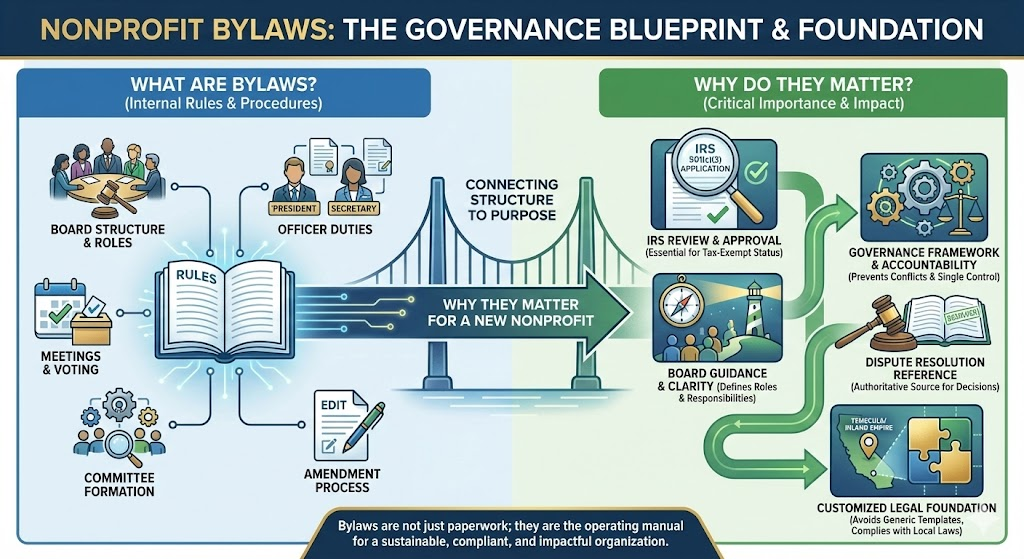
Bylaws are the internal governance rules and operational procedures that define how a nonprofit organization functions on a day-to-day basis, covering board structure and responsibilities, officer positions and duties, meeting requirements and voting procedures, committee formation and authority, membership provisions if applicable, amendment processes, and other operational protocols. These bylaws matter for new nonprofits because they establish the governance framework the IRS examines when evaluating 501(c)(3) applications, provide legal documentation of how the organization makes decisions and exercises oversight, create accountability mechanisms preventing single-person control or conflicts of interest, guide board members in understanding their roles and responsibilities, and serve as the authoritative reference for resolving governance questions or disputes throughout the organization’s existence. Eligibility varies by organization, but properly drafted and formally adopted bylaws represent one of the most critical governance documents new Temecula and Inland Empire nonprofits create during formation, requiring careful attention rather than casual adoption of generic templates that may not fit organizational needs or comply with California requirements.

What do bylaws actually contain and what decisions do they govern?

Board structure provisions form the core of nonprofit bylaws, specifying the number of directors (California requires minimum three), whether that number is fixed or within a range allowing flexibility, director term lengths and whether terms are staggered to ensure continuity, and whether term limits exist preventing perpetual board service. These provisions affect organizational stability and governance quality—boards that are too small lack diverse perspectives and skills, boards that are too large struggle with coordination and decision-making, and boards without term structures risk stagnation through directors serving decades without fresh perspectives or accountability through reelection.

Meeting requirements establish how often boards must convene (monthly, quarterly, annually), what constitutes quorum for conducting official business (typically majority of sitting directors), what advance notice directors must receive before meetings, whether meetings can occur virtually or must be in-person, and what voting procedures apply for different decision types. Meeting provisions balance ensuring adequate governance oversight through regular board engagement against respecting volunteer board members’ time constraints. Riverside nonprofits with all-volunteer boards might specify quarterly meetings as adequate for their operational complexity, while organizations with staff, facilities, and complex programs might require monthly board meetings for effective oversight.

Officer positions and duties sections identify required officers (California typically requires at minimum president/CEO, secretary, and treasurer though one person may hold multiple offices with limitations), describe the responsibilities and authority of each officer position, specify how officers are elected and for what terms, and establish procedures for officer removal or resignation. Officer provisions prevent governance confusion about who has authority to sign contracts, manage finances, maintain records, or represent the organization publicly. Clarity about officer roles also strengthens IRS applications by demonstrating functional governance rather than founder-dominated structures lacking genuine oversight.

Committee structures and authority provisions address whether standing committees will exist (finance, governance, program, fundraising, etc.), how committee members are appointed, what authority committees have to make decisions versus recommendations requiring full board approval, and what reporting requirements committees have to the full board. Committee provisions allow boards to distribute work efficiently and leverage specialized expertise without requiring every board member to be expert in finance, programs, and fundraising simultaneously. However, bylaws must clarify that ultimate authority remains with the full board rather than being delegated away to committees operating independently.

Why do bylaws matter specifically during nonprofit formation and IRS review?

IRS Form 1023 and 1023-EZ applications require submitting organizational bylaws as part of the 501(c)(3) determination process, with IRS reviewers examining bylaws to verify that governance structures meet federal requirements for tax-exempt charitable organizations. The IRS specifically looks for provisions demonstrating genuine board oversight rather than founder control, conflict of interest policies or procedures preventing self-dealing and private benefit, prohibition on distributing organizational assets or profits to individuals, and decision-making processes suggesting democratic governance rather than autocratic management.

Conflict of interest compliance represents a critical IRS focus area where bylaws often provide essential documentation. While separate conflict of interest policies are ideal, many organizations incorporate conflict provisions directly into bylaws—requiring annual disclosure of conflicts by all board members and officers, establishing procedures for handling conflicts when they arise in board decisions, prohibiting interested directors from voting on matters where conflicts exist, and ensuring that compensation or contract decisions involving board members receive independent review. Bylaws demonstrating robust conflict management strengthen IRS applications significantly because they address the agency’s fundamental concern about private individuals benefiting from charitable organization assets.

Private inurement prohibition language in bylaws reinforces similar requirements in Articles of Incorporation, clarifying that no part of organizational net earnings can benefit private individuals, that the organization operates exclusively for charitable purposes rather than private interests, and that any compensation paid to officers, employees, or contractors must be reasonable for services rendered. IRS reviewers want consistency between Articles of Incorporation (which contain legally required private inurement language) and bylaws (which operationalize those prohibitions through governance procedures), viewing discrepancies or contradictions as evidence of poor organizational planning or potential compliance risks.

Board independence from founder control emerges through bylaw provisions that IRS reviewers scrutinize carefully. Bylaws should demonstrate that boards exercise genuine oversight—not that founders appointed family members and friends who rubber-stamp founder decisions without independent judgment. Key indicators of independence include: boards with majority of unrelated, uncompensated directors; voting procedures requiring majority or supermajority approval rather than allowing single-person authority; term limits or regular reelection requirements ensuring directors remain accountable; and clear separation between board governance roles and staff operational roles preventing individuals from controlling both governance and operations.

Framework: Launch → Fix → Fund + Federal Recognition + CA Compliance Triangle

The Nonprofit Launch Office operates within a strategic framework designed to help California nonprofits move from formation to fundability:

Launch includes developing and formally adopting bylaws during the organizational meeting after California incorporation but before IRS Form 1023 submission. Launch-phase bylaw development determines whether you start with governance structures appropriate for your organizational size and complexity, whether you establish meeting requirements realistic for volunteer board members’ availability, whether you create officer positions matching your actual leadership structure, and whether you build in flexibility allowing growth and evolution without requiring frequent bylaw amendments. Proper Launch means bylaws strengthen rather than complicate IRS determination applications.

Fix addresses situations where original bylaws were problematic—generic templates adopted without customization creating provisions that don’t fit organizational reality, California-noncompliant language requiring revision to meet state nonprofit corporation law, missing provisions that IRS or funders expect to see in governance documents, or contradictions between bylaws and Articles of Incorporation raising questions about organizational coherence. Fix work involving bylaws typically requires board amendment votes, documentation of amendment approval in meeting minutes, and sometimes IRS notification if changes affect governance structures that were part of original determination basis.

Fund depends partly on bylaws because grant applications often request organizational bylaws as part of governance documentation proving functional oversight. Funders review bylaws to assess whether boards meet regularly (suggesting active engagement versus inactive rubber-stamping), whether conflict of interest procedures exist (reducing risk of grant fund misuse), whether decision-making processes are democratic (preventing single-person control of grant money), and whether the organization demonstrates professional governance practices. Well-drafted bylaws strengthen grant applications; missing or chaotic bylaws raise red flags about organizational management quality.

Federal Recognition through IRS 501(c)(3) determination depends directly on bylaw quality because bylaws are required application documents and because IRS reviewers examine governance structures carefully. Organizations with missing bylaws face application rejection or extensive IRS questions. Organizations with poorly drafted bylaws containing California-noncompliant provisions, private benefit language, or governance structures suggesting founder control face determination delays or denials requiring supplemental explanations and revisions.

CA Compliance Triangle (Secretary of State, Franchise Tax Board, Attorney General Registry) references governance structures established in bylaws even though bylaws themselves aren’t filed with state agencies. California Nonprofit Corporation Code establishes certain mandatory governance requirements—minimum three directors, certain fiduciary duties, specific meeting notice requirements—that bylaws must comply with. Bylaws that contradict California law create potential liability for board members and compliance concerns during state agency reviews or audits.

Step-by-step: How NPLO helps new nonprofits develop effective bylaws

Step 1: Organizational Needs Assessment We evaluate your specific governance needs based on organizational size, complexity, program scope, funding sources, and volunteer versus staff structure. A small all-volunteer organization with one program operates differently than an organization planning staff hires, multiple programs, and complex partnerships—bylaws should reflect actual operational reality rather than imposing unnecessary governance burden or providing insufficient oversight for organizational complexity.

Step 2: Board Structure Design We help determine appropriate board size for your organization (starting small with room to grow, or establishing larger boards from inception), whether fixed numbers or ranges provide better flexibility, what term lengths balance continuity with fresh perspectives (typically 2-3 year terms), and whether term limits or unlimited reelection better serves your governance goals. These decisions should consider your capacity to recruit quality board members—better to have seven engaged directors than fifteen disconnected ones.

Step 3: Meeting Requirements Development We establish meeting frequency realistic for your board members while ensuring adequate oversight (monthly may be excessive for small organizations, quarterly may be insufficient for complex operations), determine quorum requirements that allow business to proceed without requiring perfect attendance, specify notice periods giving members adequate preparation time, and address virtual meeting provisions particularly important post-pandemic when geographic barriers can be reduced through technology.

Step 4: Officer Position Specification We define which officer positions your organization needs (president, secretary, treasurer are standard; vice president, assistant secretary, or other positions are optional), clarify duties and authority for each position preventing role confusion, establish reasonable term lengths and succession procedures, and address whether officers must be board members or whether non-board staff can serve in certain officer capacities (particularly executive director relationships with board president).

Step 5: Conflict of Interest Integration We ensure bylaws include robust conflict of interest provisions—either incorporating full conflict policies directly into bylaws or referencing separate adopted conflict policies, establishing annual disclosure requirements for all board members, specifying procedures for handling conflicts when they arise in board decisions, and prohibiting interested parties from voting on matters where personal conflicts exist. Strong conflict provisions significantly strengthen IRS applications.

Step 6: Amendment Procedures Establishment We specify how bylaws can be amended in the future—typically requiring notice to board members of proposed amendments, supermajority votes (two-thirds or three-quarters) rather than simple majority to prevent casual changes, and documentation in meeting minutes. Amendment provisions balance allowing necessary evolution as organizations mature against preventing impulsive changes to fundamental governance structures.

Step 7: California Compliance Verification We review draft bylaws against California Nonprofit Corporation Code requirements ensuring compliance with mandatory state law provisions, verify that bylaw language doesn’t contradict Articles of Incorporation, confirm that governance structures meet both state and federal legal requirements, and eliminate provisions that might be unenforceable under California law even if they appear in generic national templates.

Step 8: Formal Adoption and Documentation We guide the organizational meeting where initial board formally adopts bylaws through recorded vote, ensure adoption is properly documented in meeting minutes with dates and vote tallies, verify that adopted bylaws are maintained in organizational records where board members and regulators can access them, and establish protocols for keeping bylaws current as amendments occur.

Checklist: What your bylaws should address

Well-drafted bylaws for Riverside nonprofits should include provisions covering:

  • Organizational identification stating the nonprofit’s legal name and confirming it’s organized under California Nonprofit Public Benefit Corporation Law
  • Board size and composition specifying number of directors (minimum three for California), whether fixed or range, and any diversity or qualification requirements
  • Director terms and elections establishing term lengths (typically 2-3 years), whether terms are staggered, term limits if any, and election or reelection procedures
  • Board meeting requirements specifying regular meeting frequency (monthly, quarterly, etc.), annual meeting requirements, special meeting procedures, and notice periods
  • Quorum and voting defining what constitutes quorum (typically majority), what vote threshold is required for decisions (simple majority, supermajority for certain actions), and proxy or absentee voting provisions if allowed
  • Officer positions and duties identifying required officers (president, secretary, treasurer minimum), describing responsibilities, specifying election procedures and terms, and addressing officer removal or resignation
  • Committee structures establishing which standing committees exist (finance, governance, etc.), describing committee authority and limitations, specifying appointment procedures, and requiring committee reports to full board
  • Conflict of interest provisions requiring annual disclosure of potential conflicts, establishing procedures for handling conflicts in board decisions, prohibiting interested directors from voting on conflicted matters, and ensuring independent review of compensation or contracts with board members
  • Executive Director relationship (if applicable) clarifying that ED reports to board, ED attends board meetings in non-voting capacity, ED implements board policies but doesn’t set them, and clear separation between governance and operations exists
  • Financial management addressing fiscal year designation, financial report requirements to board, audit or financial review requirements based on organization size, and approval authorities for budgets and expenditures
  • Amendment procedures specifying how bylaws can be changed, what vote threshold is required (typically two-thirds or three-quarters), what notice of proposed amendments is required, and documentation requirements
  • Dissolution provisions (optional but recommended) describing what happens to assets if organization dissolves, typically referencing the Articles of Incorporation dissolution clause directing assets to other 501(c)(3) organizations
  • Indemnification (optional) providing that organization will defend and indemnify directors and officers against claims arising from their service, subject to legal limitations
  • Document retention (optional but increasingly expected) establishing policies for maintaining organizational records including meeting minutes, financial documents, and legal filings

Quick Answers (PPA)

Can we just use a generic bylaws template from the internet, or do we need something customized? Generic templates provide useful starting points showing what sections bylaws typically include, but using templates without customization creates several problems. National templates may not comply with California Nonprofit Corporation Code requirements that differ from other states. Generic templates often include provisions inappropriate for your organization’s size, structure, or operational model—like complex committee structures that small all-volunteer organizations won’t actually use, or governance processes too informal for organizations planning to hire staff and pursue significant grants. Most importantly, bylaws should reflect actual governance decisions your founding board makes—how often will you realistically meet, what size board can you sustain, what officer structure fits your leadership—rather than imposing generic structures that don’t match organizational reality. The best approach involves starting with quality templates, then carefully customizing every provision to fit your specific needs and ensuring California compliance.

Do bylaws need to be filed anywhere like Articles of Incorporation, or are they just internal documents? Bylaws are internal governance documents not filed with California Secretary of State, IRS, or other government agencies during routine operations. However, bylaws are required attachments to IRS Form 1023/1023-EZ applications for 501(c)(3) determination, and funders commonly request bylaws as part of grant application documentation. Additionally, regulatory agencies can request bylaws during audits or investigations. While not publicly filed, bylaws are not secret documents—they should be maintained in organizational records accessible to board members, provided to IRS during determination process, shared with funders when requested, and potentially disclosed to Attorney General or other regulators conducting oversight. The practical reality is that bylaws function as semi-public governance documentation that should be professionally drafted and well-maintained rather than treated as casual internal paperwork.

How often should bylaws be updated or revised? Bylaws don’t require routine annual updates like some organizational policies. Well-drafted initial bylaws often serve organizations effectively for 5-10 years or longer without amendments. However, bylaws should be amended when organizational reality changes significantly—board size needs to expand or contract from original provisions, meeting frequency proves unrealistic requiring adjustment, officer positions need addition or restructuring, or legal requirements change necessitating compliance updates. Many organizations review bylaws every 3-5 years as part of governance self-assessment, identifying provisions that no longer fit operational reality or areas where amendments would improve governance effectiveness. The key is balancing stability (bylaws shouldn’t change constantly) with responsiveness (bylaws should reflect actual governance practices rather than becoming obsolete documents no one follows).

What’s the difference between what goes in Articles of Incorporation versus what goes in bylaws? Articles of Incorporation are the external legal document filed with California Secretary of State creating the corporate entity and containing legally required provisions: corporate name and address, statement of charitable purpose, dissolution clause, prohibition on private inurement, initial registered agent, and incorporator signature. Articles are public documents, difficult to amend (requiring state filing and fees), and legally establish the organization’s existence and tax-exempt eligibility basis. Bylaws are internal governance documents containing operational details: board size and structure, meeting requirements, officer positions and duties, committee structures, voting procedures, and amendment processes. Bylaws are not publicly filed (though shared when requested), easier to amend (requiring board vote without state filing), and govern day-to-day operations rather than establishing legal existence. Some provisions appear in both—particularly charitable purpose and private inurement language—with Articles providing legally required minimal statements and bylaws providing operational detail about how those legal requirements are implemented.

What happens if our board violates the bylaws—like holding fewer meetings than required or not following voting procedures? Bylaw violations create several potential problems depending on severity and context. Minor technical violations that don’t affect substantive decisions (like holding a meeting five days after the scheduled date rather than exactly on the calendar date) typically don’t create serious consequences if corrected. Significant violations affecting decision validity (like making major decisions without required quorum or supermajority votes) can render those decisions voidable, potentially requiring re-votes under proper procedures. Persistent bylaw violations suggest governance dysfunction that raises IRS concerns during audits, creates funder skepticism about organizational management, and potentially exposes board members to liability for breaching fiduciary duties. The best approach involves treating bylaws as binding governance requirements rather than suggestions, documenting when circumstances require waiving or modifying bylaw provisions (which boards can typically do through proper vote), and amending bylaws when provisions prove consistently unrealistic rather than simply ignoring inconvenient requirements.

What to do next (DIY vs Done-With-You)

DIY approach: Begin by reviewing several nonprofit bylaw templates from reputable sources like CalNonprofits.org, National Council of Nonprofits, or state association resources—compare templates to identify common sections and understand typical provisions. Research California Nonprofit Corporation Code basic requirements for directors (minimum three), meeting notice periods, and other mandatory provisions your bylaws must comply with. Make organizational decisions about governance structure: How many board members can you realistically recruit and sustain? How often can volunteer directors commit to meeting? What officer positions match your leadership structure? What committee structure (if any) fits your organizational complexity? Use template language as starting point, but customize every section to reflect your actual governance decisions rather than just accepting generic provisions. Ensure your bylaws include robust conflict of interest provisions either as separate articles or by reference to adopted conflict policies. Review draft bylaws against California legal requirements and IRS expectations before formal adoption. Hold proper organizational meeting where founding board reviews, discusses, and formally adopts bylaws through recorded vote, documenting adoption in meeting minutes. Maintain adopted bylaws in organizational records accessible to all board members and available for IRS submission and funder requests.

Done-With-You approach: The Nonprofit Launch Office provides comprehensive bylaw development for Riverside and Inland Empire nonprofits, ensuring governance documents fit organizational needs while satisfying California law and IRS requirements. We assess your specific governance needs based on organizational size, complexity, and operational model, design appropriate board structures balancing oversight quality with volunteer capacity constraints, establish meeting requirements realistic for your board while ensuring adequate governance, define officer positions and duties matching your leadership structure, integrate robust conflict of interest provisions strengthening IRS applications, develop committee structures appropriate to organizational scale, verify California Nonprofit Corporation Code compliance throughout bylaw language, ensure consistency between bylaws and Articles of Incorporation, guide formal adoption at organizational meeting with proper documentation, and establish amendment procedures allowing future evolution as organizations mature. This comprehensive approach delivers professionally drafted, legally compliant, operationally appropriate bylaws that strengthen rather than complicate formation while establishing governance foundations supporting long-term organizational effectiveness and funder confidence.

Contact

Book: https://thedocumentpro.com/
 Call: 1(800) 285-0078
 Email: mydocumentpro@gmail.com
 The Nonprofit Launch Office™ — a discipline of The Document Pro, operated by Gitta Williams.
 Operated by The Document Pro (Gitta Williams)

Sources


Disclaimer

Document preparation and nonprofit readiness support — not legal or tax advice.
Short Answer

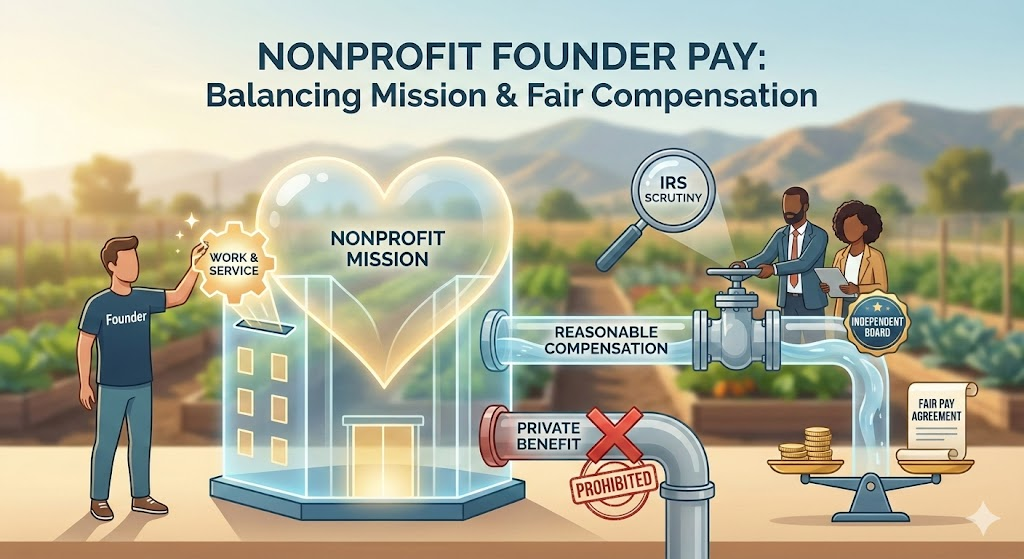
Nonprofit founders and board members can receive reasonable compensation for actual services performed in employee or contractor roles, but cannot receive compensation solely for serving as directors or for ownership interest in the organization—the key distinction is being paid fairly for work done versus extracting organizational assets as profit or personal benefit. IRS rules prohibit “private inurement” (insiders benefiting from nonprofit assets beyond reasonable compensation for services) and “excess benefit transactions” (compensation exceeding fair market value for services rendered), requiring that any payments to founders, board members, or family members receive independent board review, reflect market-rate compensation for comparable positions, and be documented with clear employment agreements or contractor arrangements. Eligibility varies by organization, but Temecula and Inland Empire nonprofits can employ founders or board members in staff roles with appropriate compensation as long as governance structures ensure independence, conflicts are properly managed, and compensation remains reasonable—creating sustainable leadership while maintaining the fundamental nonprofit principle that organizational assets serve charitable purposes rather than private enrichment.

What’s the fundamental difference between compensation for services versus prohibited private benefit?

The private inurement prohibition represents the core IRS principle distinguishing nonprofits from for-profit businesses—no part of a nonprofit’s net earnings can benefit private individuals beyond reasonable compensation for actual services rendered. This prohibition prevents nonprofits from functioning as profit-distribution vehicles where founders or insiders extract organizational assets as personal income without providing equivalent value through work performed. The IRS carefully scrutinizes transactions between nonprofits and insiders (founders, board members, substantial contributors, family members) to ensure these transactions serve organizational interests rather than enriching individuals.

Reasonable compensation for services performed is explicitly permitted and necessary for nonprofit operations. Nonprofits need staff to deliver programs, manage operations, raise funds, and maintain compliance—these staff members, whether founders or not, deserve fair pay for their work. The reasonableness standard requires that compensation aligns with what similar organizations pay for comparable positions, reflects the skills and experience the position requires, and relates directly to actual services performed rather than being disguised profit distribution. A founder serving as executive director managing a $500,000 budget organization might reasonably earn $60,000-$80,000 annually for full-time work, while a founder demanding $200,000 salary for the same role would face IRS questions about excessive compensation.

Independent review by disinterested board members forms the critical governance mechanism ensuring compensation decisions serve organizational rather than personal interests. When setting compensation for founders, board members, or family members of either, the IRS expects organizations to follow careful procedures: independent directors (those without personal or family interest in the compensation decision) review and approve compensation, the board bases decisions on comparable salary data from similar organizations and positions, the approval process is documented in board meeting minutes including the comparability data reviewed, and the individual whose compensation is being set doesn’t participate in the decision or vote. These procedures demonstrate that compensation reflects market rates for services rather than insider favoritism.

The distinction between founder as volunteer board member versus founder as paid employee matters enormously for both legal compliance and organizational perception. Serving as a board director is voluntary governance service—directors cannot receive compensation for board service itself in California nonprofit public benefit corporations. However, a board director can separately serve as a paid employee (like executive director) as long as proper conflicts are managed, the employee role is distinct from the board role, compensation is independently approved, and board independence is maintained (typically requiring that fewer than 49% of directors receive compensation). This dual role creates complexity requiring careful conflict management but is legally permissible and practically common in smaller nonprofits where founders provide both governance and operational leadership.

How do you determine what compensation is “reasonable” and properly document it?

Comparability data from similar organizations provides the foundation for determining reasonable compensation. Temecula nonprofits should research what organizations of similar size (budget, staff, complexity), in similar program areas (education, health, social services), in similar geographic markets (Inland Empire, Southern California), pay for comparable positions (executive director, program director, development director). Sources for comparability data include nonprofit salary surveys published by state associations or national organizations, Form 990 filings from similar nonprofits showing officer compensation (publicly available through GuideStar/Candid), job postings for similar positions showing offered salary ranges, and professional compensation consultants specializing in nonprofit pay scales.

The three-factor safe harbor test from IRS regulations provides a framework that, when followed, creates presumption of reasonableness protecting organizations from excess benefit transaction penalties. Organizations satisfy the safe harbor by: (1) having compensation approved in advance by authorized body (board or compensation committee) composed entirely of individuals without conflicts of interest in the decision, (2) basing the decision on appropriate comparability data showing what similar organizations pay for similar positions, and (3) adequately documenting the decision contemporaneously including the comparability data relied upon and the basis for determining compensation was reasonable. Following this safe harbor process doesn’t guarantee compensation is reasonable—extremely high compensation won’t be protected just because procedures were followed—but it shifts burden of proof to IRS to demonstrate unreasonableness.

Written employment agreements or contractor arrangements document compensation clearly and establish mutual expectations. These agreements should specify: compensation amount (salary or hourly rate), whether compensation is full-time or part-time and expected hours, what services the individual will perform (detailed position description), benefits provided beyond salary (health insurance, retirement contributions, paid leave), evaluation procedures and performance expectations, and term of employment or contract renewal provisions. Written agreements prevent misunderstandings, provide documentation for IRS review, and demonstrate professionalism that strengthens rather than weakens nonprofit credibility.

Board meeting minutes documenting compensation decisions create the permanent record proving independent review occurred. Minutes should include: who participated in the compensation discussion (identifying that interested parties were absent or recused), what comparability data the board reviewed (naming specific surveys, Form 990s, or other sources), how the board determined proposed compensation was reasonable based on comparables, the vote authorizing compensation with individual votes recorded, and the date of the decision. These contemporaneous minutes (recorded at or near the time decisions are made) are critical if IRS later questions compensation—claiming you followed proper procedures years after the fact without contemporaneous documentation won’t satisfy IRS requirements.

Framework: Launch → Fix → Fund + Federal Recognition + CA Compliance Triangle

The Nonprofit Launch Office operates within a strategic framework designed to help California nonprofits move from formation to fundability:

Launch includes making strategic decisions about founder compensation from the beginning—whether founders will serve as unpaid volunteers during startup phase, whether one founder will become paid executive director while others remain unpaid board members, or whether the organization will delay any founder compensation until revenue reaches sustainable levels. Launch-phase compensation planning prevents common problems: setting compensation too high relative to organizational revenue creating financial stress, paying founders without proper independent approval creating IRS problems, or creating compensation disparities between founders causing internal conflict.

Fix addresses situations where compensation arrangements created problems—founders paid without independent board approval requiring retroactive documentation and possibly repayment, compensation set at levels that comparability data don’t support requiring adjustment, or lack of written employment agreements creating confusion about expectations and authority. Fix work might involve developing compensation policies that weren’t established during Launch, securing independent compensation review for existing arrangements, or adjusting excessive compensation to reasonable levels.

Fund intersects with compensation because funders review organizational budgets and Form 990 compensation disclosures when evaluating grant applications. Funders question situations where executive compensation consumes high percentages of organizational budgets, where founder compensation seems excessive relative to organizational size, or where multiple family members receive compensation suggesting nepotism rather than merit-based employment. Reasonable, properly documented compensation strengthens grant applications by demonstrating fiscal responsibility; questionable compensation patterns weaken applications by raising concerns about financial management.

Federal Recognition through IRS 501(c)(3) determination involves scrutiny of proposed compensation arrangements described in Form 1023 applications. The IRS examines whether founders plan to receive compensation, whether governance structures ensure independence in compensation decisions, and whether proposed compensation seems reasonable for organizational size and scope. Organizations proposing that founders receive significant compensation from small budgets may face IRS questions requiring explanation and justification.

CA Compliance Triangle (Secretary of State, Franchise Tax Board, Attorney General Registry) includes specific California requirements about board member compensation. California law prohibits directors of nonprofit public benefit corporations from receiving compensation for board service (though they can be reimbursed for expenses). The Attorney General monitors compensation through Form 990 and RRF-1 reviews, investigating situations where compensation appears excessive or where insider transactions suggest private benefit violations.

Step-by-step: How NPLO helps nonprofits establish appropriate compensation practices

Step 1: Compensation Philosophy Development We help boards articulate compensation philosophy appropriate to organizational stage—should the organization prioritize paying competitive salaries to attract talent, or maintain lean budgets with below-market compensation while building programs? Should founders receive any compensation during startup, or volunteer until revenue reaches specific thresholds? These philosophical decisions guide specific compensation choices and prevent reactionary decisions made under financial pressure.

Step 2: Conflict of Interest Assessment We identify all potential compensation conflicts requiring management—which board members are or may become employees, which board members have family members as employees, which substantial donors might receive compensation, and what independent directors exist to review conflicted compensation decisions. Clear conflict mapping ensures proper procedures are followed before compensation is set.

Step 3: Comparability Research and Documentation We help gather appropriate comparability data from nonprofit salary surveys, similar organization Form 990 filings, job postings, and industry benchmarks. We document data sources, identify comparable organizations and positions, and prepare summary reports showing compensation ranges for positions being considered. This research provides the foundation for independent board decisions about reasonable compensation.

Step 4: Independent Board Review Process We guide proper governance procedures for compensation approval—interested parties recuse themselves from discussions and votes, independent directors review comparability data and discuss proposed compensation, decisions are documented in contemporaneous board meeting minutes including the data relied upon, and approval votes are recorded with individual directors’ votes noted. Proper procedures create the documentation trail proving independent review occurred.

Step 5: Written Agreement Development We prepare employment agreements or contractor arrangements documenting compensation terms clearly—position title and reporting structure, salary or hourly rate with payment schedule, full-time or part-time status and expected hours, detailed description of services and responsibilities, benefits beyond salary, evaluation procedures and performance expectations, and term or renewal provisions. Written agreements prevent misunderstandings and provide documentation for IRS and funder review.

Step 6: Form 990 Disclosure Preparation We ensure Form 990 compensation disclosures accurately reflect approved compensation—Part VII officer compensation reporting, Schedule J supplemental compensation details for highly compensated individuals, narrative explanations in Schedule O for compensation practices, and compliance with reporting thresholds requiring detailed disclosure. Accurate Form 990 reporting prevents IRS questions and demonstrates transparency.

Step 7: Policy Implementation We help establish compensation policies governing future decisions—requiring independent review for all insider compensation, specifying what comparability data will be reviewed, documenting decision-making procedures, establishing regular compensation review schedules, and creating procedures for handling compensation increases or bonuses. Written policies guide consistent practices and demonstrate commitment to appropriate compensation practices.

Step 8: Ongoing Compliance Monitoring We establish systems for reviewing compensation periodically against comparability data, ensuring continued reasonableness as organizations grow, documenting annual review in board minutes, and adjusting compensation when organizational size or market rates change significantly. Ongoing monitoring prevents compensation from becoming excessive over time as organizations succeed and grow.

Checklist: What you should consider before establishing founder compensation

Temecula founders considering nonprofit compensation should address:

  • Financial sustainability assessing whether organizational revenue can support proposed compensation while maintaining program funding and reserves
  • Board independence ensuring that a majority of directors are unrelated and uncompensated to maintain genuine governance oversight
  • Comparable position research identifying what similar organizations pay for similar work in similar markets
  • Independent approval securing compensation approval from disinterested directors who don’t personally benefit from the decision
  • Written employment terms documenting compensation, responsibilities, hours, benefits, and expectations in employment agreements
  • Conflict disclosure requiring annual written disclosure of all conflicts including compensation arrangements
  • Form 990 implications understanding that compensation will be publicly disclosed on annual Form 990 filings
  • Funder perception considering how compensation will appear to grant makers reviewing budgets and Form 990s
  • IRS safe harbor compliance following the three-factor test for approval, comparability, and documentation
  • California law compliance ensuring compensation complies with prohibition on paying directors for board service
  • Alternative compensation timing considering whether delaying compensation until revenue grows reduces financial stress and IRS scrutiny
  • Partial compensation evaluating whether part-time employment or reduced salaries during startup phase is more sustainable than full compensation
  • Non-financial compensation exploring whether benefits like health insurance, professional development, or flexible schedules provide value beyond cash salary
  • Succession planning considering how compensation arrangements affect organizational sustainability if founder transitions out
  • Tax implications understanding that compensation is taxable income requiring W-2 or 1099 reporting

Quick Answers (PPA)

Can board members receive any compensation at all, or must board service always be unpaid? California law prohibits directors of nonprofit public benefit corporations from receiving compensation for serving on the board itself—board service is volunteer governance work. However, board directors can receive compensation for providing services to the organization in roles separate from board membership—a director who also serves as executive director, program coordinator, or consultant can be paid reasonably for those services as long as: proper conflicts are disclosed and managed, fewer than 49% of directors receive any compensation from the organization, compensation is approved by independent directors without conflicts, and the amounts are reasonable for services performed. The key distinction is payment for actual work performed in employee or contractor roles versus payment for being a board member.

What counts as “reasonable” compensation—is there a specific percentage of budget that’s too high? The IRS doesn’t specify maximum percentages of budget for compensation but evaluates reasonableness based on comparability to what similar organizations pay for similar work. A small startup nonprofit with $50,000 budget probably cannot reasonably pay an executive director $45,000 (90% of budget) regardless of work performed, while a $2 million organization might reasonably pay $150,000 for executive leadership (7.5% of budget). Reasonableness depends on organizational size, program complexity, geographic market, required skills and experience, and what comparable nonprofits pay. Compensation consistently exceeding the 75th percentile of comparable positions raises IRS questions. Very high compensation percentages (over 50% of budget going to one person) raise both IRS concerns and funder skepticism about organizational priorities.

If I’m the founder and also the executive director, do I need to recuse myself from compensation decisions even though I’m doing the work? Yes, absolutely. Even though you’re performing valuable work deserving compensation, you have a direct personal financial interest in compensation decisions about your own pay. Independent directors without personal or family interest must review comparability data, discuss appropriate compensation levels, and vote on your compensation without your participation in deliberation or voting. You can provide information about your responsibilities and work performed, but you should leave the meeting during actual compensation discussion and decision. This independent review process is critical for both IRS compliance (safe harbor requirements) and organizational credibility with funders who scrutinize insider compensation decisions.

What happens if the IRS determines compensation was excessive—do I have to pay money back? If the IRS determines compensation constitutes an excess benefit transaction (payment exceeding reasonable compensation for services), several consequences can occur. The recipient (person who received excess compensation) must repay the excess amount plus interest—if you received $100,000 but reasonable compensation was $60,000, you’d repay $40,000 plus interest. Additionally, the recipient faces excise taxes on the excess benefit (25% initially, potentially 200% if not corrected). Organization managers (board members) who knowingly approved the excessive compensation also face excise taxes (10% of excess benefit up to $20,000 per manager). The organization itself doesn’t lose tax-exempt status for isolated excess benefit transactions, but pattern of excessive compensation or private benefit can lead to revocation. These penalties make proper procedures and reasonable compensation levels critical.

Should I wait to take any compensation until the nonprofit is financially stable, or can I pay myself from the beginning? This is a strategic decision depending on financial reality and personal circumstances. Many founders volunteer during the startup phase while building revenue, then begin receiving compensation once organizational income reaches sustainable levels—this approach reduces financial stress on new organizations and demonstrates founder commitment to mission over personal gain. However, founders with relevant professional expertise providing significant work deserve fair compensation even during startup if organizational revenue supports it. Consider: Can the organization afford your compensation while maintaining programs and reserves? Will taking compensation during startup create IRS or funder concerns about priorities? Do you have personal financial flexibility to volunteer temporarily? Can you start with part-time or reduced compensation rather than full market-rate salary? Many Temecula nonprofits use hybrid approaches—founders volunteer initially, begin receiving partial compensation as revenue grows, and eventually transition to market-rate salaries as organizations stabilize.

What to do next (DIY vs Done-With-You)

DIY approach: Research compensation for comparable positions by searching nonprofit salary surveys from CalNonprofits.org or national organizations, reviewing Form 990 filings from similar-sized nonprofits in similar program areas using GuideStar/Candid databases, checking job postings for nonprofit positions in your region, and documenting all sources and salary ranges you find. If considering compensating yourself or another founder, identify truly independent board directors who have no personal or family relationship with the person being compensated. Develop written employment agreement or contractor arrangement documenting compensation amount, services provided, expected hours, benefits, and term. Schedule board meeting where independent directors review comparability data, discuss whether proposed compensation is reasonable, and vote on approval with interested parties recused from discussion and voting. Document the entire process in meeting minutes including comparability data reviewed, basis for determining reasonableness, and individual votes. Maintain all documentation for IRS review. Review compensation annually against updated comparability data. If you cannot identify genuinely independent directors to review founder compensation, this signals that compensation should wait until board independence can be established.

Done-With-You approach: The Nonprofit Launch Office provides comprehensive compensation planning for Temecula and Inland Empire nonprofits ensuring compliance with IRS requirements while supporting sustainable leadership. We help develop compensation philosophy appropriate to organizational stage and financial capacity, conduct thorough comparability research from multiple reliable sources documenting market-rate compensation for your positions, assess conflict of interest situations and identify which directors can provide independent review, design proper governance procedures ensuring independent board review and approval, prepare written employment agreements or contractor arrangements documenting compensation terms clearly, guide board meetings through proper approval processes with appropriate recusal and documentation, ensure accurate Form 990 compensation disclosure and reporting, develop compensation policies governing future decisions and reviews, and provide ongoing guidance as organizations grow and compensation needs evolve. This comprehensive approach ensures founder compensation serves organizational needs while maintaining IRS compliance, funder confidence, and organizational sustainability.

Contact

Book: https://thedocumentpro.com/
 Call: 1(800) 285-0078
 Email: mydocumentpro@gmail.com
 The Nonprofit Launch Office™ — a discipline of The Document Pro, operated by Gitta Williams.
 Operated by The Document Pro (Gitta Williams)

Sources


Disclaimer

Document preparation and nonprofit readiness support — not legal or tax advice.
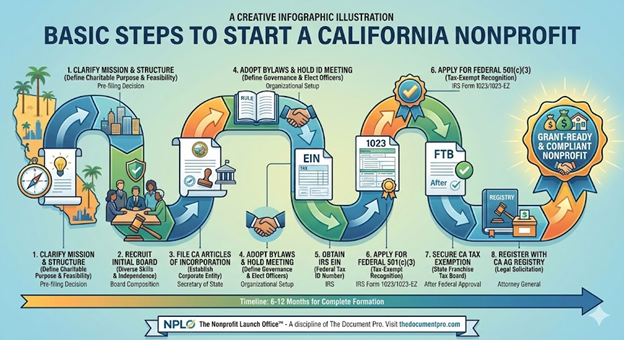
Short Answer

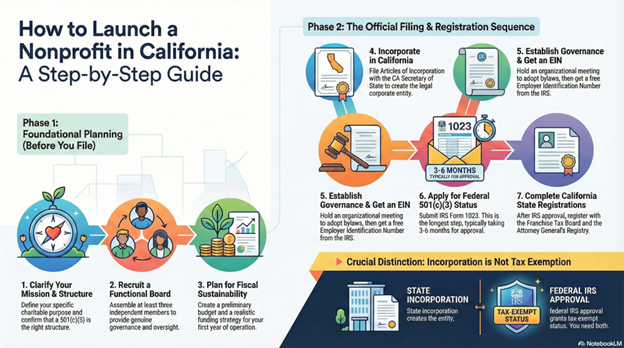
Starting a nonprofit in California requires completing several sequential steps: clarifying your charitable mission and determining whether nonprofit structure serves your goals, selecting and reserving a compliant organizational name, recruiting initial board members who meet legal requirements, drafting and filing Articles of Incorporation with the California Secretary of State establishing corporate existence, adopting bylaws defining governance structure and operational procedures, obtaining an Employer Identification Number from the IRS for tax and banking purposes, applying for federal 501(c)(3) tax-exempt recognition through IRS Form 1023 or 1023-EZ, securing California state tax exemption with the Franchise Tax Board after federal approval, and registering with the California Attorney General Registry of Charities to legally solicit donations. Eligibility varies by organization, but completing all steps typically requires 6-12 months and establishes the compliance foundation necessary for pursuing grants, accepting tax-deductible donations, and operating as a recognized charitable organization in California’s complex regulatory environment.

What foundational decisions must you make before filing any paperwork?

Mission clarity represents the most critical pre-filing decision because your charitable purpose determines IRS eligibility, shapes every formation document, guides board recruitment, and defines programmatic boundaries for your organization’s entire existence. Riverside founders should articulate precisely what community need their nonprofit addresses, what populations it serves, what activities it conducts, and what outcomes it pursues—not in vague generalities like “helping people” but in specific, demonstrable charitable purposes that qualify under IRS Section 501(c)(3). The mission statement becomes foundational language appearing in Articles of Incorporation, IRS applications, grant proposals, and public communications, so investing time in clarity before filing prevents costly amendments later.

Nonprofit structure appropriateness requires honest assessment of whether forming a 501(c)(3) charitable organization actually serves your goals better than alternative structures. Some community initiatives function better as informal volunteer groups, fiscally sponsored projects, social enterprises structured as benefit corporations, or collaborative programs of existing nonprofits rather than independent tax-exempt organizations. Consider whether you have sustainable funding sources beyond initial enthusiasm, whether you can recruit and maintain a functional board providing governance oversight, whether you’re prepared for ongoing compliance obligations including annual IRS and California filings, and whether the benefits of tax-exempt status (tax-deductible donations, grant eligibility, tax exemption) justify the administrative burdens and restrictions nonprofits face.

Board composition planning before filing Articles of Incorporation prevents common problems like insufficient directors to meet California’s three-person minimum, board members who don’t understand fiduciary responsibilities, or governance structures that violate conflict of interest rules. Ideal founding boards include members bringing diverse skills—financial oversight, legal/compliance understanding, fundraising capacity, programmatic expertise, community connections—and represent the communities you serve. California law prohibits nonprofit boards from being controlled by single families or having majority membership receiving compensation from the organization, so board design must ensure genuine independent oversight rather than serving as rubber stamp for founders’ decisions.

Fiscal sustainability planning before incorporation establishes realistic expectations about revenue generation and operational costs. Map potential funding sources—individual donations, foundation grants, government contracts, earned income, corporate sponsorships—and honestly assess which are accessible given your mission, capacity, and timeline. Develop preliminary budgets showing startup costs (incorporation fees, initial supplies, insurance) and first-year operating expenses (space, staff/contractors, program costs, compliance) against projected revenue. Organizations that launch without financial planning often discover too late that their program models don’t generate sufficient revenue to sustain operations, leading to organizational collapse despite good intentions.

What are the actual filing steps in sequence with California and federal agencies?

Name reservation with California Secretary of State represents the first formal step, requiring that your chosen name includes a corporate designation (Corporation, Incorporated, Limited, etc. or abbreviations Corp., Inc., Ltd.), doesn’t confusingly resemble existing registered names, and complies with nonprofit naming restrictions. The SOS business name database at bizfileonline.sos.ca.gov allows checking name availability before attempting reservation or filing. While name reservation isn’t mandatory, it protects your chosen name for 60 days while you prepare other formation documents, preventing another organization from registering the same name during your preparation period.

Articles of Incorporation filing with California Secretary of State creates the legal corporate entity by submitting Form ARTS-PB-501(c)(3) or equivalent document containing required elements: corporate name and California address, statement of charitable purpose aligned with IRS requirements, dissolution clause specifying that assets go to other 501(c)(3) organizations if your nonprofit dissolves, prohibition on private inurement ensuring no individual profits from organizational assets, and initial agent for service of process with California street address. The current filing fee is $30 plus $15 for Statement of Information if filed simultaneously. Upon acceptance, California issues a corporation number and your nonprofit legally exists as a California corporation, though not yet tax-exempt.

Organizational meeting of initial board establishes governance by adopting bylaws that specify board size and meeting requirements, officer positions and duties, membership provisions if applicable, amendment procedures, and operational policies. The board elects officers (typically president, secretary, treasurer at minimum), adopts conflict of interest and other essential policies, authorizes bank account opening, and documents decisions in meeting minutes. This organizational meeting creates the governance foundation the IRS examines when evaluating 501(c)(3) applications, so documentation demonstrating thoughtful, independent governance strengthens federal recognition prospects.

Employer Identification Number application through IRS Form SS-4 provides the federal tax identification number required for opening bank accounts, filing IRS Form 1023/1023-EZ for tax exemption, hiring employees or contractors, and fulfilling various regulatory requirements. EIN application is free and can be completed online at irs.gov with immediate number assignment for most applicants. The EIN becomes your nonprofit’s permanent federal tax identifier, remaining unchanged even if organizational name or structure changes, and appears on all federal tax documents, grant applications, and financial records.

IRS Form 1023 or 1023-EZ application for 501(c)(3) recognition represents the most complex and consequential filing, requiring detailed information about organizational purpose, planned activities, governance structure, compensation arrangements, financial projections, and relationships with other entities. Form 1023-EZ (simplified version for smaller organizations projecting under $50,000 annual gross receipts) costs $275 and processes faster but provides less detailed IRS review. Full Form 1023 (for larger or more complex organizations) costs $600 and involves more extensive documentation but creates more thorough IRS determination. Processing typically takes 3-6 months, during which the IRS may request additional information. Upon approval, the IRS issues a determination letter confirming 501(c)(3) status generally retroactive to your incorporation date.

Framework: Launch → Fix → Fund + Federal Recognition + CA Compliance Triangle

The Nonprofit Launch Office operates within a strategic framework designed to help California nonprofits move from formation to fundability:

Launch is precisely the process this question addresses—the sequential steps transforming an idea into a legally recognized, grant-eligible nonprofit organization. Launch includes both the mechanical filing steps (Articles of Incorporation, EIN application, IRS Form 1023) and the strategic planning decisions (mission clarity, board recruitment, financial sustainability) that determine whether the formed nonprofit functions effectively or struggles from inception. Proper Launch execution establishes compliance foundations, creates functional governance, and positions organizations for grant success rather than creating problems requiring later Fix interventions.

Fix becomes necessary when Launch steps were completed incorrectly, incompletely, or not at all—organizations that incorporated without proper charitable purpose language requiring Articles amendment, boards that never adopted bylaws or held organizational meetings requiring retroactive documentation, nonprofits that operated for years without applying for IRS recognition now facing revocation threats, or entities that missed California registrations and now need restoration. Fix is always more expensive, time-consuming, and complicated than proper Launch would have been, which is why understanding correct formation sequence matters enormously.

Fund represents the operational capability that proper Launch enables—once you’ve completed all formation steps including federal and state recognition, you can pursue institutional grants, accept tax-deductible donations, and operate with the compliance profile funders verify. Organizations that shortcut Launch steps often discover they cannot access funding because they lack required recognition, registration, or documentation. Fund-phase success depends on Launch-phase thoroughness.

Federal Recognition through IRS 501(c)(3) determination forms the foundation enabling most institutional funding and tax-deductible donations. While California incorporation creates corporate existence, federal IRS recognition creates tax-exempt charitable status. The two-level structure—state corporate formation plus federal tax exemption—confuses many Riverside founders who assume incorporating as a nonprofit automatically confers tax benefits. Understanding that federal recognition is separate and subsequent to state incorporation prevents the common error of attempting grant applications before IRS determination arrives.

CA Compliance Triangle represents the three California agencies requiring separate post-federal-recognition compliance: Secretary of State (Statement of Information biennial filings maintaining Active status), Franchise Tax Board (annual Form 199 or 199N maintaining state tax exemption), and Attorney General Registry of Charities (initial registration plus annual RRF-1 renewals authorizing fundraising). These three state-level requirements supplement rather than replace federal IRS obligations, creating the four-point compliance framework (IRS plus three California agencies) that distinguishes California nonprofit oversight from simpler single-agency states.

Step-by-step: How NPLO guides Riverside nonprofits through complete formation

Step 1: Mission and Structure Consultation We help clarify your charitable purpose into specific, IRS-compliant language that will appear in formation documents and determine whether nonprofit structure actually serves your goals better than alternatives. This consultation includes assessing financial sustainability prospects, evaluating whether sufficient board and leadership capacity exists, and confirming that your planned activities qualify as charitable under 501(c)(3) requirements. Many potential founders discover through this assessment that fiscal sponsorship, collaborative partnership, or other structures better serve their specific situations.

Step 2: Board Recruitment and Development We guide recruitment of initial board members meeting California’s three-person minimum with skills, diversity, and independence that signal functional governance to IRS reviewers. We help founding boards understand fiduciary responsibilities, conflict of interest obligations, and meeting requirements rather than treating board membership as honorary recognition. Proper board composition and education from day one prevents governance problems that plague nonprofits with rubber-stamp boards lacking oversight capacity.

Step 3: Name Selection and Availability Verification We help select organizational names that are distinctive, memorable, aligned with mission, compliant with California requirements, and available for registration. This includes checking Secretary of State name availability, verifying that domain names and social media handles are available for consistency, and ensuring the name isn’t confusingly similar to existing Riverside-area nonprofits serving similar populations. Strong name selection creates brand identity supporting fundraising and community recognition.

Step 4: Articles of Incorporation Preparation and Filing We draft Articles of Incorporation containing all required IRS-compliant language—charitable purpose statement, dissolution clause, private inurement prohibition, and other provisions IRS examines when reviewing 501(c)(3) applications. We file with California Secretary of State and manage any questions or requests for clarification. Properly drafted Articles prevent the need for amendments later when IRS identifies language problems, saving time and money.

Step 5: Bylaws Development and Organizational Meeting We prepare comprehensive bylaws tailored to your organization’s structure, size, and governance needs rather than using generic templates that may not fit. We guide the organizational board meeting where bylaws are adopted, officers are elected, conflict of interest policies are approved, and initial operational decisions are documented. We ensure meeting minutes demonstrate genuine deliberation and independent governance rather than founder-controlled rubber-stamping.

Step 6: EIN Application and Initial Compliance Setup We complete IRS Form SS-4 EIN application and establish initial compliance tracking systems—filing calendars covering federal and California obligations, document organization protocols, and basic record-keeping structures. Early compliance systems prevent the drift into noncompliance that creates problems when organizations pursue grants 18-24 months post-formation.

Step 7: IRS Form 1023/1023-EZ Preparation and Submission We prepare complete, accurate IRS applications including detailed narratives about planned activities, financial projections, governance structures, and compensation arrangements. We guide the choice between Form 1023-EZ (simpler, faster but less IRS scrutiny) versus full Form 1023 (more complex but more thorough IRS review). We manage IRS correspondence if additional information is requested and coordinate response strategies maximizing approval likelihood.

Step 8: California State Compliance Completion Once IRS determination arrives, we complete California state registrations—Franchise Tax Board exemption application (Form 3500A), Attorney General Registry of Charities initial registration (Form CT-1), and any other required state filings. We establish ongoing compliance monitoring ensuring Statement of Information, Form 199, and RRF-1 filings happen on schedule. This comprehensive approach delivers fully compliant, grant-ready organizations rather than partially formed entities missing critical registrations.

Checklist: What you should have ready before starting formation

Riverside founders beginning nonprofit formation should prepare or gather:

  • Clear mission statement articulating specific charitable purpose, target populations, planned activities, and intended outcomes in IRS-compliant language
  • Founding board member commitments from at least three individuals willing to serve, meeting regularly, and providing genuine governance oversight
  • Initial board member information including full legal names, residential addresses, email addresses, phone numbers, and brief biographical information
  • Organizational name options (primary plus alternates) that are distinctive, mission-aligned, and available for California registration
  • Registered agent information including name and California street address (not PO Box) of person or service receiving legal notices
  • Principal office address in California where organizational business is conducted and records are maintained
  • Preliminary program descriptions explaining what activities you’ll conduct, how they serve charitable purposes, and who benefits
  • Initial officers identified including president/CEO, secretary, and treasurer with understanding of their roles and responsibilities
  • Financial projections showing anticipated startup costs, first-year operating expenses, and realistic revenue sources
  • Funding strategy outline identifying potential individual donors, foundation prospects, earned income possibilities, or other revenue streams
  • Conflict of interest policy draft addressing how the board will handle conflicts, require annual disclosures, and ensure independent decision-making
  • Formation budget covering California incorporation fee ($30), IRS application fee ($275-$600), registered agent service if using one, potential professional assistance, and initial operating costs
  • Timeline expectations understanding that complete formation from incorporation through IRS determination typically requires 6-12 months
  • Commitment to ongoing compliance recognizing that nonprofits face annual federal and California filing obligations requiring time, attention, and resources

Quick Answers (PPA)

How long does the complete formation process actually take from start to finish? The mechanical filing steps—California incorporation, EIN application, IRS Form 1023 submission—can be completed within 2-4 weeks if you have all information prepared. However, IRS processing of 501(c)(3) applications typically takes 3-6 months, during which your organization exists as a California corporation but lacks federal tax-exempt recognition. Total timeline from initial planning through receiving IRS determination and completing California state registrations typically spans 6-12 months for well-prepared applications. Delays occur when IRS requests additional information, when founders take time gathering required documentation, or when formation steps are completed out of sequence requiring corrections. Organizations needing grant eligibility quickly sometimes pursue fiscal sponsorship as a bridge during the formation waiting period.

Can I start operating programs and accepting donations before IRS determination arrives? Yes, you can operate programs and accept donations after California incorporation and before IRS determination, but with important caveats. Donors cannot claim tax deductions for contributions until your IRS determination is granted, though recognition is typically retroactive to your incorporation date once approved. Most institutional funders won’t consider grant applications until you have actual IRS determination in hand and appear in the TEOS database. Early operations should focus on individual donor cultivation, program piloting, board development, and preparation for aggressive fundraising once determination arrives rather than attempting premature grant applications likely to be rejected for lack of federal recognition.

Do I need a lawyer to start a nonprofit, or can I do it myself? California law doesn’t require attorney involvement to form nonprofits—individuals can complete incorporation, EIN application, and even IRS Form 1023 independently using IRS instructions, online resources, and nonprofit formation guides. However, several formation elements benefit significantly from professional guidance: drafting Articles of Incorporation language that satisfies both California corporate law and IRS charitable requirements, preparing comprehensive bylaws tailored to your governance needs, developing conflict of interest and other policies meeting legal standards, and completing Form 1023 narratives that present your organization favorably to IRS reviewers. Many Riverside founders use hybrid approaches—handling simple mechanical filings themselves while getting professional review of critical documents like Articles and Form 1023 before submission.

What happens if we make mistakes in our formation documents—can we fix them later? Most formation mistakes can be corrected through amendments, though corrections are always more expensive and time-consuming than getting documents right initially. Articles of Incorporation amendments require California Secretary of State filing fees and potentially IRS notification if changes affect your tax-exempt status. Bylaws amendments require board approval and documentation but don’t require state filing. IRS Form 1023 errors discovered during processing can often be corrected through supplemental submissions, though errors suggesting misrepresentation or fundamental disqualification cause application rejection. The most problematic mistakes involve operating for extended periods under flawed formation documents—incorporating without proper charitable purpose language, adopting bylaws with California-noncompliant provisions, or forming board structures that violate conflict rules—requiring complex and expensive remediation when discovered during grant applications or audits.

What’s the difference between incorporating in California and getting 501(c)(3) status from the IRS? California incorporation creates corporate legal existence—your organization becomes a California nonprofit corporation, can enter contracts, hold property, and conduct business as a legal entity. However, incorporation alone doesn’t confer tax-exempt status or make donations tax-deductible. Federal 501(c)(3) recognition from IRS creates tax exemption—your organization becomes exempt from federal income tax and donors can claim charitable deductions for contributions. You need BOTH—California incorporation establishes the corporate entity, and IRS recognition grants that entity tax-exempt charitable status. This two-level structure confuses many founders who assume incorporating as a “nonprofit” automatically provides tax benefits, when in fact federal IRS determination is a separate, subsequent application proving your incorporated entity serves charitable purposes qualifying for tax exemption.

What to do next (DIY vs Done-With-You)

DIY approach: Begin by clarifying your mission through written exercises answering: What specific community need does your nonprofit address? What populations do you serve? What activities will you conduct? What measurable outcomes do you seek? Recruit at least three potential board members willing to provide genuine governance oversight and meet regularly. Research name availability through California Secretary of State business name database and secure matching domain names. Review IRS Publication 557 “Tax-Exempt Status for Your Organization” to understand 501(c)(3) requirements and eligibility criteria. Download California Form ARTS-PB-501(c)(3) and review requirements for Articles of Incorporation. Obtain nonprofit bylaws templates from resources like CalNonprofits.org and adapt to your governance structure. Create preliminary budgets showing startup costs and first-year operating expenses against realistic revenue projections. File California Articles of Incorporation through bizfileonline.sos.ca.gov once prepared. Apply for EIN online at irs.gov immediately after incorporation. Hold organizational board meeting adopting bylaws, electing officers, and documenting decisions in meeting minutes. Begin preparing IRS Form 1023 or 1023-EZ using instructions and worksheets at irs.gov. Understand this DIY approach requires significant time investment, careful attention to detail, and willingness to learn complex regulatory requirements.

Done-With-You approach: The Nonprofit Launch Office provides comprehensive formation guidance for Riverside and Inland Empire founders, ensuring proper completion of all federal and California requirements in correct sequence. We clarify charitable mission into IRS-compliant language that strengthens both formation documents and future grant applications, guide board recruitment and development ensuring functional governance from inception, prepare Articles of Incorporation containing all required provisions while avoiding common language problems that complicate IRS applications, draft comprehensive bylaws tailored to your structure rather than using generic templates, facilitate organizational meetings that demonstrate genuine deliberation and independent oversight, complete EIN applications and establish initial compliance tracking systems, prepare complete IRS Form 1023 or 1023-EZ applications maximizing approval likelihood, and coordinate California state registrations once federal determination arrives. This comprehensive approach delivers fully formed, grant-ready organizations typically within 6-9 months while preventing the formation errors that require expensive later remediation, ensuring founders understand ongoing compliance obligations rather than treating formation as one-time event, and positioning new nonprofits for funding success rather than discovering barriers when first grant applications are attempted.

Contact

Book: https://thedocumentpro.com/
 Call: 1(800) 285-0078
 Email: mydocumentpro@gmail.com
 The Nonprofit Launch Office™ — a discipline of The Document Pro, operated by Gitta Williams.
 Operated by The Document Pro (Gitta Williams)

Sources


Disclaimer

Document preparation and nonprofit readiness support — not legal or tax advice.