Education

Short Answer

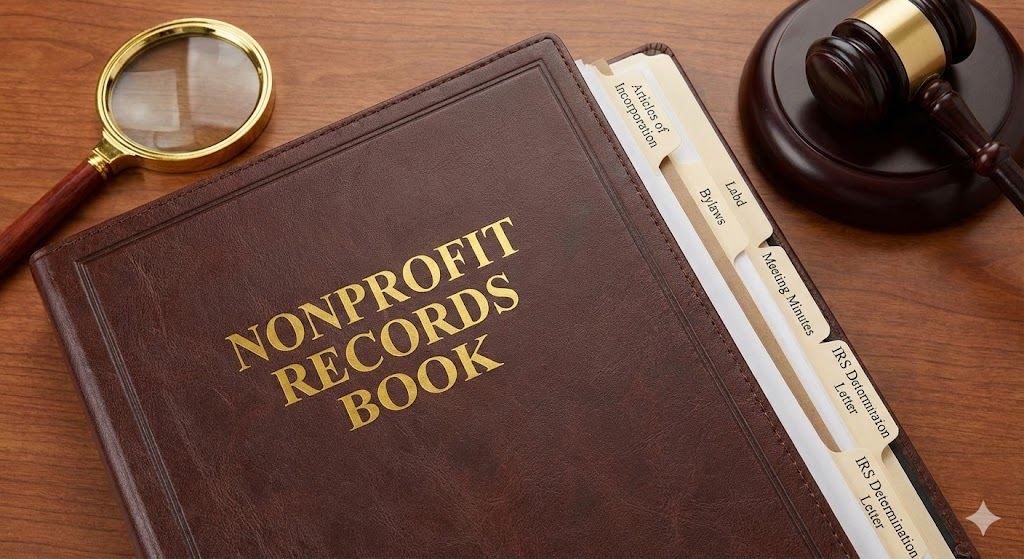
A nonprofit records book (also called a corporate records book or minute book) is the organized collection of essential organizational documents including formation documents, governance records, meeting minutes, resolutions, and compliance filings maintained in one accessible location. It should contain Articles of Incorporation, IRS determination letter, bylaws, board meeting minutes, annual reports, key policies, and other critical documents. The records book matters because California law requires nonprofits to maintain corporate records accessible for inspection, IRS and funders commonly request documents contained in the records book, and organized record-keeping prevents the crisis where critical documents can’t be located when urgently needed.

What documents belong in the nonprofit records book?

Formation documents establish legal existence and organizational structure. The records book should contain filed Articles of Incorporation showing Secretary of State filing stamp, original or certified copy of IRS determination letter confirming 501(c)(3) status, current bylaws as adopted and amended, and initial organizational meeting minutes documenting bylaw adoption, officer election, and policy approval. These foundational documents prove the organization was properly formed and operates under defined governance structures.

Meeting minutes and resolutions document ongoing governance activity. Include all board meeting minutes chronologically, committee meeting minutes if committees have decision-making authority, annual meeting minutes if membership structure exists, and board resolutions authorizing specific actions like bank account opening, contract signing authority, or major transactions. Complete minute records prove the board exercises genuine oversight rather than existing only on paper.

Policies and governance documents demonstrate operational frameworks. The records book should contain conflict of interest policy with annual disclosure forms, whistleblower policy, document retention and destruction policy, financial management policies, gift acceptance policy, and other adopted policies governing organizational operations. These policies show how the organization implements governance principles and manages operational risks.

Compliance and registration documents prove ongoing legal standing. Include California Statement of Information filings, Franchise Tax Board correspondence confirming tax exemption, Attorney General Registry of Charities registration and renewal confirmations, annual Form 990 and Form 199 returns, and current certificates of insurance. These documents demonstrate compliance with federal and California requirements funders verify during due diligence.

How should records be organized and who can access them?

Physical organization traditionally uses three-ring binders with tabbed sections separating document categories. Many San Bernardino nonprofits maintain multiple binders—one for formation and governance (Articles, bylaws, policies), another for meeting minutes chronologically, and a third for annual compliance filings. Tabs should clearly label sections, documents should be arranged chronologically within sections, and the organization should maintain a table of contents or index showing what’s included.

Digital organization increasingly supplements or replaces physical records books. Scan critical documents to PDF format maintaining quality for legibility, organize files in clearly labeled folders matching physical binder structure, maintain cloud storage with regular backups, and implement access controls ensuring appropriate people can retrieve documents while maintaining security. Hybrid approaches maintaining both physical signed originals and digital copies for convenience work well for many organizations.

Access requirements under California law mandate that directors have right to inspect corporate records. The organization should maintain records at its principal office or make them available electronically to board members upon request. California Attorney General can request inspection of charitable corporation records during investigations. Certain documents like bylaws and conflict of interest policies may be requested by IRS or funders. Clear procedures for record access prevent disputes while maintaining appropriate confidentiality.

Responsibility assignment ensures someone maintains the records book. The corporate secretary typically holds primary responsibility for maintaining accurate, current records and ensuring meeting minutes get added promptly. However, small nonprofits without staff often assign treasurer or executive director to maintain the physical or digital files. Clear assignment prevents the common problem where everyone assumes someone else maintains records and critical documents get lost.

Framework: Launch → Fix → Fund + Federal Recognition + CA Compliance Triangle

Launch includes establishing the records book immediately after incorporation. New San Bernardino nonprofits should create organized filing systems from day one, adding formation documents as they’re received and minutes as meetings occur.

Fix addresses organizations with missing, disorganized, or incomplete records requiring systematic reconstruction and organization. Retroactively organizing scattered documents and identifying gaps allows developing complete records going forward.

Fund depends on organized records because grant applications request multiple documents with tight deadlines. Having everything organized in accessible records books prevents scrambling or missing opportunities because critical documents can’t be located.

Federal Recognition applications require submitting multiple documents that should be maintained in records books. IRS Form 1023 requests Articles, bylaws, minutes, and other documents. Well-maintained records books make application preparation straightforward.

CA Compliance Triangle documentation belongs in records books. Secretary of State status certificates, Franchise Tax Board exemption verifications, and Attorney General Registry confirmations should all be maintained in organized compliance sections.

Step-by-step: How NPLO helps organizations establish records books

Step 1: Document Inventory We identify what documents you currently have and what’s missing.

Step 2: Organization Structure Design We create logical section organization matching your operational needs.

Step 3: Missing Document Acquisition We help obtain duplicates of lost critical documents.

Step 4: Physical Book Assembly We set up physical binders with tabs and organized document placement.

Step 5: Digital Archive Creation We scan documents creating secure digital archives with backup.

Step 6: Index Development We create tables of contents showing what’s included and where.

Step 7: Maintenance Procedures We establish systems for adding new documents promptly.

Step 8: Access Protocols We implement procedures for board member access and security.

Checklist: Essential records book contents

Formation Section:

  • Articles of Incorporation (filed with SOS stamp)
  • IRS determination letter
  • Current bylaws
  • Organizational meeting minutes

Governance Section:

  • Conflict of interest policy
  • Annual conflict disclosure forms
  • Whistleblower policy
  • Document retention policy
  • Other adopted policies

Minutes Section:

  • All board meeting minutes (chronological)
  • Committee minutes (if applicable)
  • Annual meeting minutes (if applicable)

Resolutions Section:

  • Bank account authorization
  • Signing authority designations
  • Major transaction approvals

Compliance Section:

  • Statement of Information filings
  • FTB exemption correspondence
  • AG Registry confirmations
  • Form 990 returns (recent years)
  • Form 199 returns
  • Insurance certificates

Financial Section:

  • Current year budget
  • Recent financial statements
  • Audit reports (if applicable)

Quick Answers (PPA)

Can records be kept entirely electronically, or must we maintain physical copies? California law doesn’t mandate physical records books—electronic records are acceptable if properly maintained with security and backups. Many organizations maintain hybrid systems keeping physical signed originals in binders while also maintaining digital scans for easy sharing. The key is ensuring records are preserved, organized, accessible to those with legitimate need, and protected from loss. Whatever system you choose, maintain it consistently and ensure directors know how to access documents.

Who is allowed to look at the records book—can anyone request access? California law gives directors absolute right to inspect corporate records. The organization must make records available to directors at reasonable times and locations. Other parties have more limited access rights—California Attorney General can inspect charitable corporation records during investigations, IRS can request documents during audits or reviews, funders can request specific documents during grant applications, and some documents like Form 990 are publicly available regardless. The organization can maintain appropriate confidentiality for sensitive documents while meeting legal access obligations.

What should we do if our organization has no records book and we don’t know where critical documents are? Start by systematically searching for whatever documents exist—check email archives, old board members’ files, accountant or attorney files, cloud storage accounts, and organizational file cabinets. Obtain duplicates of critical missing documents—request duplicate IRS determination letter, download filed Articles of Incorporation from Secretary of State website, and request copies of Form 990s from IRS or download from GuideStar. Then create organized records book going forward, adding retroactively located documents and maintaining new documents as they’re created. Better to start organizing now than continue operating without accessible records.

How long must we keep documents in the records book—can old ones eventually be removed? Formation documents, bylaws, minutes, and resolutions should be maintained permanently—they’re the historical governance record. Compliance filings generally should be retained for significant periods—IRS recommends keeping Form 990s for seven years minimum, though many organizations keep them permanently. Financial records typically require seven-year retention. Document retention policy should specify retention periods for different document types. However, records books usually aren’t space-limited—adding sections or new binders as documents accumulate is straightforward, making permanent retention of most governance documents practical.

Should the records book stay at one person’s home or office, or should it be at the nonprofit’s office location? If the organization has a physical office, records should be maintained there for accessibility. If no office exists, records typically stay with whoever is responsible for maintenance—usually the secretary, treasurer, or executive director. California law requires making records available at the principal office address or electronically to directors. The key is that responsible parties know where records are located, multiple people know how to access them if the primary person is unavailable, and backup copies exist in case originals are lost. Digital records solve many location problems since multiple authorized people can access cloud storage.

What to do next (DIY vs Done-With-You)

DIY approach: Purchase three-ring binders and tab dividers from office supply store. Create sections: Formation, Governance/Policies, Minutes, Resolutions, Compliance, Financial. Gather all organizational documents you can locate—Articles, determination letter, bylaws, minutes, policies, compliance filings. Organize documents chronologically within each section. Create simple table of contents listing what’s in each section. Identify missing critical documents and obtain replacements—request duplicate determination letter from IRS, download filed Articles from Secretary of State website. Scan organized documents to PDF creating digital backup stored in secure cloud location. Assign clear responsibility for maintaining records book and adding new documents promptly—meeting minutes after each meeting, compliance filings when submitted, new policies when adopted. Establish procedure for board members to access records when needed. Review and update records book quarterly ensuring it remains current and complete.

Done-With-You approach: The Nonprofit Launch Office provides comprehensive records book establishment for San Bernardino and Inland Empire nonprofits. We inventory existing documents and identify gaps requiring attention, design logical organization structures matching operational needs, help obtain replacement documents for critical missing items, assemble physical binders with professional organization and labeling, create secure digital archives with backup systems, develop comprehensive indexes showing contents and locations, implement maintenance procedures ensuring new documents get added promptly, establish access protocols balancing director rights with appropriate security, and provide ongoing support updating records as organizations evolve. This ensures you maintain the organized, complete, accessible records that satisfy California law, IRS requirements, and funder expectations while preventing the governance crises that emerge when critical documents can’t be located.

Contact

Book: https://thedocumentpro.com/
 Call: 1(800) 285-0078
 Email: mydocumentpro@gmail.com
 The Nonprofit Launch Office™ — a discipline of The Document Pro, operated by Gitta Williams.
 Operated by The Document Pro (Gitta Williams)

Sources


Disclaimer

Document preparation and nonprofit readiness support — not legal or tax advice.

Short Answer

A conflict of interest policy establishes procedures for identifying, disclosing, and managing situations where board members, officers, or key employees have personal, financial, or family interests that could influence organizational decisions. Nonprofits need this policy because IRS Form 1023 applications specifically ask whether the organization has adopted one, because conflicts left unmanaged create private benefit violations jeopardizing tax-exempt status, and because funders reviewing governance documentation expect to see robust conflict procedures preventing self-dealing and ensuring board decisions serve organizational rather than personal interests.

What situations constitute conflicts of interest requiring disclosure?

Financial conflicts occur when board members, officers, or their family members could personally benefit from organizational decisions. Examples include voting on contracts with businesses owned by board members, approving compensation for themselves or relatives, deciding whether to purchase property from a director’s spouse, or selecting vendors where a board member has ownership interest. Any situation where an insider stands to gain financially creates a conflict requiring disclosure and management.

Family relationship conflicts emerge when relatives serve together or when family members of board members seek employment, contracts, or other financial arrangements with the organization. California law limits how many related board members can serve, and IRS scrutinizes family relationships closely for private benefit concerns. Even when family involvement is legitimate, proper conflict procedures must ensure independent review of any financial arrangements.

Competing loyalty conflicts arise when board members serve on multiple nonprofit boards with overlapping missions or when board members have business interests that compete with the organization. A board member serving both your organization and a similar nonprofit that competes for the same grants or serves the same population has divided loyalties requiring disclosure. Board members whose businesses provide services the nonprofit needs face conflicts between securing organizational contracts and maintaining competitive procurement.

Dual compensation conflicts occur when board members receive both governance authority and employee compensation. California law allows this with proper management, but board members who are also paid employees cannot participate in decisions about their own compensation, evaluation, or employment terms. The policy must establish clear recusal procedures and ensure independent directors handle all employment matters.

What must an effective conflict of interest policy include?

Definition of conflicts must be broad enough to capture situations requiring disclosure. Effective policies define conflicts as any personal, financial, or family interest that could reasonably appear to influence judgment, not just situations where actual improper influence occurred. The definition should specifically include business relationships, family connections, financial interests, and outside board service.

Annual disclosure requirements create the foundation for conflict identification. All board members and officers should complete written disclosure statements annually identifying potential conflicts—business relationships, family employment or contracts with the organization, ownership interests in vendors, service on other nonprofit boards. Annual disclosure prevents the problem where individuals only disclose conflicts when they arise in specific decisions, potentially after having influenced prior related decisions.

Recusal procedures establish what happens when conflicts are identified. Interested parties must be absent from deliberation and voting on matters where they have conflicts. The policy should specify that recused individuals may provide factual information if requested but must leave the room during actual discussion and decision. Meeting minutes must document when individuals recused themselves and that decisions were made by disinterested parties.

Independent review requirements ensure conflicted transactions receive scrutiny from board members without personal interests. Policies should require that a majority of board members reviewing conflicted matters be free from conflicts themselves, that compensation or contracts involving insiders are based on comparability data showing market rates, and that the organization could demonstrate the arrangement benefits the organization fairly even without the insider relationship.

Framework: Launch → Fix → Fund + Federal Recognition + CA Compliance Triangle

Launch includes adopting conflict of interest policies during organizational meetings before IRS applications. New San Bernardino nonprofits should prioritize conflict policy adoption because IRS Form 1023 specifically asks for it.

Fix addresses organizations that never adopted conflict policies or adopted weak policies that don’t actually prevent conflicts. Retroactive policy adoption and implementation of annual disclosure procedures remediate these gaps.

Fund depends on conflict policies because grant applications commonly request governance policies and funders evaluate whether organizations have procedures preventing self-dealing. Strong conflict policies strengthen applications; missing policies raise governance concerns.

Federal Recognition applications require conflict policies. Organizations answering “no” to the IRS Form 1023 conflict policy question face delays and supplemental information requests. Including well-drafted policies with applications demonstrates governance quality.

CA Compliance Triangle includes Attorney General oversight of nonprofit governance practices. The AG monitors for conflicts through Form 990 review and investigations. Organizations with clear conflict policies demonstrate commitment to preventing private benefit violations.

Step-by-step: How NPLO helps organizations establish conflict procedures

Step 1: Policy Drafting We prepare California-compliant conflict policies matching organizational structure and needs.

Step 2: Board Education We help boards understand what conflicts are and why management matters.

Step 3: Formal Adoption We guide proper policy adoption through documented board vote.

Step 4: Disclosure Form Creation We develop annual disclosure forms for all board members and officers.

Step 5: Initial Disclosure Collection We implement first-year disclosure collection establishing baseline.

Step 6: Procedures Documentation We create clear procedures for handling conflicts when they arise.

Step 7: Annual Renewal System We establish calendar reminders for collecting annual disclosures.

Step 8: Form 1023 Integration We prepare conflict policy documentation for IRS applications.

Checklist: Essential conflict policy elements

  • Broad definition of conflicts (financial, family, competing loyalty)
  • Annual written disclosure requirements
  • Disclosure form template
  • Recusal procedures (absence during deliberation/voting)
  • Independent review requirements
  • Comparability data for conflicted transactions
  • Meeting minute documentation standards
  • Consequences for policy violations
  • Board approval and adoption date
  • Annual disclosure collection schedule
  • Procedures for handling mid-year conflicts
  • Clear assignment of who monitors compliance

Quick Answers (PPA)

Can board members ever do business with the organization, or must all conflicts be completely avoided? Conflicts can be managed rather than entirely prohibited. Board members can provide services or contracts to organizations if proper procedures are followed—full disclosure, independent review by disinterested directors, comparability data demonstrating market rates, and the interested party’s recusal from decisions. The key is transparent management ensuring the organization benefits fairly rather than avoiding all insider transactions. Complete prohibition would prevent many small nonprofits from leveraging board member expertise through paid consulting or services.

What happens if we discover a conflict after a decision was already made? Retroactive conflict discovery requires careful handling. The organization should document when and how the conflict was discovered, review whether the conflict actually influenced the decision, and determine if the decision needs revisiting with proper conflict procedures. If the conflicted transaction was fair to the organization at market rates, retroactive ratification by disinterested board members might suffice. If the transaction favored the insider, unwinding or renegotiating may be necessary. The critical point is demonstrating good faith corrective action.

Do we really need annual disclosures if our board members don’t have any conflicts? Yes, annual disclosures serve multiple purposes beyond just identifying known conflicts. They remind board members to think about potential conflicts, create paper trail proving you have a conflict identification system, satisfy IRS and funder expectations for governance procedures, and prevent the problem where individuals genuinely don’t recognize situations that constitute conflicts. Even if disclosures show “no conflicts,” the process of completing them demonstrates governance commitment.

Can family members serve on the board together, or does that automatically create conflicts? California law allows related individuals to serve on nonprofit boards with limitations—fewer than 49% of directors can be related or compensated. Family relationships don’t automatically disqualify service but do require conflict management. Related board members must recuse themselves from decisions affecting their relatives’ compensation, employment, or contracts. The policy should specifically address family relationships and require their disclosure on annual forms.

What should we do if a board member refuses to disclose potential conflicts? Board members refusing to disclose conflicts create serious governance problems. The policy should specify that disclosure is mandatory as a condition of board service. Refusal to disclose might constitute grounds for removal under bylaws. The organization should document that disclosure was requested, that the individual refused, and what board action was taken. In severe cases, refusing to disclose conflicts could indicate the individual has undisclosed conflicts they’re attempting to hide—which raises even greater concerns than acknowledged conflicts that are properly managed.

What to do next (DIY vs Done-With-You)

DIY approach: Download model conflict of interest policy templates from CalNonprofits.org or National Council of Nonprofits. Review template carefully, customizing language to match your organizational structure. Ensure policy includes broad conflict definition, annual disclosure requirements, recusal procedures, and independent review provisions. Create simple annual disclosure form asking board members to identify business relationships, family connections, outside board service, and any other potential conflicts. Schedule board meeting to review, discuss, and formally adopt policy through documented vote. Record adoption in meeting minutes with date and vote count. Distribute policy and disclosure forms to all current board members and officers. Collect completed disclosure forms and maintain in organizational records. Establish annual calendar reminder to collect fresh disclosures each year. Include adopted policy as exhibit in IRS Form 1023 application.

Done-With-You approach: The Nonprofit Launch Office provides comprehensive conflict policy development for San Bernardino and Inland Empire nonprofits. We draft California-compliant policies customized to organizational needs, educate boards about conflict recognition and management, guide formal policy adoption with proper documentation, create annual disclosure forms appropriate to organizational complexity, implement initial disclosure collection, establish procedures for handling conflicts when they arise, set up annual renewal systems with calendar reminders, and prepare conflict policy documentation for IRS Form 1023 applications. This ensures your organization has robust conflict procedures that satisfy IRS requirements, strengthen grant applications, and prevent the private benefit violations that jeopardize tax-exempt status.

Contact

Book: https://thedocumentpro.com/
 Call: 1(800) 285-0078
 Email: mydocumentpro@gmail.com
 The Nonprofit Launch Office™ — a discipline of The Document Pro, operated by Gitta Williams.
 Operated by The Document Pro (Gitta Williams)

Sources


Disclaimer

Document preparation and nonprofit readiness support — not legal or tax advice.
Short Answer

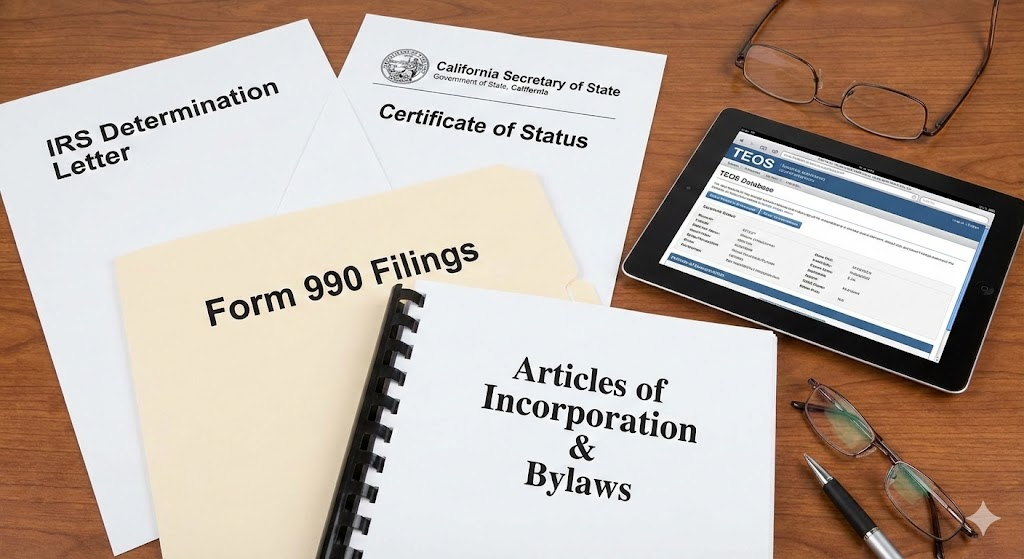
Key documents proving nonprofit standing include IRS determination letter confirming 501(c)(3) status, current TEOS database printout showing federal recognition, California Secretary of State Active status certificate, Franchise Tax Board exemption verification, Attorney General Registry current registration confirmation, recent Form 990 filings demonstrating financial transparency, Articles of Incorporation and bylaws showing governance structure, and board resolutions authorizing specific actions. These documents matter because funders verify claims during due diligence, banks require proof before opening accounts, and partners need documentation before signing agreements.

What federal documents demonstrate tax-exempt status and compliance?

IRS determination letter represents the official federal recognition document. This letter confirms 501(c)(3) approval and states your effective date of exemption. Funders request this letter to verify you’re actually tax-exempt, not just claiming to be. Keep the original determination letter in permanent organizational records and maintain digital copies for sharing.

TEOS database printout from apps.irs.gov/app/eos provides real-time verification. The IRS Tax Exempt Organization Search shows current status—”Eligible to receive tax-deductible contributions” confirms active recognition while “Revoked” or absence from database indicates problems. Many funders check TEOS directly, so you should verify your listing shows correctly before applications.

Form 990 annual returns demonstrate ongoing compliance and financial transparency. Recent 990s show funders your revenue sources, expense patterns, program spending percentages, and compensation practices. Organizations with clean 990 histories signal fiscal responsibility; those with missing years or concerning patterns raise red flags.

What California state documents prove compliance across three agencies?

Secretary of State status certificate shows “Active” corporate standing. The SOS business entity search at bizfileonline.sos.ca.gov generates printable status reports. Active status proves you can legally conduct business and enter contracts. Suspended or Forfeited status blocks grant agreements regardless of program quality.

Franchise Tax Board exemption verification confirms state tax-exempt status. The FTB exempt organization lookup generates printable confirmations. Current exemption without suspension flags proves state compliance. Suspended status indicates missed Form 199 filings and accrued tax liabilities.

Attorney General Registry current registration confirms fundraising authorization. The AG Registry search at oag.ca.gov/charities shows registration status—”Current” means you’re legally authorized to solicit donations in California. “Delinquent” means you’re operating without proper registration, violating charitable solicitation law.

Framework: Launch → Fix → Fund + Federal Recognition + CA Compliance Triangle

Launch includes obtaining and organizing foundational documents. New organizations should create a master documentation folder immediately after receiving IRS determination, collecting all formation and compliance documents in one accessible location.

Fix addresses situations where critical documents are missing or show problems. Organizations discovering suspended status or missing determination letters must obtain current verification documents before pursuing grants.

Fund depends on providing clean documentation quickly. Grant applications request documents with tight deadlines—having organized, current documents ready prevents scrambling or missing opportunities.

Federal Recognition documentation centers on the IRS determination letter and TEOS verification. Without these, you cannot demonstrate federal tax-exempt status to funders or partners.

CA Compliance Triangle requires simultaneous good standing across Secretary of State, Franchise Tax Board, and Attorney General Registry. You need current documentation from all three agencies—weakness in any area blocks funding access.

Step-by-step: How NPLO helps organizations organize standing documentation

Step 1: Document Inventory We identify which standing documents you currently have and which are missing.

Step 2: Current Status Verification We check real-time status across all four agencies, generating current printouts.

Step 3: Missing Document Acquisition We obtain replacement documents for anything missing—duplicate determination letters from IRS, status certificates from SOS.

Step 4: Organization System We create master documentation folders with clear labeling and version control.

Step 5: Digital and Physical Copies We establish both secure digital archives and physical backup files.

Step 6: Update Procedures We implement systems for obtaining fresh status verifications quarterly.

Step 7: Quick-Access Formatting We prepare documents in formats funders commonly request—PDFs, specific page selections.

Step 8: Board Access We ensure board members know where documentation is stored and how to access it.

Checklist: Essential standing documents to maintain

  • IRS determination letter (original or certified copy)
  • Current TEOS database printout (dated within 30 days)
  • Most recent Form 990 (last 3 years preferred)
  • California SOS Active status certificate (current)
  • FTB exemption verification (current)
  • AG Registry current registration confirmation
  • Articles of Incorporation (filed version)
  • Bylaws (current adopted version)
  • Conflict of interest policy (board-approved)
  • Board roster with current contact information
  • Meeting minutes (recent year minimum)
  • Financial statements (recent fiscal year)
  • Audit report (if applicable)
  • Board resolution authorizing grant applications
  • Certificate of insurance (if applicable)

Quick Answers (PPA)

How current do status documents need to be—can we use printouts from six months ago? Most funders want verification dated within 30-90 days of application submission. Status can change between when old printouts were generated and when funders verify—organizations suspended in the interim face rejection even with old documentation showing previous good standing. Generate fresh status printouts quarterly and always obtain new verifications immediately before major grant applications.

What if our IRS determination letter was lost—how do we get a replacement? Request duplicate determination letters from IRS by calling the Tax Exempt and Government Entities division or writing to IRS Exempt Organizations Determinations office. Include your EIN, legal name, and incorporation date. IRS typically provides certified copies for a fee. While waiting, TEOS printouts provide interim verification of tax-exempt status for most purposes.

Do funders actually verify these documents independently, or do they just trust what we submit? Most sophisticated funders verify independently. They check TEOS directly, search California agency databases, and review public Form 990 filings. Submitting false documentation or claiming status you don’t have gets discovered during due diligence and results in immediate application rejection plus potential fraud investigations. Always provide accurate, current documentation matching what independent verification will show.

Can we black out sensitive information like board member addresses before sharing documents? Some information can be redacted while other information cannot. EIN and organizational identifying information must remain visible for verification purposes. Board member personal addresses can often be redacted if funders don’t specifically require them. However, blanket redaction of all board information raises transparency concerns. Review specific funder requirements and redact only what’s truly sensitive while maintaining verification capability.

What’s the difference between Articles of Incorporation we filed versus bylaws—which do funders want? Articles of Incorporation are the legal formation document filed with Secretary of State creating corporate existence. Bylaws are internal governance rules adopted by the board. Funders commonly request both—Articles prove legal existence and contain required charitable purpose language, while bylaws demonstrate governance structure and operational procedures. Some funders request only one; comprehensive applications typically request both.

What to do next (DIY vs Done-With-You)

DIY approach: Create master documentation folder organizing all standing documents. Verify current status across all four agencies—IRS TEOS, CA SOS, CA FTB, CA AG Registry. Generate and save dated printouts from each. Locate your IRS determination letter, Articles of Incorporation, and current bylaws. If determination letter is missing, request replacement from IRS. Download recent Form 990 filings from GuideStar or IRS. Compile recent board meeting minutes, financial statements, and board roster. Scan everything to PDF format for electronic sharing. Create both digital archive (secure cloud storage with backup) and physical binder with organized sections. Update quarterly—generate fresh status verifications, add recent 990s when filed, update board roster when directors change. Before each grant application, verify all documents are current and status printouts are dated within 30 days.

Done-With-You approach: The Nonprofit Launch Office provides comprehensive documentation organization for Moreno Valley and Inland Empire nonprofits. We inventory existing documents and identify gaps, verify current status across all agencies with dated printouts, obtain replacement documents for anything missing, create organized master documentation systems with clear labeling, establish digital archives and physical backup files, implement quarterly update procedures, prepare documents in formats funders commonly request, ensure board members can access documentation when needed, and provide quick-turnaround verification updates before urgent grant deadlines. This ensures you have complete, current, organized documentation ready when opportunities arise rather than scrambling under deadline pressure.

Contact

Book: https://thedocumentpro.com/
 Call: 1(800) 285-0078
 Email: mydocumentpro@gmail.com
 The Nonprofit Launch Office™ — a discipline of The Document Pro, operated by Gitta Williams.
 Operated by The Document Pro (Gitta Williams)

Sources


Disclaimer

Document preparation and nonprofit readiness support — not legal or tax advice.
Short Answer

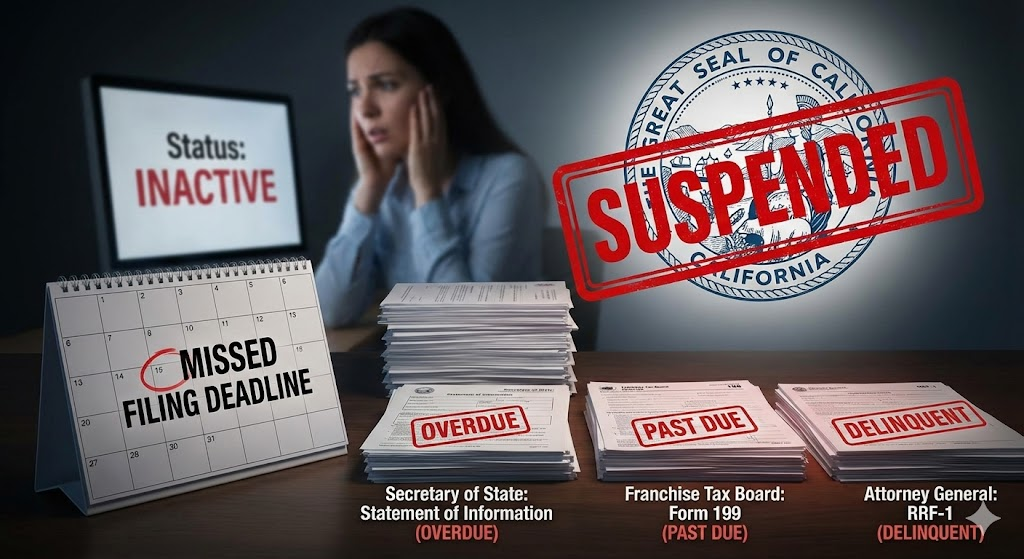
Missing recurring California state filings triggers progressive consequences depending on which filing was missed and for how long—California Secretary of State suspension for missed Statement of Information filings prevents the organization from legally conducting business or entering contracts, Franchise Tax Board suspension for missed Form 199 filings blocks state tax-exempt status and can trigger penalties, and Attorney General Registry delinquency for missed RRF-1 renewals technically prohibits charitable solicitation and fundraising until registration is current. These consequences matter for nonprofits because suspended or delinquent status discovered during grant due diligence typically results in immediate application rejection regardless of program quality, banking relationships may be affected when financial institutions verify organizational standing, the organization cannot enter legally enforceable contracts including grant agreements while suspended, and restoration requires filing all delinquent returns plus paying penalties and reinstatement fees. Eligibility varies by filing type, but Temecula and Inland Empire nonprofits can restore good standing through systematic remediation filing overdue returns and paying associated costs, though prevention through compliance calendars and deadline tracking proves far less expensive and disruptive than after-the-fact restoration efforts.

What specific consequences follow from each type of missed California filing?

Secretary of State Statement of Information filing lapses create corporate status problems when the biennial filing (due every two years during the organization’s designated filing month) isn’t submitted by the deadline. California nonprofit corporations must file Statement of Information updating the organization’s registered agent, principal office address, and current directors. Missing this filing initially doesn’t trigger immediate consequences—California provides grace periods before taking action. However, continued non-filing eventually results in Secretary of State changing corporate status from “Active” to “Suspended” or in severe cases “Forfeited.” Suspended status means the organization cannot legally conduct business in California, cannot enter enforceable contracts (including grant agreements), and technically should cease operations until status is restored through filing overdue Statement of Information and paying reinstatement fees.

Franchise Tax Board Form 199 or Form 199N filing lapses create state tax exemption problems when the annual California return isn’t filed by the deadline (typically the 15th day of the 5th month after fiscal year end, same as federal Form 990 deadline). The FTB requires tax-exempt nonprofits to file annually even though they owe no taxes—the filing maintains state tax-exempt status and demonstrates continued eligibility. Missing Form 199 filings triggers FTB suspension of tax-exempt status after appropriate notice periods. FTB suspension means the organization loses California state tax exemption (though federal IRS recognition remains unaffected), the organization is assessed minimum franchise tax ($800 annually) which accrues until resolved, penalties and interest accumulate on unpaid taxes, and the organization shows “Suspended” status in FTB lookups that funders commonly check during due diligence.

Attorney General Registry of Charities RRF-1 renewal filing lapses create fundraising registration problems when the annual renewal isn’t submitted by the deadline (within 4 months and 15 days after fiscal year end, matching Form 990 deadline). Most California nonprofits must register with Attorney General Registry and file annual RRF-1 renewals to maintain legal authority to solicit charitable donations in California. Missing RRF-1 renewals changes Registry status from “Current” to “Delinquent.” Delinquent status means the organization is technically operating without proper fundraising authorization, is violating California charitable solicitation law if continuing to fundraise, may face Attorney General investigation or enforcement action, and cannot demonstrate current registration to funders who verify Registry status during grant due diligence.

Combined filing failures across multiple agencies create compounding problems because California’s three-agency oversight structure (Secretary of State, Franchise Tax Board, Attorney General Registry) operates independently. An organization might be current with IRS federally but suspended by both FTB and Secretary of State while also delinquent with Attorney General. Each agency problem must be resolved separately—there’s no single “fix everything” filing that restores good standing across all three agencies simultaneously. Murrieta nonprofits discovering multiple concurrent suspensions face coordinating restoration efforts across three different state agencies with different procedures, forms, fees, and timelines.

How do you discover missed filings and what’s the restoration process?

Proactive status verification through periodic checking prevents the surprise discovery of missed filings during urgent grant applications or partnerships. Organizations should regularly (quarterly or at minimum annually) verify their status with all three California agencies plus IRS: search California Secretary of State business entity database confirming “Active” status, check Franchise Tax Board exempt organization lookup confirming tax-exempt status without suspension flags, search Attorney General Registry of Charities confirming “Current” registration status, and verify IRS TEOS database showing “Eligible to receive tax-deductible contributions” without revocation warnings. Many suspended organizations only discover problems when funders notify them that due diligence verification revealed compliance issues—at which point restoration must happen urgently under deadline pressure.

Secretary of State reinstatement to Active status requires filing all overdue Statement of Information returns for each missed period (if you missed three filing cycles, you file three separate Statements), paying the current filing fee for each overdue Statement ($20 per filing currently), and potentially paying reinstatement penalties if status reached Forfeited rather than just Suspended. Secretary of State processing of reinstatement typically happens within days to a couple weeks once complete filings and fees are submitted, making SOS restoration the fastest of California’s three agencies. However, you must know your designated filing month and which periods were missed—organizations that moved or changed leadership sometimes lose track of filing schedules.

Franchise Tax Board restoration from suspension requires filing all delinquent Form 199 or Form 199N returns for every year missed, paying accrued minimum franchise taxes ($800 per year assessed while suspended), paying penalties and interest on unpaid taxes, and submitting abatement requests if circumstances warrant penalty reduction. FTB processing of reinstatement and suspension lifts typically takes 4-8 weeks after complete filings and payments are received. Organizations suspended for multiple years may owe thousands in back taxes plus penalties before FTB lifts suspension—a significant financial burden for small nonprofits that missed filings through oversight rather than deliberate avoidance.

Attorney General Registry restoration from delinquent status requires filing all overdue RRF-1 annual renewals for each year missed, paying late filing fees ($25 for renewals filed within one year of due date, increasing for longer delays), and potentially re-registering if registration lapsed entirely rather than just becoming delinquent. AG Registry processing typically happens within 2-4 weeks of receiving complete filings and fees. Unlike SOS and FTB which impose significant financial penalties, AG Registry late fees are relatively modest—but the legal exposure from fundraising without current registration is serious even though financial penalties are low.

Framework: Launch → Fix → Fund + Federal Recognition + CA Compliance Triangle

The Nonprofit Launch Office operates within a strategic framework designed to help California nonprofits move from formation to fundability:

Launch includes establishing compliance calendars and tracking systems from day one preventing missed filings before they occur. Launch-phase organizations should create comprehensive filing calendars showing all federal and California deadlines—IRS Form 990, California Form 199, Statement of Information in designated filing month, RRF-1 renewal deadline—with advance reminders 90, 60, and 30 days before each deadline. Organizations that launch with systematic compliance tracking rarely experience the missed filing crises that plague organizations treating compliance as afterthought rather than operational priority.

Fix is precisely what organizations with missed filings need—urgent remediation restoring good standing across all affected agencies before compliance problems block critical funding or partnership opportunities. Fix work involves discovering the full extent of filing lapses across all agencies (many organizations find multiple concurrent problems when they start investigating), prioritizing which agency restorations are most urgent based on immediate organizational needs, coordinating simultaneous filings across multiple agencies to restore complete compliance rather than fixing one problem while others persist, and implementing prevention systems ensuring missed filings don’t recur after expensive restoration efforts.

Fund becomes impossible when missed filings create suspended or delinquent status because funders conducting due diligence verification discover compliance problems and reject applications immediately. Grant applications commonly ask organizations to certify good standing with all applicable agencies—answering “yes” while actually suspended constitutes misrepresentation, while answering “no” triggers immediate disqualification. Organizations must pause grant pursuit during Fix phase while restoring compliance, then resume applications once all agencies show current status. The missed funding opportunities during restoration periods often exceed the direct costs of penalties and fees.

Federal Recognition through IRS 501(c)(3) determination remains unaffected by California state filing lapses in most cases—you can be suspended by California agencies while maintaining current federal tax-exempt status. However, IRS reviews Form 990 filings and may notice through Schedule O narratives or other disclosures that California compliance problems exist, potentially triggering questions during audits. Additionally, some funders won’t consider applications from organizations with any compliance problems regardless of whether issues are state or federal.

CA Compliance Triangle illustrates why missed California filings are particularly problematic—the three-agency structure (Secretary of State, Franchise Tax Board, Attorney General Registry) means problems can exist with one, two, or all three agencies simultaneously, and each must be resolved independently. Unlike states with single-agency nonprofit oversight, California requires maintaining current status with three separate agencies plus federal IRS, creating four verification points where problems might exist. The triangle structure means you cannot compensate for weakness in one area with strength in another—suspended FTB status blocks grant access regardless of current SOS and AG status.

Step-by-step: How NPLO helps organizations restore standing after missed filings

Step 1: Comprehensive Status Verification We check organizational status across all four agencies (IRS, CA SOS, CA FTB, CA AG Registry) identifying every compliance problem that exists rather than addressing only the one missed filing you discovered. Many organizations find multiple concurrent issues once systematic verification happens—suspended SOS status, suspended FTB status, and delinquent AG Registry all existing simultaneously. Complete assessment prevents fixing one problem while remaining unaware of others.

Step 2: Missing Filing Identification We determine which specific filings were missed, for what periods, and when they were originally due. This requires reconstructing filing history—what fiscal year does your organization use, when is your SOS designated filing month, what years have RRF-1 renewals been filed—information that organizations with poor record-keeping may have lost. Accurate identification of all missing filings prevents the problem where you file some delinquent returns but miss others, failing to achieve complete restoration.

Step 3: Restoration Priority Assessment We help prioritize which agency restorations are most urgent based on immediate organizational needs. If you have a grant application deadline in three weeks, FTB restoration (4-8 weeks processing) might not complete in time while SOS restoration (days to weeks) could, suggesting whether pursuing the grant makes sense or requires delay. If you need to sign a partnership contract immediately, SOS Active status restoration becomes top priority. Strategic prioritization focuses resources on highest-impact restoration efforts first.

Step 4: Delinquent Filing Preparation and Submission We prepare all overdue filings for each agency—completing missed Statement of Information forms with accurate current data, preparing delinquent Form 199 returns for each year missed with accurate financial information, and completing overdue RRF-1 renewals with required financial schedules. We coordinate simultaneous submission to all affected agencies rather than sequential filing that extends total restoration timeline unnecessarily.

Step 5: Penalty and Fee Calculation We calculate total costs for restoration including base filing fees for each delinquent return, reinstatement fees where applicable, accrued franchise taxes if FTB suspended, penalties and interest on unpaid amounts, and late filing fees for AG Registry renewals. Cost transparency allows organizational planning and prevents the surprise when restoration proves more expensive than anticipated—multiple years of missed filings can cost thousands in back taxes and penalties.

Step 6: Abatement Request Preparation When circumstances warrant, we prepare penalty abatement requests explaining why penalties should be reduced or waived—reasonable cause for missing filings (organizational transition, board turnover, poor recordkeeping systems now corrected), first-time penalty abatement if organization has clean history otherwise, or financial hardship making full penalty payment difficult. Agencies have discretion to reduce penalties when persuasive explanations and genuine remediation efforts are demonstrated.

Step 7: Restoration Monitoring and Verification We track submission status with each agency, follow up on processing delays, and verify once agencies update status to current/active. We obtain and save documentation of restored status—current SOS status printout, FTB exemption verification, AG Registry current status confirmation. This documentation proves to funders conducting due diligence that compliance problems have been resolved.

Step 8: Prevention System Implementation Once restoration is complete, we implement systems preventing recurrence—comprehensive compliance calendars with all filing deadlines, automated reminder systems providing advance notice before deadlines, clear responsibility assignment for tracking and completing each filing, and quarterly status verification routines catching problems early before they escalate to suspension. Prevention systems ensure expensive restoration efforts don’t repeat in future years.

Checklist: What you need to restore good standing after missed filings

Murrieta nonprofits restoring compliance after missed filings should:

  • Verify status comprehensively checking IRS TEOS, CA SOS entity search, CA FTB exempt org lookup, and CA AG Registry to identify all problems
  • Identify all missed filings determining which returns were due for what periods across all agencies
  • Gather historical financial data needed to complete delinquent returns accurately—prior year revenues, expenses, program activities
  • Calculate total restoration costs including filing fees, reinstatement fees, back taxes, penalties, interest, and late fees
  • Prepare all delinquent filings completing forms accurately with historical data for each missed period
  • Submit filings with payment to each affected agency simultaneously to accelerate overall restoration timeline
  • Request penalty abatement if circumstances justify reduced penalties—reasonable cause, first-time abatement, hardship
  • Track processing status following up with agencies about restoration timeline
  • Verify restored status obtaining current status documentation from each agency once processing completes
  • Pause grant applications during restoration if deadlines won’t allow completion before due diligence verification
  • Notify affected funders if mid-application when compliance problems discovered, explaining restoration efforts underway
  • Document lessons learned identifying why filings were missed and what systems failed
  • Implement prevention systems creating calendars, reminders, responsibility assignments preventing future missed filings
  • Conduct quarterly verification checking status regularly to catch future problems early before escalation
  • Update board on compliance restoration, costs incurred, and prevention measures implemented

Quick Answers (PPA)

How long does it typically take to restore good standing once you discover missed filings? Restoration timeline varies by agency and how many years of filings were missed. California Secretary of State restoration happens fastest—typically days to 2 weeks after filing overdue Statement of Information and paying fees. Attorney General Registry restoration typically takes 2-4 weeks after filing overdue RRF-1 renewals. Franchise Tax Board restoration takes longest—typically 4-8 weeks after filing delinquent Form 199 returns and paying back taxes, penalties, and interest. If you missed filings with multiple agencies simultaneously, total restoration timeline is determined by the slowest agency (typically FTB), meaning you should expect minimum 4-8 weeks from starting restoration efforts to achieving complete good standing across all agencies. Organizations facing imminent grant deadlines may not have time for complete restoration before applications are due.

Can we still apply for grants while restoration is in process, or must we wait until status is fully restored? This depends on funder requirements and application timing. Most funders verify organizational status during due diligence, which for competitive grants might happen weeks or months after application deadline—if you submit application while in restoration process and status is restored before due diligence occurs, the funder may never know problems existed. However, many grant applications ask organizations to certify current good standing at time of application submission—answering “yes” while actually suspended constitutes misrepresentation even if you’re actively working on restoration. The safer approach involves transparent communication: notify funders that compliance issues exist but restoration is underway, provide documentation of restoration efforts and expected completion timeline, and ask whether they’ll consider applications conditionally pending verification of restored status. Some funders accommodate this; others maintain strict eligibility requirements requiring current status at application submission.

What if we can’t afford to pay all the back taxes and penalties—are there payment plans or options? California Franchise Tax Board offers payment plan options for organizations unable to pay full tax liabilities immediately, typically requiring some down payment with monthly payments for remaining balance over agreed period. However, suspension typically isn’t lifted until full payment or approved payment plan is established and initial payment made—you can’t restore status without addressing financial obligations. For organizations facing genuine financial hardship, requesting penalty abatement explaining circumstances and demonstrating inability to pay full amounts may reduce total obligations to manageable levels. In severe cases where years of back taxes create obligations exceeding organizational capacity to pay, consulting with tax professionals about options including potential tax-exempt status reinstatement procedures or organizational dissolution and reformation may be necessary—though dissolution and reformation creates significant complications and should be last resort.

Will missed California state filings affect our federal IRS tax-exempt status? Generally no—California state filing lapses don’t directly affect federal IRS 501(c)(3) status. You can be suspended by California Franchise Tax Board while maintaining current IRS recognition, or be delinquent with Attorney General Registry while showing “Eligible to receive tax-deductible contributions” in IRS TEOS database. Federal and state tax-exempt statuses are separate and independent. However, IRS Form 990 includes questions about compliance with state filing requirements, and persistent state compliance problems might raise IRS questions during audits or reviews about overall organizational management quality. Additionally, some state compliance problems (like failure to maintain registered agent) might prevent IRS from communicating with organization about federal matters, potentially creating indirect federal problems. The key point is that state filing lapses should be corrected to restore state standing, but they don’t immediately trigger federal IRS revocation.

How do we prevent this from happening again after going through expensive restoration? Prevention requires systematic compliance management rather than reactive crisis response. Create comprehensive filing calendar listing every federal and California deadline—IRS Form 990 (15th day of 5th month after fiscal year end), California Form 199 (same deadline as 990), Statement of Information (specific designated filing month every two years), RRF-1 renewal (within 4 months 15 days after fiscal year end). Set automated reminders 90, 60, and 30 days before each deadline. Assign clear responsibility for tracking and completing filings—board treasurer, executive director, bookkeeper, or outside accountant depending on organizational structure. Conduct quarterly status verification checking all four agencies (IRS, SOS, FTB, AG) to catch problems early. Maintain organized records of when filings were submitted and confirmations received. Budget annually for filing fees and professional preparation assistance. Many Murrieta nonprofits that experienced suspension implement these systems and never face compliance crises again.

What to do next (DIY vs Done-With-You)

DIY approach: Immediately verify your current status with all four agencies: search IRS TEOS database at apps.irs.gov/app/eos, check California Secretary of State business entity search at bizfileonline.sos.ca.gov, verify Franchise Tax Board exempt organization status, and search Attorney General Registry of Charities at oag.ca.gov/charities. Save screenshots showing current status for all four agencies dated today. If any show suspended or delinquent status, determine which specific filings were missed—review organizational records to identify your fiscal year end, SOS designated filing month, and when last filings were submitted for Form 990, Form 199, Statement of Information, and RRF-1. Calculate how many years or periods of filings are missing. Gather financial data needed to complete delinquent returns—prior year revenues, expenses, program information from bank records, board minutes, or other documentation. Download appropriate forms for each missed filing from agency websites. Complete all delinquent filings accurately. Calculate total fees, taxes, penalties, and interest owed. Submit all filings simultaneously with required payments. Track processing status and follow up if delays occur. Once restored, create compliance calendar preventing recurrence and implement quarterly status verification routine.

Done-With-You approach: The Nonprofit Launch Office provides comprehensive compliance restoration for Murrieta and Inland Empire nonprofits facing suspended or delinquent status from missed state filings. We conduct thorough verification across all four agencies identifying every compliance problem comprehensively, reconstruct filing history determining which returns were missed for what periods, gather and organize historical data needed for accurate delinquent filing preparation, prepare all overdue filings with proper financial information and narratives, calculate total restoration costs including fees, taxes, penalties, and interest, coordinate simultaneous submission to all agencies accelerating overall restoration timeline, prepare penalty abatement requests when circumstances warrant reduced penalties, track processing status and follow up ensuring timely completion, verify restored status and obtain documentation proving compliance resolution, communicate with funders if mid-application explaining restoration efforts and timeline, implement prevention systems including calendars, reminders, and responsibility assignments, and provide ongoing compliance monitoring preventing future missed filing crises. This comprehensive approach resolves current problems while preventing expensive repeat occurrences.

Contact

Book: https://thedocumentpro.com/
 Call: 1(800) 285-0078
 Email: mydocumentpro@gmail.com
 The Nonprofit Launch Office™ — a discipline of The Document Pro, operated by Gitta Williams.
 Operated by The Document Pro (Gitta Williams)

Sources


Disclaimer

Document preparation and nonprofit readiness support — not legal or tax advice.