
15 Jan Do I Really Need a Nonprofit to Get Grants in Inland Empire, California?
Short Answer
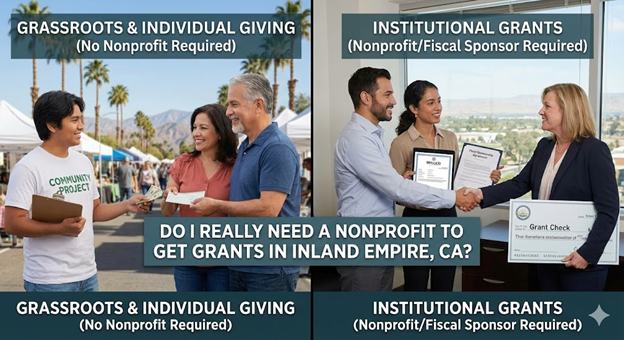
Most institutional grant makers in Inland Empire, California require applicants to hold federal 501(c)(3) tax-exempt status or operate through fiscal sponsorship arrangements where a recognized nonprofit serves as the legal grant recipient. While some grassroots funding, individual donations, and crowdfunding campaigns don’t require nonprofit status, eligibility for foundation grants, government contracts, corporate giving programs, and most structured funding sources typically depends on having verifiable tax-exempt recognition through the IRS or an established fiscal sponsor relationship. Eligibility varies by grant, but forming a nonprofit or securing fiscal sponsorship generally opens significantly more funding opportunities than operating as an unincorporated group or for-profit entity.
What types of funding actually require nonprofit status?
Foundation grants represent one of the largest funding categories requiring 501(c)(3) status. Community foundations like the Inland Empire Community Foundation, regional grantmakers, and national foundations typically limit eligibility to organizations holding current IRS determination letters showing tax-exempt charitable status. These funders need tax-exempt recipients because their own charitable mission and tax status depend on distributing funds to qualified organizations, not to individuals or for-profit entities.
Government grants and contracts at federal, state, county, and municipal levels generally require nonprofit status for programs serving public benefit. When Riverside County or San Bernardino County issue requests for proposals for social services, youth programs, or community development initiatives, eligible applicants typically must demonstrate 501(c)(3) recognition. Government funders face accountability requirements ensuring public money supports charitable purposes through legally recognized tax-exempt organizations.
Corporate giving programs from major employers in the Inland Empire often restrict charitable contributions to verified 501(c)(3) organizations because corporate donations to qualified nonprofits provide tax deductions under IRS rules. Companies want documentation proving their contributions support tax-exempt charitable purposes rather than personal projects or commercial ventures. Corporate matching gift programs, employee volunteer grants, and strategic philanthropy initiatives typically verify nonprofit status before releasing funds.
Service clubs, civic organizations, and religious institutions making grants usually prefer or require 501(c)(3) status to ensure their charitable dollars support legally recognized charitable work. Even when these funders have flexibility to support unincorporated groups, they often choose established nonprofits because verification of tax-exempt status provides assurance about organizational legitimacy and charitable purpose.
However, some funding sources don’t require nonprofit status. Individual donor campaigns, crowdfunding platforms, small grassroots grants from informal community groups, certain types of business sponsorships, and program fees or earned income generally don’t depend on 501(c)(3) recognition. Groups operating without nonprofit status can often access these funding streams, though the total available dollars typically represent a fraction of institutional grant opportunities.
What’s the alternative to forming your own nonprofit?
Fiscal sponsorship provides an established alternative to forming your own nonprofit, allowing projects and initiatives to receive tax-deductible contributions and pursue grants before completing the lengthy process of securing independent 501(c)(3) status. Under fiscal sponsorship, an existing nonprofit with IRS recognition agrees to accept and manage funds on behalf of your project, acting as the legal grant recipient while you operate the programs.
Several fiscal sponsorship models exist, but the most common for Moreno Valley and Inland Empire groups involves “comprehensive” or “Model A” sponsorship where the sponsor organization exercises significant control and the sponsored project becomes a program of the sponsor. The sponsor’s board maintains legal and financial oversight, the project operates under the sponsor’s tax exemption, and donors receive tax deductions through the sponsor’s 501(c)(3) status.
Fiscal sponsorship offers distinct advantages for new initiatives. You can begin fundraising and grant applications immediately using the sponsor’s established compliance status rather than waiting 6-12 months for IRS determination of your own exemption. You avoid initial formation costs for incorporation, federal applications, and state registrations. You benefit from the sponsor’s existing administrative infrastructure, financial systems, and compliance expertise without building these capacities yourself.
However, fiscal sponsorship involves meaningful tradeoffs. Sponsors typically charge administrative fees ranging from 5% to 15% of contributed funds to cover overhead, compliance management, and insurance costs. The sponsor maintains legal control over funds and program decisions, which can limit your autonomy. If the sponsor’s organizational priorities shift or their compliance status encounters problems, your project faces vulnerability. Fiscal sponsorship works best as a temporary arrangement while you determine whether your initiative has sustainable support justifying independent nonprofit formation.
Fiscal sponsorship doesn’t eliminate all compliance work—sponsors generally require detailed budgets, program reports, and evidence that your activities align with their charitable mission and IRS exemption. You’re essentially operating as a program of the sponsor organization rather than as an independent entity. For some Inland Empire initiatives, this arrangement provides ideal support during development phases. For others, the limitations and costs make direct nonprofit formation more strategic.
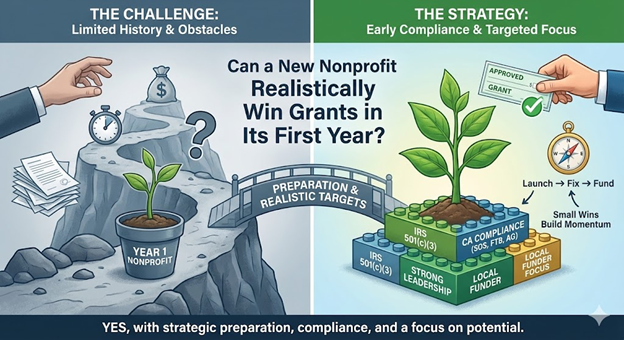
Framework: Launch → Fix → Fund + Federal Recognition + CA Compliance Triangle
The Nonprofit Launch Office operates within a strategic framework designed to help California nonprofits move from formation to fundability:
Launch means making strategic decisions about organizational structure before filing any paperwork. For groups asking whether they need a nonprofit, Launch-phase guidance helps evaluate whether fiscal sponsorship, independent 501(c)(3) formation, or alternative structures best serve their mission, funding goals, timeline, and capacity. Launch includes understanding what different structures enable or restrict, analyzing which funding sources align with your work, and choosing the formation path that positions you for sustainable success.
Fix addresses situations less relevant to new founders but critical when existing nonprofits lost status or formed incorrectly. For organizations that incorporated without considering compliance requirements or attempted to operate through inadequate structures, Fix work involves restructuring, securing missing registrations, or transitioning from fiscal sponsorship to independent status when appropriate.
Fund represents the operational state where your chosen structure—whether independent nonprofit or fiscally sponsored project—maintains the compliance and documentation profile funders verify. Fund-phase work differs between independent nonprofits (maintaining direct compliance across federal and state agencies) and fiscally sponsored projects (meeting sponsor requirements and supporting the sponsor’s compliance obligations).
Federal Recognition through IRS 501(c)(3) determination forms the foundation for most institutional grant access. Whether you pursue recognition independently or access it through fiscal sponsorship determines your timeline, costs, control, and long-term flexibility. Federal recognition typically requires 3-6 months minimum from application to determination, though backlogs can extend this considerably. Fiscal sponsorship provides immediate access to an existing organization’s federal recognition.
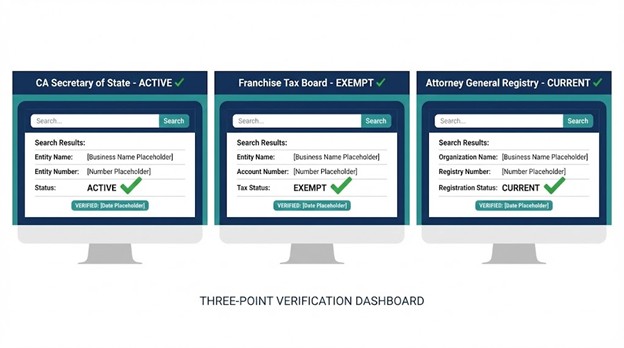
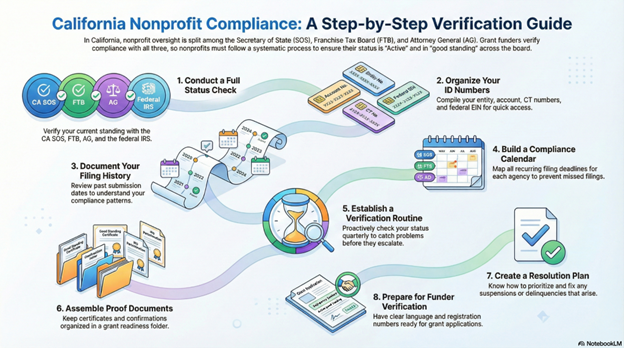
CA Compliance Triangle represents California’s three-agency oversight system (Secretary of State, Franchise Tax Board, Attorney General Registry of Charities). Independent nonprofits must maintain direct compliance with all three agencies. Fiscally sponsored projects operate under their sponsor’s compliance status, avoiding direct responsibility but also lacking independent verification. The compliance burden difference significantly affects the nonprofit-versus-sponsorship decision for Moreno Valley groups evaluating formation options.
Step-by-step: How NPLO helps evaluate and navigate formation decisions
Step 1: Funding Landscape Assessment We analyze which funding sources your initiative realistically targets—foundation grants, government contracts, corporate giving, individual donations, earned income, or mixed strategies. This assessment reveals whether the funding you need requires 501(c)(3) status or whether alternative structures provide adequate access. Understanding your actual funding landscape prevents over-investing in unnecessary infrastructure or under-investing in essential recognition.
Step 2: Timeline and Urgency Evaluation We determine your timeline for needing funding access. If you need to apply for grants within 2-3 months, fiscal sponsorship may be necessary because independent 501(c)(3) formation typically requires 6-12 months minimum. If you have 12-18 months before major funding needs, independent formation may be preferable to avoid ongoing sponsorship fees and control limitations.
Step 3: Organizational Capacity Analysis We assess your capacity for managing compliance obligations independently. Maintaining 501(c)(3) status requires annual IRS filings, California multi-agency compliance, board governance, financial record-keeping, and policy management. Organizations with limited volunteer capacity or no paid staff may find fiscal sponsorship provides essential administrative support during development phases.
Step 4: Strategic Control Consideration We help evaluate how much organizational autonomy matters for your mission and operations. Fiscal sponsorship involves sponsor oversight, approval requirements, and potential program restrictions. Independent nonprofit status provides full control over direction, priorities, and decisions (subject to board governance and IRS rules). The control tradeoff significantly affects long-term sustainability and program evolution.
Step 5: Cost-Benefit Comparison We calculate the financial implications of each path. Independent nonprofit formation involves upfront costs ($275 California incorporation, $600-$750 IRS application fees for larger organizations using Form 1023, various state filing fees) plus ongoing compliance costs. Fiscal sponsorship involves lower upfront costs but ongoing percentage fees on all contributed funds. We project costs over 3-5 years to reveal which approach proves more economical.
Step 6: Formation Process Guidance For groups choosing independent nonprofit formation, we provide systematic guidance through California incorporation (Articles of Incorporation with Secretary of State), initial board establishment, bylaws adoption, EIN application with IRS, federal 501(c)(3) application (Form 1023 or 1023-EZ), California exemption with Franchise Tax Board, and registration with Attorney General Registry of Charities. This comprehensive process establishes independent grant-ready status.
Step 7: Fiscal Sponsor Identification and Evaluation For groups choosing fiscal sponsorship, we help identify potential sponsors with missions aligned to your work, capacity to provide quality sponsorship services, reasonable fee structures, and solid compliance histories. We assist with evaluating sponsor agreements, negotiating terms where possible, and understanding obligations on both sides of the relationship.
Step 8: Hybrid or Transition Planning We help groups considering starting under fiscal sponsorship with planned transition to independent status develop realistic timelines, understand transition requirements, and prepare for eventual independence. This hybrid approach provides immediate funding access while building toward long-term autonomy when capacity and resources support independent operations.
Checklist: What you should consider before deciding your structure
These strategic questions help Moreno Valley and Inland Empire groups make informed structure decisions:
- Funding target assessment: Which specific funders or funding types does your work require access to, and what do their eligibility criteria actually specify?
- Timeline urgency: How soon do you need to pursue grant funding—within months, within a year, or in 1-2+ years?
- Administrative capacity: Do you have staff, volunteers, or board members capable of managing ongoing compliance filings and documentation?
- Financial sustainability: Can your initiative generate enough revenue to cover both program costs and compliance overhead, or does tight budget favor fiscal sponsorship?
- Organizational autonomy: How important is independent decision-making authority versus accepting sponsor oversight and approval requirements?
- Mission alignment: If considering fiscal sponsorship, do potential sponsors share values and mission alignment that supports long-term partnership?
- Geographic scope: Will your work remain local to Inland Empire or expand regionally/nationally, and how does scope affect structure needs?
- Collaboration requirements: Does your work involve partnerships with government agencies, schools, or other institutions that may require independent nonprofit status?
- Liability considerations: Does your programming involve risks (working with vulnerable populations, property ownership, employee management) where independent incorporation provides important liability separation?
- Long-term vision: Where do you see this initiative in 5-10 years—still a small project, or a substantial organization with multiple programs and staff?
- Board development: Do you have potential board members committed to governance responsibilities, or would recruiting and managing a board create unsustainable burden?
- Tax deduction importance: How critical are tax-deductible contributions to your donors, and could you successfully fundraise without providing tax deductions?
Quick Answers (PPA)
Can I apply for grants as an individual or do I absolutely need a nonprofit or fiscal sponsor? A small number of grants support individual artists, researchers, or activists without requiring nonprofit status, but these represent a tiny fraction of total grant funding available. The vast majority of foundation grants, government contracts, and corporate giving programs require recipients to hold 501(c)(3) status or operate through fiscal sponsorship. Attempting to pursue grants without nonprofit structure typically results in immediate ineligibility for most opportunities. For Inland Empire groups serious about institutional funding, nonprofit formation or fiscal sponsorship generally proves essential.
How long does it take to get 501(c)(3) status and can I fundraise while waiting? From the day you file Form 1023 or 1023-EZ with the IRS, determination typically takes 3-6 months, though processing times vary and can extend longer during IRS backlogs. You can accept donations during the application period, but donors cannot claim tax deductions until your determination is granted (though IRS generally provides retroactive recognition to your formation date if approved). Many funders won’t consider grant applications until you have actual determination in hand. This timeline gap explains why some Moreno Valley groups choose fiscal sponsorship for immediate funding access while pursuing independent recognition in parallel.
Is fiscal sponsorship cheaper than forming my own nonprofit? Short-term, fiscal sponsorship typically costs less because you avoid incorporation fees ($275), IRS application fees ($275-$600), and various state filing fees. However, fiscal sponsors charge ongoing administrative fees (typically 5-15% of all funds) that compound over time. A project raising $50,000 annually under a sponsor charging 10% pays $5,000 per year in sponsorship fees. Over five years, that’s $25,000 in fees—far exceeding one-time formation costs of independent nonprofit structure. The cost equation favors fiscal sponsorship for short-term projects and independent formation for sustainable long-term organizations.
What happens if I start under fiscal sponsorship and later want to become independent? Transitioning from fiscal sponsorship to independent nonprofit status is common and generally straightforward, though it requires advance planning. You’ll need to form your own California nonprofit corporation, apply for 501(c)(3) recognition, establish independent compliance systems, and coordinate the transfer of programs, relationships, and potentially funds from sponsor to your new entity. Sponsor agreements vary on fund transfer—some sponsors allow accumulated funds to transfer to the now-independent organization, others retain funds or require board approval for transfer. Review sponsor agreements carefully regarding transition provisions before entering fiscal sponsorship if independence is your long-term goal.
Are there Inland Empire organizations that provide fiscal sponsorship locally? Several established Inland Empire nonprofits provide fiscal sponsorship services for projects aligned with their missions. Community foundations, regional umbrella organizations, and some larger nonprofits offer sponsorship programs. However, sponsors need mission alignment between their charitable purposes and your project’s work—a youth development organization typically won’t sponsor environmental projects, for example. National fiscal sponsorship organizations also serve California projects when local mission-aligned sponsors aren’t available. Identifying appropriate sponsors requires researching organizations whose work connects to yours and reaching out to discuss whether they offer sponsorship services and what their requirements involve.
What to do next (DIY vs Done-With-You)
DIY approach: List the specific grants and funding sources you plan to pursue over the next 2-3 years. Visit each funder’s website and review their eligibility criteria—do they require 501(c)(3) status or accept fiscal sponsorship? Calculate what percentage of your target funding requires nonprofit structure. Research fiscal sponsorship options by identifying Inland Empire nonprofits whose missions align with your work and contacting them about sponsorship services, fees, and requirements. Simultaneously, estimate the costs and timeline for forming your own nonprofit by reviewing IRS Form 1023-EZ eligibility (for organizations projecting under $50,000 annual gross receipts) versus Form 1023, California incorporation requirements, and Attorney General registration. Create a comparison chart weighing fiscal sponsorship costs/benefits/timeline against independent formation, then decide based on your specific funding needs, timeline, and capacity.
Done-With-You approach: The Nonprofit Launch Office provides comprehensive formation strategy consultation for Moreno Valley and Inland Empire groups evaluating structure options. We analyze your specific funding landscape to determine whether nonprofit status is truly necessary for your goals, assess timeline and capacity to recommend fiscal sponsorship versus independent formation, identify mission-aligned fiscal sponsors if sponsorship is appropriate and facilitate introductions, guide complete independent nonprofit formation if that path better serves your strategy, and develop hybrid approaches where you start under sponsorship while building toward independence. This personalized guidance prevents costly mistakes like forming unnecessary corporate structures or choosing fiscal sponsors with misaligned missions, missions, ensures you understand tradeoffs before committing to either path, and positions you for sustainable funding access matching your actual needs and capacity.
Contact
Book: https://thedocumentpro.com/
Call: 1(800) 285-0078
Email: mydocumentpro@gmail.com
The Nonprofit Launch Office™ — a discipline of The Document Pro, operated by Gitta Williams.
Operated by The Document Pro (Gitta Williams)
Sources
- IRS – Charitable Organizations Overview
- IRS Tax Exempt Organization Search (EO Finder)
- California Secretary of State – Business & Nonprofit Entities
- California Franchise Tax Board – Nonprofit Tax Information
- California Attorney General – Registry of Charitable Trusts
- CalNonprofits – Resources for California Nonprofits
Disclaimer
Document preparation and nonprofit readiness support — not legal or tax advice.