case studies

Short Answer

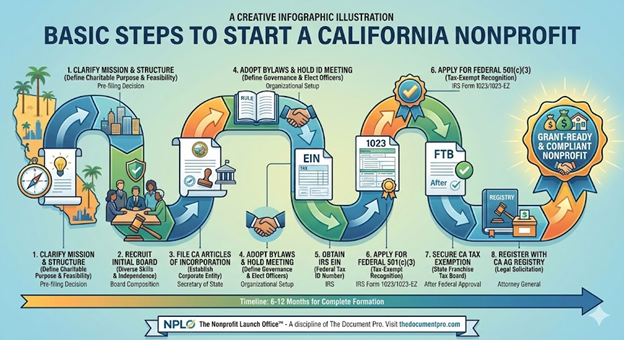
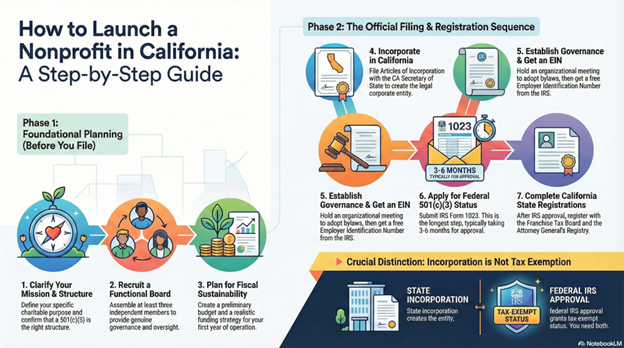
Starting a nonprofit in California requires completing several sequential steps: clarifying your charitable mission and determining whether nonprofit structure serves your goals, selecting and reserving a compliant organizational name, recruiting initial board members who meet legal requirements, drafting and filing Articles of Incorporation with the California Secretary of State establishing corporate existence, adopting bylaws defining governance structure and operational procedures, obtaining an Employer Identification Number from the IRS for tax and banking purposes, applying for federal 501(c)(3) tax-exempt recognition through IRS Form 1023 or 1023-EZ, securing California state tax exemption with the Franchise Tax Board after federal approval, and registering with the California Attorney General Registry of Charities to legally solicit donations. Eligibility varies by organization, but completing all steps typically requires 6-12 months and establishes the compliance foundation necessary for pursuing grants, accepting tax-deductible donations, and operating as a recognized charitable organization in California’s complex regulatory environment.

What foundational decisions must you make before filing any paperwork?

Mission clarity represents the most critical pre-filing decision because your charitable purpose determines IRS eligibility, shapes every formation document, guides board recruitment, and defines programmatic boundaries for your organization’s entire existence. Riverside founders should articulate precisely what community need their nonprofit addresses, what populations it serves, what activities it conducts, and what outcomes it pursues—not in vague generalities like “helping people” but in specific, demonstrable charitable purposes that qualify under IRS Section 501(c)(3). The mission statement becomes foundational language appearing in Articles of Incorporation, IRS applications, grant proposals, and public communications, so investing time in clarity before filing prevents costly amendments later.

Nonprofit structure appropriateness requires honest assessment of whether forming a 501(c)(3) charitable organization actually serves your goals better than alternative structures. Some community initiatives function better as informal volunteer groups, fiscally sponsored projects, social enterprises structured as benefit corporations, or collaborative programs of existing nonprofits rather than independent tax-exempt organizations. Consider whether you have sustainable funding sources beyond initial enthusiasm, whether you can recruit and maintain a functional board providing governance oversight, whether you’re prepared for ongoing compliance obligations including annual IRS and California filings, and whether the benefits of tax-exempt status (tax-deductible donations, grant eligibility, tax exemption) justify the administrative burdens and restrictions nonprofits face.

Board composition planning before filing Articles of Incorporation prevents common problems like insufficient directors to meet California’s three-person minimum, board members who don’t understand fiduciary responsibilities, or governance structures that violate conflict of interest rules. Ideal founding boards include members bringing diverse skills—financial oversight, legal/compliance understanding, fundraising capacity, programmatic expertise, community connections—and represent the communities you serve. California law prohibits nonprofit boards from being controlled by single families or having majority membership receiving compensation from the organization, so board design must ensure genuine independent oversight rather than serving as rubber stamp for founders’ decisions.

Fiscal sustainability planning before incorporation establishes realistic expectations about revenue generation and operational costs. Map potential funding sources—individual donations, foundation grants, government contracts, earned income, corporate sponsorships—and honestly assess which are accessible given your mission, capacity, and timeline. Develop preliminary budgets showing startup costs (incorporation fees, initial supplies, insurance) and first-year operating expenses (space, staff/contractors, program costs, compliance) against projected revenue. Organizations that launch without financial planning often discover too late that their program models don’t generate sufficient revenue to sustain operations, leading to organizational collapse despite good intentions.

What are the actual filing steps in sequence with California and federal agencies?

Name reservation with California Secretary of State represents the first formal step, requiring that your chosen name includes a corporate designation (Corporation, Incorporated, Limited, etc. or abbreviations Corp., Inc., Ltd.), doesn’t confusingly resemble existing registered names, and complies with nonprofit naming restrictions. The SOS business name database at bizfileonline.sos.ca.gov allows checking name availability before attempting reservation or filing. While name reservation isn’t mandatory, it protects your chosen name for 60 days while you prepare other formation documents, preventing another organization from registering the same name during your preparation period.

Articles of Incorporation filing with California Secretary of State creates the legal corporate entity by submitting Form ARTS-PB-501(c)(3) or equivalent document containing required elements: corporate name and California address, statement of charitable purpose aligned with IRS requirements, dissolution clause specifying that assets go to other 501(c)(3) organizations if your nonprofit dissolves, prohibition on private inurement ensuring no individual profits from organizational assets, and initial agent for service of process with California street address. The current filing fee is $30 plus $15 for Statement of Information if filed simultaneously. Upon acceptance, California issues a corporation number and your nonprofit legally exists as a California corporation, though not yet tax-exempt.

Organizational meeting of initial board establishes governance by adopting bylaws that specify board size and meeting requirements, officer positions and duties, membership provisions if applicable, amendment procedures, and operational policies. The board elects officers (typically president, secretary, treasurer at minimum), adopts conflict of interest and other essential policies, authorizes bank account opening, and documents decisions in meeting minutes. This organizational meeting creates the governance foundation the IRS examines when evaluating 501(c)(3) applications, so documentation demonstrating thoughtful, independent governance strengthens federal recognition prospects.

Employer Identification Number application through IRS Form SS-4 provides the federal tax identification number required for opening bank accounts, filing IRS Form 1023/1023-EZ for tax exemption, hiring employees or contractors, and fulfilling various regulatory requirements. EIN application is free and can be completed online at irs.gov with immediate number assignment for most applicants. The EIN becomes your nonprofit’s permanent federal tax identifier, remaining unchanged even if organizational name or structure changes, and appears on all federal tax documents, grant applications, and financial records.

IRS Form 1023 or 1023-EZ application for 501(c)(3) recognition represents the most complex and consequential filing, requiring detailed information about organizational purpose, planned activities, governance structure, compensation arrangements, financial projections, and relationships with other entities. Form 1023-EZ (simplified version for smaller organizations projecting under $50,000 annual gross receipts) costs $275 and processes faster but provides less detailed IRS review. Full Form 1023 (for larger or more complex organizations) costs $600 and involves more extensive documentation but creates more thorough IRS determination. Processing typically takes 3-6 months, during which the IRS may request additional information. Upon approval, the IRS issues a determination letter confirming 501(c)(3) status generally retroactive to your incorporation date.

Framework: Launch → Fix → Fund + Federal Recognition + CA Compliance Triangle

The Nonprofit Launch Office operates within a strategic framework designed to help California nonprofits move from formation to fundability:

Launch is precisely the process this question addresses—the sequential steps transforming an idea into a legally recognized, grant-eligible nonprofit organization. Launch includes both the mechanical filing steps (Articles of Incorporation, EIN application, IRS Form 1023) and the strategic planning decisions (mission clarity, board recruitment, financial sustainability) that determine whether the formed nonprofit functions effectively or struggles from inception. Proper Launch execution establishes compliance foundations, creates functional governance, and positions organizations for grant success rather than creating problems requiring later Fix interventions.

Fix becomes necessary when Launch steps were completed incorrectly, incompletely, or not at all—organizations that incorporated without proper charitable purpose language requiring Articles amendment, boards that never adopted bylaws or held organizational meetings requiring retroactive documentation, nonprofits that operated for years without applying for IRS recognition now facing revocation threats, or entities that missed California registrations and now need restoration. Fix is always more expensive, time-consuming, and complicated than proper Launch would have been, which is why understanding correct formation sequence matters enormously.

Fund represents the operational capability that proper Launch enables—once you’ve completed all formation steps including federal and state recognition, you can pursue institutional grants, accept tax-deductible donations, and operate with the compliance profile funders verify. Organizations that shortcut Launch steps often discover they cannot access funding because they lack required recognition, registration, or documentation. Fund-phase success depends on Launch-phase thoroughness.

Federal Recognition through IRS 501(c)(3) determination forms the foundation enabling most institutional funding and tax-deductible donations. While California incorporation creates corporate existence, federal IRS recognition creates tax-exempt charitable status. The two-level structure—state corporate formation plus federal tax exemption—confuses many Riverside founders who assume incorporating as a nonprofit automatically confers tax benefits. Understanding that federal recognition is separate and subsequent to state incorporation prevents the common error of attempting grant applications before IRS determination arrives.

CA Compliance Triangle represents the three California agencies requiring separate post-federal-recognition compliance: Secretary of State (Statement of Information biennial filings maintaining Active status), Franchise Tax Board (annual Form 199 or 199N maintaining state tax exemption), and Attorney General Registry of Charities (initial registration plus annual RRF-1 renewals authorizing fundraising). These three state-level requirements supplement rather than replace federal IRS obligations, creating the four-point compliance framework (IRS plus three California agencies) that distinguishes California nonprofit oversight from simpler single-agency states.
Step-by-step: How NPLO guides Riverside nonprofits through complete formation

Step 1: Mission and Structure Consultation We help clarify your charitable purpose into specific, IRS-compliant language that will appear in formation documents and determine whether nonprofit structure actually serves your goals better than alternatives. This consultation includes assessing financial sustainability prospects, evaluating whether sufficient board and leadership capacity exists, and confirming that your planned activities qualify as charitable under 501(c)(3) requirements. Many potential founders discover through this assessment that fiscal sponsorship, collaborative partnership, or other structures better serve their specific situations.

Step 2: Board Recruitment and Development We guide recruitment of initial board members meeting California’s three-person minimum with skills, diversity, and independence that signal functional governance to IRS reviewers. We help founding boards understand fiduciary responsibilities, conflict of interest obligations, and meeting requirements rather than treating board membership as honorary recognition. Proper board composition and education from day one prevents governance problems that plague nonprofits with rubber-stamp boards lacking oversight capacity.

Step 3: Name Selection and Availability Verification We help select organizational names that are distinctive, memorable, aligned with mission, compliant with California requirements, and available for registration. This includes checking Secretary of State name availability, verifying that domain names and social media handles are available for consistency, and ensuring the name isn’t confusingly similar to existing Riverside-area nonprofits serving similar populations. Strong name selection creates brand identity supporting fundraising and community recognition.

Step 4: Articles of Incorporation Preparation and Filing We draft Articles of Incorporation containing all required IRS-compliant language—charitable purpose statement, dissolution clause, private inurement prohibition, and other provisions IRS examines when reviewing 501(c)(3) applications. We file with California Secretary of State and manage any questions or requests for clarification. Properly drafted Articles prevent the need for amendments later when IRS identifies language problems, saving time and money.

Step 5: Bylaws Development and Organizational Meeting We prepare comprehensive bylaws tailored to your organization’s structure, size, and governance needs rather than using generic templates that may not fit. We guide the organizational board meeting where bylaws are adopted, officers are elected, conflict of interest policies are approved, and initial operational decisions are documented. We ensure meeting minutes demonstrate genuine deliberation and independent governance rather than founder-controlled rubber-stamping.

Step 6: EIN Application and Initial Compliance Setup We complete IRS Form SS-4 EIN application and establish initial compliance tracking systems—filing calendars covering federal and California obligations, document organization protocols, and basic record-keeping structures. Early compliance systems prevent the drift into noncompliance that creates problems when organizations pursue grants 18-24 months post-formation.

Step 7: IRS Form 1023/1023-EZ Preparation and Submission We prepare complete, accurate IRS applications including detailed narratives about planned activities, financial projections, governance structures, and compensation arrangements. We guide the choice between Form 1023-EZ (simpler, faster but less IRS scrutiny) versus full Form 1023 (more complex but more thorough IRS review). We manage IRS correspondence if additional information is requested and coordinate response strategies maximizing approval likelihood.

Step 8: California State Compliance Completion Once IRS determination arrives, we complete California state registrations—Franchise Tax Board exemption application (Form 3500A), Attorney General Registry of Charities initial registration (Form CT-1), and any other required state filings. We establish ongoing compliance monitoring ensuring Statement of Information, Form 199, and RRF-1 filings happen on schedule. This comprehensive approach delivers fully compliant, grant-ready organizations rather than partially formed entities missing critical registrations.

Checklist: What you should have ready before starting formation

Riverside founders beginning nonprofit formation should prepare or gather:

  • Clear mission statement articulating specific charitable purpose, target populations, planned activities, and intended outcomes in IRS-compliant language
  • Founding board member commitments from at least three individuals willing to serve, meeting regularly, and providing genuine governance oversight
  • Initial board member information including full legal names, residential addresses, email addresses, phone numbers, and brief biographical information
  • Organizational name options (primary plus alternates) that are distinctive, mission-aligned, and available for California registration
  • Registered agent information including name and California street address (not PO Box) of person or service receiving legal notices
  • Principal office address in California where organizational business is conducted and records are maintained
  • Preliminary program descriptions explaining what activities you’ll conduct, how they serve charitable purposes, and who benefits
  • Initial officers identified including president/CEO, secretary, and treasurer with understanding of their roles and responsibilities
  • Financial projections showing anticipated startup costs, first-year operating expenses, and realistic revenue sources
  • Funding strategy outline identifying potential individual donors, foundation prospects, earned income possibilities, or other revenue streams
  • Conflict of interest policy draft addressing how the board will handle conflicts, require annual disclosures, and ensure independent decision-making
  • Formation budget covering California incorporation fee ($30), IRS application fee ($275-$600), registered agent service if using one, potential professional assistance, and initial operating costs
  • Timeline expectations understanding that complete formation from incorporation through IRS determination typically requires 6-12 months
  • Commitment to ongoing compliance recognizing that nonprofits face annual federal and California filing obligations requiring time, attention, and resources

Quick Answers (PPA)

How long does the complete formation process actually take from start to finish? The mechanical filing steps—California incorporation, EIN application, IRS Form 1023 submission—can be completed within 2-4 weeks if you have all information prepared. However, IRS processing of 501(c)(3) applications typically takes 3-6 months, during which your organization exists as a California corporation but lacks federal tax-exempt recognition. Total timeline from initial planning through receiving IRS determination and completing California state registrations typically spans 6-12 months for well-prepared applications. Delays occur when IRS requests additional information, when founders take time gathering required documentation, or when formation steps are completed out of sequence requiring corrections. Organizations needing grant eligibility quickly sometimes pursue fiscal sponsorship as a bridge during the formation waiting period.

Can I start operating programs and accepting donations before IRS determination arrives? Yes, you can operate programs and accept donations after California incorporation and before IRS determination, but with important caveats. Donors cannot claim tax deductions for contributions until your IRS determination is granted, though recognition is typically retroactive to your incorporation date once approved. Most institutional funders won’t consider grant applications until you have actual IRS determination in hand and appear in the TEOS database. Early operations should focus on individual donor cultivation, program piloting, board development, and preparation for aggressive fundraising once determination arrives rather than attempting premature grant applications likely to be rejected for lack of federal recognition.

Do I need a lawyer to start a nonprofit, or can I do it myself? California law doesn’t require attorney involvement to form nonprofits—individuals can complete incorporation, EIN application, and even IRS Form 1023 independently using IRS instructions, online resources, and nonprofit formation guides. However, several formation elements benefit significantly from professional guidance: drafting Articles of Incorporation language that satisfies both California corporate law and IRS charitable requirements, preparing comprehensive bylaws tailored to your governance needs, developing conflict of interest and other policies meeting legal standards, and completing Form 1023 narratives that present your organization favorably to IRS reviewers. Many Riverside founders use hybrid approaches—handling simple mechanical filings themselves while getting professional review of critical documents like Articles and Form 1023 before submission.

What happens if we make mistakes in our formation documents—can we fix them later? Most formation mistakes can be corrected through amendments, though corrections are always more expensive and time-consuming than getting documents right initially. Articles of Incorporation amendments require California Secretary of State filing fees and potentially IRS notification if changes affect your tax-exempt status. Bylaws amendments require board approval and documentation but don’t require state filing. IRS Form 1023 errors discovered during processing can often be corrected through supplemental submissions, though errors suggesting misrepresentation or fundamental disqualification cause application rejection. The most problematic mistakes involve operating for extended periods under flawed formation documents—incorporating without proper charitable purpose language, adopting bylaws with California-noncompliant provisions, or forming board structures that violate conflict rules—requiring complex and expensive remediation when discovered during grant applications or audits.

What’s the difference between incorporating in California and getting 501(c)(3) status from the IRS? California incorporation creates corporate legal existence—your organization becomes a California nonprofit corporation, can enter contracts, hold property, and conduct business as a legal entity. However, incorporation alone doesn’t confer tax-exempt status or make donations tax-deductible. Federal 501(c)(3) recognition from IRS creates tax exemption—your organization becomes exempt from federal income tax and donors can claim charitable deductions for contributions. You need BOTH—California incorporation establishes the corporate entity, and IRS recognition grants that entity tax-exempt charitable status. This two-level structure confuses many founders who assume incorporating as a “nonprofit” automatically provides tax benefits, when in fact federal IRS determination is a separate, subsequent application proving your incorporated entity serves charitable purposes qualifying for tax exemption.

What to do next (DIY vs Done-With-You)

DIY approach: Begin by clarifying your mission through written exercises answering: What specific community need does your nonprofit address? What populations do you serve? What activities will you conduct? What measurable outcomes do you seek? Recruit at least three potential board members willing to provide genuine governance oversight and meet regularly. Research name availability through California Secretary of State business name database and secure matching domain names. Review IRS Publication 557 “Tax-Exempt Status for Your Organization” to understand 501(c)(3) requirements and eligibility criteria. Download California Form ARTS-PB-501(c)(3) and review requirements for Articles of Incorporation. Obtain nonprofit bylaws templates from resources like CalNonprofits.org and adapt to your governance structure. Create preliminary budgets showing startup costs and first-year operating expenses against realistic revenue projections. File California Articles of Incorporation through bizfileonline.sos.ca.gov once prepared. Apply for EIN online at irs.gov immediately after incorporation. Hold organizational board meeting adopting bylaws, electing officers, and documenting decisions in meeting minutes. Begin preparing IRS Form 1023 or 1023-EZ using instructions and worksheets at irs.gov. Understand this DIY approach requires significant time investment, careful attention to detail, and willingness to learn complex regulatory requirements.

Done-With-You approach: The Nonprofit Launch Office provides comprehensive formation guidance for Riverside and Inland Empire founders, ensuring proper completion of all federal and California requirements in correct sequence. We clarify charitable mission into IRS-compliant language that strengthens both formation documents and future grant applications, guide board recruitment and development ensuring functional governance from inception, prepare Articles of Incorporation containing all required provisions while avoiding common language problems that complicate IRS applications, draft comprehensive bylaws tailored to your structure rather than using generic templates, facilitate organizational meetings that demonstrate genuine deliberation and independent oversight, complete EIN applications and establish initial compliance tracking systems, prepare complete IRS Form 1023 or 1023-EZ applications maximizing approval likelihood, and coordinate California state registrations once federal determination arrives. This comprehensive approach delivers fully formed, grant-ready organizations typically within 6-9 months while preventing the formation errors that require expensive later remediation, ensuring founders understand ongoing compliance obligations rather than treating formation as one-time event, and positioning new nonprofits for funding success rather than discovering barriers when first grant applications are attempted.

Contact

Book: https://thedocumentpro.com/
 Call: 1(800) 285-0078
 Email: mydocumentpro@gmail.com
 The Nonprofit Launch Office™ — a discipline of The Document Pro, operated by Gitta Williams.
 Operated by The Document Pro (Gitta Williams)

Sources


Disclaimer

Document preparation and nonprofit readiness support — not legal or tax advice.
Short Answer

A nonprofit’s purpose statement should include specific charitable purposes qualifying under IRS Section 501(c)(3) (education, poverty relief, community development, health services, etc.), clearly identified target populations or communities served with enough specificity to demonstrate focus without overly limiting future flexibility, concrete descriptions of primary activities or programs the organization conducts to achieve its charitable purposes, and intended outcomes or community benefits that result from the organization’s work. Eligibility varies by organization, but effective purpose statements avoid vague generalities like “helping people” or “making the world better” in favor of precise language that satisfies IRS requirements, appears in Articles of Incorporation and determination applications, guides board governance and program decisions, and communicates organizational identity to funders, donors, and community stakeholders throughout the nonprofit’s existence.

What are the core elements every purpose statement must contain?

Charitable purpose classification under IRS Section 501(c)(3) represents the foundational element determining whether your organization qualifies for tax-exempt status. The IRS recognizes specific categories of charitable purposes: relief of poverty, advancement of education, advancement of religion, promotion of health, governmental or municipal purposes, lessening neighborhood tensions, eliminating prejudice and discrimination, defending human and civil rights, and combating community deterioration. Your purpose statement must clearly fall within one or more of these recognized categories—”we do good work in the community” doesn’t specify a recognized charitable purpose, while “we provide literacy tutoring to low-income adults” clearly advances education while relieving poverty.

Target population or community identification demonstrates organizational focus and helps establish public benefit rather than private interest. Effective purpose statements specify who benefits from the organization’s work with enough detail to communicate focus—”youth ages 14-18 in Riverside County,” “homeless veterans in the Inland Empire,” “seniors experiencing food insecurity,” “immigrant families seeking legal services.” However, purpose statements should avoid such narrow specificity that they limit organizational flexibility—”students at Riverside High School graduating in 2025″ creates problems if you want to serve students at other schools or in different years. The balance involves being specific enough to demonstrate genuine charitable focus while broad enough to allow reasonable program evolution.

Primary activities or methods describing how the organization achieves its charitable purposes transform abstract goals into concrete operational plans. Rather than stating only “we serve homeless individuals” (target population), effective purpose statements add “through emergency shelter provision, case management, employment readiness training, and housing placement assistance” (specific activities). This activity description helps IRS evaluators understand what your nonprofit actually does, prevents confusion about organizational operations, and provides accountability framework ensuring activities remain aligned with stated charitable purposes.

Intended outcomes or community benefits articulate why the organization’s work matters and what change it seeks to create. Purpose statements might reference “enabling participants to achieve economic self-sufficiency,” “improving academic performance and graduation rates,” “reducing food insecurity,” or “increasing civic participation among underserved communities.” While outcomes shouldn’t promise unrealistic guarantees (“we will eliminate homelessness”), they should describe the positive community impact the organization pursues through its charitable activities.

How should purpose statements balance specificity with flexibility?

Overly specific purpose statements create operational constraints that become problematic as organizations evolve. If your Articles of Incorporation state “we provide after-school tutoring in mathematics to 6th grade students at Lincoln Elementary School,” you’ve locked yourself into serving only that grade level, only that subject, only that school, and only through after-school timing. Expanding to serve 7th graders, adding reading tutoring, serving students at other schools, or offering weekend programs would technically require amending your Articles of Incorporation—an expensive, time-consuming process requiring Secretary of State filing and potential IRS notification. Many Temecula nonprofits discover years later that overly narrow original purpose statements constrain their ability to adapt programs based on community needs, evaluation findings, or funding opportunities.

Overly broad purpose statements create different problems by failing to demonstrate focused charitable purpose or raising IRS concerns about organizational mission clarity. Purpose statements like “improving the quality of life for all people” or “addressing social problems” are so vague they don’t meaningfully communicate what the organization does, don’t help IRS evaluators determine whether activities qualify as charitable, and don’t provide governance boundaries ensuring the board maintains mission focus. Broad statements also create credibility problems with funders who question whether organizations pursuing everything effectively accomplish anything.

The strategic middle ground involves specific-enough-to-be-meaningful language that preserves reasonable flexibility for program evolution. Consider: “We advance education and relieve poverty by providing literacy training, workforce development, and economic empowerment programs for low-income adults in Riverside County.” This statement specifies charitable purposes (education, poverty relief), describes activity categories (literacy, workforce development, economic empowerment), identifies target population (low-income adults), and indicates geographic focus (Riverside County)—while remaining flexible about specific program models, particular curricula, exact age ranges, or precise service locations within the county.

Purpose statement refinement over organizational life stages often proves necessary as nonprofits mature, programs evolve, or community needs shift. While amending Articles of Incorporation requires formal processes, most organizations can adjust program emphasis, service models, or activity details through board policy decisions without Articles amendments—as long as changes remain consistent with the general charitable purposes stated in formation documents. The initial purpose statement should be specific enough for IRS approval and meaningful board governance while broad enough to accommodate reasonable adaptation without requiring Articles amendments every few years.

Framework: Launch → Fix → Fund + Federal Recognition + CA Compliance Triangle

The Nonprofit Launch Office operates within a strategic framework designed to help California nonprofits move from formation to fundability:

Launch includes developing purpose statements during the formation phase that will appear in California Articles of Incorporation, IRS Form 1023 applications, grant proposals, and organizational communications throughout your existence. Purpose statement quality during Launch determines whether you achieve smooth IRS approval or face questions requiring supplemental submissions, whether your Articles of Incorporation provide appropriate operational flexibility or create constraints requiring later amendments, and whether board members and stakeholders clearly understand organizational mission or operate with confusion about focus and boundaries. Getting purpose statements right during Launch prevents Fix needs later.

Fix addresses situations where original purpose statements were problematic—too vague to satisfy IRS requirements requiring supplemental clarification, too narrow constraining current operations requiring Articles amendments to expand scope, misaligned with actual activities raising IRS concerns about mission consistency, or written in language that confuses rather than clarifies organizational identity. Fix work involving purpose statement problems often requires amending California Articles of Incorporation (Secretary of State filing plus fees), notifying IRS of significant organizational changes, revising grant applications and communications using outdated language, and managing stakeholder confusion about organizational identity shifts.

Fund depends partly on clear purpose statements that communicate organizational focus to funders evaluating whether your mission aligns with their priorities. Grant applications universally request organizational mission or purpose statements, and funders use this language to determine program fit with their funding focus areas. Vague or confusing purpose statements weaken grant applications because reviewers cannot confidently assess mission alignment. Clear, compelling purpose statements strengthen applications by immediately communicating what you do, who you serve, and what change you seek—helping funders understand within seconds whether your work matches their priorities.

Federal Recognition through IRS 501(c)(3) determination depends fundamentally on demonstrating that your stated purpose qualifies as charitable under Section 501(c)(3) and that your planned activities advance that charitable purpose rather than serving private interests. The IRS examines purpose statements in Articles of Incorporation and Form 1023 applications closely, requesting clarification when language is vague or concerning when activities don’t clearly support stated purposes. Purpose statements using recognized IRS terminology and clearly describing charitable activities strengthen applications and streamline approval processes.

CA Compliance Triangle (Secretary of State, Franchise Tax Board, Attorney General Registry) all reference the charitable purpose established in your Articles of Incorporation. When registering with Attorney General Registry of Charities, you must describe organizational purpose and activities—language should align with what appears in your Articles and IRS determination. Inconsistencies between purpose statements in different documents raise compliance questions and suggest poor organizational coordination or potential mission drift from originally approved charitable purposes.

Step-by-step: How NPLO helps organizations develop effective purpose statements

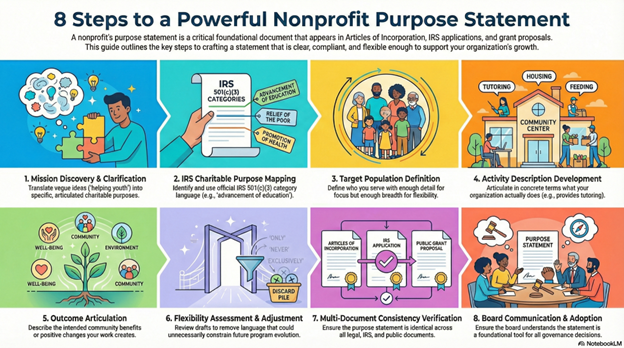
Step 1: Mission Discovery and Clarification We facilitate conversations with founding teams exploring what problem you’re addressing, why it matters to your community, who specifically needs your services, what approaches you’ll use, and what change you seek to create. These discovery conversations often reveal that initial vague ideas (“we want to help youth”) contain more specific charitable purposes when properly articulated (“we advance education and prevent juvenile delinquency by providing academic tutoring and positive mentoring relationships for at-risk youth in Temecula”).

Step 2: IRS Charitable Purpose Mapping We help identify which recognized 501(c)(3) charitable purpose categories your work fits within—education, poverty relief, health promotion, etc.—and use IRS-friendly terminology that strengthens determination applications. Many founders describe their work in community language that doesn’t clearly map to IRS categories; we translate community language into regulatory language that satisfies IRS requirements while remaining authentic to organizational identity.

Step 3: Target Population Definition We help define who you serve with appropriate specificity—specific enough to demonstrate focused charitable purpose, broad enough to allow reasonable program flexibility. This includes considering geographic boundaries (Temecula, Riverside County, Inland Empire), demographic characteristics (age ranges, income levels, specific populations), and eligibility criteria (homeless, formerly incarcerated, immigrant, etc.) that focus your work without unnecessarily constraining it.

Step 4: Activity Description Development We help articulate what your organization actually does in concrete terms—providing services, conducting education, distributing resources, advocating for policy changes, building community capacity—in language that clearly advances your charitable purposes. Activity descriptions should be specific enough that IRS evaluators understand your operations while flexible enough to accommodate program model evolution.

Step 5: Outcome Articulation We help describe intended community benefits or changes your work pursues—educational attainment, economic self-sufficiency, health improvement, community development—that demonstrate charitable impact. Outcome language should be aspirational without promising unrealistic guarantees, results-oriented without requiring specific quantified metrics that might become outdated.

Step 6: Flexibility Assessment and Adjustment We review draft purpose statements for appropriate flexibility, identifying language that might unnecessarily constrain future program evolution and suggesting broader formulations that preserve mission focus while allowing adaptation. This assessment prevents the common problem where organizations outgrow overly narrow original purpose statements and face expensive Articles amendments.

Step 7: Multi-Document Consistency Verification We ensure purpose statement language appears consistently across Articles of Incorporation (exact legal language), IRS Form 1023 applications (detailed narrative), bylaws (mission section), and organizational communications (public-facing descriptions). Consistency across documents prevents confusion and demonstrates organizational coherence to regulators and funders.

Step 8: Board Communication and Adoption We help founding boards understand the purpose statement’s significance—it’s not just bureaucratic language for formation documents but foundational guidance for all future governance decisions about program development, funding priorities, partnership opportunities, and organizational boundaries. Board adoption of purpose statements should involve genuine discussion and understanding rather than rubber-stamping language they haven’t considered.

Checklist: What your purpose statement should communicate

Effective nonprofit purpose statements for Temecula organizations should clearly convey:

  • Recognized charitable classification falling within IRS Section 501(c)(3) categories (education, poverty relief, health, etc.)
  • Specific target population identifying who benefits from organizational work with appropriate demographic, geographic, or situational specificity
  • Primary activity categories describing what the organization does in concrete operational terms (providing services, conducting education, distributing resources, etc.)
  • Intended outcomes or benefits articulating what positive change or community impact the organization pursues through its activities
  • Geographic scope indicating service area (Temecula, Riverside County, Inland Empire, California, or broader) appropriate to operational reality and funding sources
  • Sufficient specificity to demonstrate focused charitable purpose and guide board governance decisions about program priorities and boundaries
  • Adequate flexibility to accommodate reasonable program evolution, service model adaptation, and response to changing community needs without requiring Articles amendments
  • IRS-compliant language using terminology recognized in charitable organization regulations and determination precedents
  • Clarity and accessibility written in language stakeholders, funders, and community members can understand without regulatory expertise
  • Consistency across documents matching language in Articles of Incorporation, IRS applications, bylaws, grant proposals, and public communications
  • Authenticity to organizational identity reflecting genuine mission and values rather than generic template language
  • Distinction from for-profit purposes clearly pursuing public benefit rather than private commercial interests or individual profit
  • Exclusivity of charitable purpose demonstrating that all substantial activities advance charitable purposes rather than mixing charitable and non-charitable goals
  • Permanence and commitment conveying that the organization pursues its charitable purposes consistently and sustainably rather than as temporary or occasional efforts

Quick Answers (PPA)

Can we change our purpose statement later if our programs evolve, or are we locked in forever? You can change purpose statements, but the process and implications depend on the significance of the change. Minor refinements or clarifications to how you describe work within your existing charitable purpose typically require only updating marketing materials, grant applications, and internal documents without formal Articles amendments. Substantial changes adding new charitable purpose categories, significantly expanding target populations, or fundamentally shifting organizational focus generally require amending California Articles of Incorporation (Secretary of State filing plus fees) and potentially notifying the IRS if changes affect your tax-exempt status basis. The IRS wants consistency between your stated purpose and actual operations, so significant mission drift without formal amendments raises red flags during audits or Form 990 reviews. The strategic approach involves crafting initial purpose statements with enough breadth to accommodate reasonable program evolution without needing frequent amendments.

How detailed should the purpose statement in Articles of Incorporation be compared to what we use in grant applications? Articles of Incorporation purpose statements should be moderately detailed—specific enough to clearly establish charitable purpose and guide operations, but not so detailed that minor program changes require amendments. Many California nonprofits use 2-4 sentence purpose statements in Articles capturing charitable categories, target populations, primary activities, and geographic scope at a relatively high level. Grant application purpose statements can and should be more detailed, elaborating on specific program models, particular service approaches, outcome measurements, and organizational history that provides context—often expanding to full paragraphs or pages depending on application requirements. The key is ensuring grant application language remains consistent with and clearly derives from the broader purpose stated in Articles, demonstrating faithful adherence to your chartered mission rather than suggesting mission drift or activities beyond your legal authorization.

Should we include specific programs or services by name in our purpose statement? Generally no—specific program names shouldn’t appear in Articles of Incorporation purpose statements because programs evolve, get renamed, end, or expand in ways that would make naming them in permanent formation documents constraining. Instead, describe program categories or activity types at a conceptual level. Rather than “we operate the Summer Youth Leadership Academy,” state “we provide leadership development and educational enrichment programs for youth.” This approach allows ending, renaming, or expanding the specific academy program without Articles amendments while maintaining alignment with your stated purpose of youth development and education. Save specific program names and detailed descriptions for operational documents, grant applications, and marketing materials that can be updated easily as programs evolve.

What if we want to serve multiple different populations or pursue several charitable purposes—can one purpose statement cover everything? Yes, purpose statements can and often should cover multiple charitable purposes or populations when organizations legitimately work in several areas, but should avoid becoming so comprehensive that they lack meaningful focus. For example: “We advance education, promote health, and relieve poverty by providing integrated services including academic tutoring, health education, nutritious food distribution, and economic empowerment programs for low-income families in Riverside County.” This statement covers multiple charitable purposes (education, health, poverty) with multiple activities serving a defined population. However, be cautious about “kitchen sink” purpose statements listing ten charitable categories and twenty activities—this suggests lack of focus and raises IRS questions about organizational clarity. Most effective purpose statements cover 1-3 primary charitable purposes with 2-5 major activity categories, demonstrating focused mission while preserving reasonable flexibility.

Does the purpose statement need to mention anything about tax-exempt status or that we’re a nonprofit organization? Purpose statements should focus on charitable purposes and activities rather than tax status or corporate structure. The charitable purpose itself is what qualifies you for tax exemption—”we advance education” is the relevant content, not “we are a tax-exempt educational organization.” However, California Articles of Incorporation must include specific required language elsewhere in the document (not necessarily in the purpose statement itself) stating that the corporation is organized under Nonprofit Public Benefit Corporation Law, that it’s organized exclusively for charitable purposes under 501(c)(3), and including the required dissolution clause specifying that assets will go to other 501(c)(3) organizations upon dissolution. These structural provisions appear in separate articles from the purpose statement but are equally mandatory for formation and IRS recognition.

What to do next (DIY vs Done-With-You)

DIY approach: Begin developing your purpose statement by free-writing answers to core questions: What specific community problem does your organization address? Who specifically experiences this problem and needs your services? What concrete activities will your organization conduct to address the problem? What positive changes or outcomes do you hope to create? What geographic area do you serve? Review your answers and identify which IRS charitable purpose categories your work fits within—education, poverty relief, health, community development, etc. Research how similar organizations in your field describe their purposes by reviewing their websites, IRS Form 990 filings (public on GuideStar/Candid), and grant materials. Draft purpose statement language combining charitable purpose classification, target population, primary activities, and intended outcomes in 2-4 clear sentences. Test your draft by asking: Is it specific enough that someone unfamiliar with your work understands what you do? Is it flexible enough to accommodate reasonable program evolution? Does it use recognized IRS charitable terminology? Could board members use this statement to guide decisions about whether new opportunities align with mission? Revise based on these questions. Review IRS Publication 557 examples of acceptable purpose statements. Consider having attorneys or nonprofit consultants review your draft before filing in Articles of Incorporation.

Done-With-You approach: The Nonprofit Launch Office provides comprehensive purpose statement development for Temecula and Inland Empire organizations, ensuring language satisfies IRS requirements while preserving operational flexibility and communicating organizational identity effectively. We facilitate mission discovery conversations that clarify what community need you address, who you serve, what activities you conduct, and what outcomes you pursue, translating initial ideas into focused charitable purposes. We map your work to recognized IRS charitable purpose categories using regulatory-friendly terminology that strengthens determination applications. We help define target populations with appropriate specificity that demonstrates focus without constraining reasonable expansion. We develop activity descriptions that clearly convey operational plans while allowing program model evolution. We craft outcome statements that communicate intended impact without unrealistic promises. We review draft language for flexibility, identifying constraints that might require expensive later amendments. We ensure consistency across Articles of Incorporation, IRS Form 1023, bylaws, and organizational communications. We prepare board members to understand purpose statements as governance tools rather than just bureaucratic requirements. This comprehensive approach delivers purpose statements that satisfy regulatory requirements, guide effective governance, communicate clearly to stakeholders, and position organizations for grant success while preserving appropriate operational flexibility.

Contact

Book: https://thedocumentpro.com/
 Call: 1(800) 285-0078
 Email: mydocumentpro@gmail.com
 The Nonprofit Launch Office™ — a discipline of The Document Pro, operated by Gitta Williams.
 Operated by The Document Pro (Gitta Williams)

Sources


Disclaimer

Document preparation and nonprofit readiness support — not legal or tax advice.
Short Answer

Common compliance red flags that scare funders away include suspended or revoked IRS tax-exempt status discovered through TEOS database verification, suspension by California Franchise Tax Board for delinquent filings, missing or expired Attorney General Registry of Charities registration, Secretary of State status showing anything other than “Active,” missed Form 990 annual filings creating automatic IRS revocation risk, governance red flags like no board meetings documented or conflict of interest policies absent, financial warning signs such as excessive administrative expenses or negative net assets, inconsistencies between different documents suggesting poor record-keeping or misrepresentation, and unresponsive or defensive communication when funders ask clarifying questions about compliance status. Eligibility varies by grant, but these red flags trigger immediate concern during due diligence because they indicate organizational dysfunction, legal exposure, or misuse risk that most funders cannot accept regardless of how compelling the program narrative appears.

What federal compliance red flags immediately concern grant reviewers?

IRS tax-exempt status problems represent the most serious federal red flag because they question whether the organization legally qualifies as a charitable nonprofit entitled to receive tax-deductible contributions. When funders verify applicants through the IRS TEOS database at apps.irs.gov/app/eos and discover the organization doesn’t appear, shows revoked status, or displays warnings about lost recognition, applications typically stop immediately regardless of program quality. Most funders cannot legally distribute charitable dollars to organizations lacking current federal tax exemption, making IRS status problems absolute dealbreakers rather than concerns that can be explained or excused.

Automatic IRS revocation for failure to file Form 990 for three consecutive years catches many Temecula nonprofits by surprise. Organizations assume that because they received determination letters years ago, their tax-exempt status is permanent. In reality, status is conditional on ongoing compliance with annual filing requirements—even very small organizations with gross receipts under $50,000 must file Form 990-N (e-postcard). When organizations miss three consecutive years of required filings, the IRS automatically revokes recognition without advance warning. Funders discovering this revocation during due diligence view it as evidence of fundamental governance failure and organizational incompetence.

Missing or incomplete Form 990 filings even short of automatic revocation raise serious concerns. Organizations current with IRS but with spotty filing histories—filing some years but not others, filing extremely late consistently, or submitting incomplete returns with errors or missing schedules—signal poor financial management and compliance awareness. Funders reviewing multi-year Form 990 histories on GuideStar or ProPublica Nonprofit Explorer notice these patterns and question whether grant funds will be managed responsibly by organizations that struggle with basic federal reporting obligations.

Determination letter problems create red flags when the letter presented is outdated, doesn’t match the organization’s current legal name, shows a different EIN than provided elsewhere in application materials, or appears altered or fraudulent. Some organizations present determination letters from parent organizations or former affiliations rather than their own current recognition. Others present letters that are decades old without understanding that while determination doesn’t typically expire, it can be revoked for noncompliance. Funders cross-reference determination letters against TEOS verification to catch discrepancies suggesting misrepresentation or confusion about organizational status.

What California-specific compliance red flags trigger immediate funder concern?

California Franchise Tax Board suspension status discovered during verification represents a serious red flag because it indicates the organization failed to file required annual Form 199 or Form 199N returns or didn’t pay associated fees. FTB suspension can occur even when organizations maintain current federal IRS recognition, creating the confusing scenario where a nonprofit is recognized by the IRS but suspended by California. Funders—particularly California-based foundations, corporate givers, and government agencies—view FTB suspension as evidence of poor state compliance management and often pause or reject applications until suspension is lifted.

Attorney General Registry of Charities problems raise red flags around legal authority to solicit charitable contributions in California. Organizations that never registered with the AG Registry despite being required to (most nonprofits must register within 30 days of first receiving assets), let their registration lapse by failing to file annual RRF-1 renewals, or show “delinquent” status in the AG Registry search at oag.ca.gov/charities are technically violating California charitable solicitation law. Funders discovering these problems face legal concerns—by giving money to an organization operating without proper fundraising authorization, are they facilitating illegal activity? Most funders won’t risk this exposure.

Secretary of State status showing anything other than “Active” creates immediate questions about the organization’s legal corporate existence and ability to conduct business in California. Status descriptors like “Suspended,” “Forfeited,” “Dissolved,” or “Surrendered” indicate serious problems with corporate compliance—typically missed Statement of Information filings or failure to maintain a current registered agent. Organizations showing these statuses cannot legally enter contracts, meaning grant agreements would be unenforceable. Most funders verify SOS status as part of basic due diligence and halt applications immediately when non-Active status appears.

Inconsistent information across California’s three agencies creates red flags even when each individual agency shows acceptable status. For example, an organization might show Active with Secretary of State but use a different address or slightly different legal name with Franchise Tax Board or Attorney General Registry. These inconsistencies suggest poor record-keeping, lack of coordination in filing requirements, or potential identity confusion between similarly named organizations. Funders notice discrepancies during multi-agency verification and question organizational competence and attention to detail.

Framework: Launch → Fix → Fund + Federal Recognition + CA Compliance Triangle

The Nonprofit Launch Office operates within a strategic framework designed to help California nonprofits move from formation to fundability:

Launch includes understanding common compliance red flags from day one so you avoid creating them through ignorance or neglect. Launch-phase organizations should establish systems ensuring all filings happen before deadlines, maintain consistent organizational information across all agencies, document governance practices that demonstrate functional oversight, and implement regular status verification preventing the surprise discovery of compliance problems when pursuing grants. Proper Launch prevents most red flags from ever emerging.

Fix is precisely what organizations showing red flags need—urgent remediation addressing specific compliance failures that block funding access. Fix work for Temecula nonprofits might include filing delinquent Form 990 returns and requesting IRS reinstatement after automatic revocation, submitting overdue Form 199 filings and paying penalties to lift Franchise Tax Board suspension, filing late RRF-1 renewals with Attorney General Registry to restore fundraising authorization, correcting Secretary of State status by filing overdue Statement of Information and paying restoration fees, and implementing governance improvements preventing recurrence. Fix is always more expensive and time-consuming than Launch would have been, but it’s essential for organizations already showing red flags.

Fund represents the compliance state where no red flags exist—all agencies show current status, all filings are timely, all governance documentation demonstrates functional oversight, and all financial records signal responsible management. Fund-phase organizations can pursue grants confidently knowing that due diligence verification will reveal clean compliance profiles rather than problems requiring explanation or correction. Maintaining Fund status requires ongoing vigilance and systems rather than assuming compliance maintains itself automatically.

Federal Recognition through IRS 501(c)(3) determination creates the foundation that must remain clean—any problems at the federal level (revocation, missed filings, determination letter issues) create the most serious red flags because they question fundamental charitable status. Organizations must view federal compliance as non-negotiable baseline rather than optional burden because federal problems block nearly all institutional funding regardless of state-level compliance quality.

CA Compliance Triangle represents California’s three-agency oversight system where problems with any single agency create red flags even when the other two show clean status. Funders verify all three agencies independently (Secretary of State, Franchise Tax Board, Attorney General Registry), so Temecula nonprofits cannot compensate for problems in one area with excellent status in another. The triangle structure requires simultaneous good standing across all three vertices plus the federal IRS foundation—weakness anywhere compromises the entire compliance profile.

Step-by-step: How NPLO helps organizations address and eliminate red flags

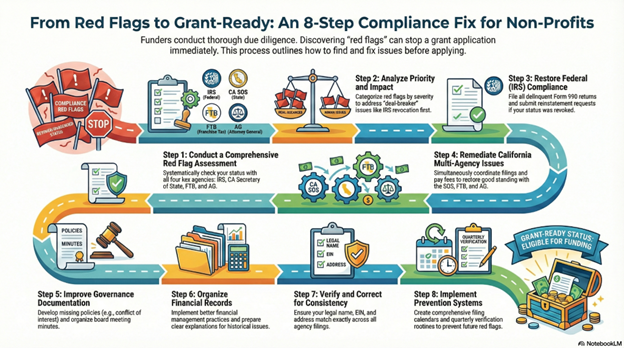
Step 1: Comprehensive Red Flag Assessment We conduct systematic verification across all four agencies—IRS TEOS status, California Secretary of State entity status, Franchise Tax Board exemption status, and Attorney General Registry registration—to identify every red flag that funders would discover during due diligence. This complete assessment reveals the full scope of compliance problems rather than addressing issues piecemeal as they’re discovered. Many Temecula organizations are shocked to learn they have multiple simultaneous red flags they weren’t aware existed.

Step 2: Priority and Impact Analysis We categorize identified red flags by severity and urgency—which problems block all funding immediately (like IRS revocation or FTB suspension) versus which create concerns but don’t absolutely prevent applications (like slightly outdated board rosters or minor governance documentation gaps). This prioritization guides remediation strategy, ensuring you address dealbreaker problems before investing time in lower-priority improvements.

Step 3: Federal Compliance Restoration When IRS problems exist, we coordinate urgent remediation—filing all delinquent Form 990 returns for missed years, submitting Form 1023 reinstatement requests if automatic revocation occurred, obtaining replacement determination letters if originals are lost or problematic, and establishing filing calendar systems preventing future IRS problems. Federal restoration often takes months, during which grant pursuit typically must pause until status is clean.

Step 4: California Multi-Agency Remediation We coordinate simultaneous restoration across California’s three agencies—filing overdue Statement of Information and paying reinstatement fees to achieve Secretary of State Active status, submitting delinquent Form 199 returns and paying penalties to lift Franchise Tax Board suspension, and filing overdue RRF-1 renewals with Attorney General Registry to restore current registration. Multi-agency coordination is critical because remediation timelines differ and you need all three showing clean status simultaneously for full grant-readiness.

Step 5: Governance Documentation Improvement We address governance red flags by helping develop or update missing policies (conflict of interest, whistleblower, document retention), organize board meeting minutes demonstrating regular oversight, create comprehensive board rosters with current information, and implement governance practices that signal functional organizational management. These improvements show funders that past problems resulted from fixable gaps rather than fundamental dysfunction.

Step 6: Financial Record Organization When financial red flags exist—concerning Form 990 patterns, negative net assets, excessive administrative costs, or messy financial documentation—we help implement better financial management practices, prepare clear financial narratives explaining historical patterns, develop sustainability plans addressing structural financial problems, and organize financial documentation that demonstrates current fiscal responsibility despite past challenges.

Step 7: Consistency Verification and Correction We identify and correct inconsistencies across different documents and agencies—ensuring legal name matches exactly across IRS, California SOS, FTB, and AG Registry filings, confirming EIN appears identically in all materials, verifying addresses are current and consistent, and eliminating discrepancies that raise questions about organizational identity or record-keeping quality.

Step 8: Prevention System Implementation Once red flags are eliminated, we implement systems preventing recurrence—comprehensive filing calendars covering all federal and state obligations, quarterly compliance verification routines checking status across all agencies, governance practices ensuring board awareness of compliance obligations, and documentation protocols maintaining organized records that facilitate timely filings and accurate reporting.

Checklist: What you should verify to catch red flags before funders do

Temecula nonprofits should regularly check these areas where red flags commonly emerge:

  • IRS TEOS database listing at apps.irs.gov/app/eos showing “Eligible to receive tax-deductible contributions” without revocation warnings
  • Form 990 filing history on GuideStar/Candid showing complete, timely filings for every required year without gaps or patterns of extreme lateness
  • IRS determination letter validity confirming it matches current legal name, shows correct EIN, and isn’t outdated or from a different organization
  • California Secretary of State entity status showing “Active” rather than Suspended, Forfeited, Dissolved, or any problematic status
  • Statement of Information currency with most recent filing within past two years during your designated filing month
  • Registered agent current with valid California street address (not PO Box) and agent who actually receives and forwards legal notices
  • Franchise Tax Board exemption status showing state tax exemption maintained without suspension flags
  • Form 199 filing history showing annual California returns filed timely without major gaps or delinquencies
  • Attorney General Registry registration showing current active status with valid CT number
  • RRF-1 renewal currency with most recent filing within past 13 months of registration anniversary date
  • Consistency across agencies with identical legal name, matching addresses (or documented reasons for differences), and coherent organizational identity
  • Board meeting documentation with minutes from recent meetings showing active governance rather than rubber-stamping or inactivity
  • Conflict of interest policy adopted by board with annual signed disclosures from all board members and key staff
  • Financial policy documentation addressing approval authorities, internal controls, expense management, and oversight procedures
  • Form 990 accuracy with program expense percentages reasonable (typically 65%+), administrative costs not excessive, compensation appropriate, and narrative descriptions matching grant applications
  • Net asset trends showing financial sustainability rather than declining reserves, chronic deficits, or concerning financial trajectory
  • Audit issues (if audited) with clean opinions rather than qualified opinions, material weaknesses, or going concern warnings
  • Legal name consistency with identical organizational name across all documents, websites, marketing materials, and public communications
  • EIN consistency with same nine-digit number used across all federal and state filings, bank accounts, and grant applications
  • Responsive communication with funders when questions arise, providing complete answers rather than evasive or defensive responses

Quick Answers (PPA)

If we discover red flags during grant application preparation, should we still submit or wait until problems are fixed? Generally, wait until major red flags are corrected before submitting applications. Submitting applications with known IRS revocation, FTB suspension, or other serious compliance problems wastes time and often creates negative impressions with funders who may remember the problematic application when you reapply later with restored compliance. Minor red flags—slightly outdated documentation or small governance gaps—might be acceptable to explain if application deadlines are imminent and the program opportunity is time-sensitive. But major compliance failures should be fixed before applying. Contact funders directly to ask whether addressing red flags before submission or submitting with explanation of remediation in progress serves applications better.

How long does it typically take to resolve major red flags like IRS revocation or FTB suspension? Federal IRS reinstatement after automatic revocation typically requires 3-6 months minimum—you must file all delinquent Form 990 returns, submit reinstatement request, wait for IRS processing, and receive new determination letter. California Franchise Tax Board suspension lifts more quickly once delinquent returns are filed and penalties paid—often within 4-8 weeks. Attorney General Registry reinstatement from delinquent status usually processes within 2-4 weeks after filing overdue RRF-1. Secretary of State reinstatement to Active status can happen within days after filing overdue Statement of Information and paying fees. Total timeline for comprehensive compliance restoration across all agencies typically spans 4-8 months when multiple serious problems exist simultaneously.

Can we still apply for grants if we’re in the process of fixing red flags but not yet fully compliant? This depends heavily on the specific funder and the nature of the red flags. Some funders will conditionally approve grants contingent on compliance restoration by specific dates, particularly for organizations with strong programs and fixable administrative problems. Other funders maintain strict eligibility requirements and won’t consider applications until full compliance is documented. If pursuing grants during remediation, be completely transparent—”Our organization is currently addressing compliance gaps that resulted from [honest explanation]. We have filed delinquent returns, paid penalties, and expect full restoration by [date]. We are providing documentation of remediation progress.” Honesty sometimes preserves opportunities; hiding problems always creates worse outcomes when discovered.

What if only one agency shows problems but the other three are clean—will funders overlook it? Unfortunately, no. Funders conducting thorough due diligence verify all four agencies (IRS, CA SOS, CA FTB, CA AG Registry) independently, and problems with any single agency typically pause or reject applications. Being 3-for-4 on compliance doesn’t create 75% eligibility—it creates ineligibility until the fourth agency problem is resolved. This reflects the reality that each agency serves different legal purposes, and funders need confidence that organizations maintain all required registrations and filings. The multi-agency structure means you cannot compensate for weakness in one area with strength in another.

How do we prevent red flags from emerging in the first place? Prevention requires systematic compliance management rather than reactive problem-solving. Establish comprehensive filing calendars showing every deadline for IRS Form 990, California Form 199, Statement of Information, and RRF-1 renewals with advance reminders 90, 60, and 30 days before deadlines. Conduct quarterly status verification across all four agencies to catch problems early before they escalate. Assign clear board or staff responsibility for compliance tracking with backup coverage if primary responsible person changes roles. Document all governance practices—board meetings, policy adoptions, conflict disclosures—as they happen rather than retroactively creating documentation when grants require it. Treat compliance as continuous operational function rather than annual crisis when filing deadlines arrive.

What to do next (DIY vs Done-With-You)

DIY approach: Conduct honest self-assessment by verifying your organization’s status across all four verification points—search IRS TEOS database for your organization and confirm “Eligible” status without warnings, check California Secretary of State business entity search and verify “Active” status, look up Franchise Tax Board exemption status and confirm you’re not suspended, and search Attorney General Registry of Charities and verify current registration. Save dated screenshots documenting what you find. Review your Form 990 filing history on GuideStar or ProPublica Nonprofit Explorer and identify any missed years or concerning patterns. Compare information across different sources—does your legal name match exactly across all agencies, is your EIN consistent, are addresses current? List every red flag discovered with honest assessment of severity. Prioritize which problems absolutely block grant applications (IRS revocation, FTB suspension) versus which create concerns but might be explainable (minor governance gaps). Research how to address each red flag—which agencies to contact, what forms to file, what fees to pay. Create remediation plan with realistic timelines. Consider whether to pause grant applications until major red flags are resolved.

Done-With-You approach: The Nonprofit Launch Office provides comprehensive red flag identification and remediation for Temecula and Inland Empire nonprofits facing compliance problems that block funding access. We conduct thorough verification across all four agencies identifying every red flag funders would discover, categorize problems by severity and urgency to guide efficient remediation, coordinate federal IRS compliance restoration including delinquent filing and reinstatement when necessary, manage California multi-agency remediation addressing Secretary of State, Franchise Tax Board, and Attorney General problems simultaneously, develop or improve governance documentation eliminating governance-related red flags, organize financial records and narratives addressing financial concerns, ensure consistency across all documents and agencies, implement prevention systems maintaining clean compliance going forward, and provide honest guidance about whether pursuing grants during remediation makes strategic sense or whether waiting for full restoration produces better outcomes. This comprehensive approach addresses red flags systemically rather than piecemeal, preventing the scenario where you fix one problem only to discover three others blocking grant access.

Contact

Book: https://thedocumentpro.com/
 Call: 1(800) 285-0078
 Email: mydocumentpro@gmail.com
 The Nonprofit Launch Office™ — a discipline of The Document Pro, operated by Gitta Williams.
 Operated by The Document Pro (Gitta Williams)

Sources


Disclaimer

Document preparation and nonprofit readiness support — not legal or tax advice.
Short Answer

Restricted grant funds come with funder-imposed limitations specifying how the money must be used—typically for particular programs, specific expenses, designated time periods, or defined populations—and cannot be redirected to other purposes without funder permission, requiring careful tracking and separate accounting to demonstrate compliance. Unrestricted grant funds (also called general operating support) come with no usage limitations beyond supporting the organization’s overall charitable mission, giving nonprofits complete discretion to allocate funds where needed most—whether for programs, administration, staff salaries, infrastructure, reserves, or emerging priorities. Eligibility varies by grant, but the distinction fundamentally affects organizational flexibility, financial sustainability, administrative burden, and strategic capacity, with most Temecula and Inland Empire nonprofits finding that balanced portfolios combining both restricted program grants and unrestricted operating support provide optimal sustainability and adaptability.

What do restricted grant funds actually restrict and how does this affect operations?

Restricted grant funds typically specify one or more types of limitations that govern how recipients can use the money. Program restrictions limit funds to supporting specific activities—a grant for youth mentoring programs cannot be redirected to senior services even if both serve the organization’s mission. Expense category restrictions designate funds for particular costs like equipment purchases, staff salaries, facility improvements, or program supplies rather than allowing allocation across various expense types. Time restrictions require that funds be spent within defined periods—a one-year grant cannot extend spending into year two without funder approval. Population restrictions target funds toward serving specific communities like veterans, homeless families, or students in particular school districts.

These restrictions create operational complexity because Temecula nonprofits must track restricted funds separately from other revenue through fund accounting practices that demonstrate compliance with funder requirements. When a nonprofit receives three different restricted grants each supporting different programs with different allowable expenses and different time periods, financial management becomes significantly more complicated than if all revenue were unrestricted. Organizations need accounting systems that allocate expenses correctly to restricted fund sources, track spending against grant budgets, prevent inadvertent use of restricted funds for non-permitted purposes, and generate reports showing funder-specific financial activity.

The administrative burden of managing restricted funds increases with the number of different restricted grants an organization holds simultaneously. Each restricted grant requires separate budget tracking, periodic financial reports to the funder showing how their specific money was spent, documentation proving expenses charged to the grant align with approved budgets and allowable costs, and careful attention to spending deadlines ensuring funds are fully utilized before grant periods expire. Organizations heavily dependent on restricted program grants often employ significant staff time on grant compliance and reporting rather than direct program delivery.

Restricted funds limit strategic flexibility because they cannot be redirected when organizational priorities shift or unexpected needs emerge. If a nonprofit experiences facility emergency repairs requiring immediate funding, restricted program grants cannot be used for this purpose even if the organization desperately needs the money. If one program is oversubscribed while another struggles with low participation, restricted funding cannot shift between programs to align with actual community demand. Restrictions mean saying “we have money, but we cannot use it for this purpose” even when the purpose clearly serves the mission.

What makes unrestricted grants valuable despite being harder to obtain?

Unrestricted grants provide maximum organizational flexibility because funders impose no limitations on how recipients allocate the money beyond supporting the charitable mission generally. Organizations can use unrestricted funds for any legitimate purpose—direct program expenses, staff salaries regardless of which programs they support, administrative costs like accounting and legal services, facility rent and utilities, technology and equipment, professional development, financial reserves, or strategic initiatives not yet funded by specific program grants. This flexibility allows nonprofits to function as integrated organizations rather than collections of separately funded programs.

General operating support fills critical funding gaps that restricted program grants inherently create. While restricted grants might fund program staff salaries and direct participant costs, they rarely cover the executive director’s time spent on fundraising and organizational management, the bookkeeper processing grant reimbursements and financial reports, the rent and utilities for space where programs operate, or the technology infrastructure enabling program delivery. Unrestricted funds cover these essential but often “unexciting” costs that make programmatic work possible but struggle to attract dedicated restricted funding.

Unrestricted grants enable organizational innovation and adaptation by supporting work that hasn’t been pre-approved in specific grant applications. If community needs shift and a new program approach emerges as critical, unrestricted funds allow piloting the innovation before securing dedicated restricted funding. If evaluation data suggests program adjustments would improve outcomes, unrestricted funds enable adaptation without lengthy funder approval processes. Unrestricted support says “we trust your judgment about how to advance your mission” rather than “we’ll support specific pre-approved activities only.”

Financial sustainability and organizational health depend heavily on adequate unrestricted revenue. Organizations operating entirely on restricted program grants face chronic financial stress because they cannot cover indirect costs, build reserves, invest in infrastructure improvements, or weather temporary revenue shortfalls. Unrestricted funds provide the working capital and financial cushion that allow nonprofits to manage cash flow fluctuations, bridge gaps between restricted grant payments, and maintain operations during funding transitions. Most financially healthy Temecula nonprofits maintain unrestricted revenue representing 30-50% of total budgets alongside restricted program grants.

Framework: Launch → Fix → Fund + Federal Recognition + CA Compliance Triangle

The Nonprofit Launch Office operates within a strategic framework designed to help California nonprofits move from formation to fundability:

Launch includes understanding restricted versus unrestricted funding distinctions from the beginning so new organizations can develop balanced fundraising strategies. Launch-phase Temecula nonprofits often focus heavily on restricted program grants because they seem more accessible—funders feel comfortable supporting specific programs they can track and measure. However, Launch planning should include unrestricted revenue development through individual donor cultivation, board giving, earned income strategies, or capacity-building grants that provide general operating support. Early habits around funding mix significantly affect long-term financial sustainability.

Fix addresses situations where nonprofits became over-dependent on restricted program grants and now face financial stress from inability to cover administrative costs, invest in organizational infrastructure, or adapt to changing circumstances. Fix work involves diversifying revenue sources to include more unrestricted funding, developing compelling cases for general operating support that resonate with funders skeptical of “overhead,” implementing fund accounting systems that properly track restricted and unrestricted funds, and sometimes renegotiating restrictions with existing funders when original limitations prove operationally problematic.

Fund represents the operational state where organizations maintain healthy balances between restricted program grants funding specific work and unrestricted revenue providing flexibility, covering indirect costs, and enabling strategic adaptation. Fund-phase organizations understand how to articulate the value of general operating support to funders, maintain accounting systems that manage multiple restricted grants efficiently, and budget realistically about what restricted program grants can and cannot support. They pursue restricted grants strategically while continuously building unrestricted revenue streams.

Federal Recognition through IRS 501(c)(3) determination allows nonprofits to receive both restricted and unrestricted grants, but doesn’t eliminate the strategic challenge of building balanced funding portfolios. Federal tax exemption makes contributions tax-deductible regardless of whether they’re restricted or unrestricted, but funders make independent decisions about what types of support to provide based on their own philanthropic philosophies and risk tolerance.

CA Compliance Triangle (Secretary of State, Franchise Tax Board, Attorney General Registry) must be maintained with current standing regardless of whether an organization’s revenue is predominantly restricted or unrestricted. Compliance costs—filing fees, staff time for reporting, professional services—typically come from unrestricted funds since most restricted program grants won’t pay for compliance activities. This reality illustrates why unrestricted revenue is essential—compliance obligations exist regardless of funding mix, and someone must pay for them.

Step-by-step: How NPLO helps organizations understand and manage funding restrictions

Step 1: Current Funding Mix Analysis We review your existing grant portfolio to determine what percentage of revenue is restricted versus unrestricted, identify what restrictions currently apply to various funding sources, assess whether current restrictions create operational challenges or limit flexibility, and evaluate whether your funding balance supports financial sustainability. Many Temecula organizations discover they’re far more dependent on restricted program grants than optimal, with unrestricted revenue representing only 10-20% of budgets rather than healthier 30-50% targets.

Step 2: Restriction Documentation and Tracking We help organize clear documentation of every restriction on current grants—what each funder’s money can and cannot be used for, what time periods apply, what reporting requirements exist, and when restrictions expire. This comprehensive tracking prevents inadvertent misuse of restricted funds and ensures compliance with all funder requirements. We also help implement or improve fund accounting systems that maintain separate tracking for each restricted fund source.

Step 3: Indirect Cost Rate Development We help calculate legitimate indirect cost rates showing what percentage of program expenses represents shared organizational costs like facilities, administration, and overhead. Many restricted program grants allow charging indirect costs at negotiated or federally approved rates, but nonprofits must calculate and justify these rates. Proper indirect cost recovery helps restricted program grants cover their fair share of organizational overhead rather than leaving all administrative costs to unrestricted funds.

Step 4: Unrestricted Revenue Strategy Development We help identify and prioritize opportunities for building unrestricted revenue—individual donor campaigns emphasizing general operating support, corporate partnerships providing flexible funding, board giving focused on unrestricted contributions, earned income from fee-for-service programs, endowment or reserve fund development, and capacity-building grants specifically for organizational infrastructure. The strategy creates intentional plans for reducing over-dependence on restricted program grants.

Step 5: Funder Communication About Flexibility We help craft compelling cases for unrestricted support when approaching funders, explaining why general operating grants provide greater impact than restricted program support, articulating how administrative capacity enables program quality, and demonstrating organizational health and financial responsibility that justify funder confidence in unrestricted giving. Many funders will provide unrestricted support when asked thoughtfully, but nonprofits must make the case.

Step 6: Budget Development Reflecting Restrictions We help create organizational budgets that accurately reflect restricted and unrestricted revenue sources, show how restricted grants support specific programs, demonstrate how unrestricted funds cover shared organizational costs, identify funding gaps where additional unrestricted revenue is needed, and present realistic rather than optimistic financial pictures. Honest budgeting prevents the scenario where organizations commit to expenses they cannot cover once restrictions are properly accounted for.

Step 7: Grant Agreement Negotiation Guidance When restricted grant opportunities emerge, we help evaluate whether proposed restrictions are operationally workable, identify potentially problematic limitation language that should be negotiated, suggest alternative restriction frameworks that achieve funder accountability goals while providing recipient flexibility, and advise when restrictions are so onerous that declining the grant serves the organization better than accepting overly burdensome limitations.

Step 8: Reporting Systems Implementation We help establish efficient reporting systems that track restricted grant compliance and satisfy funder requirements without consuming excessive staff time—templates for common report types, documentation protocols for restricted expenses, financial tracking mechanisms linking expenses to specific grants, and calendars ensuring timely submission of required reports. Efficient systems reduce the administrative burden that makes restricted grants costly to manage.

Checklist: What you should understand before accepting restricted grants

Before accepting restricted grant funding, Temecula nonprofits should evaluate these considerations:

  • Precise restriction language understanding exactly what the funder’s money can and cannot pay for based on grant agreement terms
  • Allowable expense categories clarifying whether funds can cover salaries, benefits, equipment, supplies, subcontractors, travel, or other specific costs
  • Indirect cost provisions determining whether the grant allows charging indirect/overhead costs and at what rate or amount
  • Time period limitations knowing when spending must occur and whether unspent funds must be returned or can be extended with approval
  • Geographic or population restrictions understanding if funds must serve specific communities, regions, or demographic groups
  • Reporting requirements knowing what financial and programmatic reports funders expect, how often, and in what format
  • Documentation standards understanding what records must be maintained proving restricted funds were used appropriately
  • Amendment processes knowing how to request permission if circumstances change and you need to modify how funds are used
  • Matching or cost-share requirements determining if you must provide specific amounts of other funding to access the restricted grant
  • Budget line-item restrictions understanding if you must spend exact amounts on specific budget categories or have flexibility within the total
  • Equipment and property provisions knowing if assets purchased with restricted funds become your property or have funder ownership interests
  • End-of-grant requirements understanding what happens to unused funds, whether spending can extend past the grant period, or if unexpended amounts must be returned
  • Modification and transfer limitations knowing if funds can be reallocated between budget categories with or without funder approval
  • Audit and monitoring rights understanding if funders can conduct site visits, financial audits, or program monitoring to verify compliance
  • True cost of compliance calculating staff time and systems needed to track, report, and comply with restrictions to determine if the grant amount justifies the administrative burden

Quick Answers (PPA)

Can we move money from a restricted grant to unrestricted use if we have urgent needs the restricted grant won’t cover? No, not without explicit funder permission, which is rarely granted. Restricted grant funds must be used according to the specific limitations the funder imposed, and redirecting restricted money to other purposes violates grant agreements and potentially violates charitable solicitation laws if restrictions were communicated to donors. If you have urgent unrestricted needs and only restricted funds available, you must either seek funder approval to modify restrictions (usually difficult), find other unrestricted revenue sources, or explain to stakeholders why the restricted funds cannot address the need despite being available. This frustrating scenario illustrates exactly why building unrestricted revenue is critical—it provides the flexibility to respond to unexpected needs that restricted grants cannot address.

Why don’t all funders just give unrestricted grants if they’re so much more valuable to nonprofits? Funders restrict grants for several reasons: accountability concerns (they want to ensure money supports specific work they care about), outcome measurement (easier to evaluate impact when funding specific programs versus general operations), donor expectations (individual donors or board members who provided the money expect it to fund particular work), strategic focus (foundation missions target specific issue areas or populations, not broad organizational support), and risk management (restricted grants feel safer to funders uncertain about an organization’s overall management). Additionally, many funders believe restricted program support is more valuable because they fundamentally misunderstand the importance of organizational infrastructure, adequate staffing, and administrative capacity. Shifting funder behavior toward more unrestricted giving requires persistent sector-wide advocacy about the true costs of program delivery and the value of organizational health.

What’s a reasonable split between restricted and unrestricted revenue for a healthy nonprofit? While ideal ratios vary by organizational size, complexity, and program models, most financial sustainability experts suggest that 30-50% unrestricted revenue provides healthy balance for mid-sized nonprofits. Organizations with 20% or less unrestricted funding often struggle chronically with covering administrative costs, building reserves, and adapting to changing circumstances. Organizations with 60%+ unrestricted revenue enjoy significant flexibility but may struggle to attract the restricted program grants that demonstrate programmatic focus and impact to funders. Very small grassroots organizations might operate successfully with higher percentages of unrestricted revenue from individual donors, while large organizations managing complex multi-year government contracts might maintain lower unrestricted percentages if indirect cost recovery is strong. The key is having sufficient unrestricted funds to cover shared organizational costs, maintain working capital, and provide strategic flexibility.

Can we count the same expense toward multiple restricted grants if it benefits multiple programs? Generally no—this is considered “double-dipping” or improper cost allocation and violates grant compliance requirements. If an expense legitimately benefits multiple programs supported by different restricted grants, you must allocate the cost proportionally across those grants based on reasonable allocation methodologies (percentage of time, percentage of program participants served, square footage used, etc.). For example, if your executive director spends 25% of time on Program A (Grant 1) and 25% on Program B (Grant 2), you can charge 25% of their salary to each restricted grant, but you cannot charge 100% to both grants. Proper cost allocation requires time tracking, space usage documentation, or other allocation basis evidence. This is one reason why fund accounting systems and good financial management are essential when managing multiple restricted grants.

What happens if we don’t spend all the restricted grant money by the deadline—do we have to give it back? This depends entirely on the specific grant agreement language. Some funders require that unspent funds be returned at the end of the grant period, treating the grant as “use it or lose it.” Other funders allow requesting no-cost extensions that provide additional time to spend funds without additional money. Some agreements include provisions allowing unspent funds to roll into subsequent grant periods if the funder makes multi-year commitments. Review your grant agreement carefully to understand what provisions apply. If the deadline is approaching and spending won’t be complete, contact the funder immediately rather than waiting—proactive communication about legitimate reasons for underspending and requesting modifications shows professionalism and often results in workable solutions, while silent non-compliance or last-minute requests create funder distrust.

What to do next (DIY vs Done-With-You)

DIY approach: Conduct funding mix analysis by reviewing your current revenue sources and categorizing each as restricted or unrestricted based on grant agreements, donation letters, or funder communications. Calculate what percentage of total revenue is unrestricted—if it’s below 30%, you’re likely experiencing financial stress from inability to cover administrative costs or respond to unexpected needs. Review your accounting practices to ensure restricted and unrestricted funds are tracked separately through fund accounting rather than lumped together in single accounts. Examine each restricted grant agreement to document specific limitations—what the money can/cannot be used for, time periods, reporting requirements, and compliance obligations. Assess whether current restrictions create operational problems—are you unable to cover legitimate organizational costs because everything is restricted? Develop a strategic plan for increasing unrestricted revenue over the next 2-3 years through individual donor cultivation, general operating support grant applications, earned income, or other flexible funding sources. When considering new grant opportunities, evaluate the total cost of compliance including staff time for tracking and reporting against the grant amount to determine if restricted grants justify the administrative burden.

Done-With-You approach: The Nonprofit Launch Office provides comprehensive funding restriction strategy for Temecula and Inland Empire nonprofits struggling with imbalanced funding portfolios or poor understanding of how restrictions affect operations. We analyze your current funding mix identifying the percentage restricted versus unrestricted and whether the balance supports sustainability, document all current restrictions and assess whether they create operational challenges, implement or improve fund accounting systems that properly track restricted and unrestricted funds separately, calculate legitimate indirect cost rates enabling better cost recovery from restricted program grants, develop strategic plans for building unrestricted revenue through diversified sources, create compelling cases for general operating support that persuade funders to provide flexible funding, provide grant agreement review and negotiation guidance when restricted funding opportunities emerge, and implement efficient reporting systems that satisfy funder compliance requirements without consuming excessive administrative resources. This comprehensive approach helps organizations understand the true impact of funding restrictions and develop sustainable funding portfolios balancing the accountability restricted grants provide with the flexibility unrestricted revenue enables.

Contact

Book: https://thedocumentpro.com/
 Call: 1(800) 285-0078
 Email: mydocumentpro@gmail.com
 The Nonprofit Launch Office™ — a discipline of The Document Pro, operated by Gitta Williams.
 Operated by The Document Pro (Gitta Williams)

Sources


Disclaimer

Document preparation and nonprofit readiness support — not legal or tax advice.