Author: Owner

Short Answer

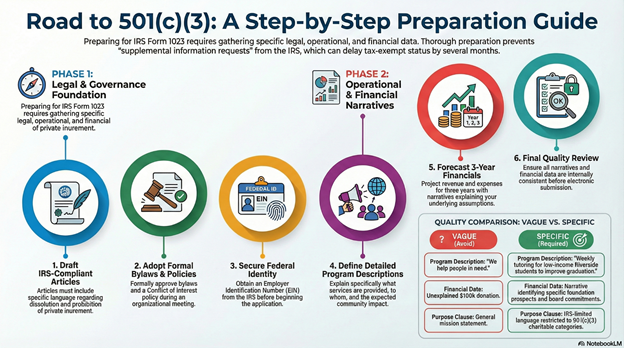
Before filing IRS Form 1023 or 1023-EZ, nonprofits should prepare Articles of Incorporation with required IRS language including dissolution clauses, adopted bylaws and governance policies demonstrating functional oversight, detailed program descriptions explaining what services will be provided to whom and how, three-year financial projections showing projected revenue sources and expenses, organizational meeting minutes documenting bylaw adoption and policy approval, conflict of interest policy with board disclosure procedures, and Employer Identification Number obtained from IRS. This preparation matters because incomplete applications trigger IRS requests for supplemental information delaying processing by months, poorly documented governance structures raise questions about charitable purpose and board oversight, and unrealistic financial projections suggest poor planning or unsustainable operations causing IRS to question organizational viability.

What formation and governance documents must be ready?

Articles of Incorporation with IRS-compliant language form the foundation. California Articles must contain specific provisions IRS requires: organizational purpose limited to recognized 501(c)(3) charitable categories, dissolution clause stating that upon dissolution assets will be distributed to other 501(c)(3) organizations or governmental purposes, and prohibition on private inurement stating no net earnings benefit individuals. If Articles lack this language, they must be amended before IRS application—retroactive amendments create complications better avoided through proper initial drafting.

Adopted bylaws demonstrate governance structure and operational procedures. IRS wants to see that boards will exercise genuine oversight through regular meetings, independent directors provide accountability rather than founder domination, conflict of interest procedures prevent self-dealing, and decision-making processes ensure democratic governance. Bylaws should be formally adopted at organizational meeting documented in minutes, not just downloaded templates sitting unsigned in files.

Conflict of interest policy proves commitment to preventing private benefit. IRS Form 1023 specifically asks whether the organization adopted a conflict of interest policy and requests a copy. The policy should require annual written disclosure from board members and officers identifying potential conflicts, establish procedures for recusal from conflicted decisions, and mandate independent review of transactions involving insiders. Many organizations incorporate conflict language directly into bylaws; others adopt separate standalone policies.

Organizational meeting minutes document that governance documents were properly adopted. Minutes should record the date, attendees, adoption of bylaws through board vote, approval of conflict policy, election of initial officers, authorization to apply for EIN and IRS determination, and other foundational decisions. These minutes prove the organization actually functions rather than existing only on paper.

What programmatic and operational information needs development?

Detailed program descriptions explain what charitable activities the organization will conduct. IRS needs to understand specifically what services you’ll provide, who will benefit from those services, how services will be delivered (frequency, location, staffing), and what outcomes or community impact you expect. Vague descriptions like “we help people in need” don’t satisfy IRS requirements. Specific descriptions like “we provide weekly academic tutoring to low-income high school students in Riverside, preparing participants for college admission and improving graduation rates” demonstrate clear charitable purpose.

Target population identification shows who benefits from programs. IRS evaluates whether programs serve genuine charitable purposes benefiting appropriate populations—people experiencing poverty, individuals lacking educational access, communities facing health challenges—rather than providing private benefits to specific individuals connected to founders. Define beneficiary populations with enough specificity to demonstrate focus while preserving reasonable flexibility.

Operational timelines indicate when programs will launch. New organizations applying for determination before beginning operations should provide realistic timelines showing when facilities will be secured, when staff or volunteers will be recruited, when services will commence, and how programs will scale over initial years. Unrealistic timelines suggesting immediate full operation without infrastructure raise IRS questions about planning quality.

Collaboration and partnership plans demonstrate community integration. Describing partnerships with schools, government agencies, established nonprofits, or community organizations strengthens applications by showing the organization understands the service landscape and has support rather than operating in isolation without community connections.

What financial information and projections are required?

Three-year financial projections showing revenue and expenses form the core IRS requirement. Organizations must project income sources (individual donations, foundation grants, corporate contributions, government funding, program fees, fundraising events, earned income) and expense categories (program costs, salaries, facilities, supplies, professional services, insurance, other overhead) for the current year plus next two years. Projections should be realistic and internally consistent—not showing $200,000 in program expenses with only $50,000 in projected revenue without explanation of how the gap will be covered.

Revenue source documentation explains where funding will come from. Rather than vague “donations” categories, identify specific likely funders—board member commitments, identified foundation prospects, corporate giving programs researched, realistic individual donor estimates. IRS wants to see that you’ve actually thought through fundraising strategy rather than hoping money appears. For organizations with committed funding, provide letters of intent or pledges demonstrating support.

Budget narratives explain major assumptions underlying projections. Why do you project $30,000 in foundation grants year one—have you identified specific foundations likely to fund your work? Why do program costs increase 50% in year two—are you expanding services or adding locations? Narrative explanations prevent IRS questions about unrealistic or unexplained figures.

Current financial status for existing organizations requires providing actual financial data. Organizations that incorporated and began operations before applying must submit current balance sheet, recent income statement, and explanation of activities to date. Organizations applying shortly after incorporation typically have minimal financial activity to report.

Framework: Launch → Fix → Fund + Federal Recognition + CA Compliance Triangle

Launch means preparing IRS applications carefully before submission rather than rushing incomplete applications. Riverside nonprofits that invest time developing thorough program descriptions, realistic financial projections, and complete governance documentation achieve smoother determination processes than organizations submitting hasty applications requiring supplemental information.

Fix becomes necessary when organizations submitted incomplete applications triggering IRS questions, provided unrealistic financial projections raising viability concerns, or filed with non-compliant Articles of Incorporation requiring amendments. Fixing these issues mid-application delays determination by months while corrections are made.

Fund depends on IRS determination, making application preparation critical. The faster you achieve determination through complete initial applications, the sooner you can pursue grants. Organizations stuck responding to IRS supplemental questions for months miss funding opportunities during the delay.

Federal Recognition is what IRS applications achieve. Proper preparation ensures you obtain recognition efficiently rather than experiencing delays from incomplete submissions or IRS concerns about governance, programs, or finances.

CA Compliance Triangle preparation should happen simultaneously with IRS application preparation. While gathering governance documents, financial projections, and program descriptions for IRS, also prepare for California Franchise Tax Board exemption application and Attorney General Registry registration.
Step-by-step: How NPLO helps organizations prepare IRS applications

Step 1: Document Review We review existing formation documents ensuring Articles contain required IRS language.

Step 2: Governance Documentation We verify bylaws and policies are adopted, or help develop and adopt them if missing.

Step 3: Program Development We work with clients developing detailed program descriptions with appropriate specificity.

Step 4: Financial Projections We create realistic three-year budgets with documented assumptions and explanations.

Step 5: Information Compilation We gather all required information organizing it for efficient application completion.

Step 6: Application Preparation We complete Form 1023 or 1023-EZ accurately with all required narratives and attachments.

Step 7: Quality Review We verify applications are complete, accurate, and internally consistent before submission.

Step 8: Submission Management We submit applications electronically and track processing, responding to any IRS questions.

Checklist: Information to prepare before IRS application

Formation Documents:

  • Articles of Incorporation (with required IRS language)
  • Bylaws (formally adopted)
  • Organizational meeting minutes
  • EIN assignment letter or confirmation

Governance Documents:

  • Conflict of interest policy
  • Whistleblower policy (recommended)
  • Board member list with addresses
  • Officer list with positions

Program Information:

  • Detailed program descriptions
  • Target population definitions
  • Service delivery methods
  • Expected outcomes
  • Program timelines
  • Partnership/collaboration plans

Financial Information:

  • Three-year revenue projections
  • Three-year expense projections
  • Budget narratives explaining assumptions
  • Current financial statements (if operating)
  • Funding commitment letters (if available)
  • Fundraising strategy description

Organizational Details:

  • Organization history and formation story
  • Mission statement
  • Website or social media presence (if exists)
  • Any existing marketing materials

Quick Answers (PPA)

Can we apply for IRS determination immediately after incorporation, or should we wait until programs are operating? Apply as soon as you have required documents ready—don’t wait for programs to launch. Organizations applying within 27 months of incorporation receive retroactive recognition effective from incorporation date if approved. Waiting serves no purpose and delays your ability to tell donors contributions are deductible and to pursue grants requiring federal recognition. IRS evaluates planned activities described in applications, not actual operating history, for new organizations. You’ll provide program descriptions, financial projections, and governance documentation demonstrating what you will do rather than proving what you’ve already accomplished.

What if our financial projections change after we submit the application—do we need to notify IRS? Minor variations between projected and actual finances don’t require IRS notification. Projections are estimates, not guarantees, and IRS expects that actual results will differ somewhat from applications. However, substantial changes to organizational plans—adding major program areas not described in applications, significantly exceeding projected revenue requiring different foundation classification, or fundamental shifts in operational approach—should be disclosed through amended applications or supplemental correspondence. The key is whether changes affect the basis on which determination was granted. Modest budget adjustments don’t trigger notification requirements.

Should we include letters of support from community members or partners with our IRS application? Letters of support aren’t required and IRS doesn’t specifically request them for most applications. However, letters from established organizations confirming partnerships, from funders confirming grant commitments, or from community leaders endorsing your mission can strengthen applications by demonstrating community integration and support. Include them if they add substantive value—letters confirming concrete partnerships or funding are helpful, while generic endorsement letters add little. Never include so many attachments that critical information gets buried in volume.

What if we don’t have three years of financial projections because we’re brand new—can we estimate? Yes, new organizations must estimate three-year projections even without operating history. Base projections on reasonable assumptions: research what similar organizations in your region spend for comparable programs, identify realistic funding sources through foundation research and donor conversations, and calculate necessary expenses for activities you plan to conduct. Document assumptions explaining where figures come from. IRS understands new organizations don’t have historical data—they want to see that you’ve thought through financial sustainability rather than launching without any financial planning.

Can we amend our Articles of Incorporation after IRS approval if we realize we want to add programs, or are we locked into what we initially described? Organizations can and should adjust programs as community needs evolve without IRS approval for reasonable modifications within stated charitable purposes. If your approved purpose is “advancing education through youth programs,” changing from tutoring to mentorship or adding college prep services is reasonable evolution not requiring IRS notification. However, substantial mission shifts—adding completely different charitable purpose categories or fundamentally changing who you serve—may require filing amended applications or notifying IRS of significant changes. The key distinction is modifications within approved charitable purposes (allowed and expected) versus entirely new purposes (requiring IRS review).

What to do next (DIY vs Done-With-You)

DIY approach: Review your California Articles of Incorporation verifying they contain required IRS language about charitable purposes, asset dissolution, and private inurement prohibition—if missing, amend Articles before IRS application. Ensure bylaws are formally adopted at organizational meeting documented in minutes, not just downloaded templates. Develop or adopt conflict of interest policy requiring annual disclosures. Obtain EIN if not already acquired. Draft detailed program descriptions explaining specifically what services you’ll provide, to whom, how, and with what expected outcomes—spend time making these clear and specific. Create realistic three-year financial projections showing revenue sources and expense categories with narrative explanations of assumptions. Compile everything in organized fashion. Download appropriate IRS form (1023-EZ if eligible, Form 1023 otherwise) and instructions. Complete application carefully answering all questions accurately and attaching required documents. Create Pay.gov account and pay user fee. Submit application electronically through IRS system. Track status through online portal. Be prepared to respond to any IRS supplemental information requests promptly.

Done-With-You approach: The Nonprofit Launch Office provides comprehensive IRS application preparation for Riverside and Inland Empire nonprofits. We review formation documents ensuring Articles contain required IRS language and amending if necessary, verify or help develop adopted bylaws and governance policies, work with clients creating detailed program descriptions with appropriate specificity and clarity, develop realistic three-year financial projections with documented assumptions, compile all required information organized efficiently, prepare complete applications whether Form 1023-EZ or detailed Form 1023, verify applications are accurate and internally consistent before submission, submit applications electronically through IRS system, track processing status responding to any supplemental questions, and obtain determination letters confirming recognition. This ensures your application is complete, professional, and positioned for smooth approval without delays from incomplete submissions or IRS concerns about governance, programs, or financial sustainability.

Contact


Book: https://thedocumentpro.com/
 Call: 1(800) 285-0078
 Email: mydocumentpro@gmail.com
 The Nonprofit Launch Office™ — a discipline of The Document Pro, operated by Gitta Williams.
 Operated by The Document Pro (Gitta Williams)

Find Us Locally

Service Area: Moreno Valley, CA and surrounding areas

Coordinates: 33.9535, -117.2081

Address: 23945 Sunnymead Blvd. #4, Moreno Valley, CA 92553

Sources

  • https://www.irs.gov/charities-non-profits/charitable-organizations
  • https://www.irs.gov/forms-pubs/about-form-1023
  • https://calnonprofits.org/
Disclaimer

Document preparation and nonprofit readiness support — not legal or tax advice.
Short Answer

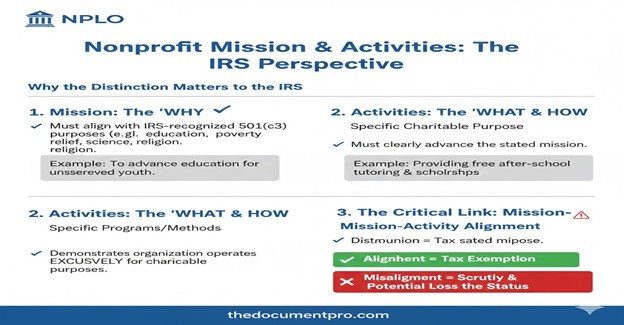
A nonprofit’s mission is the broad charitable purpose or goal the organization seeks to achieve—the “why” behind existence such as “advancing education” or “relieving poverty”—while activities are the specific methods, programs, and services the organization conducts to accomplish that mission—the “what” and “how” such as “providing tutoring” or “distributing food.” The IRS cares about this distinction because mission must fall within recognized 501(c)(3) charitable purposes qualifying for tax exemption, while activities must clearly advance the stated mission rather than serving unrelated purposes, and the relationship between mission and activities demonstrates whether the organization operates exclusively for charitable purposes or mixes charitable work with substantial non-charitable activities.

How does IRS distinguish mission statements from activity descriptions?

Mission represents organizational purpose at the highest level. Mission statements answer why the organization exists and what broad goal it pursues. “We advance education for underserved youth” is a mission. “We relieve poverty by promoting economic self-sufficiency” is a mission. These statements identify the charitable purpose category (education, poverty relief) and general target population without specifying exactly how the work will be accomplished.

Activities translate mission into concrete operational reality. Activities answer what the organization actually does on a day-to-day basis and how it accomplishes its mission. “We provide after-school tutoring three times weekly” is an activity. “We operate a job training program and food pantry” describes activities. These statements specify tangible programs, services, and operations that advance the mission.

Mission provides continuity while activities may evolve. An organization with the mission “advancing health through community wellness” could operate a fitness center, conduct health education workshops, or provide preventive screening clinics—all different activities serving the same mission. As community needs shift or funding changes, activities can be added, modified, or ended while mission remains constant. IRS expects mission stability but understands activity evolution.

The mission-activity relationship determines charitable qualification. IRS evaluates whether described activities logically advance the stated mission. An organization with education mission conducting tutoring programs shows clear alignment. An organization with education mission primarily running a restaurant shows questionable alignment—is the restaurant genuinely an educational program or an unrelated business generating income? The tighter the connection between mission and activities, the stronger the 501(c)(3) application.

What problems arise when mission and activities don’t align?

Activities unrelated to mission raise unrelated business income concerns. When substantial organizational activities don’t advance the charitable mission, IRS may determine that income from those activities is unrelated business income (UBI) subject to taxation. An organization with education mission operating a gift shop selling donated items might generate UBI if retail operations don’t have substantial relationship to educational purposes. Occasional UBI doesn’t jeopardize exemption, but substantial UBI suggests the organization isn’t operated exclusively for charitable purposes.

Mission creep occurs when activities expand beyond original charitable purposes. Organizations starting with focused missions sometimes add programs that don’t clearly connect. An organization with “youth education” mission that starts operating a senior center may be conducting charitable work, but the senior center activities don’t advance youth education mission. This doesn’t necessarily violate IRS rules if the organization properly described both youth and senior services in its purposes, but unexpected mission creep raises questions about whether the organization is operating as described in its determination application.

Vague mission statements create activity classification problems. If an organization’s mission is simply “helping the community,” IRS can’t evaluate whether specific activities advance that mission because the mission is too undefined. Specific missions like “providing health services to low-income families” allow clear assessment of whether activities (operating a free clinic, conducting health screenings, distributing medications) logically advance that purpose. Vague missions paired with diverse activities suggest lack of organizational focus.

Commercial activities disguised as mission work jeopardize exemption. Some organizations describe commercial enterprises as charitable activities when the connection is weak or non-existent. Operating a restaurant and claiming it advances education mission because employees learn job skills sounds charitable but may not satisfy IRS if the restaurant primarily functions as a commercial business competing with for-profit restaurants. The IRS looks for whether activities would be considered charitable independent of any educational or rehabilitative aspects attached to commercial operations.

Framework: Launch → Fix → Fund + Federal Recognition + CA Compliance Triangle

Launch includes articulating clear mission statements and developing activities obviously advancing that mission. San Bernardino nonprofits should ensure mission-activity alignment is apparent from formation documents and IRS applications preventing questions about whether operations serve genuine charitable purposes.

Fix addresses situations where organizational drift created misalignment between stated mission and actual activities, where mission statements are too vague to meaningfully guide operations, or where activities expanded beyond mission scope requiring either mission amendments or activity refocusing.

Fund depends on demonstrating mission-activity alignment because grant applications request both mission statements and program descriptions. Funders evaluate whether your activities logically accomplish your mission and whether mission aligns with their funding priorities. Misalignment between claimed mission and actual programs raises credibility concerns.

Federal Recognition requires proving to IRS that mission qualifies as charitable and that planned activities will advance that mission. Form 1023/1023-EZ applications ask separately about organizational purposes and specific activities because IRS evaluates both the charitable purpose itself and whether activities effectively pursue it.

CA Compliance Triangle includes Attorney General oversight ensuring charitable assets serve stated purposes. Significant deviation between stated mission in formation documents and actual organizational activities can trigger AG investigation about whether the organization is operating within its chartered purposes.

Step-by-step: How NPLO helps organizations maintain mission-activity alignment

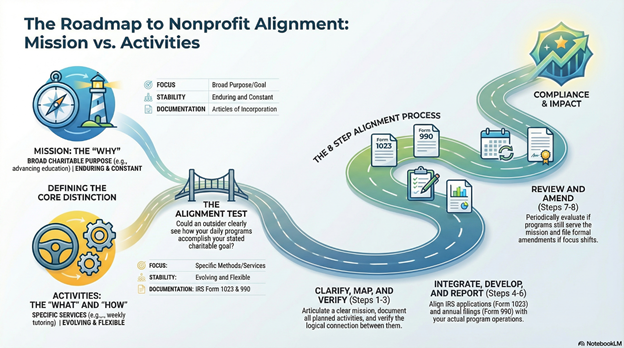
Step 1: Mission Clarification We help articulate clear mission statements that are specific enough to guide operations but flexible enough to allow reasonable evolution.

Step 2: Activity Mapping We document all planned activities and verify each clearly advances the stated mission.

Step 3: Alignment Verification We assess whether the connection between mission and activities is obvious or requires explanation.

Step 4: IRS Application Integration We ensure Form 1023/1023-EZ applications present mission and activities showing clear logical connections.

Step 5: Program Development Guidance We help organizations considering new programs evaluate whether they align with existing mission or require mission amendments.

Step 6: Form 990 Consistency We ensure annual Form 990 program descriptions remain consistent with stated mission and IRS determination basis.

Step 7: Periodic Review We establish schedules for reviewing whether activities still align with mission as organizations evolve.

Step 8: Amendment Guidance When mission or activities change significantly, we guide proper IRS notification or amended application processes.

Checklist: Mission-activity alignment essentials

Mission Statement Should:

  • Identify specific charitable purpose (education, poverty relief, health, etc.)
  • Describe general goal or outcome pursued
  • Indicate target population at high level
  • Be stable and enduring
  • Guide all organizational decisions
  • Appear in Articles of Incorporation
  • Be broad enough to encompass multiple programs

Activities Should:

  • Clearly advance the stated mission
  • Describe specific programs and services
  • Explain methods and delivery approaches
  • Specify who benefits directly
  • Show logical connection to mission
  • Be documented in IRS applications
  • Evolve as needed to serve mission

Alignment Indicators:

  • Someone unfamiliar with organization can see how activities accomplish mission
  • Each major program connects to mission directly
  • Activities wouldn’t make sense with different mission
  • Mission explains why organization conducts its activities

Quick Answers (PPA)

Can we change our mission statement, or is it permanent once IRS approves it? Mission can change through formal amendment processes, but frequent mission changes raise questions about organizational stability and focus. Minor refinements to mission language don’t require IRS notification—clarifying “youth education” to “youth education and mentoring” when mentoring was always part of the work is reasonable evolution. Substantial mission changes adding new charitable purpose categories or fundamentally shifting focus may require filing amended determination applications. Before changing mission, consider whether the issue is actually mission needing change versus activities needing adjustment to better serve existing mission. Many organizations think they need new missions when they really need better activity alignment.

What if we want to add a program that doesn’t obviously connect to our mission—should we amend the mission or just not do the program? Evaluate whether the proposed program serves a charitable purpose that could reasonably be included in your organizational purposes. If it does and you genuinely want to pursue it, consider amending your Articles of Incorporation to broaden purposes appropriately and notifying IRS if the change is substantial. However, consider whether adding unfocused programs dilutes organizational effectiveness. Organizations known for excellence in specific areas often have greater impact than organizations pursuing scattered activities across multiple unrelated missions. Unless the new program genuinely fits your expertise and capacity, declining opportunities that don’t align with mission demonstrates good judgment rather than missed opportunity.

How specific should mission statements be—is “helping people” adequate? “Helping people” is far too vague to serve as organizational mission. Mission should identify which recognized charitable purpose you serve (education, poverty relief, health, community development, etc.) and generally who benefits. “Advancing education for underserved youth” is appropriately specific—it identifies charitable purpose category (education) and general beneficiary population (underserved youth) while allowing flexibility in specific programs and methods. Mission specificity helps IRS evaluate whether purposes qualify as charitable and helps funders understand whether your work aligns with their priorities.

Do activities have to match mission word-for-word, or can they serve the mission in creative ways? Activities don’t require literal word-matching but should have logical connections clear to outside observers. An organization with “environmental conservation” mission could conduct education programs teaching conservation practices, organize community cleanup events, advocate for environmental policies, or operate habitat restoration projects—all activities serving the mission through different approaches. The test is whether reasonable observers would agree activities advance the mission. Creative approaches are fine; tenuous connections that require elaborate explanations raise concerns.

What happens if we conduct activities that IRS determines don’t advance our mission? Activities not advancing exempt purposes generate unrelated business income taxable even for exempt organizations. Occasional UBI doesn’t jeopardize exemption, but substantial UBI or operations primarily focused on non-mission activities can result in IRS revoking 501(c)(3) status on grounds the organization isn’t operated exclusively for charitable purposes. If you discover activities have drifted from mission, either refocus activities to better serve mission, eliminate activities that don’t advance exempt purposes, or formally amend mission if activities serve different charitable purposes you genuinely want to pursue. Don’t continue substantial misalignment hoping IRS won’t notice.

What to do next (DIY vs Done-With-You)

DIY approach: Write your organization’s mission statement in one clear sentence identifying the charitable purpose and general goal. Then list all current or planned programs and activities. For each activity, write 1-2 sentences explaining how it advances the mission. If you struggle articulating the connection or if the explanation requires elaborate justification, the activity may not align well. Review your Articles of Incorporation verifying the stated purpose encompasses your current activities—if activities have drifted beyond chartered purposes, consider whether Articles need amendment. Review your most recent Form 990 comparing the program service accomplishments you reported with your stated mission ensuring consistency. If you’re planning new programs, evaluate them against mission asking “does this clearly advance our charitable purpose or does it pull us in new directions?” Consider whether mission needs broadening or whether proposed activities don’t fit organizational focus. Before changing mission substantially, consult with board about whether change serves organizational best interests or whether maintaining current focus with better-aligned activities would be stronger strategy.

Done-With-You approach: The Nonprofit Launch Office provides comprehensive mission-activity alignment support for San Bernardino and Inland Empire nonprofits. We help articulate clear mission statements specific enough to guide decisions but flexible enough to allow reasonable program evolution, document and evaluate all planned or current activities verifying clear connections to mission, assess whether mission-activity alignment is obvious or requires improvement, ensure IRS applications and Form 990 filings present consistent mission and program relationships, guide organizations considering new programs through alignment analysis determining fit with existing mission, help organizations that have drifted from original mission decide whether refocusing activities or amending mission serves best interests, ensure ongoing alignment as organizations mature and programs evolve, and guide proper IRS notification when substantial mission or activity changes occur. This ensures your organization maintains the mission-activity coherence that IRS expects and that funders look for when evaluating whether your work aligns with their charitable priorities.

Contact


Book: https://thedocumentpro.com/
 Call: 1(800) 285-0078
 Email: mydocumentpro@gmail.com
 The Nonprofit Launch Office™ — a discipline of The Document Pro, operated by Gitta Williams.
 Operated by The Document Pro (Gitta Williams)

Find Us Locally

Service Area: Moreno Valley, CA and surrounding areas

Coordinates: 33.9535, -117.2081

Address: 23945 Sunnymead Blvd. #4, Moreno Valley, CA 92553

Sources

  • https://www.irs.gov/charities-non-profits/charitable-organizations
  • https://www.irs.gov/forms-pubs/about-form-1023
  • https://calnonprofits.org/
Disclaimer

Document preparation and nonprofit readiness support — not legal or tax advice.
Short Answer

Form 1023-EZ is a simplified three-page electronic application with yes/no questions and minimal narrative for smaller organizations projecting under $50,000 in annual gross receipts, costing $275 and typically processing within 2-4 weeks, while Form 1023 is a comprehensive detailed application requiring extensive narrative descriptions of programs, governance, and finances for larger or more complex organizations, costing $600 and typically processing within 3-6 months. Both forms result in the same 501(c)(3) recognition with identical tax benefits and legal status—the difference lies in application complexity, eligibility requirements, IRS review depth, and processing time, not in the tax-exempt status ultimately granted.

What specific information does the determination letter contain?

Official IRS recognition statement declares that the organization is recognized as tax-exempt under Section 501(c)(3). This formal declaration from the IRS provides legal authority that the organization qualifies for federal tax exemption. Without this official statement, organizations cannot legitimately claim federal tax-exempt status regardless of California incorporation or stated charitable purposes.

Effective date of exemption establishes when tax-exempt recognition began. For most organizations, this date matches incorporation date if Form 1023/1023-EZ was filed within 27 months of incorporation. The effective date matters because it determines when donors can claim tax deductions for contributions and when the organization became exempt from federal income tax on mission-related revenue. Funders reviewing determination letters verify the effective date to understand organizational maturity.

Foundation classification indicates whether the organization is a public charity or private foundation. Most determination letters state the organization is classified as a 509(a)(1) or 509(a)(2) public charity, meaning it receives broad public support rather than funding from a single source. This classification matters because different rules apply to public charities versus private foundations, and most funders prefer supporting public charities. The letter confirms which classification applies.

Advance ruling period information appears for some older determination letters. Previously, IRS issued “advance ruling” letters requiring organizations to demonstrate public support during an initial period before receiving permanent status. Current process typically provides definitive determinations immediately. However, older determination letters still valid may reference advance ruling periods that have since concluded, requiring organizations to hold foundation status determination letters confirming permanent classification.

Why do funders request determination letters beyond TEOS verification?

Physical documentation for grant files provides tangible proof of eligibility. While funders verify organizations in TEOS database, they also require physical determination letters filed in grant documentation. The letter serves as permanent record that due diligence was completed and that the grantee qualified as a 501(c)(3) at the time of grant award. If questions arise years later about whether proper verification occurred, the determination letter in the file provides documentation.

Verification of organization details beyond just tax-exempt status occurs through determination letter review. The letter shows the organization’s official legal name, EIN, and address as recorded by IRS at time of determination. Funders verify this information matches what appears on grant applications ensuring consistency. Discrepancies between determination letter information and application information raise questions requiring explanation.

Demonstration of IRS review and approval provides confidence in organizational legitimacy. The determination letter proves that IRS examined the organization’s purposes, governance structures, financial projections, and operational plans before granting recognition. This federal review and approval adds credibility beyond self-reported information on grant applications. Organizations without determination letters claiming to be “nonprofits” haven’t undergone federal scrutiny.

Protection against revocation or fraud risk motivates funder requests for determination letters. While TEOS database shows current status, determination letters provide historical baseline. If an organization claims 501(c)(3) status but cannot produce a determination letter, it raises questions about whether recognition was ever actually granted or whether the organization is misrepresenting its status. Legitimate organizations possess determination letters they can readily provide.

Framework: Launch → Fix → Fund + Federal Recognition + CA Compliance Triangle

Launch includes obtaining determination letters and maintaining them in permanent organizational records. Moreno Valley nonprofits should save original determination letters in corporate records books, create digital copies for easy sharing, and verify that letters contain all standard elements proving recognition.

Fix addresses situations where organizations lost determination letters requiring replacement requests from IRS, or where organizations operated for years without determination letters because recognition was never actually obtained requiring immediate Form 1023/1023-EZ applications.

Fund access depends on providing current determination letters when requested. Grant applications commonly include determination letters as required attachments. Organizations unable to provide determination letters fail basic eligibility requirements regardless of program quality.

Federal Recognition is precisely what determination letters prove. The letter is the official IRS document confirming that federal tax-exempt status was granted, when it became effective, and what classification applies.

CA Compliance Triangle operates independently—determination letters prove federal IRS recognition but say nothing about California Secretary of State, Franchise Tax Board, or Attorney General status. Funders require both determination letters AND California verification documents.

What are the eligibility requirements and restrictions for each form?

Form 1023-EZ eligibility requires meeting multiple size and activity restrictions. Organizations must project gross receipts of $50,000 or less annually for the first three years, possess assets of $250,000 or less, and have existed for less than three years. Additionally, organizations cannot be successors to or controlled by for-profit organizations, cannot be hospitals or medical research organizations, cannot support or oppose candidates for public office, and cannot operate schools. Organizations meeting all these requirements can choose 1023-EZ.

Form 1023 accommodates all organizations regardless of size or complexity. Organizations projecting over $50,000 in annual receipts must use Form 1023. Organizations with complex programs, unusual governance structures, or activities requiring detailed explanation typically fare better with Form 1023’s narrative format allowing thorough descriptions. While organizations eligible for 1023-EZ can choose to file Form 1023 instead for more comprehensive review, most small organizations prefer 1023-EZ’s simplicity and speed.

Financial thresholds create the primary eligibility distinction. Temecula nonprofits projecting under $50,000 annually in donations, grants, program fees, and other revenue qualify for 1023-EZ if meeting other criteria. Organizations projecting $50,001 or more must use Form 1023. These thresholds apply to projections, not actuals—organizations apply based on reasonable revenue expectations for their first three years.

Activity restrictions eliminate 1023-EZ for certain organization types. Schools, hospitals, supporting organizations, foreign organizations, and others explicitly listed as ineligible cannot use 1023-EZ regardless of size. These organizations must file Form 1023 providing the detailed information IRS requires for specialized organization types.

How do application complexity, review depth, and processing times differ?

Form 1023-EZ consists of three pages with mostly yes/no checkboxes. Applicants answer basic questions about organizational structure, purposes, and activities without extensive narrative explanations. The form includes attestation statements where organizations certify they meet eligibility requirements and will operate according to 501(c)(3) rules. Total preparation time for well-organized organizations might be 2-4 hours.

Form 1023 requires extensive narrative responses spanning 20-30 pages typically. Applicants describe organizational history and mission, detail all planned programs and activities including target populations and methods, provide comprehensive financial information including detailed budgets, explain governance structures and compensation arrangements, and attach supporting documents like bylaws and financial statements. Preparation time for complex organizations can reach 20-40 hours or more.

IRS review depth varies significantly between forms. Form 1023-EZ undergoes basic compliance screening verifying eligibility requirements are met and that no obvious disqualifying factors exist. The streamlined review enables faster processing but provides less opportunity for organizations to explain unusual circumstances. Form 1023 receives more thorough examination of program descriptions, financial sustainability, governance quality, and compliance with detailed 501(c)(3) requirements, sometimes including supplemental questions requiring additional information.

Processing timelines reflect review complexity differences. Form 1023-EZ typically processes within 2-4 weeks, though delays occasionally extend this to 6-8 weeks. Form 1023 typically requires 3-6 months for processing, with complex applications sometimes taking 9-12 months especially if IRS requests supplemental information. Organizations needing determination quickly may prefer 1023-EZ if eligible, while those willing to wait can provide more comprehensive information through Form 1023.

Framework: Launch → Fix → Fund + Federal Recognition + CA Compliance Triangle

Launch for Temecula nonprofits includes selecting appropriate IRS application form. Organizations eligible for both should weigh 1023-EZ’s speed and simplicity against 1023’s thorough review and documentation. Starting with realistic revenue projections and honest activity descriptions ensures choosing the right form.

Fix becomes necessary when organizations filed wrong forms—using 1023-EZ when actually ineligible due to misunderstanding revenue thresholds or activity restrictions, or filing Form 1023 unnecessarily when 1023-EZ would have sufficed creating longer wait times. While both result in same recognition, filing wrong forms delays or complicates approval.

Fund access depends on determination regardless of which form was used. Organizations with 1023-EZ determinations have identical 501(c)(3) status and grant eligibility as organizations approved through Form 1023. Funders care that you have recognition, not which application form you used.

Federal Recognition is identical whether achieved through 1023-EZ or Form 1023. Both result in official IRS determination letters stating the organization is recognized as 501(c)(3) tax-exempt, both appear in TEOS database showing eligible status, and both provide the same tax benefits and legal standing.

CA Compliance Triangle operates independently of which IRS form was filed. Organizations need California compliance with Secretary of State, Franchise Tax Board, and Attorney General Registry regardless of federal application method.

Step-by-step: How NPLO helps organizations choose and complete the right form

Step 1: Eligibility Assessment We evaluate whether organizations meet 1023-EZ requirements or must use Form 1023.

Step 2: Strategic Form Selection For organizations eligible for either, we discuss tradeoffs between speed/simplicity versus thorough review.

Step 3: Revenue Projections We develop realistic three-year revenue projections determining which form is appropriate.

Step 4: Application Preparation We prepare complete applications—1023-EZ with accurate attestations or Form 1023 with comprehensive narratives.

Step 5: Supporting Documentation We compile required attachments including bylaws, financial projections, and governance documents.

Step 6: Accuracy Verification We verify applications contain no errors triggering IRS questions or delays.

Step 7: Electronic Submission We submit applications through IRS online system with proper fee payment.

Step 8: Follow-Up Management We track processing status and respond to any IRS supplemental information requests.

Checklist: Comparing Form 1023-EZ and Form 1023

Form 1023-EZ:

  • Eligibility: Under $50K annual receipts projected
  • Eligibility: Under $250K assets
  • Length: 3 pages, mostly checkboxes
  • Fee: $275
  • Processing: 2-4 weeks typically
  • Preparation time: 2-4 hours
  • Detail level: Minimal narrative
  • IRS review: Basic compliance screening
  • Result: Same 501(c)(3) recognition
  • Best for: Small, simple organizations

Form 1023:

  • Eligibility: Any organization (required if over $50K)
  • No asset restrictions
  • Length: 20-30+ pages typical
  • Fee: $600
  • Processing: 3-6 months typically
  • Preparation time: 20-40+ hours
  • Detail level: Extensive narratives
  • IRS review: Thorough examination
  • Result: Same 501(c)(3) recognition

Best for: Larger or complex organizations

Quick Answers (PPA)

If we’re eligible for 1023-EZ, should we always use it, or are there reasons to file Form 1023 instead? Most organizations eligible for 1023-EZ benefit from its simplicity and speed. However, some situations favor Form 1023 despite eligibility for the simpler form. Organizations with complex programs difficult to explain through yes/no questions may prefer 1023’s narrative format allowing thorough description. Organizations anticipating rapid growth might want the more comprehensive IRS review that Form 1023 provides. Organizations with unusual governance structures or activities that might raise questions benefit from opportunities to explain circumstances that 1023-EZ doesn’t provide. If your organization fits straightforwardly into normal charitable categories with simple programs and governance, 1023-EZ makes sense. If complexity or unusual circumstances exist, consider Form 1023 despite longer processing.

What happens if we file 1023-EZ but IRS determines we should have filed Form 1023—is the application rejected? If IRS determines during 1023-EZ review that the organization doesn’t meet eligibility requirements or that circumstances require more detailed examination, IRS typically returns the application and user fee, requiring the organization to reapply using Form 1023. This delays determination by months while the correct application is prepared and processed. To avoid this problem, carefully verify 1023-EZ eligibility before filing. If any doubt exists about whether you meet requirements or whether your activities can be adequately explained through the simplified form, file Form 1023 initially rather than risking rejection and resubmission.

Do funders view 1023-EZ determinations differently than Form 1023 determinations, or is recognition identical? Recognition is legally identical—both result in official IRS 501(c)(3) determination with the same tax benefits, legal status, and eligibility for grants. Determination letters don’t specify which form was used. Some funders may ask about organizational finances and programs in ways that require providing information beyond what 1023-EZ collected, but the determination itself is not differentiated. Occasionally, sophisticated funders note that 1023-EZ approval involved less IRS scrutiny and may conduct their own due diligence more thoroughly, but most funders treat all 501(c)(3) determinations equivalently regardless of application form.

Can we amend from 1023-EZ to Form 1023 mid-process if we realize we need more space to explain things? The IRS online system processes applications as submitted—there’s no formal amendment process switching forms mid-review. If you submit 1023-EZ and realize during processing that Form 1023 would have been better, you can withdraw the 1023-EZ application and resubmit using Form 1023, but you’ll lose the processing time already invested. Better approach is carefully evaluating which form fits your situation before initial submission. If uncertainty exists or if your programs are genuinely complex, start with Form 1023 despite longer processing rather than filing 1023-EZ hoping it will work.

What if our projected revenue is right around $50,000—how do we decide which form to use? Conservative revenue projections are advisable when close to thresholds. If realistic projections are $48,000-$52,000 creating uncertainty, consider whether assumptions could reasonably result in exceeding $50,000. Organizations projecting close to thresholds might use Form 1023 to avoid risk of 1023-EZ rejection for exceeding limits. Alternatively, if projections conservatively stay under $50,000 even with optimistic scenarios, 1023-EZ is appropriate. Remember that projections are estimates, not guarantees—IRS expects reasonable good-faith projections, not perfect predictions. If actual revenue later exceeds projections, this doesn’t invalidate your determination as long as projections were reasonable at application time.

What to do next (DIY vs Done-With-You)

DIY approach: Evaluate your organization against 1023-EZ eligibility requirements—will your gross receipts for each of the next three years be under $50,000, are your assets under $250,000, have you existed less than three years, and do none of the activity restrictions apply? If you meet all 1023-EZ requirements and have simple straightforward programs, Form 1023-EZ is likely appropriate. If you exceed size thresholds or have complex programs requiring explanation, use Form 1023. Download appropriate form instructions from IRS website and review carefully before starting application. For 1023-EZ, gather basic organizational information, bylaws, and EIN. For Form 1023, additionally prepare detailed program descriptions, comprehensive financial projections, and governance documentation. Create Pay.gov account for fee payment. Complete application accurately and thoroughly—incomplete applications cause delays regardless of form. Submit electronically through IRS system. Track application status through online portal. For 1023-EZ, expect determination within 2-4 weeks; for Form 1023, expect 3-6 months and be prepared to respond to potential supplemental information requests.

Done-With-You approach: The Nonprofit Launch Office provides comprehensive IRS determination support for Temecula and Inland Empire nonprofits using either form. We assess whether organizations meet 1023-EZ eligibility requirements or must use Form 1023, discuss strategic form selection for organizations eligible for either weighing speed versus thoroughness, develop realistic revenue projections determining appropriate form, prepare complete applications whether simplified 1023-EZ or comprehensive Form 1023, compile all supporting documentation required by each form, verify accuracy preventing errors that trigger IRS questions, submit applications electronically through IRS system, track processing status and respond to supplemental requests if needed, and obtain determination letters confirming recognition. This ensures you file the right form the first time, complete applications accurately, and achieve determination as efficiently as possible given organizational circumstances.

Contact


Book: https://thedocumentpro.com/
 Call: 1(800) 285-0078
 Email: mydocumentpro@gmail.com
 The Nonprofit Launch Office™ — a discipline of The Document Pro, operated by Gitta Williams.
 Operated by The Document Pro (Gitta Williams)

Find Us Locally

Service Area: Moreno Valley, CA and surrounding areas

Coordinates: 33.9535, -117.2081

Address: 23945 Sunnymead Blvd. #4, Moreno Valley, CA 92553

Sources

  • https://www.irs.gov/charities-non-profits/charitable-organizations
  • https://www.irs.gov/forms-pubs/about-form-1023
  • https://calnonprofits.org/
Disclaimer

Document preparation and nonprofit readiness support — not legal or tax advice.
Short Answer

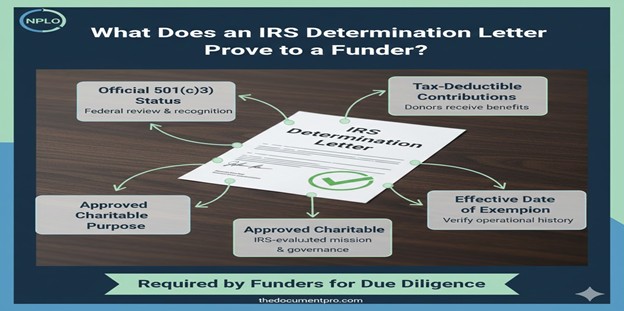
An IRS determination letter proves that the organization underwent federal review and received official recognition as a 501(c)(3) charitable organization, that donor contributions to the organization are tax-deductible, that the organization qualified based on specific charitable purposes and governance structures evaluated by IRS, and that tax-exempt status became effective on a specific date allowing verification of how long the organization has operated with federal recognition. Funders require determination letters because the letter provides definitive proof of federal tax-exempt status that organizational claims alone cannot offer, the letter demonstrates that IRS evaluated and approved the organization’s charitable purposes and governance, and most foundation and corporate grant programs explicitly require grantees to submit current determination letters as part of due diligence documentation proving eligibility.

What specific information does the determination letter contain?

Official IRS recognition statement declares that the organization is recognized as tax-exempt under Section 501(c)(3). This formal declaration from the IRS provides legal authority that the organization qualifies for federal tax exemption. Without this official statement, organizations cannot legitimately claim federal tax-exempt status regardless of California incorporation or stated charitable purposes.

Effective date of exemption establishes when tax-exempt recognition began. For most organizations, this date matches incorporation date if Form 1023/1023-EZ was filed within 27 months of incorporation. The effective date matters because it determines when donors can claim tax deductions for contributions and when the organization became exempt from federal income tax on mission-related revenue. Funders reviewing determination letters verify the effective date to understand organizational maturity.

Foundation classification indicates whether the organization is a public charity or private foundation. Most determination letters state the organization is classified as a 509(a)(1) or 509(a)(2) public charity, meaning it receives broad public support rather than funding from a single source. This classification matters because different rules apply to public charities versus private foundations, and most funders prefer supporting public charities. The letter confirms which classification applies.

Advance ruling period information appears for some older determination letters. Previously, IRS issued “advance ruling” letters requiring organizations to demonstrate public support during an initial period before receiving permanent status. Current process typically provides definitive determinations immediately. However, older determination letters still valid may reference advance ruling periods that have since concluded, requiring organizations to hold foundation status determination letters confirming permanent classification.

Why do funders request determination letters beyond TEOS verification?

Physical documentation for grant files provides tangible proof of eligibility. While funders verify organizations in TEOS database, they also require physical determination letters filed in grant documentation. The letter serves as permanent record that due diligence was completed and that the grantee qualified as a 501(c)(3) at the time of grant award. If questions arise years later about whether proper verification occurred, the determination letter in the file provides documentation.

Verification of organization details beyond just tax-exempt status occurs through determination letter review. The letter shows the organization’s official legal name, EIN, and address as recorded by IRS at time of determination. Funders verify this information matches what appears on grant applications ensuring consistency. Discrepancies between determination letter information and application information raise questions requiring explanation.

Demonstration of IRS review and approval provides confidence in organizational legitimacy. The determination letter proves that IRS examined the organization’s purposes, governance structures, financial projections, and operational plans before granting recognition. This federal review and approval adds credibility beyond self-reported information on grant applications. Organizations without determination letters claiming to be “nonprofits” haven’t undergone federal scrutiny.

Protection against revocation or fraud risk motivates funder requests for determination letters. While TEOS database shows current status, determination letters provide historical baseline. If an organization claims 501(c)(3) status but cannot produce a determination letter, it raises questions about whether recognition was ever actually granted or whether the organization is misrepresenting its status. Legitimate organizations possess determination letters they can readily provide.

Framework: Launch → Fix → Fund + Federal Recognition + CA Compliance Triangle

Launch includes obtaining determination letters and maintaining them in permanent organizational records. Moreno Valley nonprofits should save original determination letters in corporate records books, create digital copies for easy sharing, and verify that letters contain all standard elements proving recognition.

Fix addresses situations where organizations lost determination letters requiring replacement requests from IRS, or where organizations operated for years without determination letters because recognition was never actually obtained requiring immediate Form 1023/1023-EZ applications.

Fund access depends on providing current determination letters when requested. Grant applications commonly include determination letters as required attachments. Organizations unable to provide determination letters fail basic eligibility requirements regardless of program quality.

Federal Recognition is precisely what determination letters prove. The letter is the official IRS document confirming that federal tax-exempt status was granted, when it became effective, and what classification applies.

CA Compliance Triangle operates independently—determination letters prove federal IRS recognition but say nothing about California Secretary of State, Franchise Tax Board, or Attorney General status. Funders require both determination letters AND California verification documents.

Step-by-step: How NPLO helps organizations manage determination letters

Step 1: Receipt Verification We verify clients received complete determination letters after IRS approval with all standard elements.

Step 2: Information Review We review determination letters confirming information is accurate—correct legal name, EIN, classification.

Step 3: Permanent Storage We ensure determination letters are filed in organizational records books for safekeeping.

Step 4: Digital Archiving We create high-quality digital scans for electronic sharing with funders.

Step 5: Replacement Requests If determination letters are lost, we help request certified copies from IRS.

Step 6: Grant Application Preparation We prepare determination letter copies in formats funders commonly request.

Step 7: Update Handling If determination letters are superseded by foundation status letters or amendments, we ensure current versions are used.

Step 8: Board Communication We educate boards about determination letter significance and storage responsibility.

Checklist: What determination letters should contain

  • IRS letterhead and official signature
  • Statement recognizing organization as 501(c)(3)
  • Organization’s official legal name
  • Employer Identification Number (EIN)
  • Effective date of tax-exempt status
  • Foundation classification (public charity or private foundation)
  • Statement that contributions are deductible
  • Reference to Internal Revenue Code Section 501(c)(3)
  • Date letter was issued
  • IRS contact information
  • Clear without redactions obscuring critical information
  • High-quality legible copy (if using copies rather than original)

Quick Answers (PPA)

Our determination letter was issued 15 years ago—is it still valid, or do we need a new one? Determination letters remain valid indefinitely unless IRS revokes recognition through specific actions like automatic revocation for missed Form 990 filings or determination that operations no longer serve charitable purposes. Organizations in continuous good standing since receiving determination 15 years ago can continue using that letter—IRS doesn’t require renewal or reissuance at intervals. However, verify your current status in TEOS database showing you’re still recognized and eligible to receive deductible contributions. If TEOS shows revoked status, your old determination letter is no longer valid and you’ll need reinstatement. Also note that very old determination letters may reference outdated IRS procedures or advance ruling periods that have concluded—these letters remain valid but you may want to include TEOS printout alongside them showing current active status.

We lost our determination letter—how do we get a replacement, and how long does it take? Request certified copies from IRS by writing to IRS Exempt Organizations Determinations office or calling Tax Exempt and Government Entities division. Include your organization’s legal name, EIN, address, and approximate date of determination. Explain you’re requesting a certified copy of the determination letter for your records. IRS typically provides certified copies for a fee (currently around $85). Processing times vary but expect 4-8 weeks minimum. While waiting, generate current TEOS printouts showing your organization’s active status—many funders will accept TEOS verification temporarily if you explain determination letter replacement is pending. However, secure the replacement letter for permanent files since some funders specifically require the physical determination letter regardless of TEOS status.

What if our determination letter shows a different address or name than we currently use—does that invalidate it? Address changes don’t invalidate determination letters—organizations move locations frequently. However, you should notify IRS of address changes by filing Form 8822-B ensuring future correspondence reaches you and updating TEOS database information. Legal name changes are more significant and may require IRS notification through letter explaining the change with documentation like amended Articles of Incorporation. If operating under a DBA (doing business as) name different from legal name on determination letter, include explanation for funders clarifying that the DBA is the same organization. Substantial changes to organizational structure or purposes might require amended determination applications. For typical address moves or minor name adjustments, original determination letters remain valid with explanatory documentation.

Can we provide funders with a TEOS printout instead of the determination letter, or do they specifically need the letter? Funder requirements vary—some explicitly require the physical determination letter as part of grant documentation, while others accept TEOS printouts as equivalent verification. When grant applications specify “provide copy of IRS determination letter,” provide the actual letter. When requirements are less specific or say “proof of 501(c)(3) status,” TEOS printouts may suffice. Best practice is providing both—determination letter plus current TEOS printout dated within 30 days. The determination letter shows historical baseline of when and how recognition was granted, while TEOS printout confirms current active status. If you have your determination letter available, always provide it rather than substituting TEOS printout unless space limitations or funder preferences dictate otherwise.

What if we applied for 501(c)(3) recognition but haven’t received determination yet—what do we tell funders? Be completely transparent that determination is pending. Grant applications asking about 501(c)(3) status should receive honest answers: “We applied for 501(c)(3) recognition on [date] and are awaiting IRS determination. Recognition has not yet been granted.” Most funders cannot consider applications from organizations lacking current 501(c)(3) recognition regardless of pending applications. However, some foundations have programs specifically supporting emerging organizations during formation and may consider applications with pending status if you’re transparent. Never claim you have 501(c)(3) status before IRS actually grants it and you receive the determination letter—misrepresentation discovered during verification results in permanent disqualification from that funder and potential fraud investigation. Wait to submit grant applications until after receiving determination whenever possible.

What to do next (DIY vs Done-With-You)

DIY approach: Locate your organization’s IRS determination letter in organizational records. If you have it, create multiple high-quality scans or photocopies maintaining legibility, save digital versions in secure cloud storage and local backup, file physical original in permanent corporate records book section for formation documents, and prepare easily accessible copies for sharing with funders. Verify that your determination letter contains all standard elements—IRS recognition statement, effective date, foundation classification, deductibility statement—and that information matches your current organizational details. If determination letter is lost, prepare request to IRS Exempt Organizations Determinations office including organization name, EIN, address, and approximate determination date requesting certified copy. While waiting for replacement, generate current TEOS printouts for temporary verification. If your organization never received determination letter because Form 1023/1023-EZ was never filed, prioritize IRS application immediately—you’re not actually tax-exempt without it regardless of years of operation. For grant applications, attach determination letter copies as requested ensuring documents are legible and complete without critical information obscured.

Done-With-You approach: The Nonprofit Launch Office provides comprehensive determination letter management for Moreno Valley and Inland Empire nonprofits. We verify clients received complete determination letters after IRS approval, review determination letters confirming all standard elements and accurate information, establish permanent storage in organizational records books, create high-quality digital archives for electronic sharing, request IRS certified copies when letters are lost, prepare determination letter copies in formats funders commonly request, handle updates when foundation status letters or amendments supersede original determinations, educate boards about determination letter significance and preservation responsibility, and provide immediate access to determination letters when grant opportunities require rapid response. This ensures you maintain the definitive federal recognition documentation that funders require when evaluating whether to support your work.

Contact


Book: https://thedocumentpro.com/
 Call: 1(800) 285-0078
 Email: mydocumentpro@gmail.com
 The Nonprofit Launch Office™ — a discipline of The Document Pro, operated by Gitta Williams.
 Operated by The Document Pro (Gitta Williams)

Find Us Locally

Service Area: Moreno Valley, CA and surrounding areas

Coordinates: 33.9535, -117.2081

Address: 23945 Sunnymead Blvd. #4, Moreno Valley, CA 92553

Sources

  • https://www.irs.gov/charities-non-profits/charitable-organizations
  • https://www.irs.gov/forms-pubs/about-form-1023
  • https://calnonprofits.org/
Disclaimer

Document preparation and nonprofit readiness support — not legal or tax advice.