
Author: Owner

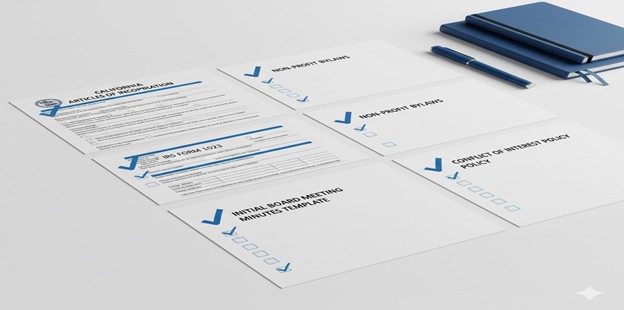
To start a non-profit in Perris, CA, you need several key documents including Articles of Incorporation, organizational bylaws, IRS Form 1023 or 1023-EZ, conflict of interest policy, and initial board meeting minutes. Preparing these documents accurately ensures smooth filing with California and federal agencies and helps avoid delays in the approval process.

This guide provides educational information and does not constitute legal or tax advice.
Answer-First Summary

  • State filing document: Articles of Incorporation (Form ARTS-PB-501) filed with California Secretary of State – $30 filing fee
  • Governance documents: Organizational bylaws, conflict of interest policy, board resolutions (not filed with state but required for IRS)
  • Federal tax-exempt application: IRS Form 1023-EZ ($275) or Form 1023 ($600) for 501(c)(3) status
  • Tax identification: Employer Identification Number (EIN) from IRS – free, obtained before tax-exempt application
  • Timeline: California state filing 5-7 business days; IRS determination 2-6+ months; complete process typically 3-9 months
  • After approval: Statement of Information (Form SI-100) due within 90 days of incorporation, California Attorney General charitable registration if fundraising

Quick Actions Checklist

  • Prepare Articles of Incorporation meeting California Corporations Code requirements
  • Draft comprehensive organizational bylaws tailored to your governance structure
  • Obtain Employer Identification Number (EIN) from IRS (free online application)
  • Complete IRS Form 1023-EZ or Form 1023 for federal tax-exempt status
  • Adopt conflict of interest policy and additional governance documents
  • Hold and document first board of directors meeting with proper minutes
  • File Articles of Incorporation with California Secretary of State ($30 fee)
  • After state approval, submit IRS tax-exempt application
  • Register with California Attorney General’s Registry of Charitable Trusts (if fundraising)
  • File Statement of Information (Form SI-100) within 90 days of incorporation ($20 fee)

Essential Documents for California Non-Profit Formation

Articles of Incorporation (State Filing Document)

The Articles of Incorporation (Form ARTS-PB-501) is your foundational legal document that creates your non-profit corporation under California law. This document must be filed with the California Secretary of State and includes:

Required information:

  • Organization’s name (must be distinguishable from existing entities and include “corporation,” “incorporated,” “corp.,” or “inc.”)
  • Statement of non-profit purpose
  • Initial agent for service of process and address
  • Initial street address of the corporation
  • Provisions for distribution of assets upon dissolution
  • Statement that organization is organized under California Nonprofit Public Benefit Corporation Law

The California Secretary of State charges a $30 filing fee. Processing typically takes 5-7 business days for standard filing, with expedited options available ($350 for 24-hour or $500 for same-day processing).

Critical requirements: Articles must comply with California Corporations Code sections 5120-5121. Improper formatting or missing required provisions will result in rejection and resubmission delays.

Organizational Bylaws

Bylaws are your internal governance document that establishes rules for operating your non-profit corporation. While not filed with the California Secretary of State, bylaws are required for IRS tax-exempt applications and proper organizational governance.

Bylaws typically include:

  • Board of directors structure, size, and election procedures
  • Officer roles and responsibilities
  • Meeting requirements and quorum rules
  • Voting procedures for board decisions
  • Committee formation and authority
  • Membership provisions (if applicable)
  • Amendment procedures
  • Fiscal year definition
  • Dissolution procedures

Bylaws must align with your Articles of Incorporation and cannot contradict provisions stated in the Articles. The IRS reviews bylaws during tax-exempt application processing to ensure proper governance structure.

Conflict of Interest Policy

California strongly recommends that non-profit corporations adopt a conflict of interest policy. The IRS requires this policy for tax-exempt status applications. This document establishes procedures for:

Policy components:

  • Identifying potential conflicts of interest among board members and officers
  • Disclosure requirements when conflicts arise
  • Recusal procedures for conflicted individuals
  • Annual disclosure statements from board members
  • Review and approval processes for potentially conflicted transactions

The IRS provides a sample conflict of interest policy in Form 1023 instructions that can be adapted to your organization’s needs.

Board Meeting Minutes and Resolutions

Documentation of your initial board meeting and organizational resolutions demonstrates proper corporate governance. Required documentation includes:

Initial meeting records:

  • Minutes of first board meeting
  • Resolution adopting bylaws
  • Resolution adopting conflict of interest policy
  • Resolution authorizing officers to open bank accounts
  • Resolution authorizing IRS tax-exempt application filing
  • Appointment of officers resolution

These documents aren’t filed with government agencies but must be maintained in your corporate records and may be requested during IRS application review.

Federal Tax-Exempt Application Documents

Employer Identification Number (EIN)

Before applying for tax-exempt status, you must obtain an EIN from the IRS. This federal tax identification number is free and can be obtained immediately through the IRS online EIN application system.

The EIN is required for:

  • Opening bank accounts in the organization’s name
  • Filing IRS Form 1023 or 1023-EZ
  • Future tax filings and correspondence with IRS
  • Employment tax reporting (if hiring staff)

Application process: Visit IRS.gov and complete the online EIN application. You’ll receive your EIN immediately upon completion. This must be done before submitting your tax-exempt application.

IRS Form 1023-EZ or Form 1023

After California approves your Articles of Incorporation, you apply for federal 501(c)(3) tax-exempt status using either the streamlined Form 1023-EZ or full Form 1023.

Form 1023-EZ eligibility ($275 user fee):

  • Projected annual gross receipts under $50,000
  • Total assets under $250,000
  • Not a hospital, school, university, or supporting organization
  • Simpler application with fewer narrative requirements

Form 1023 requirements ($600 user fee):

  • Organizations not qualifying for Form 1023-EZ
  • Requires detailed narrative descriptions of activities
  • Financial projections for three years
  • More extensive supporting documentation

Both forms require:

  • Approved California Articles of Incorporation
  • Organizational bylaws
  • Conflict of interest policy
  • Board member and officer information
  • Detailed description of planned activities
  • Financial information or projections

IRS processing typically takes 2-6 months, though timelines can extend longer depending on application volume and complexity.

Post-Formation Compliance Documents

Statement of Information (Form SI-100)

Within 90 days of incorporation, California requires filing a Statement of Information with the Secretary of State. This form provides:

  • Current officer and director names and addresses
  • Current business address
  • Principal office location
  • Brief description of business type

Filing fee: $20 Frequency: Must be filed biennially (every two years) thereafter

Failure to file the Statement of Information on time results in penalties and potential suspension of corporate status.

California Attorney General Registration

If your non-profit plans to solicit donations in California, you must register with the California Attorney General’s Registry of Charitable Trusts. Registration requirements include:

  • Initial registration (Form CT-1) – typically due within 30 days of receiving charitable assets
  • Copy of IRS determination letter
  • Financial statements
  • Annual renewal (Form RRF-1) with financial reporting

Registration is free initially, but annual renewal fees apply based on your organization’s gross revenue.

Why Choose The Document Pro – Non-Profit Launch Office

California Specialization: The Non-Profit Launch Office (NPLO), operated by The Document Pro and Gitta Williams, focuses exclusively on California non-profit formation with deep knowledge of state requirements.

Comprehensive Document Preparation: We prepare all required documents including Articles of Incorporation, bylaws, conflict of interest policies, board resolutions, and assist with IRS tax-exempt applications.

Inland Empire Expertise: Serving Perris, Moreno Valley, Riverside County, and throughout the Inland Empire with local knowledge and statewide California coverage.

After-Hours Support: Our AI assistant provides intake, guidance, and document preparation assistance outside regular business hours.

Transparent Pricing: $400-$1,200 based on organizational complexity, with clear explanation of included services.

Contact: Phone 1(800) 285-0078 | Email mydocumentpro@gmail.com

For detailed cost information: Cost to Prepare Non-Profit Papers in Perris, CA
Frequently Asked Questions

What is the first document I need to file to start a non-profit in Perris?

The first legal document is the Articles of Incorporation (Form ARTS-PB-501), which you file with the California Secretary of State to establish your non-profit's legal existence. This creates your corporation under California law and is required before you can apply for federal tax-exempt status. The filing fee is $30 with standard processing of 5–7 business days.

Do I need to file IRS Form 1023 or 1023-EZ?

It depends on your organization's size and structure. Form 1023-EZ (streamlined application, $275 fee) is available for organizations with projected annual gross receipts under $50,000 and assets under $250,000. Larger organizations or those not meeting eligibility criteria must file the full Form 1023 ($600 fee). The IRS provides an eligibility worksheet to help determine which form is appropriate.

How long does the filing process take in California?

California Secretary of State processing typically takes 5–7 business days for standard Articles of Incorporation filing. Expedited processing is available (24-hour for +$350 or same-day for +$500). After state approval, IRS tax-exempt status processing typically takes 2–6 months, though it can extend longer. Complete formation from initial state filing to IRS determination letter usually requires 3–9 months total.

Is an EIN required before applying for tax exemption?

Yes, you must obtain your Employer Identification Number (EIN) from the IRS before submitting Form 1023 or 1023-EZ. The EIN is free and can be obtained immediately through the IRS online application system. This federal tax ID is required for opening bank accounts and all IRS correspondence.

What is a Conflict of Interest Policy and do I need one?

A conflict of interest policy establishes procedures for identifying and managing situations where board members or officers have personal interests that could influence organizational decisions. California strongly recommends this policy, and the IRS requires it for tax-exempt status applications. The policy ensures transparency and proper governance procedures.

Are there any local Perris-specific filing requirements?

Perris follows standard California state regulations for non-profit formation. However, depending on your organization's activities, you may need local business licenses or permits from the City of Perris or Riverside County. Check with local government offices about requirements specific to your planned activities, especially if operating a physical location or hosting public events.

Can The Document Pro help prepare these documents?

Yes, The Document Pro – Non-Profit Launch Office specializes in preparing all essential non-profit formation documents for California organizations. We prepare Articles of Incorporation, bylaws, conflict of interest policies, board resolutions, and assist with IRS tax-exempt applications. Our services range from $400–$1,200 based on organizational complexity. Contact us at 1(800) 285-0078 for consultation.

Additional Resources

External Authority Sources

  • California Secretary of State – Nonprofit Corporation Filing Requirements
  • Internal Revenue Service (IRS) – Tax-Exempt Status Applications and Forms
  • California Corporations Code – Nonprofit Legal Framework
  • California Attorney General's Registry of Charitable Trusts – Registration Requirements
  • IRS Publication 557 – Tax-Exempt Status Guidelines
  • National Council of Nonprofits – Formation Best Practices

Sources & References

  • California Secretary of State – Official forms, filing procedures, processing timelines, and expedited service options.
  • Internal Revenue Service (IRS) – Form 1023, Form 1023-EZ, EIN applications, and tax-exempt determination procedures.
  • California Corporations Code – Legal requirements for nonprofit public benefit corporations and ongoing compliance obligations.
  • California Attorney General's Registry of Charitable Trusts – Registration requirements and annual reporting guidelines.
  • IRS Publication 557 – Comprehensive guidance on tax-exempt status applications and organizational requirements.
  • National Council of Nonprofits – Best practices for nonprofit formation, governance, and compliance management.

Disclaimer

This information is provided for educational purposes only and does not constitute legal or tax advice. Nonprofit formation requirements may vary based on organizational structure, activities, and specific circumstances. Consult qualified legal and tax professionals for advice specific to your situation.

Contact

Website:
https://thedocumentpro.com/

Phone: 1 (800) 285-0078
Email: mydocumentpro@gmail.com

The Nonprofit Launch Office™
A discipline of The Document Pro, operated by Gitta Williams.

Contact

Book: https://thedocumentpro.com/
Call: 1(800) 285-0078
Email: mydocumentpro@gmail.com
The Nonprofit Launch Office™ — a discipline of The Document Pro, operated by Gitta Williams.
Operated by The Document Pro (Gitta Williams)

Find Us Locally

Service Area: Moreno Valley, CA and surrounding areas

Coordinates: 33.9535, -117.2081

Address: 23945 Sunnymead Blvd. #4, Moreno Valley, CA 92553

Sources

  • https://www.irs.gov/charities-non-profits/charitable-organizations
  • https://www.irs.gov/forms-pubs/about-form-1023
  • https://calnonprofits.org/
Disclaimer

Document preparation and nonprofit readiness support — not legal or tax advice.

Preparing non-profit papers in Perris, CA involves various costs depending on the complexity of your organization and the level of professional assistance you choose. The California Secretary of State charges a $30 filing fee for Articles of Incorporation, while professional document preparation services typically range from several hundred to over a thousand dollars. The Document Pro – Non-Profit Launch Office (NPLO) provides comprehensive support for California non-profit formation throughout the Inland Empire, including Perris and Riverside County.

This guide provides general cost information for educational purposes and does not constitute legal or financial advice.

Answer-First Summary

  • State filing fee: California Secretary of State charges $30 for non-profit Articles of Incorporation
  • Professional service costs vary: Document preparation services typically range based on complexity, services included, and organizational structure
  • Timeline expectations: California Secretary of State processing typically takes 5-7 business days standard, 3-5 days expedited; IRS tax-exempt applications can take 2-6 months or longer
  • Cost factors: Complexity of organizational structure, number of documents required, expedited processing fees, and ongoing compliance support needs
  • DIY vs. professional help: You can file independently or use professional services for document preparation, accuracy review, and compliance guidance
  • Additional considerations: Expedited state filing ($350 for 24-hour, $500 for same-day), IRS filing fees ($275 for Form 1023, $600 for Form 1023), annual compliance costs

Quick Actions Checklist

  • Research and understand California non-profit formation requirements and costs
  • Determine your organization’s tax-exempt status goals (501(c)(3) or other)
  • Gather founding documents: organizational purpose, board member information, beneficiary details
  • Decide between self-filing or professional document preparation assistance
  • Budget for state filing fees ($30), IRS application fees, and optional expedited processing
  • Prepare Articles of Incorporation meeting California Corporations Code requirements
  • File with California Secretary of State and track application status
  • After state approval, apply for federal tax-exempt status with IRS Form 1023 or 1023-EZ
  • Plan for ongoing compliance costs: Statement of Information (SI-100), annual IRS Form 990
  • Contact The Document Pro – NPLO for document preparation consultation: 1(800) 285-0078

Understanding Non-Profit Filing Costs in Perris, CA

State-Level Filing Fees

The California Secretary of State requires a $30 filing fee for non-profit Articles of Incorporation. This is a mandatory government fee regardless of whether you file independently or use professional services. California also offers expedited processing options: 24-hour service for an additional $350 fee, or same-day service for an additional $500 fee. These expedited fees speed up state processing time but do not guarantee approval if documents contain errors.

After incorporation, California requires a Statement of Information (Form SI-100) within 90 days of formation, with a $20 filing fee. This must be filed biennially (every two years) thereafter to maintain good standing.

Federal Tax-Exempt Application Fees

If seeking 501(c)(3) tax-exempt status, the IRS charges filing fees for tax-exempt applications. Form 1023-EZ (streamlined application for smaller organizations) has a $275 user fee. Form 1023 (full application for larger organizations) has a $600 user fee. Organizations with projected annual gross receipts under $50,000 and assets under $250,000 may qualify for the simpler Form 1023-EZ.

Professional Document Preparation Services

Professional services for non-profit document preparation vary based on several factors:

Complexity factors that affect cost:

  • Organizational structure (simple vs. complex governance)
  • Number of initial board members and officers
  • Special provisions in Articles or bylaws
  • Multi-state operations or complex charitable purposes
  • Need for specialized clauses (membership structures, dissolution provisions)

Services typically included:

  • Articles of Incorporation drafting
  • Organizational bylaws preparation
  • Conflict of interest policy creation
  • Initial board resolutions and meeting minutes
  • Document review for California compliance
  • Filing coordination with Secretary of State
  • Guidance on next steps and compliance requirements

The Document Pro – Non-Profit Launch Office provides document preparation assistance with after-hours AI support for intake and guidance. Contact us to discuss your specific needs: 1(800) 285-0078 or mydocumentpro@gmail.com.

Step-by-Step Cost Overview for Non-Profit Formation

Step 1: Initial Planning and Document Gathering (No Direct Cost)

Begin by clarifying your non-profit’s mission, governance structure, and charitable purpose. Gather information about founding board members, initial address, and organizational goals. This planning phase has no filing costs but may involve consultation time if using professional services.

What you’ll need: Organization name ideas, purpose statement, initial board member names and addresses, conflict of interest policies.

Step 2: Name Reservation (Optional – $10)

If you want to secure your non-profit’s name while preparing documents, you can file a Name Reservation Request (Form NPPN-001) for a $10 fee. This reserves your name for 60 days. This step is optional but recommended if you need time to prepare complete formation documents.

Step 3: Articles of Incorporation Preparation

Draft Articles of Incorporation meeting California Corporations Code requirements. You can prepare these independently using California Secretary of State templates, or engage professional document preparation services. The Document Pro – NPLO provides guidance and document preparation assistance for California non-profits throughout the Inland Empire.

State filing fee: $30 (mandatory) Expedited processing (optional): +$350 (24-hour) or +$500 (same-day)

Step 4: Organizational Documents and Bylaws

Create organizational bylaws, conflict of interest policy, and initial board resolutions. These documents aren’t filed with the state but are essential for IRS tax-exempt applications and proper governance. Professional services may assist with drafting these documents to ensure they meet IRS requirements.

Step 5: IRS Tax-Exempt Application

After California approves your incorporation, apply for federal tax-exempt status:

Form 1023-EZ (streamlined): $275 IRS user fee

  • For organizations with projected annual gross receipts under $50,000
  • Assets under $250,000
  • Simpler application process

Form 1023 (full application): $600 IRS user fee

  • For larger organizations or those not qualifying for 1023-EZ
  • More detailed application requiring financial projections
  • May require additional supporting documentation

Processing time for IRS applications typically ranges from 2-6 months, though it can take longer depending on application volume and complexity.

Step 6: Ongoing Compliance Costs

California Statement of Information: $20 filing fee (due within 90 days, then biennially) IRS Form 990: No filing fee, but must be filed annually (990-N for small organizations is free online) State charitable registration: May be required depending on fundraising activities

Cost Comparison: DIY vs. Professional Services

Self-Filing Approach

Minimum costs:

  • State filing fee: $30
  • IRS application fee: $275 (Form 1023-EZ) or $600 (Form 1023)
  • Statement of Information: $20
  • Total minimum: $325-$650

Time investment: Significant research and document preparation time (typically 20-40 hours for thorough completion)

Considerations: Requires understanding of California Corporations Code, IRS tax-exempt requirements, and proper document formatting. Errors can result in rejections and resubmission delays.

Professional Document Preparation

Typical service range: Costs vary based on complexity and services included

Value considerations:

  • Reduced risk of filing errors and rejections
  • Time savings (professional handles document preparation)
  • Compliance guidance for California and federal requirements
  • Document review before submission
  • Assistance with IRS applications
  • Ongoing support for questions

The Document Pro – NPLO approach: We provide document preparation assistance with focus on accuracy and California compliance. Our AI assistant offers after-hours support for intake, guidance, and document questions. Contact us for consultation: 1(800) 285-0078.

Hidden Costs and Unexpected Fees to Consider

Rejection and Resubmission

If California Secretary of State rejects your Articles of Incorporation due to errors, you’ll need to correct and resubmit. While there’s typically no additional state filing fee for resubmission within a certain timeframe, you may incur additional professional service fees for corrections. Expedited processing fees are not refundable if documents are rejected.

Employer Identification Number (EIN)

Obtaining an EIN from the IRS is free and can be done online. However, some services charge fees for EIN assistance. You can always obtain your EIN directly from the IRS at no cost.

Business Licenses and Permits

Depending on your non-profit’s activities, you may need local business licenses, permits, or professional registrations. Costs vary by city and county. Check with Perris city offices and Riverside County for specific requirements.

Charitable Solicitation Registration

If your non-profit plans to solicit donations in California, you must register with the California Attorney General’s Registry of Charitable Trusts. Initial registration is free, but annual renewal fees apply based on your organization’s gross revenue.

Professional Consultations

Complex organizational structures, multi-state operations, or specialized charitable purposes may require legal or tax professional consultations. Budget accordingly if your situation requires specialized expertise beyond standard document preparation.

Why Choose The Document Pro – Non-Profit Launch Office?

Inland Empire Expertise: The Non-Profit Launch Office (NPLO), operated by The Document Pro and Gitta Williams, specializes in California non-profit formation with deep knowledge of Inland Empire communities including Perris, Moreno Valley, and Riverside County.

After-Hours Accessibility: Our AI assistant provides intake, guidance, and document preparation support outside regular business hours, making it convenient to start your non-profit formation process on your schedule.

California Focus: We concentrate exclusively on California non-profit formations, ensuring our document preparation reflects current California Corporations Code requirements and Secretary of State formatting standards.

Transparent Process: We provide clear guidance on what documents are needed, realistic timeline expectations, and honest assessments of your filing readiness to help avoid costly delays.

Comprehensive Support: From initial name checks through IRS tax-exempt applications, we offer step-by-step assistance throughout the formation process.

Contact Us: Phone 1(800) 285-0078 | Email mydocumentpro@gmail.com | Website https://thedocumentpro.com/

Frequently Asked Questions

How much does it cost to file non-profit papers in California?

The California Secretary of State charges a mandatory $30 filing fee for Articles of Incorporation. Total formation costs vary based on whether you file independently or use professional document preparation services, plus IRS tax-exempt application fees ($275 for Form 1023-EZ or $600 for Form 1023). Additional costs may include expedited state processing ($350–$500), name reservation ($10), and ongoing compliance filings such as the Statement of Information ($20 biennial fee).

How long does it take to file non-profit documents in Perris, CA?

California Secretary of State standard processing typically takes 5–7 business days after submission. Expedited options reduce processing to 24 hours (+$350) or same-day (+$500). After state incorporation approval, IRS tax-exempt status applications typically take 2–6 months, though timelines vary. Plan for approximately 3–9 months total from initial filing to receiving the IRS determination letter.

What documents are required to start a non-profit in California?

You must file Articles of Incorporation with the California Secretary of State. Supporting documents not filed with the state include organizational bylaws, conflict of interest policy, initial board resolutions, and meeting minutes. For IRS tax-exempt status, you must submit Form 1023 or 1023-EZ along with supporting schedules describing governance, activities, and financial projections.

Can The Document Pro help with IRS tax exemption filings?

Yes. The Document Pro – Non-Profit Launch Office provides document preparation assistance for federal tax-exempt applications, including determining which IRS form applies, reviewing documentation for completeness, and ensuring alignment with California incorporation records. Call 1-(800)-285-0078 for assistance.

Are there additional fees beyond basic filing costs?

Yes. Additional fees may include expedited state processing ($350–$500), optional name reservation ($10), Statement of Information filing within 90 days ($20), biennial Statement of Information filings thereafter ($20), and California Attorney General charitable registration renewal fees based on revenue. Local licensing or permits may also apply depending on organizational activities.

Do I need a lawyer to prepare non-profit filings in Perris?

California law does not require attorney involvement for non-profit formation. Many organizations file independently or use document preparation services. However, complex organizational structures, multi-state operations, or specialized charitable purposes may benefit from legal consultation. Document preparation services assist with filings but do not provide legal advice.

Additional Resources

External Authority Sources

  • California Secretary of State – Nonprofit Corporation Filing Requirements
  • Internal Revenue Service (IRS) – Tax-Exempt Status Applications and Forms
  • California Corporations Code – Nonprofit Legal Framework
  • California Attorney General's Registry of Charitable Trusts – Registration Requirements
  • IRS Publication 557 – Tax-Exempt Status Guidelines
  • National Council of Nonprofits – Formation Best Practices

Sources & References

  • California Secretary of State – Official forms, filing procedures, processing timelines, and expedited service options.
  • Internal Revenue Service (IRS) – Form 1023, Form 1023-EZ, EIN applications, and tax-exempt determination procedures.
  • California Corporations Code – Legal requirements for nonprofit public benefit corporations and ongoing compliance obligations.
  • California Attorney General's Registry of Charitable Trusts – Registration requirements and annual reporting guidelines.
  • IRS Publication 557 – Comprehensive guidance on tax-exempt status applications and organizational requirements.
  • National Council of Nonprofits – Best practices for nonprofit formation, governance, and compliance management.

Disclaimer

This information is provided for educational purposes only and does not constitute legal or tax advice. Nonprofit formation requirements may vary based on organizational structure, activities, and specific circumstances. Consult qualified legal and tax professionals for advice specific to your situation.

Contact

Website:
https://thedocumentpro.com/

Phone: 1 (800) 285-0078
Email: mydocumentpro@gmail.com

The Nonprofit Launch Office™
A discipline of The Document Pro, operated by Gitta Williams.

Contact

Book: https://thedocumentpro.com/
Call: 1(800) 285-0078
Email: mydocumentpro@gmail.com
The Nonprofit Launch Office™ — a discipline of The Document Pro, operated by Gitta Williams.
Operated by The Document Pro (Gitta Williams)

Find Us Locally

Service Area: Moreno Valley, CA and surrounding areas

Coordinates: 33.9535, -117.2081

Address: 23945 Sunnymead Blvd. #4, Moreno Valley, CA 92553

Sources

  • https://www.irs.gov/charities-non-profits/charitable-organizations
  • https://www.irs.gov/forms-pubs/about-form-1023
  • https://calnonprofits.org/
Disclaimer

Document preparation and nonprofit readiness support — not legal or tax advice.

If you need urgent help filing your non-profit paperwork in Perris, CA, start by gathering your formation documents and contacting a specialized filing service like The Nonprofit Launch Office™ (NPLO). We provide after-hours support through AI-assisted intake and guidance, ensuring your Articles of Incorporation and related documents can be prepared for submission to the California Secretary of State as quickly as possible.


Note: “24/7” refers to our after-hours AI assistant availability for intake, guidance, and document preparation. California Secretary of State processes filings during regular business hours only.

Answer-First Summary

After-hours support available: Our AI assistant provides intake, guidance, and document prep coverage outside regular business hours

State filing happens during business hours: California Secretary of State processes submissions during their normal operating schedule

Complete document preparation: Articles of Incorporation, bylaws, conflict of interest policy, and IRS tax-exempt applications

Expedited service options: California SOS offers expedited processing for faster state-level approval (fees apply)

Typical state processing: Standard filings typically process in 5-7 business days; expedited may reduce to 3-5 business days depending on state workload

Local expertise: Serving Perris, Riverside County, Moreno Valley, and throughout California’s Inland Empire


Quick Actions Checklist

• Gather essential formation documents (Articles of Incorporation, bylaws, conflict of interest policy)

• Confirm your non-profit’s name availability through California Secretary of State database

• Prepare IRS Form 1023 or 1023-EZ for federal tax-exempt status application

• Contact The Nonprofit Launch Office™ for document preparation assistance (after-hours AI support available)

• Review all documents for accuracy and completeness before submission

• Submit Articles of Incorporation to California Secretary of State (expedited service optional)

• Track filing status through California SOS online portal

• Prepare required initial reports and Statement of Information

• Apply for federal tax-exempt status after state incorporation approval

• Maintain organized records for ongoing compliance requirements


Step-by-Step Guide to Non-Profit Filing in Perris, CA

Step 1: Prepare Key Non-Profit Formation Documents

Start by collecting your Articles of Incorporation, bylaws, and conflict of interest policy. These documents form the foundation of your non-profit’s legal structure and must meet California Corporations Code requirements. The Articles of Incorporation are your primary state filing document and must include your organization’s name, purpose, initial address, and registered agent information. According to the California Secretary of State, these documents are mandatory for non-profit formation in California.

Tip: Having complete, accurate documents ready before submission helps avoid rejection and delays.

Step 2: Verify Name Availability and Consider Reservation

Check your proposed non-profit name through the California Secretary of State’s online business search database. California requires that your name be distinguishable from existing entities and include “corporation,” “incorporated,” “corp.,” or “inc.” unless you obtain a name waiver. If you need time to prepare documents, you can reserve your name for 60 days by filing a Name Reservation Request (form NPPN-001) with a $10 fee. This prevents others from taking your chosen name while you complete the filing process.

Step 3: Complete IRS Tax-Exempt Status Applications

Prepare IRS Form 1023 (full application) or Form 1023-EZ (streamlined application for smaller organizations) to apply for federal 501(c)(3) tax-exempt status. Form 1023-EZ is available for organizations with projected annual gross receipts under $50,000 and assets under $250,000. This federal application is separate from your state incorporation and typically follows state filing approval. The IRS provides detailed instructions and worksheets to help determine which form is appropriate for your organization.

Important: State incorporation must be completed before applying for federal tax-exempt status.

Step 4: Contact The Nonprofit Launch Office™ for Document Assistance

Reach out to The Nonprofit Launch Office™ (NPLO) for professional assistance with document preparation and filing coordination. Our AI assistant provides after-hours support for intake, guidance, and document preparation questions. We serve Perris, Riverside County, and throughout California’s Inland Empire, helping ensure your documents meet state requirements before submission.


Contact: Phone 1(800) 285-0078 | Email mydocumentpro@gmail.com

Step 5: File Articles of Incorporation with California Secretary of State

Submit your completed Articles of Incorporation (form ARTS-PB-501) to the California Secretary of State along with the required filing fee (currently $30 for standard processing). California offers expedited processing options:

  • Standard processing: typically 5-7 business days
  • 24-hour expedited service: additional $350 fee
  • Same-day expedited service: additional $500 fee

You can track your filing status through the California Secretary of State’s online portal using your submission confirmation number.

Note: Expedited fees apply to state processing time only and do not guarantee approval if documents contain errors.

Step 6: Monitor Filing Status and Prepare for Ongoing Compliance

After submission, monitor your filing status through the California SOS website or by contacting their office directly. Once approved, you’ll receive a stamped, filed copy of your Articles of Incorporation. You must then file an initial Statement of Information (form SI-100) within 90 days of incorporation and annually thereafter. Maintain organized records of all formation documents, meeting minutes, and financial records to support ongoing compliance requirements.

Common Mistakes and Delay Triggers

  • Incomplete Articles of Incorporation: Missing required information like registered agent, initial address, or proper corporate purpose statement
  • Name conflicts or non-compliance: Choosing a name too similar to existing entities or failing to include required corporate designators
  • Unsigned or improperly executed documents: California requires original signatures on filed documents; photocopies may be rejected
  • Incorrect filing fees: Submitting wrong payment amount or payment method not accepted by Secretary of State
  • Filing state incorporation before name reservation expires: If you reserved a name, you must file before the 60-day reservation period ends
  • Confusing state and federal filing processes: Attempting to file IRS tax-exempt application before completing state incorporation
  • Missing Statement of Information deadline: Failing to file initial SI-100 within 90 days results in penalties and potential suspension
  • Using residential address without understanding implications: California requires a registered agent address where service of process can be received during business hours

Why Choose The Nonprofit Launch Office™?

Local California Expertise: The Nonprofit Launch Office™ (NPLO), operated by The Document Pro and Gitta Williams, specializes in California non-profit formation throughout the Inland Empire, including Perris, Moreno Valley, and Riverside County.

After-Hours Support: Our AI assistant provides intake, guidance, and document preparation support outside regular business hours, ensuring you can start your filing process when it’s convenient for you.

Statewide Service: While we emphasize service to Inland Empire communities, we assist non-profit founders throughout California with document preparation and filing coordination.

Document Accuracy Focus: We help ensure your formation documents meet California Corporations Code requirements before submission to help avoid rejections and delays.

Comprehensive Guidance: From initial name checks through IRS tax-exempt applications, we provide step-by-step support throughout the non-profit formation process.

Frequently Asked Questions

1. When can schools legally use emergency removal authority?

Under California Education Code § 48911, emergency removal is authorized only when the student's presence creates immediate danger to persons or property or threatens to disrupt instruction—requiring actual present danger, not predicted future risk. True emergencies are obvious: active physical violence, weapons possession, or genuine psychiatric crisis. Districts misuse authority by claiming vague "threatening statements" or "safety concerns" create emergencies, then extending removals for weeks. If a student is sent home (not hospitalized) and days pass without a hearing, the "emergency" was pretextual.

2. What due process rights do students have during emergency removal?

Under Goss v. Lopez, 419 U.S. 565, students must receive: (1) written notice within 24 hours specifying what conduct created what danger, (2) an opportunity to respond and present their explanation, and (3) a hearing within a reasonable time (California courts interpret this as approximately 2–5 school days). Emergency circumstances do not eliminate due process—they accelerate it. If 3+ days pass without a hearing, the emergency justification expires and continued exclusion becomes unconstitutional.

3. How do emergency removals affect students with IEPs or 504 plans?

Emergency removals count toward the 10-day IDEA discipline threshold under 34 CFR § 300.530. If the removal—alone or combined with prior removals—exceeds 10 cumulative days, the district must conduct a manifestation determination within 10 school days. Districts cannot bypass manifestation determination by labeling the removal an "emergency." If the student has a disability (such as ADHD impulsivity, emotional disturbance, or autism communication differences), the conduct may be a disability manifestation requiring return to placement rather than continued exclusion.

4. What if the district will not schedule a hearing or provide written notice?

After 24 hours without written notice or after 5 days without a hearing, send written notice asserting due process violations and demanding the student's immediate return pending a proper hearing. If the district refuses, possible actions include: (1) filing an application for a temporary restraining order seeking immediate return, (2) filing a due process complaint if the student has an IEP or 504 plan, (3) filing a state complaint with the California Department of Education, or (4) submitting an OCR complaint if discrimination is suspected. Courts grant emergency relief when districts cannot articulate a specific ongoing danger.

5. How can I prove emergency removal was discriminatory?

Submit a California Public Records Act request seeking: "All emergency removals for the past 24 months showing student race, disability status, specific conduct, removal duration, and outcome." If the data shows students of one race or disability group are removed for vague statements while others making more explicit threats are not removed, this can demonstrate Title VI disparate impact. Include the statistical analysis in an OCR complaint demonstrating disparate rates, disparate treatment for comparable conduct, and lack of legitimate nondiscriminatory justification.

Additional Resources

External Authority Sources

  • California Secretary of State – Nonprofit Corporation Filing Requirements
  • Internal Revenue Service (IRS) – Tax-Exempt Status Applications and Forms
  • California Corporations Code – Nonprofit Legal Framework
  • California Attorney General's Registry of Charitable Trusts – Registration Requirements
  • IRS Publication 557 – Tax-Exempt Status Guidelines
  • National Council of Nonprofits – Formation Best Practices

Sources & References

  • California Secretary of State – Official forms, filing procedures, processing timelines, and expedited service options.
  • Internal Revenue Service (IRS) – Form 1023, Form 1023-EZ, EIN applications, and tax-exempt determination procedures.
  • California Corporations Code – Legal requirements for nonprofit public benefit corporations and ongoing compliance obligations.
  • California Attorney General's Registry of Charitable Trusts – Registration requirements and annual reporting guidelines.
  • IRS Publication 557 – Comprehensive guidance on tax-exempt status applications and organizational requirements.
  • National Council of Nonprofits – Best practices for nonprofit formation, governance, and compliance management.

Disclaimer

This information is provided for educational purposes only and does not constitute legal or tax advice. Nonprofit formation requirements may vary based on organizational structure, activities, and specific circumstances. Consult qualified legal and tax professionals for advice specific to your situation.

Contact

Website:
https://thedocumentpro.com/

Phone: 1 (800) 285-0078
Email: mydocumentpro@gmail.com

The Nonprofit Launch Office™
A discipline of The Document Pro, operated by Gitta Williams.

Contact

Book: https://thedocumentpro.com/
Call: 1(800) 285-0078
Email: mydocumentpro@gmail.com
The Nonprofit Launch Office™ — a discipline of The Document Pro, operated by Gitta Williams.
Operated by The Document Pro (Gitta Williams)

Find Us Locally

Service Area: Moreno Valley, CA and surrounding areas

Coordinates: 33.9535, -117.2081

Address: 23945 Sunnymead Blvd. #4, Moreno Valley, CA 92553

Sources

  • https://www.irs.gov/charities-non-profits/charitable-organizations
  • https://www.irs.gov/forms-pubs/about-form-1023
  • https://calnonprofits.org/
Disclaimer

Document preparation and nonprofit readiness support — not legal or tax advice.
Short Answer

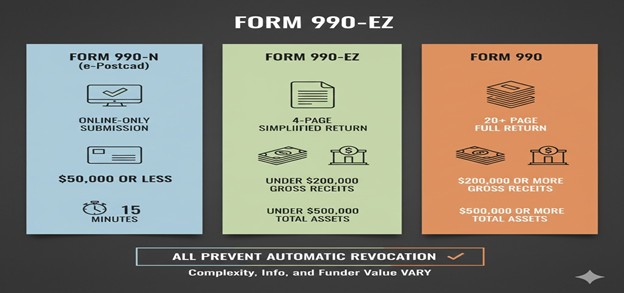
Form 990-N (e-Postcard) is a simple online-only submission for organizations with gross receipts normally $50,000 or less requiring only basic identifying information and taking 15 minutes to complete, Form 990-EZ is a 4-page simplified return for organizations with gross receipts under $200,000 AND total assets under $500,000 providing moderate financial detail with fewer schedules, and Form 990 is the comprehensive full return required for organizations with gross receipts of $200,000 or more OR total assets of $500,000 or more spanning 20+ pages with extensive financial reporting and multiple required schedules. All three satisfy annual filing requirements and prevent automatic revocation, but they differ dramatically in complexity, information disclosed, and value to funders evaluating organizational capacity—sophisticated funders prefer fuller returns showing financial health and governance practices that the e-Postcard doesn’t provide.

How do filing thresholds determine which form to use?

Gross receipts thresholds create the primary filing distinctions. Organizations with gross receipts normally $50,000 or less qualify for Form 990-N. Organizations with receipts under $200,000 AND assets under $500,000 qualify for Form 990-EZ. Organizations exceeding either the $200,000 receipts OR $500,000 assets threshold must file full Form 990. “Normally” is calculated using a three-year rolling average smoothing year-to-year fluctuations.

Both revenue and assets matter for 990-EZ eligibility. Meeting the receipts threshold alone isn’t sufficient—organizations must satisfy both tests. A small organization with $150,000 annual revenue but $600,000 in assets (perhaps owning property or having an endowment) must file Form 990, not 990-EZ. The dual thresholds recognize that organizational size isn’t purely revenue-based.

Organizations can voluntarily file more comprehensive forms. Riverside nonprofits qualifying for 990-N can choose to file 990-EZ or full Form 990 instead. Organizations qualifying for 990-EZ can choose full Form 990. Filing more comprehensive returns provides transparency and information valuable to funders. However, organizations cannot file simpler forms when thresholds require more comprehensive versions—filing 990-EZ when Form 990 is required violates filing obligations.

Threshold determination requires accurate calculations. Organizations miscalculating receipts or undervaluing assets and filing wrong forms face potential penalties and IRS inquiries. Conservative threshold application is advisable when close to boundaries—if genuinely uncertain whether you exceed thresholds, file the more comprehensive form rather than risking incorrect filing.

What information does each form require and disclose?

Form 990-N (e-Postcard) requires minimal information submitted through online system. Organizations provide tax year, legal name, any DBA names, mailing address, website if one exists, confirmation that gross receipts normally don’t exceed $50,000, name and address of principal officer, and EIN. No financial details, no program descriptions, no governance information beyond principal officer identification. The entire submission takes approximately 15 minutes.

Form 990-EZ provides moderate financial and program information. The 4-page return includes revenue summary by categories (contributions, program service revenue, other income), expense summary showing program services, management/general, and fundraising expenses, balance sheet showing assets and liabilities, and program service accomplishments describing major programs. Part V asks basic governance questions about conflict of interest policies, board meetings, and document retention. Required schedules add pages based on specific activities.

Form 990 requires comprehensive disclosure across 20+ pages. Beyond financial statements and program descriptions, the full return discloses detailed compensation information for officers, directors, key employees, and highly compensated staff, related party transactions and relationships, fundraising activities and professional fundraiser contracts, grant-making activities if applicable, foreign activities and operations, governance policies and practices in extensive detail, and compliance with specific requirements like hospital community benefit or school non-discrimination policies. Multiple schedules address specialized activities.

Public disclosure implications differ significantly. Form 990-N isn’t publicly available—only summary information confirming filing exists. Forms 990-EZ and 990 are public documents posted on GuideStar, Charity Navigator, and organizational websites. Full Form 990 discloses substantially more information about compensation, governance, and operations than 990-EZ, affecting public perception and funder evaluation.

Framework: Launch → Fix → Fund + Federal Recognition + CA Compliance Triangle

Launch includes understanding which form you’ll likely file as the organization grows. Riverside nonprofits starting small with 990-N eligibility should anticipate transitioning to 990-EZ and eventually full Form 990 as revenue and assets grow, planning recordkeeping systems supporting more comprehensive reporting.

Fix addresses situations where organizations filed wrong forms requiring amendment, underreported revenue or assets causing threshold miscalculations, or failed to transition to more comprehensive forms as they grew exceeding thresholds for simpler versions.

Fund success correlates with form comprehensiveness because funders gain more insight from fuller returns. Organizations voluntarily filing 990-EZ when they qualify for 990-N, or voluntarily filing Form 990 when they qualify for 990-EZ, often improve grant competitiveness by demonstrating transparency and providing information funders want.

Federal Recognition requires meeting annual filing obligations with appropriate form versions. Filing any of the three forms satisfies legal requirements preventing automatic revocation, but filing inappropriate versions (too simple when thresholds require comprehensive) may trigger IRS questions.

CA Compliance Triangle filing obligations exist independently of Form 990 version. Organizations filing 990-N, 990-EZ, or Form 990 federally still must file California Form 199 with Franchise Tax Board and RRF-1 with Attorney General Registry—federal form selection doesn’t affect California requirements.

Step-by-step: How NPLO helps organizations select and complete appropriate forms

Step 1: Threshold Calculation We accurately calculate 3-year average gross receipts and assess total assets determining which form is required.

Step 2: Strategic Form Selection For organizations qualifying for simpler forms, we discuss whether voluntary filing of fuller returns benefits grant competitiveness.

Step 3: Information Gathering We collect financial records, program documentation, and governance information appropriate to the form being filed.

Step 4: Accurate Completion We prepare complete returns answering all questions accurately with all required schedules.

Step 5: Governance Optimization For 990-EZ and Form 990 filers, we ensure governance question responses reflect strong practices.

Step 6: Funder Review Preparation We review returns from funder perspective identifying potential concerns before filing.

Step 7: Timely Filing We file electronically by deadlines preventing late penalties or countdown toward revocation.

Step 8: Transition Planning We help organizations anticipate when growth will require transitioning to more comprehensive forms.

Checklist: Comparing Form 990-N, 990-EZ, and Form 990

Form 990-N (e-Postcard):

  • Who: Receipts normally ≤ $50K
  • Length: Online submission, ~15 minutes
  • Financial detail: None
  • Program descriptions: None
  • Governance questions: None
  • Compensation disclosure: Principal officer only
  • Public availability: Not posted publicly
  • Funder value: Minimal information

Form 990-EZ:

  • Who: Receipts < $200K AND assets < $500K
  • Length: 4 pages + required schedules
  • Financial detail: Revenue/expense summary, balance sheet
  • Program descriptions: Program service accomplishments
  • Governance questions: Basic (conflict policy, board meetings, retention)
  • Compensation disclosure: Officers and directors
  • Public availability: Posted on GuideStar, etc.
  • Funder value: Moderate transparency

Form 990:

  • Who: Receipts ≥ $200K OR assets ≥ $500K
  • Length: 20+ pages + multiple schedules
  • Financial detail: Comprehensive financial statements
  • Program descriptions: Detailed program accomplishments
  • Governance questions: Extensive governance section
  • Compensation disclosure: Officers, directors, key employees, highly compensated
  • Public availability: Widely posted and reviewed
  • Funder value: Comprehensive transparency

Quick Answers (PPA)

We qualify for Form 990-N but funders keep asking for financial information—should we file 990-EZ instead? If you’re serious about pursuing grants, strongly consider voluntarily filing Form 990-EZ even though 990-N would satisfy legal requirements. The e-Postcard provides virtually no information funders need to evaluate financial health, program effectiveness, or governance quality. Filing 990-EZ demonstrates transparency and provides the financial and program information funders expect. The additional preparation time investment typically strengthens grant applications significantly enough to justify the effort. Many small organizations have adopted policies of filing 990-EZ regardless of 990-N eligibility specifically to support funding development.

What happens when we grow and exceed thresholds—do we automatically know, or does IRS notify us? You’re responsible for monitoring your own thresholds and transitioning to appropriate forms without IRS notification. Calculate your 3-year average gross receipts annually and assess total assets at year-end. When you exceed thresholds requiring a more comprehensive form, file that form starting with that tax year. IRS doesn’t send notices saying “you now need to file Form 990 instead of 990-EZ.” Organizations filing forms that are too simple when they’ve exceeded thresholds may face IRS inquiries requiring corrected returns and potential penalties.

If we filed Form 990-N last year but exceeded $50K this year, can we still file 990-N using the 3-year average? The 3-year rolling average smooths fluctuations allowing you to stay with 990-N longer than if each year stood alone. However, once your 3-year average exceeds $50,000, you must transition to 990-EZ or Form 990 (depending on whether you also exceed the $200K/$500K thresholds). Calculate precisely: (Year 1 + Year 2 + Year 3) ÷ 3. If the result exceeds $50,000, you no longer qualify for 990-N regardless of any single year being under $50,000. New organizations use different calculations: year one uses actual receipts, year two averages years one and two.

Do funders view Form 990-N filers as less credible or capable than organizations filing fuller returns? Sophisticated funders understand that 990-N is appropriate for very small organizations and don’t automatically penalize organizations for filing it when they qualify. However, funders need financial and program information to evaluate applications. Organizations filing 990-N must be prepared to provide financial statements, program descriptions, and governance documentation through other means when funders request it. Organizations repeatedly unable to provide information funders need may appear less organized or transparent than organizations whose Form 990-EZ or 990 already contains that information. Size-appropriate transparency is key.

Can we file amended returns changing from one form version to another if we realize we calculated thresholds wrong? If you filed 990-N but should have filed 990-EZ or Form 990 due to threshold miscalculations, you should file the correct comprehensive form as an amendment. However, if you filed Form 990 when you qualified for 990-EZ, or 990-EZ when you qualified for 990-N, the more comprehensive filing satisfied requirements—no amendment needed since you provided more information than required. Amendments are necessary when you filed too simple a form, not when you voluntarily filed a more comprehensive version.

What to do next (DIY vs Done-With-You)

DIY approach: Calculate your 3-year average gross receipts: add receipts from current year plus prior two years, divide by three. If you’re a new organization, year one uses actual receipts, year two averages years one and two. Assess total assets at fair market value from your year-end balance sheet including cash, investments, receivables, equipment, property. Determine which form you must file: 990-N if receipts normally ≤ $50K; 990-EZ if receipts < $200K AND assets < $500K; Form 990 if you exceed either threshold. Consider whether voluntary filing of fuller returns would strengthen grant competitiveness even if you qualify for simpler versions. Download appropriate form and instructions from IRS website. For 990-N, use IRS online e-Postcard system entering basic identifying information—takes about 15 minutes. For 990-EZ or Form 990, gather comprehensive financial records, program documentation, and governance information. Complete returns accurately answering all questions and completing required schedules. Have board treasurer or finance committee review draft before filing. File electronically by deadline (15th day of 5th month after fiscal year end) or file Form 8868 for automatic 6-month extension. Save filed return for records and prepare copies for funder requests.

Done-With-You approach: The Nonprofit Launch Office provides comprehensive Form 990 preparation for Riverside and Inland Empire nonprofits filing any version. We accurately calculate 3-year average receipts and assess total assets determining which form is required, discuss strategic form selection including whether voluntary filing of fuller returns benefits grant development, collect all required financial records, program documentation, and governance information appropriate to the form being filed, prepare complete accurate returns answering all questions with all required schedules, optimize governance question responses demonstrating strong organizational practices, review returns from funder perspective identifying potential concerns before filing, file electronically by deadlines preventing late penalties, help organizations anticipate when growth will require transitioning to more comprehensive forms, and provide funder-ready copies for grant applications. This ensures you file appropriate forms satisfying legal requirements while maximizing the transparency and credibility that strengthen funding opportunities.

What happens immediately after missing a filing deadline?

Late filing penalties begin accruing based on organization size. Organizations with gross receipts over $1 million face penalties of $105 per day up to maximum $52,500. Smaller organizations face penalties of $20 per day up to lesser of $10,500 or 5% of gross receipts. Penalties accrue from the filing deadline until the return is filed, making prompt filing of delinquent returns financially important beyond just compliance concerns.

The three-year countdown toward automatic revocation starts. IRS tracks consecutive years without required filings. Missing one year doesn’t immediately revoke status but begins the countdown. If the organization files the second year’s return (even if late), the countdown resets. However, missing year two after missing year one creates serious urgency—you’re now one year away from automatic revocation requiring immediate corrective action.

TEOS database status remains active initially. After missing one filing deadline, the organization still appears in TEOS showing active status eligible to receive deductible contributions. Funders checking TEOS won’t immediately detect the filing failure. However, sophisticated funders requesting copies of recent Form 990 returns will discover the missing filing when organizations cannot provide the most recent year’s return.

IRS notices may or may not arrive. While IRS sometimes sends reminder notices about unfiled returns, don’t rely on receiving warnings. The IRS is not required to notify organizations before automatic revocation occurs. Many organizations only discover they’ve been revoked when checking TEOS database for other reasons or when funders inform them of revoked status during grant application due diligence.

What are the consequences of automatic revocation after three years?

Tax-exempt status terminates completely. After three consecutive years without required filings, IRS automatically revokes 501(c)(3) recognition effective the filing due date of the third missed year. The organization is no longer tax-exempt—any income generated after the effective date of revocation is potentially taxable as if the organization were a for-profit corporation. The determination letter becomes invalid and TEOS listing changes to “revoked” status.

Donor tax deductions become unavailable. Contributions made after the effective revocation date are not tax-deductible regardless of what the organization tells donors. Organizations continuing to solicit donations while claiming tax-deductibility after revocation commit fraud. Donors discovering their contributions weren’t actually deductible may demand refunds and can report organizations to IRS and state regulators for fraudulent solicitation.

Grant eligibility disappears immediately. Foundation and corporate grant programs verify tax-exempt status through TEOS searches before processing awards. Organizations showing “revoked” status fail basic eligibility requirements triggering automatic application rejection. Existing multi-year grants may be terminated when funders discover grantees lost tax-exempt status, potentially requiring return of already-disbursed funds depending on grant agreements.

Banking and vendor relationships face complications. Many banks, payment processors, donors management platforms, and vendors offer nonprofit pricing or services contingent on verified tax-exempt status. Loss of exemption may trigger account holds, service terminations, or repricing to for-profit rates. Organizations may be unable to process online donations through platforms like PayPal Giving Fund that verify tax-exempt status.

Framework: Launch → Fix → Fund + Federal Recognition + CA Compliance Triangle

Launch includes establishing filing systems preventing missed deadlines. Temecula nonprofits should create filing calendars with multiple advance reminders, assign clear responsibility for Form 990 preparation, and implement backup systems ensuring filings occur even when personnel changes happen.

Fix is precisely where organizations land after missing IRS filings. The Fix work involves filing all delinquent returns immediately, paying applicable penalties, applying for reinstatement if automatic revocation occurred, and establishing systems preventing future filing failures. Fix work is expensive and time-consuming—far better to prevent than remediate.

Fund access completely stops during revocation. Organizations cannot pursue grants while showing revoked TEOS status. Even after filing reinstatement applications, the processing period (often 3-6 months) prevents grant pursuit until TEOS updates showing restored active status. Every month in Fix mode is a month losing potential funding opportunities.

Federal Recognition was granted contingent on meeting ongoing filing requirements. Determination letters aren’t permanent guarantees—they represent recognition valid only while organizations maintain compliance including annual filing obligations. Missing filings voids the recognition determination originally granted.

CA Compliance Triangle operates independently of federal filing compliance. Organizations can miss IRS Form 990 filings while remaining current with California Secretary of State, Franchise Tax Board, and Attorney General—or vice versa. However, most Temecula nonprofits missing federal filings also miss California filings creating multiple concurrent compliance failures requiring simultaneous remediation.

Step-by-step: How NPLO helps organizations correct missed IRS filings

Step 1: Status Assessment We determine exactly which years have unfiled returns and whether revocation has occurred.

Step 2: TEOS Verification We check current TEOS listing confirming whether status shows active or revoked.

Step 3: Delinquent Return Preparation We prepare all missing Form 990/990-EZ/990-N returns for unfiled years.

Step 4: Penalty Calculation We calculate applicable late filing penalties and advise on reasonable cause abatement requests if circumstances warrant.

Step 5: Simultaneous Filing We file all delinquent returns together demonstrating commitment to compliance restoration.

Step 6: Reinstatement Application If revocation occurred, we prepare Form 1023 or 1024 applications requesting retroactive reinstatement.

Step 7: Status Monitoring We track reinstatement processing and TEOS updates confirming restored active status.

Step 8: Prevention Systems We establish filing calendars, responsibility assignments, and backup procedures preventing future missed filings.

Checklist: Correcting missed IRS filings

Immediate Actions:

  • Check TEOS database determining current status
  • Count consecutive years without filings
  • Gather financial records for all unfiled years
  • Determine which Form 990 version was required each year
  • Calculate late filing penalties

Filing Delinquent Returns:

  • Prepare accurate returns for each missed year
  • Complete all required schedules
  • Answer governance questions honestly
  • Include explanatory statements about late filing
  • File all delinquent returns promptly

If Revoked (3+ consecutive years):

  • File all delinquent Form 990 returns
  • Prepare Form 1023 or 1024 reinstatement application
  • Request retroactive reinstatement to effective revocation date
  • Pay user fees ($275 or $600)
  • Include explanations of filing failure causes
  • Demonstrate corrective measures preventing recurrence

After Reinstatement:

  • Verify TEOS shows active status restored
  • Update donor communications confirming deductibility restored
  • Notify funders of restored status
  • Resume grant applications
  • Establish prevention systems

Prevention Going Forward:

  • Create filing calendar with 90/60/30-day reminders
  • Assign clear responsibility for preparation
  • Establish backup person awareness
  • Consider professional preparation assistance
  • Review compliance quarterly

Quick Answers (PPA)

We just discovered we missed last year’s Form 990—should we file it immediately or wait until this year’s is due to file both together? File the missed return immediately—don’t wait. Filing late is far better than missing a second consecutive year which accelerates toward automatic revocation. You started the three-year countdown by missing one year; filing the delinquent return promptly stops that countdown and demonstrates good faith compliance effort potentially supporting penalty abatement. After filing the late return, ensure you file the current year’s return on time preventing any future gaps.

Can we request penalty abatement for late filing, or do we automatically have to pay? You can request reasonable cause abatement by submitting written explanation of circumstances preventing timely filing with your delinquent return. IRS may waive penalties if you demonstrate reasonable cause (serious illness, natural disaster, death of key personnel, unavoidable circumstance beyond organizational control) and that you acted responsibly by filing as soon as circumstances permitted. However, simply being disorganized, forgetting the deadline, or lacking funds to hire preparers typically don’t qualify as reasonable cause. Don’t assume automatic abatement—include detailed reasonable cause statement if requesting penalty waiver.

If we’re automatically revoked, can we just start a new nonprofit instead of going through reinstatement? Starting new organizations to avoid reinstatement creates significant problems. The new organization wouldn’t have your operating history, established reputation, existing contracts, donor relationships, or community recognition. Assets and liabilities from the old organization don’t automatically transfer to new entities—complex transactions would be required. Some funders track organizations that dissolved and reformed viewing it as attempt to escape accountability. Furthermore, the underlying causes of filing failure likely exist in the new organization too without corrective measures. Reinstatement is usually faster, simpler, and more appropriate than starting over.

How long does reinstatement take after filing the application? Reinstatement applications typically process in 3-6 months similar to original determination applications, though complex cases can take longer. Organizations cannot legitimately operate as tax-exempt or tell donors contributions are deductible during the processing period—you must wait for IRS approval and TEOS database update showing restored status. This processing delay is why prevention is so critical—every month without valid exemption is a month you can’t fundraise or pursue grants effectively.

Will funders hold the missed filings against us even after we’re reinstated? Many funders will ask about the circumstances of revocation and what measures you’ve implemented preventing recurrence. Honest acknowledgment of the failure, clear explanation of corrective actions, and demonstration of improved systems can rebuild funder confidence. However, some funders may view revocation as indicator of poor management regardless of subsequent correction. The best approach is transparency about what happened, accountability for the failure, and concrete evidence of improved compliance systems—don’t hide or minimize the revocation, but do demonstrate you’ve learned and improved.

What to do next (DIY vs Done-With-You)

DIY approach: Immediately check IRS TEOS database at apps.irs.gov/app/eos searching for your organization by name and EIN. Note whether status shows “Active” or “Revoked.” Count how many consecutive years you’ve missed filings—one year means urgency but not yet revoked, two consecutive years means extreme urgency and immediate action required, three or more means automatic revocation requiring reinstatement application. Gather financial records, bank statements, receipts, and program documentation for all unfiled years. Determine which Form 990 version was required each year based on revenue and asset thresholds at that time. Download appropriate forms and instructions from IRS website. Complete accurate returns for each missed year answering all questions honestly including governance questions. Consider including brief explanatory statement about why filing was late and what measures you’ve implemented preventing future failures. File all delinquent returns electronically through IRS-authorized e-file provider. If you’ve been revoked (three consecutive years missed), file all delinquent Form 990s first, then prepare Form 1023 or 1024 requesting retroactive reinstatement including detailed explanation of filing failure causes and corrective measures. After filing, monitor TEOS database weekly checking for status updates. Establish comprehensive filing calendar with multiple advance reminders preventing future missed filings. Assign clear responsibility for Form 990 preparation and establish backup procedures.

Done-With-You approach: The Nonprofit Launch Office provides comprehensive missed filing correction for Temecula and Inland Empire nonprofits. We determine exactly which years have unfiled returns and current TEOS status, prepare all delinquent Form 990/990-EZ/990-N returns with accurate financial information and governance responses, calculate late filing penalties and advise on reasonable cause abatement requests if circumstances warrant, file all delinquent returns promptly demonstrating compliance restoration commitment, prepare reinstatement applications (Form 1023/1024) if automatic revocation occurred including persuasive explanations and corrective measures, track reinstatement processing and TEOS updates confirming restored active status, communicate with funders about restored status when appropriate, and establish prevention systems including filing calendars, responsibility assignments, and backup procedures preventing future filing failures. This ensures you correct filing failures as efficiently as possible, minimize penalties where reasonable cause exists, restore tax-exempt status through successful reinstatement, and prevent future compliance failures through improved systems.

Contact


Book: https://thedocumentpro.com/
 Call: 1(800) 285-0078
 Email: mydocumentpro@gmail.com
 The Nonprofit Launch Office™ — a discipline of The Document Pro, operated by Gitta Williams.
 Operated by The Document Pro (Gitta Williams)

Find Us Locally

Service Area: Moreno Valley, CA and surrounding areas

Coordinates: 33.9535, -117.2081

Address: 23945 Sunnymead Blvd. #4, Moreno Valley, CA 92553

Sources

  • https://www.irs.gov/charities-non-profits/charitable-organizations
  • https://www.irs.gov/forms-pubs/about-form-1023
  • https://calnonprofits.org/
Disclaimer

Document preparation and nonprofit readiness support — not legal or tax advice.