Author: Owner

Short Answer

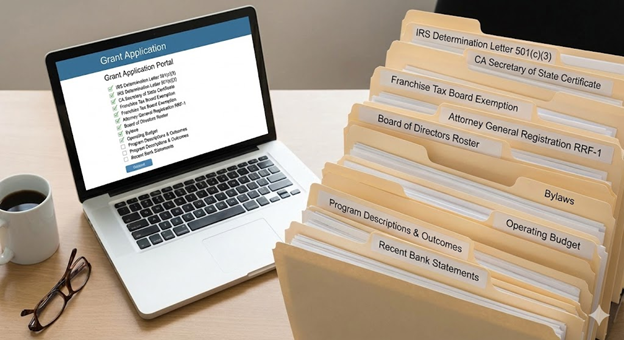
Funders reviewing first-time grantees commonly request federal IRS 501(c)(3) determination letters proving tax-exempt status, recent IRS Form 990 filings showing financial activity and program expenses, organizational bylaws demonstrating governance structure, board of directors roster with names and affiliations, conflict of interest policies proving ethical oversight, operating budgets showing revenue sources and expense allocations, financial statements or bank records demonstrating fiscal capacity, and program descriptions with measurable outcomes showing what the organization actually does and achieves. California funders additionally verify Secretary of State Active status certificates, Franchise Tax Board exemption confirmations, and Attorney General Registry of Charities registration numbers to confirm multi-agency compliance. Eligibility varies by grant, but first-time applicants generally face heightened documentation scrutiny because funders lack relationship history and prior grant performance data to inform risk assessment.

Why do first-time grantees face different documentation expectations than established applicants?

First-time applicants represent unknown quantities to funders who lack performance history, relationship familiarity, or track records demonstrating organizational competence. When funders evaluate repeat applicants, they draw on years of grant reporting, site visits, ongoing communication, and observed program results that provide confidence in the organization’s capacity and integrity. First-time applicants have no such history, requiring funders to establish baseline confidence through documentation review rather than through accumulated relationship knowledge.

Risk assessment drives heightened documentation requirements. Funders releasing money to unknown organizations face risks that recipients will misuse funds, fail to deliver promised programs, lack capacity to manage grants effectively, or present compliance problems that create reputational damage for the funder. Documentation serves as the primary risk mitigation tool—proof of IRS recognition confirms legitimacy, financial records demonstrate fiscal capacity, governance documents show oversight structures, and program documentation reveals organizational competence.

Temecula and Inland Empire first-time applicants should expect longer application processes, more detailed information requests, and potentially lower initial award amounts compared to what established grantees receive. Funders often start new relationships with modest grants that test organizational performance before committing larger amounts. Successfully managing that first grant—delivering promised outcomes, reporting accurately and timely, maintaining compliant operations—establishes the performance history that reduces documentation burden and increases funding access in subsequent cycles.

The transition from first-time applicant to established grantee happens through consistent demonstration of organizational quality. Each successful grant relationship builds funder confidence, reduces perceived risk, and streamlines future documentation requirements. Organizations that maintain excellent governance, deliver strong programs, communicate proactively, and report thoroughly typically find that documentation requests decrease and award amounts increase as the relationship matures and trust develops.

What federal recognition documents do all funders require regardless of prior relationship?

The IRS determination letter stands as the single most universal document requirement across all institutional funders. This letter from the Internal Revenue Service officially confirms your organization’s 501(c)(3) tax-exempt status, specifies your determination date, shows your Employer Identification Number, and indicates your foundation classification (typically public charity rather than private foundation). Funders need this document because it proves contributions to your organization qualify as tax-deductible charitable donations under federal law, a requirement for most institutional grants.

Current IRS TEOS verification supplements or sometimes replaces determination letters as primary federal recognition proof. TEOS (Tax Exempt Organization Search) at apps.irs.gov/app/eos is the IRS database showing organizations with current tax-exempt recognition. Funders increasingly verify applicant status directly through TEOS rather than relying solely on determination letters because TEOS reflects real-time status—organizations can possess old determination letters while having lost recognition through automatic revocation for missed filings. First-time Temecula applicants should provide both the determination letter and recent TEOS printout showing “Eligible to receive tax-deductible contributions” status.

Recent IRS Form 990 filings demonstrate ongoing compliance with federal filing requirements that maintain tax-exempt status. Form 990 (or 990-EZ for smaller organizations, or 990-N for very small ones) provides funders with financial transparency—total revenue by source, expenses by category, program spending percentages, governance practices, compensation information, and narrative descriptions of activities. First-time applicants may only have one or two years of Form 990 history, which funders understand and accept, but having whatever filings you’re required to submit completed and available is essential.

For very new organizations, explaining limited filing history becomes part of the documentation narrative. If you incorporated within the past 12-18 months, you may not have filed your first Form 990 yet because it’s not due until the 15th day of the 5th month after your first fiscal year ends. Funders generally understand new organization timelines, but you should proactively explain your filing status—”We incorporated in March 2024, so our first Form 990 will be filed in August 2025″ provides context that prevents funder confusion about missing documents.

What California-specific compliance documents do regional funders verify?

California Secretary of State documentation proving current “Active” entity status appears on nearly all California funder checklists. This typically takes the form of a certificate of good standing (officially requested from the Secretary of State for a fee) or a business entity search printout showing your nonprofit corporation’s current status, registered agent, and recent Statement of Information filing. California funders verify SOS status because it confirms your nonprofit legally exists as a California corporation and maintains basic structural compliance with state corporate law.

Franchise Tax Board exemption confirmation demonstrates your organization holds California state tax exemption in addition to federal IRS recognition. While qualifying 501(c)(3) organizations are exempt from California’s $800 annual franchise tax, you must still file annual information returns (Form 199 or 199N) to maintain that exemption. Funders may request your FTB exemption letter (Form 3500A issued after IRS determination) or recent Form 199 filing confirmation proving you’re current with state tax obligations and not operating under FTB suspension.

Attorney General Registry of Charities registration documentation confirms your organization is properly registered for charitable fundraising in California. Most nonprofits must register with the AG Registry within 30 days of first receiving assets and file annual renewal reports (RRF-1) thereafter. Funders request your CT number (Charity Trust registration number) from initial registration or your most recent RRF-1 confirmation. Some funders verify your AG Registry status independently through the online search at oag.ca.gov/charities, but providing documentation proactively demonstrates compliance awareness.

The California three-agency verification pattern—Secretary of State, Franchise Tax Board, Attorney General Registry—distinguishes California from most other states with simpler nonprofit oversight. First-time applicants in Temecula pursuing funding from California-based foundations, corporate giving programs, or government grants should expect verification across all three state agencies plus federal IRS recognition, creating a four-point compliance documentation requirement that national applicants in other states don’t typically encounter.

Framework: Launch → Fix → Fund + Federal Recognition + CA Compliance Triangle

The Nonprofit Launch Office operates within a strategic framework designed to help California nonprofits move from formation to fundability:

Launch includes establishing the documentation systems that first-time grant applications will require. Launch-phase organizations should create central files—digital and physical—containing all governance documents, compliance proofs, financial records, and program descriptions that funders commonly request. Building these systems during formation rather than scrambling during first application deadlines creates significant competitive advantage. Launch means having documentation ready before you need it rather than discovering gaps under deadline pressure.

Fix addresses situations where first-time applicants discover during application processes that they’re missing critical documents or have compliance gaps funders verify. Common Fix scenarios include realizing your IRS determination letter was lost and needs replacement (requesting Form 4506-A), discovering you’re suspended by Franchise Tax Board and need urgent restoration, finding that you never registered with Attorney General Registry despite being required to, or identifying that governance documents like bylaws or conflict policies were never formally adopted. Fix work during first grant applications creates stress and often results in missed deadlines.

Fund represents the operational state where documentation systems remain current without crisis management. Fund-phase organizations maintain updated board rosters as membership changes, refresh financial statements quarterly, file compliance renewals before deadlines, and update program descriptions as services evolve. This continuous maintenance means first-time grant applications and subsequent applications both access current, organized documentation rather than outdated or missing materials.

Federal Recognition through IRS 501(c)(3) determination provides the foundation document that appears in virtually every first-time grant application. Organizations lacking federal recognition cannot access most institutional funding regardless of how strong their programs are or how urgent community needs are. The determination letter and TEOS verification prove federal recognition to funders conducting due diligence on unknown applicants.

CA Compliance Triangle represents California’s three-agency state verification system that first-time applicants must satisfy alongside federal recognition. Temecula nonprofits applying to California-based funders need simultaneous current standing with Secretary of State (Active status), Franchise Tax Board (exemption without suspension), and Attorney General Registry (current registration). Being compliant with two out of three creates application rejections just as surely as being compliant with none.

Step-by-step: How NPLO helps first-time applicants organize documentation

Step 1: Documentation Inventory and Gap Analysis We assess what documents you currently have organized versus what first-time grant applications typically require. This inventory reveals which items you possess and can easily access, which items exist but need organizing or updating, and which items are missing entirely and need creation or procurement. The gap analysis prioritizes which missing documents represent urgent needs versus nice-to-have additions.

Step 2: Federal Recognition Verification and Organization We locate your IRS determination letter (or help request replacement if lost), generate current TEOS printout showing your active tax-exempt status, organize recent Form 990 filings or explain filing timeline if you’re too new to have filed yet, and prepare narrative explaining your federal recognition history for funders. This federal documentation package addresses the baseline requirement nearly all funders verify.

Step 3: California Multi-Agency Compliance Documentation We obtain Secretary of State certificate of good standing or business entity search printout showing Active status, gather Franchise Tax Board exemption confirmation and recent Form 199 filing, compile Attorney General Registry CT number and current RRF-1 confirmation, and verify that all three California agencies show current compliance without suspensions or delinquencies. This three-agency package satisfies California funder verification requirements.

Step 4: Governance Document Assembly We organize or help create the governance documents funders request—formally adopted bylaws with board approval date, comprehensive board roster with complete contact information and terms, conflict of interest policy with signed annual disclosure forms, recent board meeting minutes demonstrating active oversight, and any other governance policies your organization has established. These documents prove functional organizational structure to skeptical reviewers.

Step 5: Financial Documentation Preparation We compile financial records funders commonly request—operating budget for current fiscal year showing revenue sources and expense categories, recent financial statements or bank statements demonstrating fiscal capacity, Form 990 analysis highlighting program expenses and fundraising efficiency, financial policies addressing fund management and internal controls, and explanations for any financial patterns that might raise funder questions.

Step 6: Program Documentation Development We help articulate program descriptions, measurable outcomes, service statistics, and community impact narratives that appear throughout grant applications. For first-time applicants with limited formal evaluation data, we develop frameworks for documenting outcomes going forward and present available evidence of effectiveness—participant testimonials, preliminary outcome measurements, partnership letters, or community needs documentation supporting your program approach.

Step 7: Master Documentation Folder Creation We organize all compliance proofs, governance documents, financial records, and program materials into a systematic master folder—digital files with clear naming conventions, physical binder for board reference and backup, quick-access organization matching common funder request patterns, and master index showing what’s available and when each document was last updated. This organized system accelerates application completion.

Step 8: Application-Specific Document Customization When you identify specific grant opportunities, we review the application requirements and customize your master documentation to match funder requests—adapting program descriptions to match word count limits and focus areas, highlighting budget elements most relevant to that funder’s priorities, and selecting governance or financial documents most responsive to their specific requirements. Customization from organized master files is far faster than creating documents from scratch under deadline.

Checklist: What you should have ready for first-time grant applications

First-time grant applicants in Temecula and the Inland Empire should maintain organized access to these commonly requested documents:

  • IRS determination letter showing 501(c)(3) recognition with your current legal name, EIN, and determination date clearly visible
  • IRS TEOS printout from apps.irs.gov/app/eos showing your organization currently listed with “Eligible to receive tax-deductible contributions” status
  • Most recent IRS Form 990, 990-EZ, or 990-N demonstrating federal filing compliance (or explanation of filing timeline if too new)
  • California Secretary of State certificate of good standing or business entity search showing “Active” status
  • Current Statement of Information confirmation from Secretary of State showing biennial filing within past two years
  • Franchise Tax Board exemption letter (Form 3500A) and most recent Form 199 or 199N filing
  • Attorney General Registry CT number and most recent RRF-1 (Registry Renewal Fee Report) confirmation
  • Formally adopted bylaws with board approval date and any amendment history documented
  • Current board of directors roster listing all members with names, affiliations, contact information, term dates, and committee assignments
  • Conflict of interest policy with annual disclosure forms signed by all board members and key staff
  • Board meeting minutes from organizational meeting and recent regular meetings showing active governance
  • Operating budget for current fiscal year detailing anticipated revenue sources and planned expenses by program and administration
  • Financial statements showing recent activity (bank statements minimum; audited financials for larger organizations)
  • Financial policies addressing approval authorities, fund management, expense reimbursement, and internal controls
  • Program descriptions for each major activity area with target populations, service geography, and intended outcomes
  • Outcome measurement framework showing how you track program effectiveness and impact
  • Service statistics documenting how many people you serve, what activities you provide, and what results you achieve
  • Letters of support from community partners, beneficiaries, or stakeholders attesting to your work’s value and impact
  • Insurance certificates showing general liability coverage and directors & officers liability if applicable
  • Registered agent documentation showing current agent authorization and contact information for legal service

Quick Answers (PPA)

What if I’m asked for documents I don’t have because we’re a very new organization? Funders generally understand that brand new organizations have limited documentation history—you can’t provide three years of Form 990 filings if you’ve only existed 18 months. The key is being transparent and proactive: explain your organizational age, provide whatever documentation your current stage allows, demonstrate that you’re establishing proper systems going forward, and show that you understand what mature organizations maintain even if you don’t have years of history yet. Many funders specifically target emerging organizations and design eligibility criteria accommodating new nonprofits. Being new isn’t disqualifying—lacking awareness of what you should be building toward is.

Do I need audited financial statements for my first grant application? Most first-time grant applications don’t require audited financial statements unless the grant amount is substantial (typically $250,000+) or the funder has specific audit requirements. Smaller first-time applicants usually satisfy financial documentation requirements with Form 990 filings, operating budgets, and bank statements or internally prepared financial statements. However, as your organization grows and pursues larger grants, some funders will eventually require audited financials. Review each funder’s specific requirements—don’t assume you need expensive audits for every application, but don’t ignore audit requirements when they’re explicitly stated.

How many years of Form 990 filings do funders expect from first-time applicants? Funders generally expect whatever Form 990 history your organization’s age allows. If you’re in your second year of operations, having one Form 990 on file is normal and acceptable. If you’ve existed five years but haven’t filed Form 990s, that’s a serious compliance problem raising red flags. First-time applicants should provide all Form 990s they’ve been required to file, even if that’s only one or two years of history. Funders understand limited filing history for genuinely new organizations but view missing required filings as evidence of poor governance and compliance management.

Can I use the same documents for all grant applications or do I need to customize everything? Core documents like IRS determination letters, bylaws, board rosters, and Form 990s are universal—you’ll provide identical versions to all funders. However, program descriptions, budgets, and outcome narratives typically need customization to match each funder’s specific focus areas, word count limits, and format requirements. Maintain master versions of customizable documents that you can adapt quickly rather than starting from scratch for each application. The organized documentation folder approach allows you to have both universal documents ready and flexible templates that customize efficiently.

What if I discover missing documents or compliance gaps while working on my first grant application? Address problems immediately rather than hoping funders won’t notice or trying to submit incomplete applications. If you’re missing required compliance filings, start the process to file them before submitting the application—many funders accept evidence of filing in progress for first-time applicants establishing systems. If governance documents were never formally adopted, have an emergency board meeting to rectify this before the application deadline. If compliance restoration takes longer than the application timeline allows, consider focusing on different funders with later deadlines while you fix problems, rather than submitting applications you know will be rejected for eligibility issues.

What to do next (DIY vs Done-With-You)

DIY approach: Create a comprehensive documentation checklist by reviewing application guidelines from 3-5 funders you plan to approach and noting every document requested across those applications. Compile a master list of unique documents rather than duplicates. Systematically gather or create each document on your list—start with federal recognition documents (determination letter, TEOS printout, Form 990s), then move to California compliance proofs (SOS, FTB, AG Registry), then governance documents (bylaws, board roster, conflict policy, minutes), then financial materials (budget, statements, policies), then program documentation (descriptions, outcomes, statistics). Organize everything in a digital folder with clear file names like “IRS_Determination_Letter_2023.pdf” or “Board_Roster_Current_2025Q1.pdf” and create a physical binder backup. Build a master index document listing every item in your documentation folder with last update dates. Set quarterly calendar reminders to review and update time-sensitive documents like board rosters, budgets, and financial statements.

Done-With-You approach: The Nonprofit Launch Office provides comprehensive first-time grantee documentation preparation for Temecula and Inland Empire nonprofits. We conduct detailed documentation inventories identifying exactly what you have versus what applications require, verify and organize federal recognition documents including determination letters and TEOS verification, compile California three-agency compliance documentation proving good standing across SOS, FTB, and AG Registry, create or formalize governance documents meeting institutional funder expectations, organize financial records into funder-friendly formats with appropriate narratives, develop program descriptions and outcome frameworks translating your work into grant language, assemble master documentation folders with systematic organization and version control, and provide application-specific customization support when you target particular opportunities. This preparation work transforms first-time applications from overwhelming documentation hunts into manageable processes where you focus on program narrative rather than scrambling for proof of legitimacy.

Contact

Book: https://thedocumentpro.com/
 Call: 1(800) 285-0078
 Email: mydocumentpro@gmail.com
 The Nonprofit Launch Office™ — a discipline of The Document Pro, operated by Gitta Williams.
 Operated by The Document Pro (Gitta Williams)

Sources


Disclaimer

Document preparation and nonprofit readiness support — not legal or tax advice.
Short Answer

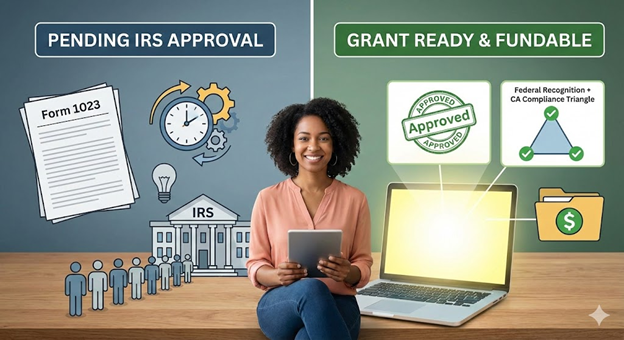
Most institutional funders require that your nonprofit hold current IRS 501(c)(3) determination before they will consider grant applications, though a small number of funders accept applications from organizations with pending IRS recognition if you provide proof of timely submission and demonstrate strong likelihood of approval. While you can legally accept donations during the IRS application period, donors cannot claim tax deductions until determination is granted, and grant makers typically want verification through IRS TEOS database before releasing funds. Eligibility varies by grant, but waiting for full IRS approval before pursuing most institutional funding prevents wasted application effort and allows you to demonstrate the verifiable tax-exempt status funders need to satisfy their due diligence requirements.

What actually happens during the IRS application period?

When you submit Form 1023 or Form 1023-EZ to the IRS applying for 501(c)(3) recognition, your application enters a processing queue where IRS specialists review your organizational documents, purpose statements, planned activities, governance structure, and financial projections. The IRS evaluates whether your nonprofit meets the requirements for tax-exempt charitable status under Internal Revenue Code Section 501(c)(3), including operating exclusively for charitable purposes, limiting private benefit, and complying with various operational tests.

Processing timelines vary significantly. Form 1023-EZ applications for smaller organizations often receive determination within 2-4 weeks if the application is complete and straightforward. Standard Form 1023 applications for larger or more complex organizations typically take 3-6 months, though processing times can extend considerably during IRS backlogs or if the agency requests additional information to clarify aspects of your application. During this waiting period, your organization exists as a legally incorporated California nonprofit corporation but lacks federal tax-exempt recognition.

This interim status creates practical challenges for Riverside and Inland Empire nonprofits seeking funding. You have corporate existence through California Secretary of State filing, but you cannot yet demonstrate to funders that contributions to your organization qualify for tax deductions. The IRS TEOS database—where most funders verify nonprofit status—will not list your organization until determination is granted. Grant applications asking for your “determination date” or requesting a copy of your IRS determination letter cannot be satisfied because you don’t have these documents yet.

The retroactive recognition provision provides some protection. If the IRS approves your 501(c)(3) application, recognition generally takes effect from your date of incorporation rather than your determination date, meaning donations received during the application period can retroactively qualify for tax deductions once approval is granted. However, this retroactive treatment doesn’t help with the immediate problem: funders reviewing applications during the pending period cannot verify your tax-exempt status because the IRS hasn’t issued determination yet.

Which funders actually accept applications from organizations with pending IRS status?

A small subset of funders—typically those focused on capacity building for emerging organizations—explicitly accept applications from nonprofits with pending IRS determination. These funders recognize the catch-22 facing new organizations: you need funding to build capacity, but you can’t access most funding until you have full IRS recognition, which takes months to secure. These early-stage funders may request proof that you’ve submitted your IRS application (typically a copy of your filed Form 1023-EZ or Form 1023 with submission receipt) and evidence that your application is complete and likely to be approved.

Community foundations occasionally make exceptions for local organizations with pending status, particularly if the nonprofit has strong community relationships, experienced leadership, or addresses urgent needs. The Inland Empire Community Foundation or smaller regional funders might consider pending-status applicants on a case-by-case basis, especially for modest initial grants that help organizations sustain operations while waiting for IRS determination. However, these exceptions typically involve extra scrutiny and may require additional documentation demonstrating organizational legitimacy.

Government grants rarely accept pending-status applicants because federal and state agencies face strict accountability requirements about distributing public funds to verified tax-exempt organizations. Most government grant programs specify that applicants must possess current 501(c)(3) determination and appear in IRS TEOS database at the time of application. Attempting to apply for government contracts or grants before your IRS determination arrives typically results in immediate disqualification.

Corporate giving programs almost universally require completed IRS determination because corporate contributions to 501(c)(3) organizations provide tax deductions that corporations claim on their own tax returns. Corporate funders need documentation proving that recipient organizations hold verified tax-exempt status, and they’re unwilling to make contributions contingent on future IRS approval that might never materialize. Corporate applications submitted before determination typically receive form rejection letters citing eligibility requirements.

The practical reality for most Riverside nonprofits: pursuing grant applications before IRS determination wastes significant time and effort. The majority of applications will be ineligible due to lack of current recognition. The few funders who might consider pending-status applications will request extensive additional documentation and conduct heightened due diligence. The strategic approach involves using the IRS application period for different preparation work—building governance systems, developing program documentation, cultivating individual donors, and organizing financial records—so you’re ready to pursue grants aggressively the moment determination arrives.

Framework: Launch → Fix → Fund + Federal Recognition + CA Compliance Triangle

The Nonprofit Launch Office operates within a strategic framework designed to help California nonprofits move from formation to fundability:

Launch includes the IRS application period as a critical phase where new nonprofits establish operational infrastructure before pursuing institutional grants. During the months waiting for determination, Launch-phase work involves completing California state registrations (Franchise Tax Board exemption, Attorney General Registry filing), adopting essential governance policies, establishing financial management systems, documenting initial programs and outcomes, and cultivating relationships with potential funders who will be ready to consider applications once determination is granted. Launch means using waiting time strategically rather than attempting premature grant applications.

Fix becomes relevant when IRS applications encounter problems—requests for additional information that delay processing, preliminary denial letters raising concerns about organizational structure or activities, or outright rejection requiring resubmission with corrections. Fix work during the application period involves responding to IRS inquiries promptly with complete information, revising organizational documents if IRS feedback reveals structural problems, and potentially consulting with nonprofit attorneys or specialists when complex issues arise that could jeopardize approval.

Fund represents the post-determination phase when your IRS recognition is granted, your organization appears in TEOS database, and you can pursue the full range of institutional funding opportunities. Fund-phase grant applications benefit from the preparation work completed during Launch—you have governance documentation organized, financial systems established, program descriptions developed, and relationships cultivated, allowing you to move quickly and confidently once the determination barrier is removed.

Federal Recognition through IRS 501(c)(3) determination is the specific threshold this question addresses. Federal recognition transforms your organization from “pending nonprofit” to “verified tax-exempt charity” in funders’ eyes. The determination letter becomes one of the most important documents in your grant readiness folder, and your TEOS listing becomes the verification tool funders use to confirm your status independently. Understanding that federal recognition is a process requiring patience prevents wasted effort on premature applications while you’re still pending.

CA Compliance Triangle represents California’s three-agency state requirements that you can and should complete during the federal application period. While waiting for IRS determination, Riverside nonprofits should file Statement of Information with Secretary of State, apply for California tax exemption with Franchise Tax Board using Form 3500A (after IRS approval) or Form 3500 (before IRS approval if you want state exemption immediately), and register with Attorney General Registry of Charities. Completing state compliance during the IRS waiting period means you achieve full grant-ready status quickly once federal determination arrives.

Step-by-step: How NPLO helps organizations navigate the IRS application period

Step 1: Application Timeline Assessment We evaluate where you are in the IRS application process—have you submitted Form 1023-EZ or Form 1023, when was it filed, have you received any IRS correspondence, what’s the realistic timeline for determination based on current processing patterns. This assessment establishes whether pursuing any grant applications makes strategic sense or whether focusing on preparation serves you better.

Step 2: Funder Eligibility Research We research specific funders you’re interested in to determine their policies regarding pending-status applicants. This targeted research identifies the small subset of funders who might consider applications before determination versus the majority requiring current recognition. We prioritize relationship-building with funders whose applications won’t be accessible until post-determination, establishing familiarity so you’re positioned to apply quickly once eligible.

Step 3: State Compliance Completion We guide completion of California-level requirements that don’t depend on IRS determination—Statement of Information filing with Secretary of State, initial registration with Attorney General Registry of Charities (required within 30 days of receiving assets), and preparation for Franchise Tax Board exemption filing once IRS determination is granted. Completing state compliance during federal waiting period accelerates full grant-readiness.

Step 4: Governance Infrastructure Development We help establish the governance documentation funders will request once you can apply—adopted bylaws, complete board roster with contact information, conflict of interest policy with signed disclosures, board meeting minutes establishing regular oversight, financial policies addressing fund management. Building this infrastructure during the waiting period means grant applications can be assembled quickly post-determination.

Step 5: Financial System Implementation We assist with establishing financial management practices funders expect—separate bank account for organizational funds, bookkeeping system tracking revenue and expenses by category, budget development showing planned operations, procedures for financial oversight and approval. Solid financial systems make the first Form 990 filing easier and provide documentation for grant financial questions.

Step 6: Program Documentation Preparation We help develop program descriptions, outcome measurements, service statistics, and impact narratives that will appear in future grant applications. Using the IRS waiting period to articulate your work clearly means you can adapt these descriptions quickly to different funder requirements once applications become feasible.

Step 7: Individual Donor Cultivation We encourage focus on individual donor development during the pending period since individual donations don’t require the same verification as institutional grants. Building a base of individual supporters provides operating funds while you wait for determination and demonstrates community support that strengthens eventual grant applications.

Step 8: Post-Determination Launch Planning We develop a strategic plan for the first 90 days after IRS determination—which funders to approach first, which grant deadlines to target, what additional documentation to prepare, how to announce your newly verified status to stakeholders. This planning ensures you capitalize immediately on determination rather than losing momentum figuring out next steps.

Checklist: What you should prepare during the IRS application period

Use the waiting time strategically by preparing these elements of grant readiness:

  • California Secretary of State compliance including filed Statement of Information showing current directors and addresses
  • Attorney General Registry registration (CT-1 initial filing) completed within 30 days of receiving any assets
  • Franchise Tax Board awareness of your organization and preparation for Form 3500A filing immediately after IRS determination
  • Adopted bylaws reflecting your actual governance structure and operational procedures
  • Complete board roster with names, contact information, terms, and committee assignments if applicable
  • Conflict of interest policy with annual disclosure forms signed by all board members
  • Board meeting minutes from organizational meeting and subsequent regular meetings demonstrating active governance
  • Financial management system with separate bank account, bookkeeping platform or procedures, and budget
  • Operating budget showing anticipated revenue sources and planned expenses for first full year
  • Financial policies addressing approval authorities, fund management, internal controls
  • Program descriptions clearly articulating each activity area, target populations, and intended outcomes
  • Outcome measurement framework showing how you’ll track program effectiveness and impact
  • Individual donor database or tracking system for cultivating and managing donor relationships
  • Grant prospect list identifying funders you’ll approach once determination is granted
  • Application templates drafted for common questions so you can customize quickly for specific opportunities
  • Relationship cultivation plan for building familiarity with program officers at target funders before you can formally apply

Quick Answers (PPA)

If I submit my grant application while IRS status is pending, can I just update it when determination arrives? Most funders don’t hold applications pending status changes—they review applications based on eligibility at submission time and reject ineligible applications immediately. Submitting before you have determination typically results in rejection that goes on record with that funder, potentially affecting how they view future applications. Some funders allow you to notify them of status changes if determination arrives during their review period, but this varies by funder and requires explicit permission. The cleaner approach involves waiting until determination is granted so your application meets eligibility requirements from submission.

Can I apply for grants using fiscal sponsorship while waiting for my own IRS determination? Yes, fiscal sponsorship provides a strategic bridge during the IRS application period. You can operate as a fiscally sponsored project of an established 501(c)(3), apply for grants through your sponsor’s tax-exempt status, and transition to direct grantee once your determination is approved. This approach allows immediate funding pursuit while building your own recognition. However, fiscal sponsors typically charge administrative fees (5-15% of funds) and maintain legal control during sponsorship, so you’ll want a sponsor whose mission aligns with yours and whose fees you can sustain during the transition period.

Does paying for expedited IRS processing help me get grants faster? The IRS does not offer expedited processing for 501(c)(3) applications regardless of payment. Processing timelines depend on application complexity, IRS workload, and whether your submission requires additional review. The fastest path involves filing complete, accurate applications that don’t trigger IRS questions—Form 1023-EZ for organizations projecting under $50,000 annual gross receipts typically processes faster than standard Form 1023. Some Riverside nonprofits reduce waiting time by ensuring their applications are thorough and well-documented from initial submission, avoiding delays from IRS requests for additional information.

What should I tell potential funders when they ask about my IRS status during networking? Be honest and strategic: “We submitted our 501(c)(3) application to the IRS on [date] and expect determination within [timeframe based on current processing]. We’re currently using this period to build our governance infrastructure and program documentation so we’re ready to pursue funding immediately when recognition is granted. We’d love to stay in touch and learn about your funding priorities so we can submit a strong application once we’re eligible.” This response demonstrates professionalism, realistic expectations, and serious organizational development rather than appearing naive about funding requirements.

If the IRS denies my application, can I still pursue grants? IRS denial means you don’t hold 501(c)(3) status and cannot access funding requiring tax-exempt recognition until you address the denial. Denials typically stem from organizational structure problems, activities that don’t qualify as charitable, insufficient governance, or documentation issues. You can appeal IRS denials, revise your organization to address stated concerns and reapply, or pursue fiscal sponsorship with an established nonprofit. Denial doesn’t permanently bar you from grant funding, but it requires addressing the underlying issues the IRS identified before institutional funders will consider you eligible.

What to do next (DIY vs Done-With-You)

DIY approach: Check your IRS application status through the IRS online system if you filed Form 1023-EZ, or contact the IRS Exempt Organizations division if you filed Form 1023 and haven’t received correspondence in over 90 days. Research specific funders you want to pursue by visiting their websites and reviewing eligibility requirements—note whether they require current 501(c)(3) determination or accept pending applicants. Use the waiting period to complete California state compliance by filing Statement of Information if you haven’t already, registering with Attorney General Registry of Charities, and preparing for Franchise Tax Board exemption application. Develop your governance infrastructure by adopting bylaws, establishing conflict of interest policy, organizing board meeting minutes, and creating financial management systems. Build relationships with potential funders through informational conversations, attending funder events, and cultivating individual donors who don’t require tax-exempt verification before contributing.

Done-With-You approach: The Nonprofit Launch Office provides comprehensive IRS-period strategy and preparation for Riverside and Inland Empire nonprofits waiting for federal determination. We assess your application timeline and manage any IRS correspondence requiring response, research funder policies to identify which rare opportunities might accept pending-status applications versus which require patience, guide completion of all California state compliance so you’re fully ready when federal determination arrives, develop complete governance documentation meeting institutional funder expectations, establish financial management systems and prepare initial budgets, create program descriptions and outcome frameworks that translate easily into grant applications, identify and prioritize target funders for immediate approach post-determination, and develop strategic 90-day post-determination launch plans ensuring you capitalize on new eligibility immediately. This preparation work transforms waiting time from frustrating delay into productive infrastructure building that accelerates grant success once determination is granted.

Contact

Book: https://thedocumentpro.com/
 Call: 1(800) 285-0078
 Email: mydocumentpro@gmail.com
 The Nonprofit Launch Office™ — a discipline of The Document Pro, operated by Gitta Williams.
 Operated by The Document Pro (Gitta Williams)

Sources


Disclaimer

Document preparation and nonprofit readiness support — not legal or tax advice.
Short Answer

Nonprofits with no prior Form 990 filings can still be considered for grants if they’re genuinely new organizations that haven’t yet reached their first filing deadline, can provide alternative financial documentation like operating budgets and bank statements, target funders who specifically support emerging organizations without extensive financial history requirements, and proactively explain their filing timeline in cover letters rather than leaving reviewers to wonder why filings are absent. Eligibility varies by grant, but the key distinction is between legitimately new organizations that haven’t filed because filings aren’t yet due versus organizations that missed required filings through noncompliance—funders generally accommodate the former while rejecting the latter as evidence of poor governance and financial management.

What does Form 990 filing status tell funders about an organization?

Form 990 filing history provides funders with standardized financial transparency showing total revenue by source, expenses by category and program, compensation information for key staff, governance practices and policies, and narrative descriptions of organizational activities and accomplishments. The IRS requires most tax-exempt organizations to file annually—Form 990-N (e-postcard) for very small organizations with gross receipts under $50,000, Form 990-EZ for organizations with gross receipts under $200,000 and total assets under $500,000, or full Form 990 for larger organizations. Filing history demonstrates compliance with federal reporting obligations that maintain tax-exempt status.

When funders review Form 990 filings, they’re assessing fiscal responsibility and organizational capacity beyond what narrative applications convey. Form 990 data reveals whether an organization spends reasonable percentages on programs versus administration and fundraising, compensates staff at appropriate levels, maintains adequate cash reserves or operates with precarious finances, has diversified revenue sources or depends heavily on single funders, and operates at scales consistent with their stated impact claims. Multi-year Form 990 histories show trends—growing, stable, or declining organizations—that inform funding decisions.

Missing Form 990 filings trigger immediate questions in reviewers’ minds. For Moreno Valley nonprofits applying to sophisticated funders, absence of Form 990 documentation suggests one of several scenarios: the organization is extremely new and hasn’t reached first filing deadline yet (understandable), the organization is small enough that Form 990-N suffices but hasn’t filed even that minimal requirement (compliance red flag), the organization fell behind on filings and faces potential IRS revocation (serious problem), or the organization doesn’t understand that Form 990 filing is mandatory for maintaining tax-exempt status (competence concern). Only the first scenario is acceptable to most funders.

The IRS publicly posts Form 990 filings, making them independently verifiable through databases like GuideStar/Candid, Foundation Directory Online, and ProPublica’s Nonprofit Explorer. Funders often check these databases regardless of what applicants submit, discovering discrepancies between applications claiming financial health and Form 990s showing concerning patterns. The transparency Form 990 provides means organizations cannot easily hide financial problems from funders conducting thorough due diligence.

How do new nonprofits explain legitimate absence of Form 990 filings?

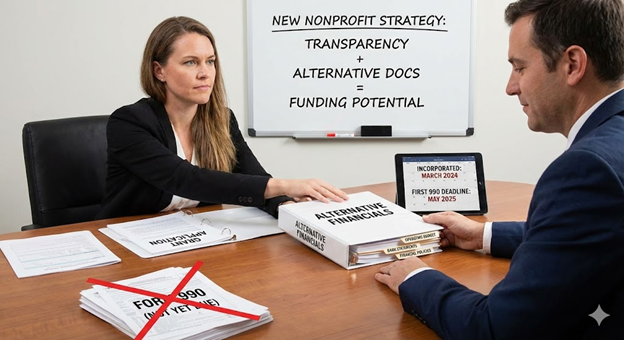
Proactive explanation in cover letters or application narratives prevents funder confusion about missing Form 990 filings. Rather than hoping reviewers won’t notice or assume they’ll understand, new Moreno Valley nonprofits should state clearly: “Our organization incorporated in March 2024 with fiscal year ending December 31, 2024. Our first Form 990 will be due May 15, 2025. We have not yet filed Form 990 because our first filing deadline has not arrived. We have provided our operating budget and recent bank statements as alternative financial documentation.” This transparency demonstrates awareness of filing requirements and honest communication rather than attempting to hide information.

The filing timeline explanation should match your actual organizational age and fiscal year structure. Organizations with fiscal years ending December 31 file Form 990 by May 15 of the following year (or November 15 with extensions). Organizations with fiscal years ending June 30 file by November 15 (or May 15 of the following year with extensions). New organizations formed mid-year often have short first fiscal years—incorporating in September with December 31 fiscal year end means your first “year” is only four months, but you still file Form 990 covering that short period. Understanding and accurately explaining your specific timeline shows competence even when you lack filing history.

Alternative financial documentation fills the gap that Form 990 would otherwise occupy. New nonprofits should provide comprehensive operating budgets showing detailed revenue projections and expense allocations, recent bank statements demonstrating actual financial activity and account balances, any financial statements prepared internally or by bookkeepers/accountants, financial policies addressing approval authorities and internal controls, and narratives explaining financial assumptions and sustainability plans. While these alternatives don’t provide the standardized comparability that Form 990 offers, they demonstrate financial thinking and fiscal responsibility to reviewers evaluating new organizations.

Targeting funders who explicitly support emerging organizations increases acceptance of limited filing history. Application guidelines stating “open to organizations in their first three years” or “capacity building grants for new nonprofits” signal that absence of extensive Form 990 history won’t automatically disqualify applications. These funders structure evaluation criteria accounting for limited track records, often placing greater weight on leadership credentials, community need, program design quality, and partnership strength rather than emphasizing financial history that new organizations cannot provide.

Framework: Launch → Fix → Fund + Federal Recognition + CA Compliance Triangle

The Nonprofit Launch Office operates within a strategic framework designed to help California nonprofits move from formation to fundability:

Launch includes understanding Form 990 filing requirements from day one so you can explain your filing timeline accurately when pursuing early grants. Launch-phase organizations should establish fiscal years strategically (many choose December 31 for simplicity with calendar years), understand which Form 990 version applies based on revenue projections, implement financial record-keeping systems that facilitate eventual Form 990 preparation, and anticipate that absence of Form 990 filings will raise questions requiring clear explanations during first-year grant applications.

Fix addresses situations where nonprofits missed required Form 990 filings—either through ignorance that filing was mandatory (many small organizations incorrectly assume “no taxes owed” means “no filing required”) or through administrative failure despite knowing the obligation. IRS automatically revokes 501(c)(3) recognition for organizations failing to file for three consecutive years, creating serious grant eligibility problems. Fix work involves filing delinquent returns, requesting retroactive reinstatement if revocation occurred, paying penalties, and demonstrating to funders that you’ve addressed compliance gaps before they’ll consider renewed funding.

Fund represents the operational state where Form 990 filing happens consistently on schedule, creating the multi-year filing history that strengthens grant applications. Fund-phase organizations view Form 990 not as burdensome paperwork but as public accountability documentation and funder communication tool. They file before deadlines, review filings for accuracy and completeness, understand what Form 990 information tells funders about their operations, and use filing data strategically when crafting grant narratives about financial health and program spending.

Federal Recognition through IRS 501(c)(3) determination establishes the tax-exempt status that makes Form 990 filing mandatory. Organizations must file annual returns to maintain recognition—failure to file triggers the automatic revocation that ends grant eligibility immediately. Understanding that federal recognition creates ongoing filing obligations prevents the compliance gap where organizations celebrate receiving determination letters without realizing annual filings are required thereafter.

CA Compliance Triangle includes California’s state-level equivalent of Form 990—Form 199 or Form 199N filed with the Franchise Tax Board. While funders focus more heavily on federal Form 990, California funders may also request Form 199 filings demonstrating state compliance. New Moreno Valley nonprofits explaining absence of Form 990 should similarly explain Form 199 timeline—often the same explanation works for both since filing schedules align: “We have not yet filed Form 990 or Form 199 because our first fiscal year has not yet ended.”

Step-by-step: How NPLO helps nonprofits address Form 990 gaps in grant applications

Step 1: Filing Status Assessment We determine your actual Form 990 filing status—are you truly too new to have filed, or have you missed required filings? This assessment distinguishes between “legitimate absence requiring explanation” versus “compliance gap requiring correction.” The strategies differ dramatically depending on which scenario applies. We review your incorporation date, fiscal year structure, and time elapsed to calculate when filings were or will be due.

Step 2: Timeline Explanation Development We craft clear, accurate explanations of your filing timeline for inclusion in cover letters and application narratives. These explanations state your incorporation date, fiscal year ending, first filing deadline, and what alternative financial documentation you’re providing. The explanation tone conveys competence and transparency rather than defensiveness or confusion about requirements.

Step 3: Alternative Financial Documentation Assembly We help gather and organize financial materials that demonstrate fiscal responsibility despite absence of Form 990—operating budgets with detailed assumptions, recent bank statements showing actual activity, any financial statements prepared internally or by professionals, financial policies addressing controls and oversight, and narratives explaining financial sustainability plans. This package provides reviewers with comparable information to what Form 990 would show.

Step 4: Funder Research and Targeting We identify which funders on your prospect list have flexible requirements for new organizations versus which impose strict multi-year Form 990 requirements that make your application premature. This targeted approach prevents wasting time on funders whose guidelines explicitly require “three years of Form 990 filings” when you’re a first-year organization that couldn’t possibly satisfy that criterion.

Step 5: Form 990 Preparation Planning Even though your first Form 990 isn’t yet due, we help establish the financial record-keeping and documentation systems that will make preparation straightforward when the deadline arrives. Organizations that implement good systems from day one file accurate, complete Form 990s easily. Organizations that operate informally until deadline approaches struggle with reconstructing financial information and often submit incomplete or error-riddled filings.

Step 6: Delinquent Filing Remediation (if applicable) If assessment reveals you’ve missed required filings, we coordinate urgent remediation—preparing delinquent Form 990 returns for all missed years, filing with IRS and paying associated late penalties, requesting retroactive reinstatement if automatic revocation occurred, and developing governance improvements preventing future missed filings. We also help explain compliance gaps honestly to funders while demonstrating corrective action.

Step 7: Application Customization We customize how you address Form 990 absence for each specific application. Some applications have explicit fields for uploading Form 990s with clear options like “Not yet required—organization formed [date].” Others require narrative explanation in cover letters or supplemental materials. We ensure each application clearly addresses why Form 990 isn’t included rather than leaving reviewers to speculate.

Step 8: Future Filing Communication Strategy Once you file your first Form 990, we help communicate this milestone to funders who previously received applications without filings—”We’re pleased to share that our organization has now filed our first Form 990, demonstrating [positive financial patterns like strong program spending, diverse revenue, etc.].” This proactive communication shows organizational maturation and builds funder confidence for subsequent grant cycles.

Checklist: What you should provide when Form 990 filings aren’t available

Nonprofits applying for grants without Form 990 filing history should ensure applications include:

  • Clear written explanation of filing timeline stating incorporation date, fiscal year structure, first filing deadline, and why filings aren’t yet available
  • Operating budget for current fiscal year showing detailed revenue projections by source and expense allocations by program and category
  • Recent bank statements (typically 3-6 months) demonstrating actual financial activity, account balances, and cash flow patterns
  • Financial statements if available—internally prepared balance sheets and income statements showing organizational financial position
  • Financial policies addressing approval authorities, signing requirements, internal controls, and fund management procedures
  • Board treasurer report or financial committee documentation showing regular financial oversight and review
  • Funding sources narrative explaining current revenue—individual donations, earned income, in-kind contributions, volunteer support, or other sources
  • Financial sustainability plan articulating how you’ll build sustainable revenue as you mature beyond seed funding phase
  • Budget assumptions document explaining how you developed revenue projections and expense estimates for a new organization without historical data
  • Cash reserve policy or discussion of how you’re building financial stability and managing cash flow fluctuations
  • Fiscal sponsor documentation if operating under fiscal sponsorship—the sponsor’s Form 990 rather than your own (since sponsored projects file under sponsor)
  • Comparison to peer organizations if possible—”Organizations of similar age and focus in our region typically operate on budgets of $X, which aligns with our projections”
  • Commitment to future filing stating you understand Form 990 requirements and will file appropriately when deadlines arrive
  • Contact information for board treasurer or financial committee chair if funders want to discuss financial oversight directly
  • Proactive communication offering to provide Form 990 once filed if the grant award extends beyond your first filing deadline

Quick Answers (PPA)

What if a funder explicitly requires “most recent three years of Form 990 filings” and we’re too new to have three years? When funders specify multi-year Form 990 requirements, first contact them to ask whether newer organizations are eligible with alternative documentation or whether the requirement is absolute. Some funders state “three years” as standard language but make exceptions for promising new organizations. Others maintain the requirement firmly because their evaluation methodology depends on trend analysis requiring multiple years of data. If the requirement is absolute and you can’t satisfy it, don’t waste time applying—focus on funders with criteria you can meet. If exceptions are possible, provide whatever Form 990 history you have (even one year or none) with clear explanation and robust alternative financial documentation.

Does filing Form 990-N (the e-postcard for very small organizations) count as having Form 990 history? Form 990-N satisfies IRS filing requirements for organizations with gross receipts under $50,000, maintaining your tax-exempt status and preventing automatic revocation. However, Form 990-N provides almost no financial information to funders—it confirms your organization exists and filed something, but reveals nothing about revenue sources, expense patterns, program spending, governance practices, or organizational capacity. Many funders request “Form 990” expecting the informational content that Form 990-EZ or full Form 990 provides. If you’ve only filed Form 990-N, explain this proactively and provide detailed alternative financial documentation. Some funders accept this for very small organizations; others may view it as insufficient regardless of your legitimate reason for 990-N eligibility.

If we’re a fiscally sponsored project, whose Form 990 do we provide—ours or the sponsor’s? Fiscally sponsored projects operating under comprehensive sponsorship (Model A) do not file independent Form 990 returns—your activities and finances are included in the sponsor organization’s Form 990 as one of their programs. When applying for grants, you provide the sponsor’s Form 990 with explanation: “Our project operates under fiscal sponsorship by [Organization]. We have attached their most recent Form 990, which includes our project’s activities in Schedule O and financial information in the consolidated statements.” Some funders request additional documentation like project-specific budgets or financial reports beyond what appears in the sponsor’s consolidated Form 990.

What happens if funders discover we missed required Form 990 filings that we should have submitted? If funders discover missed filings during due diligence, they typically view this as serious governance failure indicating poor organizational management and compliance awareness. Most will reject applications immediately or pause review pending compliance correction. The appropriate response involves acknowledging the gap honestly, filing delinquent returns immediately with penalties, implementing governance improvements to prevent recurrence, and requesting opportunity to reapply once compliance is restored. Attempting to hide missed filings or make excuses beyond “we made an error, here’s how we’re correcting it” typically ends funding relationships. Prevention through understanding filing requirements from day one avoids this damaging scenario entirely.

Can we start applying for grants before we’ve filed our first Form 990 if the deadline hasn’t passed yet? Yes, absolutely. Being too new to have filed Form 990 yet is completely different from being old enough that filings should exist but are missing. New Moreno Valley nonprofits should pursue grants as soon as they achieve full compliance (IRS determination, California registrations) even if their first Form 990 isn’t due for months. The key is proactive explanation—”Our first fiscal year ends [date], with Form 990 due [deadline]. We have not yet filed because the deadline has not arrived. We have provided alternative financial documentation.” Most funders understand new organization timelines and evaluate applications based on available information rather than penalizing you for not having filed returns that aren’t yet due.

What to do next (DIY vs Done-With-You)

DIY approach: Determine your actual Form 990 filing status by reviewing your incorporation date and fiscal year ending to calculate when your first Form 990 is or was due. If you’re genuinely too new to have filed, draft clear explanation text stating your incorporation date, fiscal year, first filing deadline, and what alternative financial documentation you’re providing. Include this explanation in every grant application cover letter or narrative where Form 990 would normally be uploaded or referenced. Assemble comprehensive alternative financial documentation—detailed operating budget, recent bank statements, any financial statements, financial policies, and sustainability narrative. If you discover you’ve missed required filings, file delinquent returns immediately through IRS before pursuing additional grants—funders who discover missed filings typically reject applications regardless of program quality. Research funder requirements carefully—prioritize those who explicitly support emerging organizations over those requiring extensive financial history you cannot provide.

Done-With-You approach: The Nonprofit Launch Office provides comprehensive Form 990 strategy for Moreno Valley and Inland Empire nonprofits navigating grant applications without filing history. We assess your actual filing status distinguishing between legitimate absence versus compliance gaps requiring correction, develop accurate filing timeline explanations appropriate for grant applications, assemble alternative financial documentation packages demonstrating fiscal responsibility, identify and target funders whose requirements align with your available documentation rather than pursuing inappropriate opportunities, coordinate delinquent filing remediation if missed returns are discovered, implement financial record-keeping systems that facilitate smooth Form 990 preparation when deadlines arrive, customize application approaches explaining Form 990 absence appropriately for each funder’s specific requirements, and develop communication strategies for sharing first Form 990 once filed as evidence of organizational maturation. This guidance prevents both the premature applications to funders requiring extensive history you lack and the compliance crises from missed filings that block future funding access.

Contact

Book: https://thedocumentpro.com/
 Call: 1(800) 285-0078
 Email: mydocumentpro@gmail.com
 The Nonprofit Launch Office™ — a discipline of The Document Pro, operated by Gitta Williams.
 Operated by The Document Pro (Gitta Williams)

Sources


Disclaimer

Document preparation and nonprofit readiness support — not legal or tax advice.
Short Answer

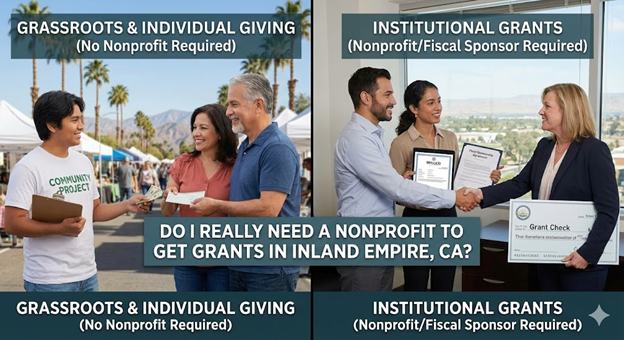
Most institutional grant makers in Inland Empire, California require applicants to hold federal 501(c)(3) tax-exempt status or operate through fiscal sponsorship arrangements where a recognized nonprofit serves as the legal grant recipient. While some grassroots funding, individual donations, and crowdfunding campaigns don’t require nonprofit status, eligibility for foundation grants, government contracts, corporate giving programs, and most structured funding sources typically depends on having verifiable tax-exempt recognition through the IRS or an established fiscal sponsor relationship. Eligibility varies by grant, but forming a nonprofit or securing fiscal sponsorship generally opens significantly more funding opportunities than operating as an unincorporated group or for-profit entity.

What types of funding actually require nonprofit status?

Foundation grants represent one of the largest funding categories requiring 501(c)(3) status. Community foundations like the Inland Empire Community Foundation, regional grantmakers, and national foundations typically limit eligibility to organizations holding current IRS determination letters showing tax-exempt charitable status. These funders need tax-exempt recipients because their own charitable mission and tax status depend on distributing funds to qualified organizations, not to individuals or for-profit entities.

Government grants and contracts at federal, state, county, and municipal levels generally require nonprofit status for programs serving public benefit. When Riverside County or San Bernardino County issue requests for proposals for social services, youth programs, or community development initiatives, eligible applicants typically must demonstrate 501(c)(3) recognition. Government funders face accountability requirements ensuring public money supports charitable purposes through legally recognized tax-exempt organizations.

Corporate giving programs from major employers in the Inland Empire often restrict charitable contributions to verified 501(c)(3) organizations because corporate donations to qualified nonprofits provide tax deductions under IRS rules. Companies want documentation proving their contributions support tax-exempt charitable purposes rather than personal projects or commercial ventures. Corporate matching gift programs, employee volunteer grants, and strategic philanthropy initiatives typically verify nonprofit status before releasing funds.

Service clubs, civic organizations, and religious institutions making grants usually prefer or require 501(c)(3) status to ensure their charitable dollars support legally recognized charitable work. Even when these funders have flexibility to support unincorporated groups, they often choose established nonprofits because verification of tax-exempt status provides assurance about organizational legitimacy and charitable purpose.

However, some funding sources don’t require nonprofit status. Individual donor campaigns, crowdfunding platforms, small grassroots grants from informal community groups, certain types of business sponsorships, and program fees or earned income generally don’t depend on 501(c)(3) recognition. Groups operating without nonprofit status can often access these funding streams, though the total available dollars typically represent a fraction of institutional grant opportunities.

What’s the alternative to forming your own nonprofit?

Fiscal sponsorship provides an established alternative to forming your own nonprofit, allowing projects and initiatives to receive tax-deductible contributions and pursue grants before completing the lengthy process of securing independent 501(c)(3) status. Under fiscal sponsorship, an existing nonprofit with IRS recognition agrees to accept and manage funds on behalf of your project, acting as the legal grant recipient while you operate the programs.

Several fiscal sponsorship models exist, but the most common for Moreno Valley and Inland Empire groups involves “comprehensive” or “Model A” sponsorship where the sponsor organization exercises significant control and the sponsored project becomes a program of the sponsor. The sponsor’s board maintains legal and financial oversight, the project operates under the sponsor’s tax exemption, and donors receive tax deductions through the sponsor’s 501(c)(3) status.

Fiscal sponsorship offers distinct advantages for new initiatives. You can begin fundraising and grant applications immediately using the sponsor’s established compliance status rather than waiting 6-12 months for IRS determination of your own exemption. You avoid initial formation costs for incorporation, federal applications, and state registrations. You benefit from the sponsor’s existing administrative infrastructure, financial systems, and compliance expertise without building these capacities yourself.

However, fiscal sponsorship involves meaningful tradeoffs. Sponsors typically charge administrative fees ranging from 5% to 15% of contributed funds to cover overhead, compliance management, and insurance costs. The sponsor maintains legal control over funds and program decisions, which can limit your autonomy. If the sponsor’s organizational priorities shift or their compliance status encounters problems, your project faces vulnerability. Fiscal sponsorship works best as a temporary arrangement while you determine whether your initiative has sustainable support justifying independent nonprofit formation.

Fiscal sponsorship doesn’t eliminate all compliance work—sponsors generally require detailed budgets, program reports, and evidence that your activities align with their charitable mission and IRS exemption. You’re essentially operating as a program of the sponsor organization rather than as an independent entity. For some Inland Empire initiatives, this arrangement provides ideal support during development phases. For others, the limitations and costs make direct nonprofit formation more strategic.

Framework: Launch → Fix → Fund + Federal Recognition + CA Compliance Triangle

The Nonprofit Launch Office operates within a strategic framework designed to help California nonprofits move from formation to fundability:

Launch means making strategic decisions about organizational structure before filing any paperwork. For groups asking whether they need a nonprofit, Launch-phase guidance helps evaluate whether fiscal sponsorship, independent 501(c)(3) formation, or alternative structures best serve their mission, funding goals, timeline, and capacity. Launch includes understanding what different structures enable or restrict, analyzing which funding sources align with your work, and choosing the formation path that positions you for sustainable success.

Fix addresses situations less relevant to new founders but critical when existing nonprofits lost status or formed incorrectly. For organizations that incorporated without considering compliance requirements or attempted to operate through inadequate structures, Fix work involves restructuring, securing missing registrations, or transitioning from fiscal sponsorship to independent status when appropriate.

Fund represents the operational state where your chosen structure—whether independent nonprofit or fiscally sponsored project—maintains the compliance and documentation profile funders verify. Fund-phase work differs between independent nonprofits (maintaining direct compliance across federal and state agencies) and fiscally sponsored projects (meeting sponsor requirements and supporting the sponsor’s compliance obligations).

Federal Recognition through IRS 501(c)(3) determination forms the foundation for most institutional grant access. Whether you pursue recognition independently or access it through fiscal sponsorship determines your timeline, costs, control, and long-term flexibility. Federal recognition typically requires 3-6 months minimum from application to determination, though backlogs can extend this considerably. Fiscal sponsorship provides immediate access to an existing organization’s federal recognition.

CA Compliance Triangle represents California’s three-agency oversight system (Secretary of State, Franchise Tax Board, Attorney General Registry of Charities). Independent nonprofits must maintain direct compliance with all three agencies. Fiscally sponsored projects operate under their sponsor’s compliance status, avoiding direct responsibility but also lacking independent verification. The compliance burden difference significantly affects the nonprofit-versus-sponsorship decision for Moreno Valley groups evaluating formation options.

Step-by-step: How NPLO helps evaluate and navigate formation decisions

Step 1: Funding Landscape Assessment We analyze which funding sources your initiative realistically targets—foundation grants, government contracts, corporate giving, individual donations, earned income, or mixed strategies. This assessment reveals whether the funding you need requires 501(c)(3) status or whether alternative structures provide adequate access. Understanding your actual funding landscape prevents over-investing in unnecessary infrastructure or under-investing in essential recognition.

Step 2: Timeline and Urgency Evaluation We determine your timeline for needing funding access. If you need to apply for grants within 2-3 months, fiscal sponsorship may be necessary because independent 501(c)(3) formation typically requires 6-12 months minimum. If you have 12-18 months before major funding needs, independent formation may be preferable to avoid ongoing sponsorship fees and control limitations.

Step 3: Organizational Capacity Analysis We assess your capacity for managing compliance obligations independently. Maintaining 501(c)(3) status requires annual IRS filings, California multi-agency compliance, board governance, financial record-keeping, and policy management. Organizations with limited volunteer capacity or no paid staff may find fiscal sponsorship provides essential administrative support during development phases.

Step 4: Strategic Control Consideration We help evaluate how much organizational autonomy matters for your mission and operations. Fiscal sponsorship involves sponsor oversight, approval requirements, and potential program restrictions. Independent nonprofit status provides full control over direction, priorities, and decisions (subject to board governance and IRS rules). The control tradeoff significantly affects long-term sustainability and program evolution.

Step 5: Cost-Benefit Comparison We calculate the financial implications of each path. Independent nonprofit formation involves upfront costs ($275 California incorporation, $600-$750 IRS application fees for larger organizations using Form 1023, various state filing fees) plus ongoing compliance costs. Fiscal sponsorship involves lower upfront costs but ongoing percentage fees on all contributed funds. We project costs over 3-5 years to reveal which approach proves more economical.

Step 6: Formation Process Guidance For groups choosing independent nonprofit formation, we provide systematic guidance through California incorporation (Articles of Incorporation with Secretary of State), initial board establishment, bylaws adoption, EIN application with IRS, federal 501(c)(3) application (Form 1023 or 1023-EZ), California exemption with Franchise Tax Board, and registration with Attorney General Registry of Charities. This comprehensive process establishes independent grant-ready status.

Step 7: Fiscal Sponsor Identification and Evaluation For groups choosing fiscal sponsorship, we help identify potential sponsors with missions aligned to your work, capacity to provide quality sponsorship services, reasonable fee structures, and solid compliance histories. We assist with evaluating sponsor agreements, negotiating terms where possible, and understanding obligations on both sides of the relationship.

Step 8: Hybrid or Transition Planning We help groups considering starting under fiscal sponsorship with planned transition to independent status develop realistic timelines, understand transition requirements, and prepare for eventual independence. This hybrid approach provides immediate funding access while building toward long-term autonomy when capacity and resources support independent operations.

Checklist: What you should consider before deciding your structure

These strategic questions help Moreno Valley and Inland Empire groups make informed structure decisions:

  • Funding target assessment: Which specific funders or funding types does your work require access to, and what do their eligibility criteria actually specify?
  • Timeline urgency: How soon do you need to pursue grant funding—within months, within a year, or in 1-2+ years?
  • Administrative capacity: Do you have staff, volunteers, or board members capable of managing ongoing compliance filings and documentation?
  • Financial sustainability: Can your initiative generate enough revenue to cover both program costs and compliance overhead, or does tight budget favor fiscal sponsorship?
  • Organizational autonomy: How important is independent decision-making authority versus accepting sponsor oversight and approval requirements?
  • Mission alignment: If considering fiscal sponsorship, do potential sponsors share values and mission alignment that supports long-term partnership?
  • Geographic scope: Will your work remain local to Inland Empire or expand regionally/nationally, and how does scope affect structure needs?
  • Collaboration requirements: Does your work involve partnerships with government agencies, schools, or other institutions that may require independent nonprofit status?
  • Liability considerations: Does your programming involve risks (working with vulnerable populations, property ownership, employee management) where independent incorporation provides important liability separation?
  • Long-term vision: Where do you see this initiative in 5-10 years—still a small project, or a substantial organization with multiple programs and staff?
  • Board development: Do you have potential board members committed to governance responsibilities, or would recruiting and managing a board create unsustainable burden?
  • Tax deduction importance: How critical are tax-deductible contributions to your donors, and could you successfully fundraise without providing tax deductions?

Quick Answers (PPA)

Can I apply for grants as an individual or do I absolutely need a nonprofit or fiscal sponsor? A small number of grants support individual artists, researchers, or activists without requiring nonprofit status, but these represent a tiny fraction of total grant funding available. The vast majority of foundation grants, government contracts, and corporate giving programs require recipients to hold 501(c)(3) status or operate through fiscal sponsorship. Attempting to pursue grants without nonprofit structure typically results in immediate ineligibility for most opportunities. For Inland Empire groups serious about institutional funding, nonprofit formation or fiscal sponsorship generally proves essential.

How long does it take to get 501(c)(3) status and can I fundraise while waiting? From the day you file Form 1023 or 1023-EZ with the IRS, determination typically takes 3-6 months, though processing times vary and can extend longer during IRS backlogs. You can accept donations during the application period, but donors cannot claim tax deductions until your determination is granted (though IRS generally provides retroactive recognition to your formation date if approved). Many funders won’t consider grant applications until you have actual determination in hand. This timeline gap explains why some Moreno Valley groups choose fiscal sponsorship for immediate funding access while pursuing independent recognition in parallel.

Is fiscal sponsorship cheaper than forming my own nonprofit? Short-term, fiscal sponsorship typically costs less because you avoid incorporation fees ($275), IRS application fees ($275-$600), and various state filing fees. However, fiscal sponsors charge ongoing administrative fees (typically 5-15% of all funds) that compound over time. A project raising $50,000 annually under a sponsor charging 10% pays $5,000 per year in sponsorship fees. Over five years, that’s $25,000 in fees—far exceeding one-time formation costs of independent nonprofit structure. The cost equation favors fiscal sponsorship for short-term projects and independent formation for sustainable long-term organizations.

What happens if I start under fiscal sponsorship and later want to become independent? Transitioning from fiscal sponsorship to independent nonprofit status is common and generally straightforward, though it requires advance planning. You’ll need to form your own California nonprofit corporation, apply for 501(c)(3) recognition, establish independent compliance systems, and coordinate the transfer of programs, relationships, and potentially funds from sponsor to your new entity. Sponsor agreements vary on fund transfer—some sponsors allow accumulated funds to transfer to the now-independent organization, others retain funds or require board approval for transfer. Review sponsor agreements carefully regarding transition provisions before entering fiscal sponsorship if independence is your long-term goal.

Are there Inland Empire organizations that provide fiscal sponsorship locally? Several established Inland Empire nonprofits provide fiscal sponsorship services for projects aligned with their missions. Community foundations, regional umbrella organizations, and some larger nonprofits offer sponsorship programs. However, sponsors need mission alignment between their charitable purposes and your project’s work—a youth development organization typically won’t sponsor environmental projects, for example. National fiscal sponsorship organizations also serve California projects when local mission-aligned sponsors aren’t available. Identifying appropriate sponsors requires researching organizations whose work connects to yours and reaching out to discuss whether they offer sponsorship services and what their requirements involve.

What to do next (DIY vs Done-With-You)

DIY approach: List the specific grants and funding sources you plan to pursue over the next 2-3 years. Visit each funder’s website and review their eligibility criteria—do they require 501(c)(3) status or accept fiscal sponsorship? Calculate what percentage of your target funding requires nonprofit structure. Research fiscal sponsorship options by identifying Inland Empire nonprofits whose missions align with your work and contacting them about sponsorship services, fees, and requirements. Simultaneously, estimate the costs and timeline for forming your own nonprofit by reviewing IRS Form 1023-EZ eligibility (for organizations projecting under $50,000 annual gross receipts) versus Form 1023, California incorporation requirements, and Attorney General registration. Create a comparison chart weighing fiscal sponsorship costs/benefits/timeline against independent formation, then decide based on your specific funding needs, timeline, and capacity.

Done-With-You approach: The Nonprofit Launch Office provides comprehensive formation strategy consultation for Moreno Valley and Inland Empire groups evaluating structure options. We analyze your specific funding landscape to determine whether nonprofit status is truly necessary for your goals, assess timeline and capacity to recommend fiscal sponsorship versus independent formation, identify mission-aligned fiscal sponsors if sponsorship is appropriate and facilitate introductions, guide complete independent nonprofit formation if that path better serves your strategy, and develop hybrid approaches where you start under sponsorship while building toward independence. This personalized guidance prevents costly mistakes like forming unnecessary corporate structures or choosing fiscal sponsors with misaligned missions, missions, ensures you understand tradeoffs before committing to either path, and positions you for sustainable funding access matching your actual needs and capacity.

Contact

Book: https://thedocumentpro.com/
 Call: 1(800) 285-0078
 Email: mydocumentpro@gmail.com
 The Nonprofit Launch Office™ — a discipline of The Document Pro, operated by Gitta Williams.
 Operated by The Document Pro (Gitta Williams)

Sources


Disclaimer

Document preparation and nonprofit readiness support — not legal or tax advice.