
04 Mar Emergency Documents for Non-Profit Filing in Perris, CA
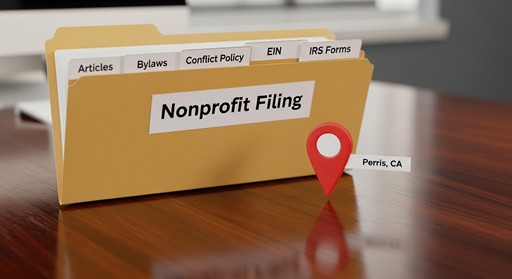
If you’re trying to file nonprofit paperwork in Perris, CA under time pressure, the fastest way to prevent delays is to build an “emergency-ready” document stack before you submit anything. Most urgent filing problems aren’t caused by speed—they’re caused by missing documents, inconsistent details, or unclear next steps.
Below is a practical, step-by-step checklist you can use to get your nonprofit packet organized fast—so your filing is clean, complete, and far less likely to be rejected.
Start here (full guide): “Non-Profit Startup in California: Documents & Filing Timeline Explained”
Link: The Document Pro | Maintain A Nonprofit
Answer-First: The Emergency Document Stack (What You Need Ready)
If you want to move quickly, your goal is to have one complete packet (PDFs + editable originals) that includes:
- Articles of Incorporation (California nonprofit format)
- Bylaws (how your organization will operate and make decisions)
- Conflict of Interest Policy (governance best practice and commonly expected)
- Board / leadership details (directors, officers, incorporator info, registered agent info if applicable)
- EIN (Employer Identification Number—your nonprofit’s federal ID)
- IRS path prep (knowing whether you’re likely using Form 1023 or 1023-EZ)
- Support attachments (purpose/mission statement, basic operating plan, any required add-ons for your filing path)
Fast-path reality: “Emergency filing” works when the packet is complete. Expedite options won’t save a filing that needs corrections.
Quick Actions Checklist (Do This in Order)
- Put everything into one “Nonprofit Filing” folder (Google Drive / Dropbox / desktop)
- Confirm your nonprofit name is consistent across all docs (same spelling, same punctuation)
- Finalize Articles of Incorporation (correct entity type + purpose language aligned with your intent)
- Draft/confirm your Bylaws
- Draft/confirm your Conflict of Interest Policy
- Gather names + roles for your board/officers (even if interim)
- Obtain your EIN (or verify you already have it)
- Decide your IRS route: 1023 vs 1023-EZ (don’t submit blindly)
- Create a one-page “Key Facts” sheet (name, city, mission, board names, email/phone)
Keep both PDF versions and editable versions of your docs (Word/Google Docs)
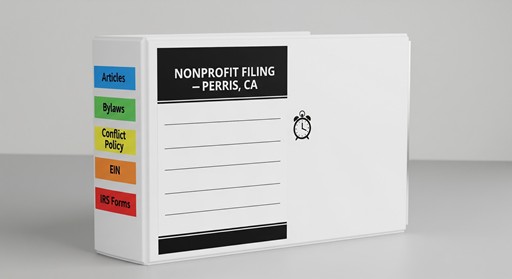
Step-by-Step Guide to Emergency Documents (Minimal Delay Path)
Step 1: Build the “One Folder Rule”
If your documents are scattered across emails, texts, and half-finished drafts, urgency turns into chaos. Create one folder and name it:
NONPROFIT – PERRIS CA – START PACKET
Inside it, create these subfolders:
- 01 Articles
- 02 Bylaws
- 03 Conflict Policy
- 04 EIN
- 05 IRS Tax-Exempt (1023/1023-EZ Prep)
- 06 Notes / Key Facts
Step 2: Confirm Articles of Incorporation Details First
Articles are the keystone. In urgent scenarios, most delays come from:
- wrong entity type language
- inconsistent nonprofit name
- missing required fields or signatures
- purpose statements that don’t match the organization’s plan
Your goal is not “fast.” Your goal is correct the first time.
Step 3: Lock Your Governance Documents (Bylaws + Conflict Policy)
Bylaws and conflict policy are where organizations often “leave it for later.” But urgency punishes that approach.
If you want to be filing-ready (and donation-ready later), set these up now:
- how board votes happen
- who can authorize spending
- conflict disclosure rules
- officer roles and terms
Step 4: Secure the EIN (and Store It Correctly)
Your EIN is used for:
- banking
- tax filings
- IRS exemption steps
- many operational tasks
If you already have it, put the EIN confirmation letter in your folder. If you don’t, make it part of the emergency packet.
Step 5: Prepare the IRS Track Before You Hit “Submit”
Many founders assume the state filing is the whole journey. It’s the start.
At minimum, emergency readiness means:
- you know whether you’re likely filing 1023 or 1023-EZ
- you have the basics documented (mission, activities, basic budget/plan)
Step 6: Create a “Key Facts” Sheet (Stops Rework)
This is the fastest “quality hack” you can do. Make a one-page sheet with:
- exact nonprofit name
- city/service area (Perris/Riverside County/Inland Empire as applicable)
- mission statement (2–3 lines)
- board/officer names + roles
- email + phone
- short list of planned activities
When details stay consistent, filings go smoother.
On-page video idea (60–90 seconds):
- What “emergency filing” really means (prep vs processing)
- The 7 documents that prevent delays
- The 3 most common missing items
- What to do today vs what can wait until after incorporation
Common Mistakes That Cause Delays (Even When You’re “Urgent”)
- Submitting Articles with inconsistent names across documents
- Missing key governance docs (bylaws/conflict policy) until the last minute
- Not having board/officer details ready
- Confusing “same-day preparation” with “same-day approval”
- Using a generic purpose statement that doesn’t match your nonprofit’s real plan
- Losing track of the EIN confirmation and redoing work
- Starting the IRS exemption process without organizing basics first
Why Use The Nonprofit Launch Office™ (NPLO)
When you’re in a rush, the real risk is rework—not effort. NPLO (a discipline of The Document Pro, operated by Gitta Williams) helps founders across California—especially Moreno Valley and Inland Empire cities—organize a clean filing packet so you can move forward with fewer delays.
After-hours coverage is available via AI assistant support for intake, guidance, and document preparation (not after-hours state/IRS processing).
Frequently Asked Questions
1) What are the most important emergency documents for nonprofit filing in Perris, CA?
Start with Articles of Incorporation, bylaws, a conflict of interest policy, board/officer details, and your EIN. If you’re pursuing tax-exempt status, you’ll also want to prep the IRS exemption pathway (1023 or 1023-EZ) so you’re not restarting later.
2) Can I file a nonprofit “same day” in California?
You can often get same-day document preparation if your information is ready and your packet is complete. Processing and approval timelines depend on government processing and can vary, so focus on “submission-ready” first.
3) Do I need bylaws before I file Articles of Incorporation?
Not always for the state filing itself, but bylaws are foundational for operating correctly and are commonly expected for good governance. Having them early reduces delays when you move into banking, fundraising, and IRS exemption steps.
4) What if I’m missing one document—should I file anyway?
Usually, missing items create rework. If your goal is speed, the fastest path is often completing the packet first so you avoid rejection or correction cycles.
5) Does after-hours support mean my filing is processed after hours?
No. After-hours support refers to intake, guidance, and document preparation help. Government processing timelines are controlled by the appropriate agencies and vary.
6) What’s the fastest way to avoid mistakes when I’m rushing?
Use a single folder, keep details consistent across every document, and create a one-page Key Facts sheet. Most “urgent filing” delays come from avoidable inconsistencies.
Additional Resources
- Starting a Nonprofit in California
- Documents Needed to Start a Non-Profit in Perris, CA
- Urgent 24/7 Non-Profit Filing Help in Perris, CA
- Top Rated Non-Profit Filing Companies Near Perris
Authoritative External Sources
- California Secretary of State — Nonprofit filing requirements, fee schedules, and business name availability.
- IRS Exempt Organizations Division — Form 1023, Form 1023-EZ, 501(c)(3) application standards, and processing timelines.
- California Attorney General's Registry of Charitable Trusts — Charitable organization registration, renewal requirements, and compliance reporting.
- National Council of Nonprofits — Formation best practices and ongoing compliance guidance.
- Nonprofit Quarterly — Industry standards and governance benchmarks.
- Better Business Bureau — General business reliability verification resource.
Sources & References
- California Secretary of State — Official guidelines on nonprofit filing requirements, fee schedules, and processing options.
- IRS Exempt Organizations Division — Federal standards for 501(c)(3) tax-exempt applications, Forms 1023 and 1023-EZ, and determination procedures.
- California Attorney General's Office — Charitable organization regulations, Conflict of Interest Policy requirements, and Registry of Charitable Trusts oversight.
- National Council of Nonprofits — Compliance checklists and nonprofit governance best practices.
- Better Business Bureau — General business reliability verification resource; not cited as a source for NPLO-specific ratings.
- Nonprofit Quarterly — Industry benchmarks for nonprofit formation service standards and governance practices.
Contact
Book: https://thedocumentpro.com/
Call: 1(800) 285-0078
Email: mydocumentpro@gmail.com
The Nonprofit Launch Office™ — a discipline of The Document Pro, operated by Gitta Williams.
Operated by The Document Pro (Gitta Williams)