
10 Feb What Happens If a Nonprofit Misses Required IRS Annual Filings?
Short Answer
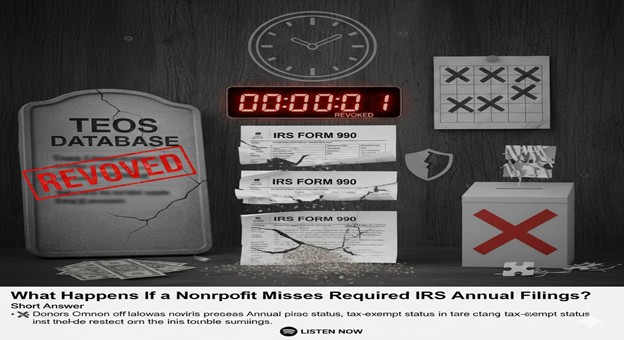
Missing required IRS Form 990 annual filings triggers progressively serious consequences—one missed year starts a three-year countdown toward automatic revocation but can be corrected by filing the delinquent return, two consecutive missed years intensifies urgency requiring immediate filing of both delinquent returns to prevent reaching the third-year threshold, and three consecutive missed years results in automatic revocation of tax-exempt status without further IRS notice causing the organization to disappear from TEOS database showing “revoked” status, preventing donors from claiming tax deductions, and disqualifying the organization from grants until reinstatement is completed. Late filing penalties may apply even when filing delinquent returns, but penalties are far preferable to revocation consequences including inability to operate as tax-exempt, months-long reinstatement processes requiring filing all delinquent returns plus new determination applications, and permanent loss of retroactive tax-exempt coverage for periods during revocation.
What annual filing requirements must organizations meet?
Form 990 series annual information returns report organizational finances and activities to IRS. Organizations with gross receipts over $200,000 or assets over $500,000 file full Form 990. Organizations with gross receipts under $200,000 and assets under $500,000 file Form 990-EZ. Organizations with gross receipts normally $50,000 or less file Form 990-N (e-Postcard). These returns are due by the 15th day of the 5th month after fiscal year end (May 15 for calendar-year organizations).
Filing deadline compliance prevents automatic revocation. Organizations missing Form 990 filings for three consecutive years automatically lose tax-exempt status without further IRS notice. The organization disappears from TEOS database showing revoked status, donors can no longer deduct contributions, and the organization must apply for reinstatement to restore recognition. Missing one year doesn’t trigger revocation, but starting the three-year countdown toward automatic loss of exemption.
Extensions provide additional filing time when needed. Organizations unable to complete Form 990 by the regular deadline can file Form 8868 requesting automatic six-month extension (extending deadline to November 15 for calendar-year organizations). Extensions prevent late filing penalties but don’t extend payment deadlines for any taxes owed. Filing extension requests demonstrates good faith compliance even when circumstances prevent timely completion.
Accuracy and completeness matter beyond just meeting deadlines. Form 990 is a public document that funders, media, watchdog organizations, and community members review. Incomplete forms with missing schedules, inconsistent data, or obvious errors create credibility problems. Answers to governance questions about conflict policies, board meeting frequency, and document availability signal organizational quality to sophisticated reviewers.
What operational compliance requirements continue after approval?
Exclusive charitable purpose operation must continue. The IRS granted exemption based on organizational purposes and planned activities described in Form 1023/1023-EZ applications. Substantial changes to purposes or activities—adding major new program areas not described in applications, fundamentally shifting who you serve, or conducting activities outside approved charitable categories—should be disclosed to IRS through amended applications or supplemental correspondence. Organizations operating significantly differently from what IRS approved risk determination that exemption was granted based on incorrect information.
Political campaign intervention remains absolutely prohibited. Tax-exempt 501(c)(3) organizations cannot participate in or intervene in political campaigns supporting or opposing candidates for public office. This includes making contributions to campaigns, endorsing candidates in organizational capacity, distributing campaign materials, or allowing organizational resources to be used for campaign purposes. Any amount of campaign intervention jeopardizes exemption—there’s no de minimis exception. Issue advocacy and nonpartisan voter education are permitted with careful structuring.
Lobbying limitations require monitoring. While campaign intervention is completely prohibited, lobbying (attempting to influence legislation) is permitted as long as it doesn’t constitute a substantial part of activities. Most organizations interpret “substantial” as less than 5-10% of time and resources. Organizations can elect to measure lobbying under Section 501(h) expenditure test providing more precise limits. Exceeding substantial lobbying limits can result in excise taxes or exemption loss.
Private inurement and excess benefit prevention continues. No part of net earnings can benefit private individuals including founders, board members, substantial contributors, or their families beyond reasonable compensation for actual services rendered. Organizations must maintain conflict of interest procedures, ensure compensation decisions receive independent review based on comparability data, and avoid self-dealing transactions benefiting insiders. Excess benefit transactions trigger excise taxes on recipients and approving managers even without exemption revocation.
Framework: Launch → Fix → Fund + Federal Recognition + CA Compliance Triangle
Launch includes establishing systems ensuring ongoing compliance from inception. Riverside nonprofits should create Form 990 filing calendars, implement governance practices supporting compliance, and establish recordkeeping systems preserving required documentation before compliance failures occur.
Fix becomes necessary when organizations missed Form 990 filings triggering automatic revocation, conducted prohibited activities requiring correction and potential penalty payment, or discovered operations drifted substantially from IRS-approved purposes requiring amended applications or operational corrections.
Fund depends on maintaining compliance because funders verify current tax-exempt status through TEOS database before awarding grants. Organizations showing revoked status due to missed filings cannot receive grants until status is restored. Organizations with compliance problems face funder skepticism even after correction.
Federal Recognition isn’t a one-time achievement but ongoing status maintained through continuous compliance. The determination letter proves recognition was granted, but maintaining recognition requires meeting annual filing requirements and operational standards indefinitely.
CA Compliance Triangle operates parallel to federal compliance. Organizations must maintain both IRS federal compliance AND California Secretary of State, Franchise Tax Board, and Attorney General compliance simultaneously—success in one doesn’t compensate for failure in others.
What happens immediately after missing a filing deadline?
Late filing penalties begin accruing based on organization size. Organizations with gross receipts over $1 million face penalties of $105 per day up to maximum $52,500. Smaller organizations face penalties of $20 per day up to lesser of $10,500 or 5% of gross receipts. Penalties accrue from the filing deadline until the return is filed, making prompt filing of delinquent returns financially important beyond just compliance concerns.
The three-year countdown toward automatic revocation starts. IRS tracks consecutive years without required filings. Missing one year doesn’t immediately revoke status but begins the countdown. If the organization files the second year’s return (even if late), the countdown resets. However, missing year two after missing year one creates serious urgency—you’re now one year away from automatic revocation requiring immediate corrective action.
TEOS database status remains active initially. After missing one filing deadline, the organization still appears in TEOS showing active status eligible to receive deductible contributions. Funders checking TEOS won’t immediately detect the filing failure. However, sophisticated funders requesting copies of recent Form 990 returns will discover the missing filing when organizations cannot provide the most recent year’s return.
IRS notices may or may not arrive. While IRS sometimes sends reminder notices about unfiled returns, don’t rely on receiving warnings. The IRS is not required to notify organizations before automatic revocation occurs. Many organizations only discover they’ve been revoked when checking TEOS database for other reasons or when funders inform them of revoked status during grant application due diligence.
What are the consequences of automatic revocation after three years?
Tax-exempt status terminates completely. After three consecutive years without required filings, IRS automatically revokes 501(c)(3) recognition effective the filing due date of the third missed year. The organization is no longer tax-exempt—any income generated after the effective date of revocation is potentially taxable as if the organization were a for-profit corporation. The determination letter becomes invalid and TEOS listing changes to “revoked” status.
Donor tax deductions become unavailable. Contributions made after the effective revocation date are not tax-deductible regardless of what the organization tells donors. Organizations continuing to solicit donations while claiming tax-deductibility after revocation commit fraud. Donors discovering their contributions weren’t actually deductible may demand refunds and can report organizations to IRS and state regulators for fraudulent solicitation.
Grant eligibility disappears immediately. Foundation and corporate grant programs verify tax-exempt status through TEOS searches before processing awards. Organizations showing “revoked” status fail basic eligibility requirements triggering automatic application rejection. Existing multi-year grants may be terminated when funders discover grantees lost tax-exempt status, potentially requiring return of already-disbursed funds depending on grant agreements.
Banking and vendor relationships face complications. Many banks, payment processors, donors management platforms, and vendors offer nonprofit pricing or services contingent on verified tax-exempt status. Loss of exemption may trigger account holds, service terminations, or repricing to for-profit rates. Organizations may be unable to process online donations through platforms like PayPal Giving Fund that verify tax-exempt status.
Framework: Launch → Fix → Fund + Federal Recognition + CA Compliance Triangle
Launch includes establishing filing systems preventing missed deadlines. Temecula nonprofits should create filing calendars with multiple advance reminders, assign clear responsibility for Form 990 preparation, and implement backup systems ensuring filings occur even when personnel changes happen.
Fix is precisely where organizations land after missing IRS filings. The Fix work involves filing all delinquent returns immediately, paying applicable penalties, applying for reinstatement if automatic revocation occurred, and establishing systems preventing future filing failures. Fix work is expensive and time-consuming—far better to prevent than remediate.
Fund access completely stops during revocation. Organizations cannot pursue grants while showing revoked TEOS status. Even after filing reinstatement applications, the processing period (often 3-6 months) prevents grant pursuit until TEOS updates showing restored active status. Every month in Fix mode is a month losing potential funding opportunities.
Federal Recognition was granted contingent on meeting ongoing filing requirements. Determination letters aren’t permanent guarantees—they represent recognition valid only while organizations maintain compliance including annual filing obligations. Missing filings voids the recognition determination originally granted.
CA Compliance Triangle operates independently of federal filing compliance. Organizations can miss IRS Form 990 filings while remaining current with California Secretary of State, Franchise Tax Board, and Attorney General—or vice versa. However, most Temecula nonprofits missing federal filings also miss California filings creating multiple concurrent compliance failures requiring simultaneous remediation.
Step-by-step: How NPLO helps organizations correct missed IRS filings
Step 1: Status Assessment We determine exactly which years have unfiled returns and whether revocation has occurred.
Step 2: TEOS Verification We check current TEOS listing confirming whether status shows active or revoked.
Step 3: Delinquent Return Preparation We prepare all missing Form 990/990-EZ/990-N returns for unfiled years.
Step 4: Penalty Calculation We calculate applicable late filing penalties and advise on reasonable cause abatement requests if circumstances warrant.
Step 5: Simultaneous Filing We file all delinquent returns together demonstrating commitment to compliance restoration.
Step 6: Reinstatement Application If revocation occurred, we prepare Form 1023 or 1024 applications requesting retroactive reinstatement.
Step 7: Status Monitoring We track reinstatement processing and TEOS updates confirming restored active status.
Step 8: Prevention Systems We establish filing calendars, responsibility assignments, and backup procedures preventing future missed filings.
Checklist: Correcting missed IRS filings
Immediate Actions:
- Check TEOS database determining current status
- Count consecutive years without filings
- Gather financial records for all unfiled years
- Determine which Form 990 version was required each year
- Calculate late filing penalties
Filing Delinquent Returns:
- Prepare accurate returns for each missed year
- Complete all required schedules
- Answer governance questions honestly
- Include explanatory statements about late filing
- File all delinquent returns promptly
If Revoked (3+ consecutive years):
- File all delinquent Form 990 returns
- Prepare Form 1023 or 1024 reinstatement application
- Request retroactive reinstatement to effective revocation date
- Pay user fees ($275 or $600)
- Include explanations of filing failure causes
- Demonstrate corrective measures preventing recurrence
After Reinstatement:
- Verify TEOS shows active status restored
- Update donor communications confirming deductibility restored
- Notify funders of restored status
- Resume grant applications
- Establish prevention systems
Prevention Going Forward:
- Create filing calendar with 90/60/30-day reminders
- Assign clear responsibility for preparation
- Establish backup person awareness
- Consider professional preparation assistance
- Review compliance quarterly
Quick Answers (PPA)
We just discovered we missed last year’s Form 990—should we file it immediately or wait until this year’s is due to file both together? File the missed return immediately—don’t wait. Filing late is far better than missing a second consecutive year which accelerates toward automatic revocation. You started the three-year countdown by missing one year; filing the delinquent return promptly stops that countdown and demonstrates good faith compliance effort potentially supporting penalty abatement. After filing the late return, ensure you file the current year’s return on time preventing any future gaps.
Can we request penalty abatement for late filing, or do we automatically have to pay? You can request reasonable cause abatement by submitting written explanation of circumstances preventing timely filing with your delinquent return. IRS may waive penalties if you demonstrate reasonable cause (serious illness, natural disaster, death of key personnel, unavoidable circumstance beyond organizational control) and that you acted responsibly by filing as soon as circumstances permitted. However, simply being disorganized, forgetting the deadline, or lacking funds to hire preparers typically don’t qualify as reasonable cause. Don’t assume automatic abatement—include detailed reasonable cause statement if requesting penalty waiver.
If we’re automatically revoked, can we just start a new nonprofit instead of going through reinstatement? Starting new organizations to avoid reinstatement creates significant problems. The new organization wouldn’t have your operating history, established reputation, existing contracts, donor relationships, or community recognition. Assets and liabilities from the old organization don’t automatically transfer to new entities—complex transactions would be required. Some funders track organizations that dissolved and reformed viewing it as attempt to escape accountability. Furthermore, the underlying causes of filing failure likely exist in the new organization too without corrective measures. Reinstatement is usually faster, simpler, and more appropriate than starting over.
How long does reinstatement take after filing the application? Reinstatement applications typically process in 3-6 months similar to original determination applications, though complex cases can take longer. Organizations cannot legitimately operate as tax-exempt or tell donors contributions are deductible during the processing period—you must wait for IRS approval and TEOS database update showing restored status. This processing delay is why prevention is so critical—every month without valid exemption is a month you can’t fundraise or pursue grants effectively.
Will funders hold the missed filings against us even after we’re reinstated? Many funders will ask about the circumstances of revocation and what measures you’ve implemented preventing recurrence. Honest acknowledgment of the failure, clear explanation of corrective actions, and demonstration of improved systems can rebuild funder confidence. However, some funders may view revocation as indicator of poor management regardless of subsequent correction. The best approach is transparency about what happened, accountability for the failure, and concrete evidence of improved compliance systems—don’t hide or minimize the revocation, but do demonstrate you’ve learned and improved.
What to do next (DIY vs Done-With-You)
DIY approach: Immediately check IRS TEOS database at apps.irs.gov/app/eos searching for your organization by name and EIN. Note whether status shows “Active” or “Revoked.” Count how many consecutive years you’ve missed filings—one year means urgency but not yet revoked, two consecutive years means extreme urgency and immediate action required, three or more means automatic revocation requiring reinstatement application. Gather financial records, bank statements, receipts, and program documentation for all unfiled years. Determine which Form 990 version was required each year based on revenue and asset thresholds at that time. Download appropriate forms and instructions from IRS website. Complete accurate returns for each missed year answering all questions honestly including governance questions. Consider including brief explanatory statement about why filing was late and what measures you’ve implemented preventing future failures. File all delinquent returns electronically through IRS-authorized e-file provider. If you’ve been revoked (three consecutive years missed), file all delinquent Form 990s first, then prepare Form 1023 or 1024 requesting retroactive reinstatement including detailed explanation of filing failure causes and corrective measures. After filing, monitor TEOS database weekly checking for status updates. Establish comprehensive filing calendar with multiple advance reminders preventing future missed filings. Assign clear responsibility for Form 990 preparation and establish backup procedures.
Done-With-You approach: The Nonprofit Launch Office provides comprehensive missed filing correction for Temecula and Inland Empire nonprofits. We determine exactly which years have unfiled returns and current TEOS status, prepare all delinquent Form 990/990-EZ/990-N returns with accurate financial information and governance responses, calculate late filing penalties and advise on reasonable cause abatement requests if circumstances warrant, file all delinquent returns promptly demonstrating compliance restoration commitment, prepare reinstatement applications (Form 1023/1024) if automatic revocation occurred including persuasive explanations and corrective measures, track reinstatement processing and TEOS updates confirming restored active status, communicate with funders about restored status when appropriate, and establish prevention systems including filing calendars, responsibility assignments, and backup procedures preventing future filing failures. This ensures you correct filing failures as efficiently as possible, minimize penalties where reasonable cause exists, restore tax-exempt status through successful reinstatement, and prevent future compliance failures through improved systems.
Contact
Book: https://thedocumentpro.com/
Call: 1(800) 285-0078
Email: mydocumentpro@gmail.com
The Nonprofit Launch Office™ — a discipline of The Document Pro, operated by Gitta Williams.
Operated by The Document Pro (Gitta Williams)
Find Us Locally
Service Area: Moreno Valley, CA and surrounding areas
Coordinates: 33.9535, -117.2081
Address: 23945 Sunnymead Blvd. #4, Moreno Valley, CA 92553
Sources
- https://www.irs.gov/charities-non-profits/charitable-organizations
- https://www.irs.gov/forms-pubs/about-form-1023
- https://calnonprofits.org/
Disclaimer
Document preparation and nonprofit readiness support — not legal or tax advice.