
26 Jan What Is a Nonprofit Program Description and Why Does It Matter?
Short Answer
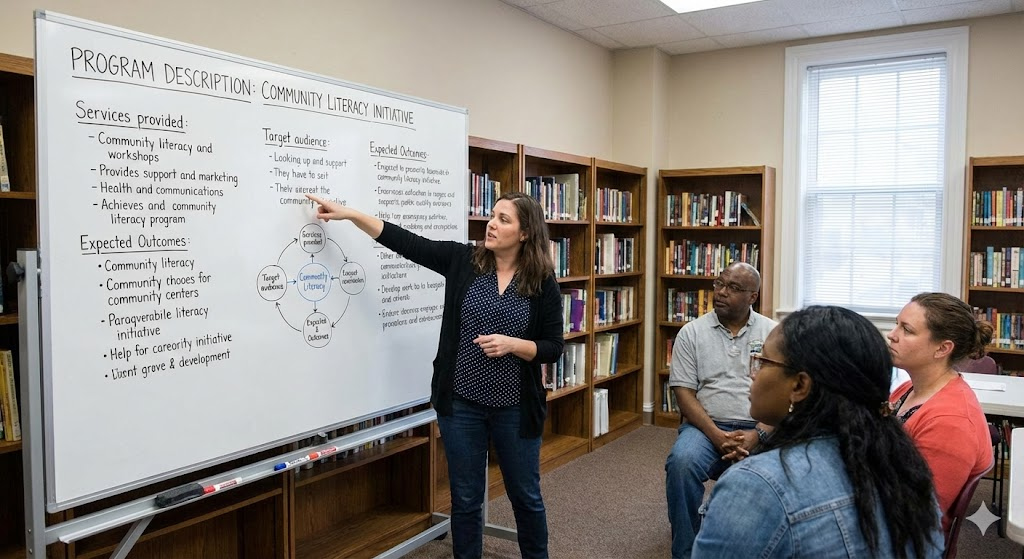
A nonprofit program description is a clear narrative explaining what specific services or activities the organization provides, who benefits from those services, how the services are delivered, and what outcomes or community impact result from the work. Program descriptions matter because IRS Form 1023 applications require detailed explanations of planned activities to evaluate whether they qualify as charitable, grant applications universally request program descriptions to assess mission alignment and impact potential, and well-articulated program descriptions help boards focus organizational efforts rather than pursuing unfocused activities that dilute effectiveness.
What essential elements must program descriptions include?
Target population identification specifies who the program serves. Effective descriptions define beneficiaries with enough specificity to demonstrate focus—”low-income youth ages 14-18 in Temecula,” “homeless veterans in Riverside County,” “seniors experiencing food insecurity.” Vague descriptions like “people in need” or “the community” don’t communicate meaningful program focus. IRS wants to know that charitable activities serve identified populations with genuine needs rather than providing general benefits available to anyone.
Specific activities and services describe what the organization actually does. Rather than stating “we help youth succeed,” effective descriptions specify “we provide one-on-one academic tutoring twice weekly, college application workshops quarterly, and mentoring relationships pairing participants with community professionals.” Activity descriptions should be concrete enough that IRS reviewers, funders, and stakeholders understand operational reality rather than abstract aspirations.
Delivery methods explain how services reach target populations. Descriptions should address where services are provided (dedicated facility, partner locations, participants’ homes, virtual platforms), how frequently services occur (weekly classes, monthly workshops, ongoing case management, annual events), and who delivers services (staff, trained volunteers, professional contractors, partner organizations). Clear delivery methods demonstrate operational feasibility.
Intended outcomes or impact articulate what positive change the program pursues. While avoiding unrealistic guarantees, descriptions should explain expected results—”participants will improve academic performance and high school graduation rates,” “participants will achieve stable housing and employment,” “participants will access nutritious food and demonstrate improved health outcomes.” Outcome statements demonstrate that programs pursue meaningful community impact rather than conducting activities for activities’ sake.
How should program descriptions differ for IRS applications versus grant proposals?
IRS Form 1023 program descriptions emphasize charitable purpose qualification. The IRS wants to know that planned activities clearly advance recognized 501(c)(3) purposes—education, poverty relief, health promotion, community development. Descriptions should use terminology that connects activities to charitable categories and demonstrate that programs serve public benefit rather than private interests. IRS descriptions can be relatively broad since you’re establishing overall organizational mission rather than seeking funding for specific projects.
Grant application program descriptions emphasize alignment with funder priorities and demonstrate impact potential. Funders want to know that your specific program matches their funding focus, that you understand the problem you’re addressing with supporting data, that your approach is evidence-based or innovative, and that you can measure results demonstrating effective use of grant funds. Grant descriptions should be detailed about specific implementation plans and evaluation methods.
Length and format requirements differ significantly. IRS Form 1023 provides limited space for program descriptions requiring concise summaries. Grant applications often request extensive narratives with multiple pages explaining needs assessment, program design, implementation timeline, evaluation plan, and sustainability strategy. Temecula nonprofits need both concise versions for IRS and detailed versions for grants.
Adaptation to audience matters for both. IRS reviewers evaluate tax-exempt qualification and compliance with charitable purpose definitions. Grant reviewers evaluate program quality, organizational capacity, and likelihood of achieving outcomes matching funder goals. The same core program can be described differently emphasizing elements most relevant to each audience while maintaining consistency about what the organization actually does.
Framework: Launch → Fix → Fund + Federal Recognition + CA Compliance Triangle
Launch includes developing clear program descriptions during formation before IRS applications. New Temecula nonprofits should articulate programs precisely rather than vaguely, ensuring descriptions align with charitable purposes and demonstrate focused mission.
Fix addresses organizations with vague, outdated, or inconsistent program descriptions across different documents. Clarifying program descriptions and ensuring consistency between IRS applications, grant proposals, websites, and Form 990 reporting strengthens organizational coherence.
Fund depends critically on compelling program descriptions because grant applications are primarily evaluated based on program quality, need, and potential impact. Weak descriptions that don’t clearly communicate what you do or why it matters result in application rejection regardless of actual program effectiveness.
Federal Recognition applications require program descriptions detailed enough for IRS to determine whether activities qualify as charitable. Vague descriptions trigger IRS questions requesting clarification. Clear descriptions demonstrating obvious charitable purpose streamline approval.
CA Compliance Triangle includes Form 990 program service accomplishment reporting describing major programs annually. Descriptions should be consistent with what was stated in IRS determination applications, what appears on websites, and what funders support through grants.
Step-by-step: How NPLO helps organizations develop program descriptions
Step 1: Program Clarification We help identify exactly what activities you’ll conduct, moving from vague intentions to concrete plans.
Step 2: Target Population Definition We develop specific population descriptions balancing focus with appropriate flexibility.
Step 3: Activity Documentation We document specific services, frequency, delivery methods, and staffing in operational detail.
Step 4: Outcomes Articulation We help describe intended impact in measurable terms without unrealistic guarantees.
Step 5: IRS Version Development We create concise program descriptions emphasizing charitable purpose for Form 1023 applications.
Step 6: Grant Version Development We develop detailed program narratives appropriate for grant applications including needs assessment and evaluation.
Step 7: Consistency Verification We ensure program descriptions align across IRS applications, grant proposals, websites, and annual reporting.
Step 8: Board Communication We prepare program descriptions for board review ensuring directors understand organizational focus.
Checklist: Essential program description components
- Program name and brief overview
- Target population (demographics, geography, needs)
- Specific problem or need being addressed
- Program activities (what you actually do)
- Service frequency (how often activities occur)
- Delivery location and methods
- Staffing (who provides services)
- Participant numbers (how many served)
- Intended outcomes (what change you pursue)
- Measurement methods (how you’ll track results)
- Connection to charitable purpose (education, poverty relief, etc.)
- Evidence or rationale for approach
- Collaboration with partners (if applicable)
- Sustainability plan (how program continues)
Quick Answers (PPA)
Should program descriptions be very specific about exact activities, or more general to allow flexibility? Balance specificity demonstrating clear focus with flexibility allowing reasonable program evolution. Describe program categories and approaches specifically enough that IRS and funders understand what you do, but avoid such narrow specificity that minor changes require amending Articles of Incorporation or re-explaining to IRS. For example: “We provide academic tutoring, mentoring, and college preparation services for at-risk youth” allows flexibility in specific tutoring subjects or mentoring models while clearly communicating program focus. Avoid either extreme—”we help people” (too vague) or “we provide geometry tutoring using Saxon textbooks exclusively for 10th graders at Temecula High School” (too narrow).
What if our programs evolve over time—do we need to notify IRS of program changes? Minor program modifications and reasonable evolution within stated charitable purposes don’t require IRS notification. If your stated purpose is advancing education through youth programs, changing from after-school tutoring to summer enrichment camps is reasonable evolution. However, significant mission shifts adding new charitable purpose categories or fundamentally changing who you serve may require IRS notification through supplemental filings. The key is whether changes remain consistent with the charitable purposes approved in your determination. When uncertain, consult tax professionals about notification requirements.
How many different programs should new nonprofits describe, or should we focus on one main program initially? Starting focused with one or two well-designed programs is generally stronger than attempting multiple unfocused activities. New organizations often lack capacity to execute many programs simultaneously, and funders prefer seeing mastery of core programs over scattered efforts. However, some missions naturally involve multiple related services—an organization addressing homelessness might describe emergency shelter, case management, and employment services as complementary components of comprehensive assistance. The key is ensuring each described program has clear implementation plans, adequate resources, and genuine organizational capacity rather than listing ambitious programs you can’t actually deliver.
Should program descriptions emphasize the innovative or unique aspects of our approach, or is it better to describe proven methods? Both innovation and proven effectiveness have value depending on context and audience. IRS cares primarily that programs advance charitable purposes regardless of whether approaches are innovative or traditional. Some funders specifically seek innovative approaches while others prefer evidence-based proven methods. The strongest descriptions explain your approach clearly, provide rationale for why that approach addresses identified needs effectively, and acknowledge relevant research or best practices whether your methods align with or intentionally differ from standard approaches. Claiming innovation without substance raises concerns; describing proven methods without explanation seems unthoughtful.
Can program descriptions mention specific partner organizations by name, or should they stay generic? Mentioning specific current partners by name strengthens descriptions by demonstrating concrete relationships and community integration. However, avoid describing programs as entirely dependent on specific partners who could withdraw—if your entire program description is “we work with XYZ School District providing services on their campuses,” what happens if that partnership ends? Better to describe “we partner with local school districts, currently including XYZ, providing services on campus” showing the partnership model allows flexibility. Naming partners demonstrates legitimacy; making programs entirely dependent on named partners creates vulnerability.
What to do next (DIY vs Done-With-You)
DIY approach: Begin by listing every activity your organization plans to conduct in year one with concrete details—tutoring sessions twice weekly, monthly food distribution, quarterly workshops. For each activity, specify who participates (target population with demographic details), where it occurs (specific locations or virtual platforms), who provides services (staff, volunteers, professionals), and how many people you expect to serve. Then explain why these activities matter—what problem or need they address, what outcomes you expect, how you’ll know if programs succeed. Draft concise versions (2-3 paragraphs) emphasizing charitable purpose for IRS applications. Draft detailed versions (multiple pages) including needs assessment, evidence-based rationale, implementation timeline, and evaluation plan for grant applications. Review all organizational documents—Articles of Incorporation, IRS Form 1023, grant proposals, website, Form 990—ensuring program descriptions are consistent while appropriately adapted to each audience. Have board members review descriptions confirming they accurately reflect planned activities and that organization has capacity to deliver described programs.
Done-With-You approach: The Nonprofit Launch Office provides comprehensive program description development for Temecula and Inland Empire nonprofits. We clarify exactly what activities you’ll conduct moving from vague intentions to concrete operational plans, define target populations with specificity demonstrating focus while preserving appropriate flexibility, document services including frequency, delivery methods, staffing, and participant numbers, articulate intended outcomes and community impact in measurable terms, develop concise IRS-focused descriptions emphasizing charitable purpose qualification, create detailed grant-focused narratives including needs assessment and evaluation frameworks, verify consistency across IRS applications, grant proposals, websites, and Form 990 reporting, and prepare program descriptions for board review ensuring directors understand organizational focus. This ensures your program descriptions strengthen IRS applications, improve grant competitiveness, and guide focused effective organizational operations.
Contact
Book: https://thedocumentpro.com/
Call: 1(800) 285-0078
Email: mydocumentpro@gmail.com
The Nonprofit Launch Office™ — a discipline of The Document Pro, operated by Gitta Williams.
Operated by The Document Pro (Gitta Williams)
Sources
Disclaimer
Document preparation and nonprofit readiness support — not legal or tax advice.