
16 Jan What is Fiscal Sponsorship and When Does It Make Sense for Grant Funding?
Short Answer
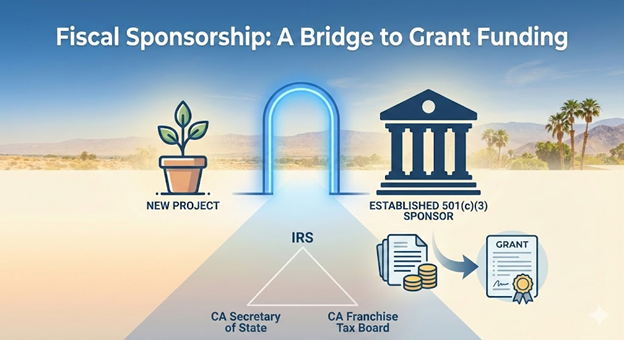
Fiscal sponsorship is an arrangement where an established 501(c)(3) nonprofit organization agrees to accept and manage grant funds on behalf of a project or initiative that lacks its own tax-exempt status, allowing the sponsored project to receive tax-deductible contributions and pursue institutional grants using the sponsor’s federal recognition and compliance infrastructure. This arrangement makes sense for grant funding when you need immediate access to institutional funders while forming your own nonprofit, when you’re testing program viability before committing to independent operations, when your initiative is temporary or time-limited and doesn’t justify permanent nonprofit formation, or when your organization lacks administrative capacity to manage compliance independently. Eligibility varies by grant, but fiscal sponsorship provides a bridge to funding that would otherwise require the 6-12 month timeline for securing independent 501(c)(3) recognition.
How does fiscal sponsorship actually work in practice?
Under fiscal sponsorship, the sponsoring organization becomes the legal grant recipient while your project operates as a program or activity of the sponsor. When you apply for grants, applications are submitted in the sponsor’s name with your project described as a sponsored initiative. The sponsor’s 501(c)(3) determination letter, tax identification number, and compliance status satisfy funder requirements for tax-exempt recipient verification. Grant awards are legally made to the sponsor organization, which then allocates funds to support your project according to the sponsorship agreement.
The most common model for San Bernardino and Inland Empire groups is “comprehensive fiscal sponsorship” (sometimes called Model A), where the sponsored project becomes a fully integrated program of the sponsoring organization. Under this model, the sponsor maintains significant control and oversight—the sponsor’s board has ultimate authority over project activities, the sponsor employs any staff working on the project, and the sponsor owns all assets and intellectual property developed through the project. This deep integration provides the legal structure funders need to direct money through the sponsor’s tax exemption.
Fiscal sponsorship agreements define the relationship terms, including administrative fee structures (typically 5-15% of all funds raised or received), reporting requirements from project to sponsor, approval processes for major decisions, insurance and liability coverage, intellectual property ownership, and termination provisions. These agreements vary significantly across sponsors—some provide extensive operational support and capacity building, while others offer minimal services beyond basic fiscal management. Understanding what’s included in the administrative fee versus what costs extra becomes critical for budget planning.
The sponsor handles compliance obligations that would otherwise fall to an independent nonprofit—filing IRS Form 990 including your project’s activities, maintaining California compliance across Secretary of State, Franchise Tax Board, and Attorney General Registry, providing liability insurance coverage, managing employment taxes if you have paid staff, and ensuring grant funds are used according to funder restrictions and charitable purposes. For projects lacking administrative infrastructure, this compliance management represents significant value beyond just access to tax-exempt status.
When does fiscal sponsorship make strategic sense versus forming your own nonprofit?
Fiscal sponsorship serves groups needing immediate grant access without the 6-12 month timeline required for independent 501(c)(3) formation. If you’ve identified grant opportunities with deadlines in the next 2-3 months, forming your own nonprofit won’t happen fast enough—the IRS alone typically takes 3-6 months to process applications after you’ve completed California incorporation, developed bylaws, established your board, and prepared the federal application. Fiscal sponsorship allows you to pursue those immediate opportunities using the sponsor’s existing recognition.
Testing program viability before committing to permanent nonprofit infrastructure makes sponsorship attractive for experimental or pilot initiatives. If you’re uncertain whether your program model will succeed, whether community support exists, or whether you can sustain operations long-term, operating under sponsorship for 1-2 years provides proof of concept without the irreversible commitment of forming a corporation. You can develop your approach, demonstrate impact, build stakeholder relationships, and determine whether independent nonprofit status justifies the investment before making that transition.
Temporary or time-limited projects often benefit from sponsorship rather than forming nonprofits that will need dissolution once the project completes. If you’re organizing a specific campaign, delivering a defined program with a clear endpoint, or working on an initiative spanning 2-3 years maximum, the overhead of forming and later dissolving a nonprofit corporation doesn’t make sense. Fiscal sponsorship provides the structure needed during the project’s lifespan without creating permanent legal entities that require formal dissolution procedures.
Lack of administrative capacity creates another sponsorship rationale. Maintaining independent 501(c)(3) status requires annual IRS filings, California multi-agency compliance, board governance, financial management, insurance coverage, and various operational systems. Organizations with entirely volunteer leadership, no paid administrative staff, or limited governance expertise often struggle with these obligations. Fiscal sponsors provide the infrastructure and expertise that small volunteer groups cannot sustain independently, allowing program focus rather than compliance crisis management.
However, fiscal sponsorship involves significant tradeoffs. Administrative fees compound over time—a project raising $100,000 annually under 10% sponsorship pays $10,000 per year in fees, totaling $50,000 over five years compared to roughly $2,000-3,000 in one-time formation costs for independent status. The sponsor maintains legal control and can restrict activities, require approval for major decisions, or terminate sponsorship if mission drift occurs. Your organization remains dependent on the sponsor’s compliance health—if the sponsor encounters IRS problems or California suspensions, your project loses access to funding even if your work is solid.
Framework: Launch → Fix → Fund + Federal Recognition + CA Compliance Triangle
The Nonprofit Launch Office operates within a strategic framework designed to help California nonprofits move from formation to fundability:
Launch includes evaluating whether fiscal sponsorship serves as a temporary launch strategy or a long-term operational model. For groups pursuing sponsorship, Launch means identifying mission-aligned sponsors, negotiating favorable sponsorship terms, establishing clear project parameters within the sponsorship agreement, and planning potential transition to independent status if that’s the long-term goal. For groups rejecting sponsorship, Launch means understanding why independent formation better serves your mission and committing to the longer timeline required.
Fix addresses situations where fiscal sponsorship relationships encounter problems—mission drift between sponsor and project creating conflict, sponsor compliance issues affecting project funding access, fee structures becoming unsustainable as project scales, or sponsor terminating relationship requiring emergency transition. Fix work might involve renegotiating sponsorship terms, finding alternative sponsors, or accelerating independent nonprofit formation when sponsorship is no longer viable.
Fund represents different realities under sponsorship versus independence. Sponsored projects pursue grants through the sponsor’s compliance profile, with applications submitted in the sponsor’s name and awards legally made to the sponsor. Independent nonprofits maintain direct funder relationships and receive awards directly. Understanding these differences affects how you present your work, build funder relationships, and manage grant administration throughout the funding lifecycle.
Federal Recognition through IRS 501(c)(3) determination is what fiscal sponsorship provides borrowed access to versus what independent formation provides direct ownership of. Sponsorship gives you immediate use of an existing organization’s federal recognition. Independent formation gives you your own permanent recognition that can’t be withdrawn by another party. The choice involves trading immediacy for autonomy and temporary access for permanent control.
CA Compliance Triangle operates differently under sponsorship versus independence. Sponsored projects rely on the sponsor’s compliance with California’s three agencies (Secretary of State, Franchise Tax Board, Attorney General Registry). The sponsor maintains these registrations and files required renewals. Independent nonprofits must establish and maintain direct relationships with all three California agencies. For San Bernardino groups evaluating sponsorship, understanding that sponsors handle this complexity provides clarity about what the administrative fee actually covers.
Step-by-step: How NPLO helps groups evaluate and navigate fiscal sponsorship
Step 1: Strategic Needs Assessment We analyze your specific situation to determine whether fiscal sponsorship addresses your actual needs—timeline urgency, funding targets, administrative capacity, project duration, and long-term vision. This assessment reveals whether sponsorship solves real problems or introduces unnecessary complexity and cost. Some San Bernardino groups discover they don’t actually need sponsorship after clarifying their funding strategy and timeline.
Step 2: Sponsor Identification and Research We help identify potential fiscal sponsors whose missions align with your work, who serve organizations in your program area or geographic region, and who have solid track records and compliance histories. Sponsor research includes reviewing their IRS Form 990 filings to understand their financial health and existing sponsored projects, checking compliance status with California agencies, and investigating their reputation among sponsored projects and funders.
Step 3: Sponsorship Agreement Review We examine sponsorship agreements to identify favorable and unfavorable terms—administrative fee structures and what services they include, control and approval provisions affecting your autonomy, intellectual property ownership clarifying who owns materials you develop, termination conditions protecting both parties, insurance and liability coverage defining risk management, and fund accounting ensuring your project’s money is segregated from the sponsor’s general operations.
Step 4: Cost-Benefit Analysis We calculate the true costs of fiscal sponsorship over realistic time periods. A project planning 1-2 years under sponsorship before transitioning to independence faces different economics than a project planning 5+ years of permanent sponsorship. We compare sponsorship fees against independent formation costs, project future administrative burdens under both models, and evaluate intangible factors like control and autonomy that affect long-term sustainability.
Step 5: Funder Acceptance Verification We verify that your target funders accept fiscally sponsored projects. Most foundation and corporate funders accept sponsorship arrangements, but some government grants or specialized programs require direct grantee status. Discovering after entering sponsorship that your key funding targets don’t accept sponsored applicants creates serious problems. Pre-verification prevents this scenario.
Step 6: Parallel Path Planning For groups choosing sponsorship as a temporary bridge, we develop parallel strategies—operate under sponsorship immediately to access current funding while simultaneously pursuing independent 501(c)(3) formation for long-term autonomy. This hybrid approach maximizes funding access during IRS waiting periods and positions you for eventual independence that eliminates ongoing sponsorship fees and control limitations.
Step 7: Sponsorship Relationship Management Once sponsorship begins, we help manage the ongoing relationship—meeting sponsor reporting requirements, navigating approval processes for program decisions, maintaining clear communication about project activities and finances, and addressing relationship problems before they escalate into termination. Successful sponsorship requires active relationship management, not just passive compliance.
Step 8: Transition Planning For sponsored projects planning eventual independence, we guide the transition process—timing independent nonprofit formation to minimize disruption, coordinating with the sponsor on fund and relationship transfers, communicating status changes to funders and donors, and ensuring no gaps in compliance or funding access during the transition. Well-managed transitions preserve relationships and momentum rather than burning bridges or losing support.
Checklist: What you should evaluate when considering fiscal sponsorship
Before committing to fiscal sponsorship, carefully assess these factors:
- Mission alignment between your project and potential sponsor’s charitable purposes and program areas
- Fee structure clarity understanding exactly what the administrative percentage covers and what costs extra
- Control provisions defining what decisions you can make independently versus what requires sponsor approval
- Reporting requirements specifying what financial and programmatic reports you’ll provide and how frequently
- Fund accounting practices ensuring your project’s money is tracked separately from sponsor’s general operations
- Insurance and liability coverage clarifying what protection exists and who bears risk for project activities
- Intellectual property ownership determining who owns materials, curricula, methods, or products you develop
- Staff employment structure understanding whether staff are sponsor employees or independent contractors
- Grant application procedures knowing how proposals are developed, reviewed, and submitted through the sponsor
- Funder relationship management clarifying who maintains direct contact with funders and how credit is attributed
- Termination conditions understanding what circumstances allow either party to end the sponsorship
- Transition provisions defining what happens to funds, relationships, and assets if sponsorship ends
- Sponsor financial health reviewing their IRS Form 990 to assess sustainability and financial management
- Sponsor compliance status verifying they maintain good standing with IRS and California agencies
- References from current sponsored projects gathering honest feedback about working with this sponsor
- Timeline expectations for how long you anticipate needing sponsorship versus transitioning to independence
Quick Answers (PPA)
How much do fiscal sponsors typically charge and what’s included in the fee? Most fiscal sponsors charge administrative fees between 5-15% of all funds received or raised by the sponsored project. Fees at the lower end (5-7%) typically cover only basic fiscal management—receiving grants, disbursing funds, filing IRS Form 990 including your project, maintaining California compliance. Mid-range fees (8-12%) often include additional services like insurance coverage, financial reporting, grant application review, and basic operational guidance. Higher fees (13-15%) may include extensive capacity building, strategic planning support, fundraising assistance, and dedicated staff attention. Always clarify exactly what’s included versus what costs extra before committing to a sponsor.
Can fiscally sponsored projects apply for all the same grants as independent nonprofits? Most foundation grants, corporate giving programs, and private funding sources accept fiscally sponsored applicants because the sponsor’s 501(c)(3) status satisfies tax-exempt requirements. However, some government grants, contracts, or specialized programs require that applicants hold direct tax-exempt status and won’t accept sponsored relationships. Additionally, some funders have policies against “indirect” relationships or require that grantees maintain independent boards. Before entering fiscal sponsorship, verify that your priority funding sources accept sponsored projects—discovering this after commitment wastes significant time and resources.
What happens to donations and grants if I end the fiscal sponsorship relationship? Sponsorship agreement termination provisions determine what happens to funds and assets. Under most comprehensive sponsorship models, funds are legally owned by the sponsor because grants were made to the sponsor organization with your project as a sponsored program. Sponsors often allow accumulated funds to transfer to a new sponsor or to your newly independent 501(c)(3) if you’ve formed one, but this transfer typically requires sponsor board approval and isn’t guaranteed. Some sponsors retain funds or require proportional administrative fees on transferred amounts. Review termination provisions carefully before entering sponsorship to understand your financial risk if the relationship ends.
How long do most organizations stay under fiscal sponsorship before becoming independent? Sponsorship duration varies widely based on strategic intent. Some San Bernardino groups use sponsorship as a temporary 6-18 month bridge while completing independent 501(c)(3) formation, allowing immediate funding access during IRS waiting periods. Others remain sponsored for 3-5 years while testing program viability, building administrative capacity, and determining whether independent operations are sustainable. A smaller percentage operate under permanent sponsorship because their work fits naturally as a program of the sponsor’s mission or because they prioritize avoiding compliance burden over gaining autonomy. The optimal duration depends on your specific goals, growth trajectory, and capacity development.
Can I have multiple fiscal sponsors or switch sponsors if the relationship isn’t working? Most sponsorship agreements prohibit having multiple sponsors simultaneously for the same project because the legal structure requires clear ownership and control—you operate as a program of one specific sponsor. However, you can transition between sponsors if your current relationship isn’t working, though this requires coordinating with both the current and prospective sponsor, transferring funds and relationships, communicating changes to funders and donors, and managing any gap period between sponsorships. Frequent sponsor changes signal instability to funders, so carefully evaluating potential sponsors before commitment prevents the need for disruptive transitions.
What to do next (DIY vs Done-With-You)
DIY approach: Clarify whether fiscal sponsorship addresses a real strategic need by listing your specific reasons for considering it—immediate funding access, avoiding compliance burden, testing program viability, temporary project duration, or other factors. Research potential fiscal sponsors in your program area by searching “fiscal sponsorship [your program focus]” or “fiscal sponsor California [your field]” to identify organizations. Contact potential sponsors to request information about their sponsorship programs, fee structures, services provided, and application processes. Request sample sponsorship agreements from multiple sponsors and compare terms carefully, particularly regarding fees, control, intellectual property, and termination. Calculate sponsorship costs over realistic time periods (2 years, 5 years) and compare against independent formation costs to understand long-term economics. Verify that your target funders accept fiscally sponsored applicants by reviewing their eligibility criteria or contacting program officers directly.
Done-With-You approach: The Nonprofit Launch Office provides comprehensive fiscal sponsorship evaluation and navigation for San Bernardino and Inland Empire groups. We conduct strategic needs assessments determining whether sponsorship actually serves your goals or introduces unnecessary cost and complexity, identify mission-aligned fiscal sponsors with solid track records and favorable terms, review and negotiate sponsorship agreements protecting your interests while maintaining productive relationships, calculate true costs comparing sponsorship against independent formation over realistic timeframes, verify funder acceptance of sponsored arrangements for your priority funding targets, develop parallel formation strategies where you operate under sponsorship while pursuing independent status, provide ongoing relationship management guidance during sponsorship, and coordinate seamless transitions to independence when appropriate. This guidance prevents costly mistakes like choosing misaligned sponsors, accepting unfavorable agreement terms, or remaining in expensive sponsorships longer than strategically necessary.
Contact
Book: https://thedocumentpro.com/
Call: 1(800) 285-0078
Email: mydocumentpro@gmail.com
The Nonprofit Launch Office™ — a discipline of The Document Pro, operated by Gitta Williams.
Operated by The Document Pro (Gitta Williams)
Sources
Disclaimer
Document preparation and nonprofit readiness support — not legal or tax advice.