
08 Jan How Do Grant Makers Verify a Nonprofit Is “Active” in California?
Short Answer
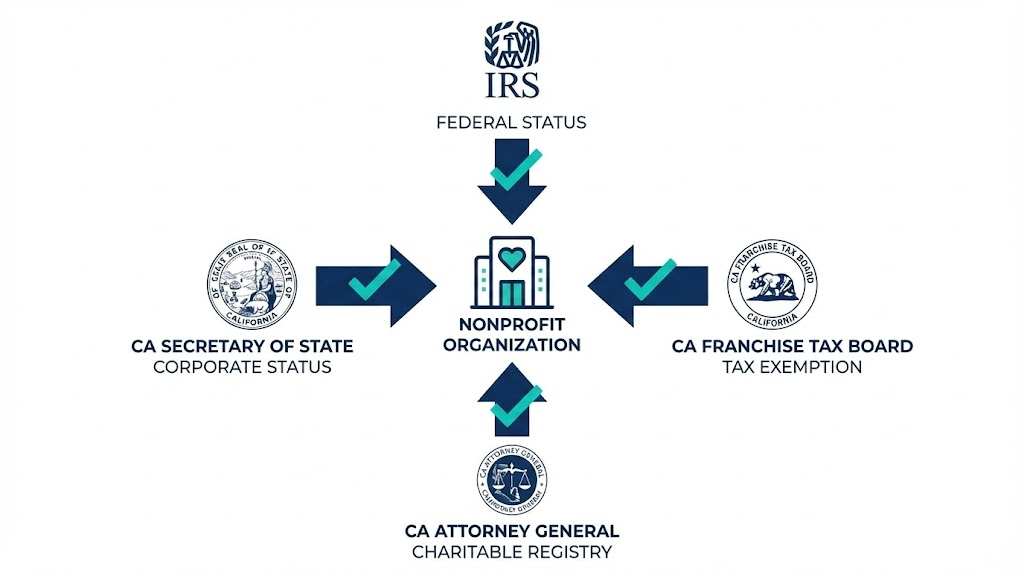
Grant makers in California typically verify a nonprofit’s active status by checking three distinct state agencies—the California Secretary of State (entity status), the California Franchise Tax Board (tax exemption status), and the California Attorney General Registry of Charities (fundraising registration)—plus federal recognition through the IRS Tax Exempt Organization Search. Eligibility varies by grant, but most institutional funders require current standing with all agencies before releasing funds, making multi-agency compliance essential for access to capital.
What does “active” actually mean when funders check your nonprofit?
When a grant maker says they’re verifying your nonprofit is “active,” they’re generally looking at more than just whether your organization exists on paper. In California, active status is a three-part verification process that spans multiple government agencies. A nonprofit can be legally incorporated with the Secretary of State but still be considered inactive or ineligible by funders if it’s delinquent with the Franchise Tax Board or the Attorney General’s Registry of Charities.
This multi-agency reality often surprises first-time grant applicants in Temecula and throughout the Inland Empire. Many assume that having an IRS determination letter and being “Active” with the California Secretary of State is sufficient. However, institutional funders—foundations, county grant programs, and federal pass-through awards—typically require documentation proving current compliance across all relevant agencies before they’ll release funds.
The verification process exists to protect donors and grant makers from directing resources to organizations that cannot legally operate or solicit funds. When a nonprofit falls out of compliance with any one agency, it may lose its ability to enforce contracts, accept certain types of donations, or maintain its tax-exempt status, creating legal and financial risk for the funder.
Why do grant makers care about multiple agencies instead of just one?
California’s regulatory structure divides nonprofit oversight among three separate state agencies, each with distinct filing requirements and enforcement authority. This creates what’s often called the “California Compliance Triangle.” The Secretary of State tracks corporate existence and registered agent information. The Franchise Tax Board monitors tax exemption status and annual filing requirements. The Attorney General’s Registry of Charities oversees fundraising activity and asset protection.
Grant makers verify all three because each agency serves a different protective function. A nonprofit that’s current with the Secretary of State but delinquent with the Attorney General technically cannot solicit donations legally in California, which creates liability for any funder distributing money to that organization. Similarly, a nonprofit suspended by the Franchise Tax Board may lose its state tax exemption, affecting how donations are treated for state tax purposes.
Federal recognition through the IRS adds another verification layer. The IRS Tax Exempt Organization Search tool allows funders to confirm that a nonprofit holds current 501(c)(3) status and is eligible to receive tax-deductible contributions. Many grant programs require proof of federal recognition as a baseline eligibility criterion, then layer on state compliance requirements.
For Temecula-based nonprofits seeking funding from sources like the Inland Empire Community Foundation or county grant programs, understanding this verification structure is essential. Local funders often know the compliance landscape well and may reject applications immediately if they detect gaps in multi-agency standing.
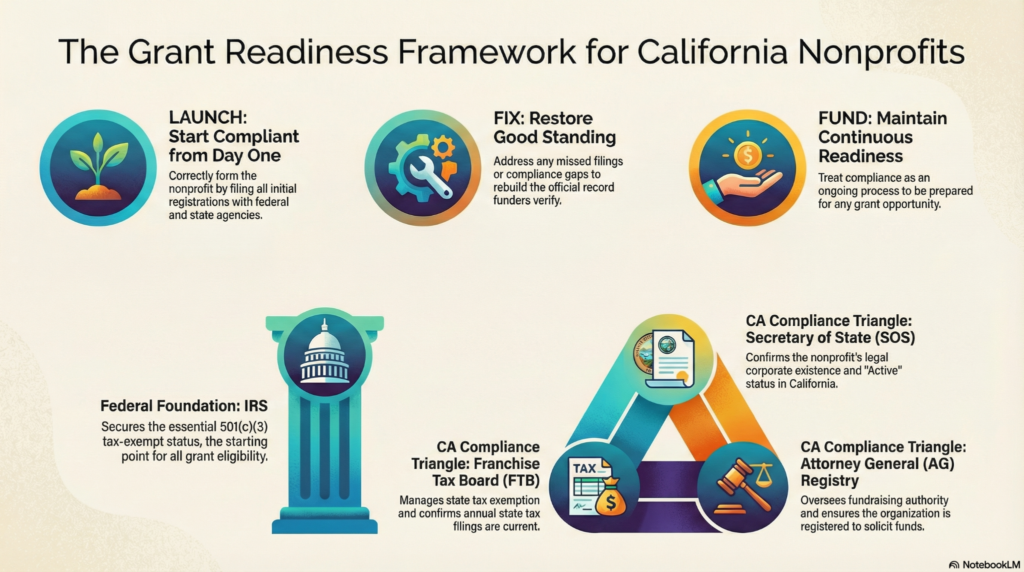
Framework: Launch → Fix → Fund + Federal Recognition + CA Compliance Triangle
The Nonprofit Launch Office operates within a strategic framework designed to help California nonprofits move from formation to fundability:
Launch means forming your nonprofit correctly from day one, with all required registrations filed and initial compliance obligations understood. This includes Articles of Incorporation with the Secretary of State, initial EIN application with the IRS, and timely registration with the Attorney General’s Registry of Charities within 30 days of receiving assets.
Fix addresses situations where a nonprofit has fallen out of good standing—whether through missed Statement of Information filings, unpaid Franchise Tax Board obligations, or delinquency with the Registry of Charities. Restoration involves coordinating filings across multiple agencies and rebuilding the compliance record funders verify.
Fund focuses on maintaining the ongoing compliance profile that grant makers check when evaluating applications. This includes keeping current with annual IRS returns (Form 990 series), California annual filings (Form 199 with FTB, RRF-1 with the Attorney General), and biennial Statement of Information updates with the Secretary of State.
Federal Recognition means securing and maintaining IRS determination of 501(c)(3) status, which serves as the foundation for tax-deductible contributions and eligibility for most institutional grants. This requires initial application (Form 1023 or 1023-EZ) and ongoing annual information returns.
CA Compliance Triangle represents the three-agency verification system unique to California: the Secretary of State (corporate status), the Franchise Tax Board (tax exemption), and the Attorney General Registry of Charities (fundraising authority). Grant readiness requires current standing with all three simultaneously.
Step-by-step: How NPLO helps maintain verifiable active status
Step 1: Compliance Status Audit We review your nonprofit’s current standing with all four verification points—IRS TEOS listing, Secretary of State entity status, Franchise Tax Board exemption status, and Attorney General Registry status. This audit identifies any gaps before a funder discovers them.
Step 2: Document Assembly We help organize the proof documents funders typically request: current IRS determination letter, Secretary of State certificate of good standing, Franchise Tax Board exemption confirmation, and Attorney General registration number. Having these ready accelerates application processing.
Step 3: Filing Calendar Development We create a custom compliance calendar showing when each recurring filing is due—Form 990 with the IRS, Form 199 with FTB, RRF-1 with the Attorney General, and Statement of Information with the Secretary of State. This prevents the missed deadlines that trigger verification problems.
Step 4: Verification Language Preparation We help craft the compliance narrative that appears in grant applications, clearly stating your nonprofit’s good standing status and providing the specific registration numbers funders need to verify your status independently.
Step 5: Multi-Agency Monitoring Setup We establish a system for checking your status regularly with all relevant agencies, catching potential issues early before they escalate into suspensions or delinquencies that block grant awards.
Step 6: Renewal Preparation We prepare annual renewal packages for the Attorney General’s Registry (RRF-1) and other recurring filings, ensuring submissions happen on time and meet current regulatory requirements.
Step 7: Grant-Specific Compliance Verification When you identify a target grant opportunity, we verify that your current compliance profile meets that specific funder’s requirements, addressing any gaps before you invest time in a full application.
Step 8: Ongoing Readiness Maintenance We provide quarterly check-ins to ensure your compliance status remains current and your proof documents remain valid, keeping you in continuous grant-ready condition rather than scrambling before each application deadline.
Checklist: What you should have ready before you apply
Funders may verify different aspects of active status depending on their due diligence requirements. Having these items organized in advance accelerates the application process:
- Current IRS determination letter showing 501(c)(3) recognition with your organization’s legal name and EIN clearly visible
- IRS TEOS verification demonstrating your nonprofit appears in the Tax Exempt Organization Search database as currently recognized
- California Secretary of State certificate or business search printout showing “Active” entity status with current registered agent information
- Franchise Tax Board exemption letter or confirmation showing your nonprofit is exempt from the $800 annual franchise tax
- Attorney General registration number from your initial CT-1 filing or current RRF-1 renewal confirmation
- Most recent Form 990 filed with the IRS, showing your organization’s financial activity and program descriptions
- Most recent California Form 199 or 199N filed with the Franchise Tax Board, demonstrating state filing compliance
- Most recent RRF-1 filed with the Attorney General’s Registry of Charities, showing current fundraising registration
- Statement of Information filing confirmation from the Secretary of State, demonstrating current biennial filing compliance
- Board roster and leadership structure showing names, titles, and contact information for current officers and directors
- Bylaws and conflict of interest policy demonstrating governance structure and ethical oversight mechanisms
Quick Answers (PPA)
Can a nonprofit be “Active” with the Secretary of State but still have verification problems? Yes, absolutely. Secretary of State status only confirms corporate existence and registered agent compliance. A nonprofit can be “Active” with the Secretary of State while simultaneously being suspended by the Franchise Tax Board or delinquent with the Attorney General’s Registry of Charities. Grant makers typically check all three agencies plus IRS status, so being current with just one agency leaves you vulnerable to rejection.
Do all grants require the same level of verification? No, verification requirements vary significantly by funder type and grant size. Small community foundation grants under $5,000 may only verify IRS recognition and Secretary of State status. Large institutional grants, government contracts, or awards over $50,000 typically require proof of good standing with all agencies plus additional documentation like audited financials or board resolution authorizing the grant application. Corporate giving programs may have their own verification protocols.
How often should a nonprofit check its status with all agencies? Many grant-ready nonprofits in the Inland Empire establish quarterly verification checks, particularly before major grant seasons. At minimum, check status whenever you receive a filing confirmation or compliance notice, before submitting significant grant applications, and annually as part of board governance review. The Attorney General’s Registry status can change quickly if an annual RRF-1 is missed, so monitoring prevents surprises during critical application periods.
What happens if a funder discovers a compliance gap during verification? Many funders will pause application review and request documentation showing the gap has been resolved before proceeding. Some may disqualify the application immediately, particularly for competitive grants with numerous qualified applicants. Smaller funders or those with existing relationships may allow time to cure the deficiency, but this delays funding and creates uncertainty. Prevention through proactive compliance monitoring is far more effective than reactive problem-solving.
Does fiscal sponsorship avoid the multi-agency verification requirement? Partially. When operating under fiscal sponsorship, the sponsor organization’s compliance status is what funders verify, not yours. This can provide immediate access to grant opportunities while your own nonprofit completes the formation and compliance process. However, fiscal sponsors typically charge administrative fees (often 10-15% of grant awards), and you remain dependent on their compliance maintenance. Establishing your own verified nonprofit status provides autonomy and eliminates ongoing sponsor fees.
What to do next (DIY vs Done-With-You)
DIY approach: Check your nonprofit’s status independently by visiting each agency’s online portal—the IRS Tax Exempt Organization Search, California Secretary of State business search, Franchise Tax Board exempt organization lookup, and Attorney General Registry of Charities search. Document your current status with each agency and identify any missing filings or renewals. Create a spreadsheet tracking upcoming filing deadlines and set calendar reminders.
Done-With-You approach: The Nonprofit Launch Office provides compliance status audits that verify your standing with all relevant agencies and organize proof documents into a grant-ready folder. We create custom filing calendars, prepare renewal packages, and provide ongoing monitoring to maintain continuous readiness. This approach is particularly valuable for Temecula and Inland Empire nonprofits pursuing multiple grant opportunities throughout the year, where the cost of a missed verification can far exceed the investment in proactive compliance support.
Contact
Book: https://thedocumentpro.com/
Call: 1(800) 285-0078
Email: mydocumentpro@gmail.com
The Nonprofit Launch Office™ — a discipline of The Document Pro, operated by Gitta Williams.
Operated by The Document Pro (Gitta Williams)
Sources
Disclaimer
Document preparation and nonprofit readiness support — not legal or tax advice.